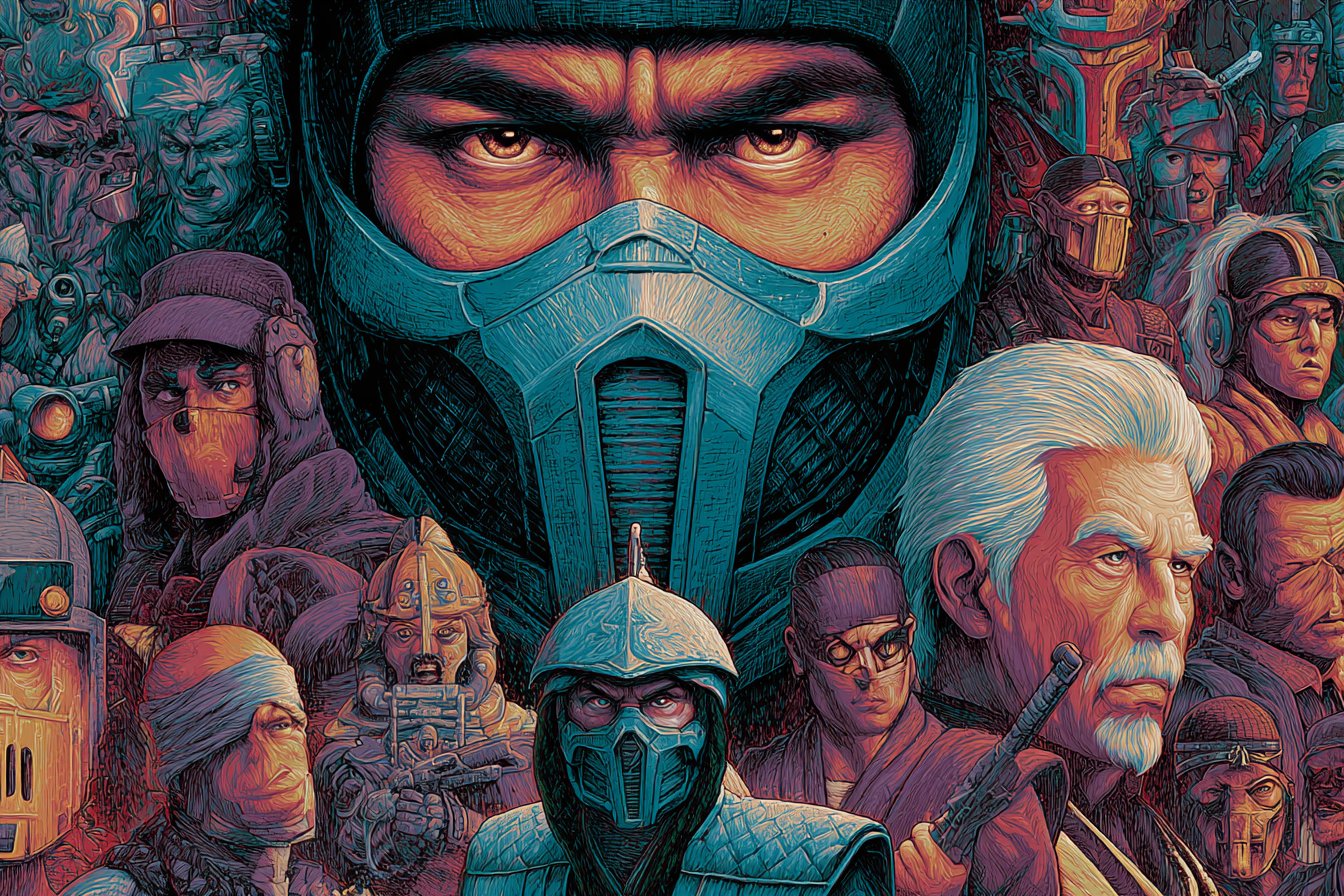
I’m here to give you my take on why Mortal Kombat II (MKII) didn’t just build upon the original – it completely destroyed every preconceived notion of what a fighting game should be. The first Mortal Kombat was certainly a major controversy maker in terms of gore and fatalities, but it was far from polished. MKII, developed by Midway (MK Wiki) and released in arcades in November 1993 (Wikipedia), took every aspect of the original that people were upset about and amplified them to the nth degree, while simultaneously fixing almost all of the gameplay issues.
This is the game that earned its place in our list of best fighting games ever made by creating something that no one thought possible: making fatalities feel like legitimate rewards for winning a fight, rather than cheap shock-value gimmicks. By the time MKII landed on home consoles in September 1994 (MobyGames), it was clear that Mortal Kombat II was a huge step forward in terms of providing competitive depth and mature content that was suitable for adults.
| Developer | Midway |
| Platform | Arcade, SNES, Genesis, and others |
| Year Published | 1993 (Arcade), 1994 (Console) |
| Genre | Fighting Game |
| Players | 1-2 (versus) |
| Our Rating | 9/10 |
A Fighting System That Actually Worked
This is the key area in which MKII separated itself from every other “Street Fighter Clone”: the fighting system was truly amazing. Where the original Mortal Kombat was stiff and unresponsive, MKII was smooth and fast. The digitised sprites (Wikipedia) looked incredible for 1993, but more importantly, they were able to animate at a level that allowed for proper fighting game timing.
The combo system was revolutionary for its time. You weren’t just mindlessly mashing buttons hoping for the best – MKII introduced combo breakers (Wikipedia) that made defensive play matter. If you had the reaction and metre to break out of a combo, getting caught in one wouldn’t automatically mean death. This single addition transformed MKII from a glorified rock-paper-scissors game into something that could be considered competitive.
Every one of the 12 playable characters (Wikipedia) was unique in the sense that they were not simply special-move-animated versions of each other. Liu Kang played like a traditional Shoto character with his fireballs and dragon kicks, but Jax was reliant on command grabs and ground pounds that required entirely different spacing. The new ninja characters Kitana and Mileena (Wikipedia) were not simply palette-swapped versions of existing characters – Kitana’s fan projectiles gave her zone control, while Mileena’s teleport kicks demanded aggressive rush-down strategies.
The button layout worked amazingly well too. Simple enough so that new players could perform basic moves, yet complex enough that experienced players could devise intricate strategies based off of punch-kick combinations and throw setups. The special move inputs were consistent and easy to understand – unlike many fighters where quarter circles turned into pretzel-like motions for no apparent reason.
What Separated MKII from Every Other Fighter
While Street Fighter II was the gold standard in 1993, MKII did something that Capcom refused to: it made violence feel relevant. Every other fighting game treated defeated opponents as though they had just gone to sleep. In MKII, however, when you beat an opponent, you could literally rip their spine out or freeze them solid and smash them to pieces. The fatalities in MKII were not simply gory for shock value – they were the ultimate manifestation of victory – the gaming equivalent of a knockout blow.
The stage fatalities (MobyGames) were incredibly imaginative. The Pit II had a feature where opponents could be upper-cutted onto spikes below. The Deadpool had acid that would dissolve fighters down to skeletons. Neither of these were arbitrary environmental hazards – both were dependent on the player having placed themselves in the correct position and timed the fatal move correctly, thus adding another layer of strategy to a fight.
However, MKII accomplished something no other fighter had done before: it included completely ridiculous finishing moves, known as “Friendships” and “Babalities,” (MK Wiki) that mocked the absurdity of its own premise for violence, while still delivering the gore that made Mortal Kombat II so infamous. Scorpion could take off his mask to show he was a normal guy under there. Sub-Zero could create a cute little snowman. Both were not mocking the gore – they were showing that Mortal Kombat II understood the absurdity of its own premise, and still delivered the gore that made it so famous.
The mercy system was equally genius. Players could revive a dead opponent with a sliver of health for one last round, but only if they had not taken any damage during the last round. It was the ultimate act of confidence, and it produced some of the most epic moments in fighting game history.
The Technical Achievement That Is Still Impressive Today
Digitised graphics looked absolutely incredible in 1993. Unlike Street Fighter II, which used sprite-based graphics, Mortal Kombat II utilised live-action footage of real actors and digitised it frame-by-frame to create animation that was both more realistic and more impactful than anything seen in the arcades. When Johnny Cage threw a punch, it seemed like a real punch from a real person, not a cartoon character flailing through motions.
The sound design of Mortal Kombat II was equally impressive. Each hit had a tangible weight behind it – punches sounded like punches, kicks sounded like kicks, and the bone-crushing fatalities were so graphic that they elicited a physical reaction from players, even when the player themselves was committing those same atrocities.
The “GET OVER HERE!” of Scorpion’s spear attack became instantly recognisable, but every character had memorable voice clips that provided personality without being obnoxious.
The stages of MKII featured incredible artistic direction. The Portal stage would switch between different realms mid-fight. The Pit II returned the iconic background of the original with greater detail. The Living Forest featured faces in the trees that watched the battle and reacted to major events. None of the backgrounds were simply static pictures – they added atmosphere to make MKII feel like a true tournament in a fantastical realm, instead of just another martial arts competition.
The music in MKII is worthy of its own praise. Dan Forden’s soundtrack perfectly complemented the dark fantasy environment of the game, while still providing the necessary energy for competitive fighting. The character select theme built excitement, while the stage themes such as the Portal and Deadpool generated a palpable sense of tension. The audio cues for special moves and fatalities became as iconic as the visuals.
The Cultural Impact That Revolutionised Gaming
MKII was a massive success, but not just because of the gore and controversy surrounding the game. It was the number one arcade earner of 1994 (Arcade Museum), and therefore every arcade owner in the world wanted one. Moreover, it served as a catalyst for the ESRB controversy (MK Wiki) that fundamentally altered how video games were rated and viewed by the public.
The Congressional hearings about video game violence were not really about the original Mortal Kombat – they were about the cultural phenomenon that MKII spawned. This was the game that popularised fatalities, that turned “Finish Him!” into a phrase every kid knew, that proved that mature content could lead to record-breaking sales if the underlying game was solid.
The home console releases of MKII sparked a true console war. The SNES version was censored but visually superior to the Genesis version, which retained all of the gore and fatalities but had slightly worse graphics. This was the first time that parents had to decide what content was acceptable for their children, and not assume that all video games were harmless.
MKII also cemented the legitimacy of fighting games as a competitive form of entertainment. The movesets were complex enough to provide serious challenges to experienced players, the characters were well-balanced enough to encourage tournaments, and the overall presentation was dramatic enough to draw crowds. This paved the way for the FGC (fighting game community) that still thrives today.
Why MKII Remains Relevant in 2024
It is now possible to play MKII on virtually any current-generation platform via numerous collections and re-releases, and it still holds up extremely well. The controls are still responsive, the characters still feel distinct, and the fatalities still elicit shock value after thirty years of increasingly graphic media.
Its influence on modern fighting games cannot be overstated. Every fighting game that features environmental finishers is directly related to MKII’s stage fatalities. Every fighting game that has elaborate super-moves is a direct descendant of MKII’s fatalities, which made finishing moves feel significant. The concept of unlocking characters through specific conditions was pioneered in MKII with hidden fighters such as Reptile and Jade.
Modern Mortal Kombat games are technically superior in every quantifiable measure, but MKII captured lightning in a bottle that has never been duplicated. The perfect blend of accessible controls, competitive depth, memorable characters, and actual controversy created a cultural moment that transcended the gaming industry.
Speedrunners continue to keep MKII alive with categories such as the fastest arcade completion and the most creative combos. Even the move lists for MKII have enough complexity that new strategies and techniques can still be discovered three decades after the game’s release. Analysis of the frame data for MKII continues to reveal additional layers of depth that competitive players are still discovering today.
Conclusion: A Violent Classic
MKII succeeded because it demonstrated something that other developers failed to grasp: controversy without substance is merely noise, but substance with controversy becomes legendary. The gore made headlines, and the solid fighting mechanics made players come back for more. The gore may have shocked parents, but the balanced roster and deep moveset impressed serious fighting game enthusiasts.
Tim believes that the later games in the Mortal Kombat series improved the combo system too much, while Carl believes that the original Mortal Kombat had a greater sense of atmosphere. However, both are missing the point. MKII represented the perfect storm of controversy, polish, and influence – it was the perfect combination of factors that made it both a cultural phenomenon and a classic in the eyes of gamers everywhere.
MKII was the first game to demonstrate that mature content and mainstream success are not mutually exclusive. It was the first game to cause parents to start paying attention to ESRB ratings. It was the first game to prove that fatalities could be more than just cheap shock value if a fighting game was designed with quality in mind.
After thirty years, MKII remains the quintessential example of how to implement controversial content: make it meaningful, make it optional, and above all else, ensure that the underlying game is worth playing regardless of the gore and violence involved.