It’s a bit odd that I’m writing this review, but I guess that’s just because I’ve listened to Joe go on about how terrible modern football games are for the umpteenth time. He does have a point, though – they’re bloated with unnecessary features and complex control systems that don’t really add to the overall experience. But at the same time, I think he forgets that there’s been a lot of improvement since then. So I thought I’d give Sensible Soccer a spin again and reflect on why it’s still one of the all-time greats.
A Real Breakthrough In Football Gaming
Released in 1992, Sensible Soccer was originally developed for the Amiga (youtube) and was revolutionary in its simplicity. Unlike other football games of the time that were trying to simulate every aspect of the sport, Sensible Soccer stripped the gameplay right back to basics. No complicated control systems, no endless menus, and no player stats that needed spreadsheets to decipher – just you and a tiny pixelated footballer, and the most responsive controls I’ve seen in any sports game.
The Amiga was the original platform for Sensible Soccer, although the game did find its way onto other consoles, such as the Mega Drive and SNES (youtube). Still, the Amiga version is definitely the definitive version of the game – and this is because the limitations of the hardware actually added to the experience rather than detracting from it.
| Developer | Sensible Software |
| Platform | Amiga (Original), Mega Drive, SNES |
| Year Published | 1992 |
| Genre | Sports (Football) |
| Players | 1-2 |
| Our Rating | 9/10 |
Genius In The Control System
One of the major things that Sensible Soccer did better than virtually any other football game, and something that most modern football games still fail to replicate, is that the controls were intuitive from the very moment you picked up the joystick. You had two buttons: one to pass or tackle, and another to shoot or slide tackle; and the joystick to move the player around. Simple. No complex button combinations, no context-dependent controls that respond differently depending on what your player is doing. The beauty of it was how those simple inputs translated into incredibly accurate gameplay.
The after-touch system was also a major innovation. After kicking the ball, you could alter the angle of the ball’s flight using the joystick. This wasn’t just a gimmick – it was essential for finding space to thread passes past defenders or bending shots around keepers. The ball movement was also physically accurate – the ball moved as you expected it to. You could ping passes across the entire pitch with ease, or delicately chip the keeper from a few feet out.
The brilliance of the control system was the fact that it was so consistent. Every single player on the pitch reacted to your inputs in exactly the same way, giving you complete control of your players. There was no element of chance – if you failed to score or misplaced a pass, it was because you misjudged the timing or direction of your input, not because the computer said your player was having a bad day.
The tackling system was also highly skill-based. You had to time your challenges perfectly, and place your player in the correct position. Slide tackles were high-risk, high-reward – if done properly, you would win the ball cleanly; if done poorly, you would be left exposed or, worst-case scenario, sent off. This created real tension in each defensive situation.
The Art Of Minimalism
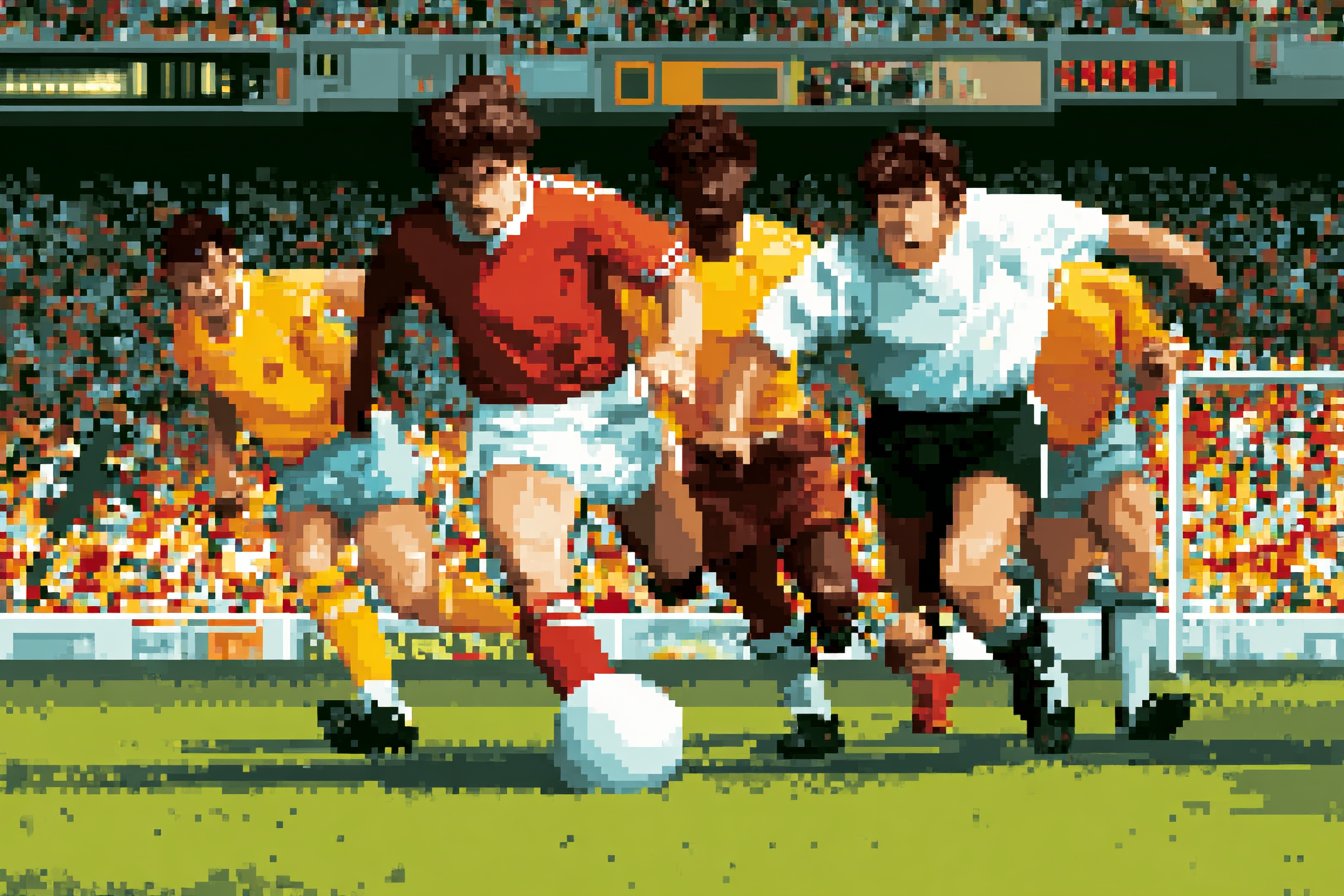
The aesthetic of Sensible Soccer was designed to be minimalist, and that was the perfect choice. The players were depicted as tiny sprites that looked more like ants than humans, but that suited the gameplay perfectly. With such small figures, you could see the entire pitch, which was essential for spotting runs and planning attacks. Modern football games with their close-up, cinematic views of the action actually make it harder to play good football because you can’t see enough of the game.
The view of the pitch itself was shown from a distance that allowed you to see almost the entire area. This was not a technological constraint that they were working around, but rather a deliberate design choice that valued playability above presentation. You could see your forward making a run at the same time as your midfielder tracking back – something that is impossible with the camera angles found in games with more “realistic” presentations.
The animation was smooth and responsive – the player moved quickly and smoothly when you changed direction, and the ball moved at the exact speed and direction you wanted when you played a pass. There was no delay between what you wanted to happen and what actually happened on screen.
The crowd noise was also wonderful – the little pixelated fans would cheerfully jump up and down when you scored a goal. It was delightfully simple but created a wonderful atmosphere that many modern games with their extensive crowd animations seem unable to reproduce.
Career Mode – Where The Game Truly Shone
The career mode of Sensible Soccer is where the game really came alive. You could take any team in the lowest divisions and work your way up through the divisions, but this was not just about winning matches. The game included a transfer system where you could buy and sell players, and importantly, the development of your players actually mattered.
Regular matches and good performance improved your players’ skills. A young striker who scored consistently would improve his shooting abilities over time. An experienced defender would become more reliable in tackles. Because the game was so finely balanced, you could notice the small improvements in player ability making a big difference on the pitch.
You could develop genuine tactics and learn which formations worked best against specific opponents, how to use weaknesses in the AI team, and when to substitute for maximum effect. The AI was competitive without being unfair – it played proper football rather than relying on statistical trickery or impossible reactions.
Long-term results were important too – a poor run of form could lead to relegation, while a successful cup campaign could raise sufficient funds to strengthen your team. The transfer market was lively, with AI teams signing and selling players realistically throughout the season.
The Sweet Spot – Accessible Without Being Too Basic
Sensible Soccer found the sweet spot between accessibility and depth. The basic gameplay was easy enough for anyone to pick up and play, but developing the advanced techniques took serious dedication. Developing the skills to curl free-kicks around the wall, timing tackles perfectly, and reading the game to create killer passes separated the good players from the great ones.
The free kick and corner system was particularly innovative – they used the same aftertouch system as regular play, allowing you to curl shots into the top corner or deliver pinpoint crosses to unmarked attackers. Penalties were pure skill – there were no random elements involved, only your ability to pick your spot and perform under pressure.
Team tactics were simplified but effective. You could choose from a variety of formations and adjust your team’s style of play, but these changes had a real effect on how your players played. For example, if you chose to play with wingers, your fullbacks would tend to overlap more, whereas choosing a defensive formation would result in your midfielders dropping back to protect the defence.
The difficulty curve was perfect. Easy matches against lower division teams allowed you to learn the controls and basic tactics, while matches against stronger teams required everything you’d learned and a few new tricks. The AI adapted its style of play based on the team it controlled – Manchester United played differently to Wrexham, and you had to adapt your strategy accordingly.
Technical Mastery On Original Hardware
When I play Sensible Soccer on original Amiga hardware, it shows why this game was such a sensation in 1992. The frame rate was solid and fast, and that was critical for the precise timing of tackles and passes. Even modern emulation doesn’t quite match the responsiveness of the original, possibly due to the lack of input lag that even the best emulators produce.
The sound design was minimalist yet effective. The crowd noise grew quieter and louder in tandem with the pace of the game – cheering wildly during attacks and quietening down during defensive periods. The ball sounds were excellent – different noises for headers, volleys, and grounded passes that aided you in judging the strength and trajectory of your kicks without needing to look at the ball.
Once you were in a match, load times were effectively non-existent, keeping the gameplay flowing continuously. Overall, the experience felt immediate and responsive in ways that modern games – with their pre-game introductions and load screens between every action – simply can’t compete with.
Reviews of Sensible Soccer from critics at the time were uniformly glowing. Amiga Power awarded it 93% (amigareviews.leveluphost), while Amiga Computing gave it 92% (amigareviews.leveluphost) and Zero Magazine gave it 92% (amigareviews.leveluphost). The latter were not just high scores, they represented a genuine acknowledgement that this was something truly special.
Impact and Continued Relevance Today
The influence of Sensible Soccer on football gaming cannot be understated. It demonstrated that responsive controls and an immediate gaming experience were far more valuable than realism or complexity. The Mega Drive version was ranked number one in the list of Top 50 Mega Drive Games of All Time (en.wikipedia), while the Mega-CD version took number two in the list of Top 10 Mega CD Games (en.wikipedia), demonstrating the game’s lasting influence across multiple platforms.
Although the Genesis port of the game did suffer some compromise, it received an 8/10 (sega-16) rating, which confirmed that the core gameplay was easily translatable across multiple platforms. Each of the subsequent versions retained the quality – version 1.2 received 93% in Amiga Format (youtube) and 90% in Amiga Power (youtube).
You can still play Sensible Soccer today through a variety of retro gaming collections, and it still stands up beautifully. The controls remain responsive, the gameplay remains engaging, and the career mode retains that irresistible “just one more match” allure that modern football games – with their large budgets and photorealistic graphics – continue to struggle to replicate.
The philosophy of the game – that gameplay should come before all else – has never been more applicable. Although modern FIFA and PES titles are technically incredible achievements, they are frequently frustrating to actually play. The complex control systems, slow reaction times, and excessive realism in player limits detract from the raw football experience that Sensible Soccer provided with such elegance.
In the end, it comes down to this: Sensible Soccer understood that the finest sports games are not simulations, but distillations. By stripping away everything extraneous and focusing solely on what makes football exciting – passing, shooting, tackling, and strategic thinking – it created an experience that felt more like real football than any photorealistic simulation has ever succeeded in replicating. Thirty years on, no football game has been able to improve on its fundamental structure, which explains why this tiny sprite-based game remains the greatest football video game of all time.
And that’s not nostalgia – that’s just good game design. And good game design has no expiration date.