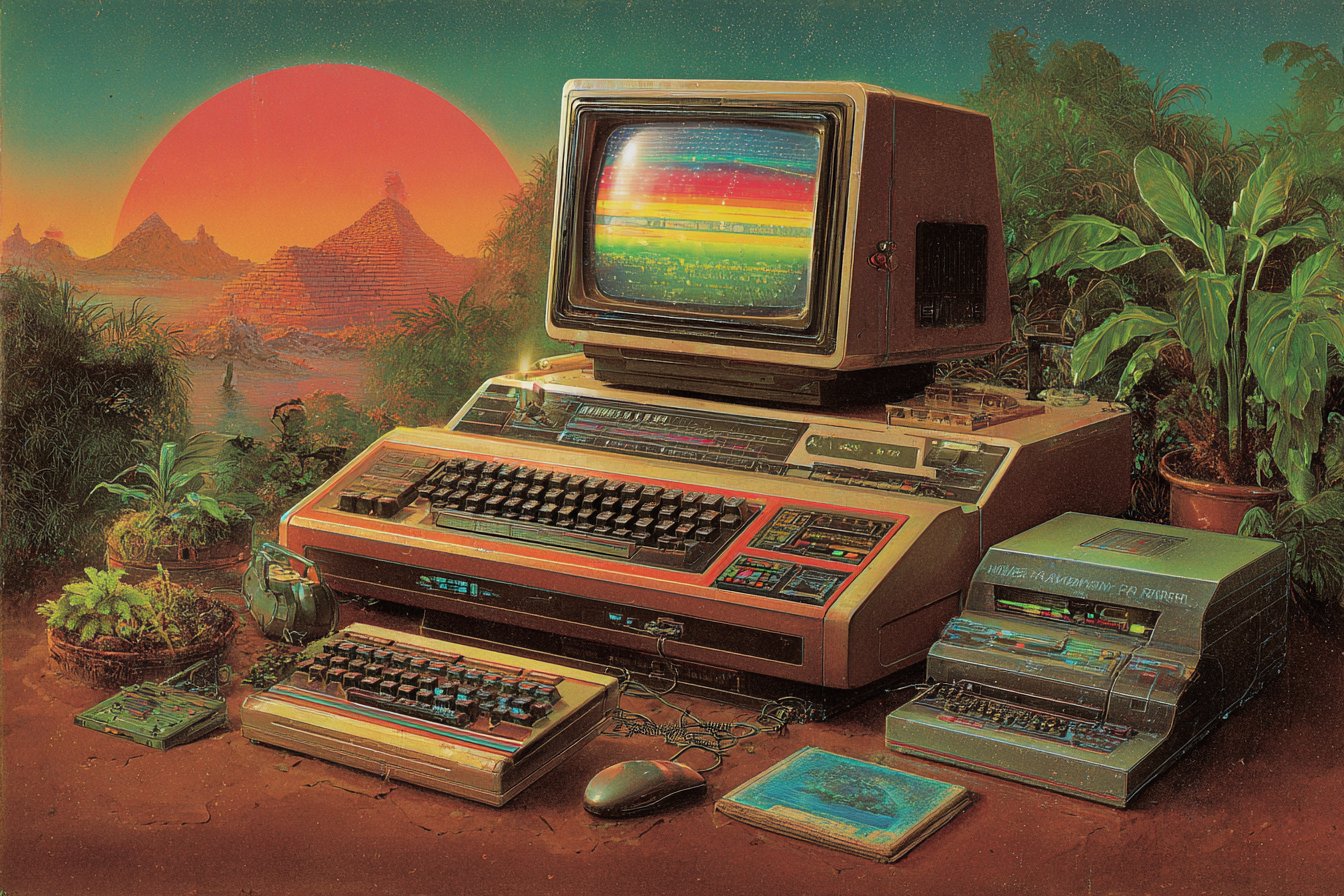
I have kept the Gateway 2000 mouse pad on my desk at work for over 25 years, and I don’t have that mouse pad there for some sort of retro flair – it is there because it is the only one of the many mouse pads I have bought that has survived three moves from one location to another and remained intact. Each time I see those cows, I am reminded of 1994 and the beige tower that showed up at my house and totally turned everything upside down.
When my parents bought the Gateway 2000, they thought they were buying us educational tools. They were right, I learned a ton from that 486 DX 2/66 with 8 MB of RAM. What I learned wasn’t what they were hoping for though. I had Microsoft Encarta installed for show-and-tell, but the real education occurred late at night when I was burning hours of my life in Civilization figuring out that “one more turn” can indeed last forever.
The Gateway 2000 was the first time I truly experienced PC gaming and some of the first experiences I’ve had have lasted longer than I ever could have imagined. I’m referring to games that I have taken with me to five different computers, two marriages (or as I like to call it, two marriages or one marriage and what feels like two), four jobs and now middle age. These aren’t just nostalgic relics sitting on a shelf gathering digital dust — I still start them up regularly today. Usually, it is when my kids are hogging the big TV for their PlayStation and/or I need something to take my mind off of a bad day of spreadsheets.
Something about Civilization allows it to feel like digital crack cocaine and a history lesson. I installed it from what felt like 37 floppy disks and I’ve been chasing that feeling of founding my first city ever since. The original Sid Meier masterpiece struck a perfect balance between being complex enough to keep you entertained and being easy enough that you wouldn’t need a phonebook-sized manual to move your warrior unit.
I remember my first complete victory in Civilization like most people remember their wedding day. It was winter break, junior year of high school and I’d been playing since Thursday night as the Romans. By the time Saturday morning rolled around, my mum was knocking on my bedroom door and asking if I was dead because I hadn’t come out of my room in days. I tried to tell her that I’d taken a Roman civilisation from the Stone Age all the way to space travel, but the look she gave me told me that was not the type of achievement she was going to brag about at her next book club meeting.
Today, I have the GOG version of Civilization installed on my computer because trying to get the old floppy disks working on Windows 11 would require a PhD in computer science. Once in a while after work, I’ll boot it up thinking I’ll play for 20 minutes to unwind. Before I know it, three hours have gone by and my wife will find me slumped over the keyboard, muttering about trade routes and whether I should build a library or barracks in my latest settlement. “That old game again?” she’ll ask and I’ll try to explain to her the beauty of the tech tree system, but she’ll just give me that look that says she loves me regardless of my obvious psychological issues.
As far as AI personalities in the original game go, I think the game developers did a great job of keeping it simple. Montezuma was always a traitorous bastard, Gandhi was peaceful until he got nuclear weapons (that freaked me out) and Napoleon was… well Napoleon. Today’s versions of Civ have a lot more advanced diplomacy options, but sometimes I miss the simplicity of “Lincoln is happy” or “Caesar is mad.” You always knew where you stood.
Fallout and the Freedom to Choose
Fallout affected me in a different way. Eric brought it to our dorm in ’97 and cut short what was supposed to be a productive evening of procrastinating on my English paper. “You gotta cheque this out,” he said, switching out whatever educational programme I was faking. From the moment I exited the vault and entered the post-apocalyptic wasteland, I knew my GPA was gonna take a hit.
It wasn’t just the post-apocalyptic environment that I fell in love with – many other games have featured such environments. It was the freedom. Want to negotiate with nearly every enemy you meet? Awesome. Want to blow every problem you face away with a plasma rifle? Cool. The turn-based combat was old even back then, but it allowed for a level of strategy that many modern-day fast paced RPGs sacrifice for style. Also, the dark humour was something entirely new. At the time, it seemed subversive.
I’ve lost count of how many different characters I’ve created in Fallout over the years. In my last run, I created a high-intelligence smooth-talker who could talk super mutants into solving their own problems through thoughtful dialogue choices. Until I ran into that one battle where I needed to use a little more than just my charm to defeat my enemies, my smooth-talking skills were being used to frantically search through my inventory to find something a little more substantial than just harsh words.
Twenty-five plus years after I first started playing Fallout, I still have occasional surprises. Just last month, I stumbled upon a dialogue option with some random NPC in the Hub that sparked a small side quest I’d somehow missed in dozens of prior play-throughs. That moment of “Wait a minute – is this new?” felt just as exciting as stumbling upon a rare item in a modern game.
Trying to get modern versions of Fallout to run on current hardware was a nightmare once upon a time. Back in the day, getting the old disks to run properly required a combination of compatibility patches and prayers. Thankfully, the nice people at Steam and GOG solved that problem. Both of those services have made it much easier to preserve games, although sometimes you may still have to search through forums to figure out the secret combination of settings that prevents crashing when you’re viewing the final scenes of the game.
SimCity 2000 and DOOM: The Other Obsessions
SimCity 2000 was the first time I became trapped in the “just five more minutes” trap that city-building simulations are famous for. Before SimCity 2000, I avoided simulation games because they were boring compared to killing demons or exploring dungeons. However, the distinctive blue box at Babbage’s store caught my eye, and the demo station sealed the deal. All of a sudden, I realised why people were so excited about zoning restrictions and placing power plants.
Will Wright was a genius when he came up with the isometric view in SimCity 2000 – my cities felt like real cities with real problems that only I could solve by digging deeper into increasingly hazardous basement levels. I spent countless hours designing my residential areas, making sure that the coal power plants were far enough away from my wealthy residents, because apparently I naturally understood the concept of environmental inequality at 16 years of age.
When my first city had 100,000 inhabitants, I actually printed out a screenshot and put it on my desk. When my dad saw the picture, he asked if it was for a school project. I told him it was because I was embarrassed to admit that I was proud of a fictional city. Man, though, those little Sims needed help from me with their infrastructure and I took that responsibility very seriously.
SimCity taught me more about urban planning than any textbook ever could. The connections between residential, commercial and industrial zones, the necessity of mass transit, and why you need parks and schools dispersed throughout your city – these were no longer just abstract concepts – these were problems that I needed to solve, lest I lose credibility.
Also, the sound design in SimCity 2000 was unbelievable. Construction music is still stuck in my head. Sometimes I catch myself whistling it while assembling IKEA furniture, which my wife thinks is both funny and disturbing. The sounds of placing buildings, the advisors popping up warning you that you’re about to run out of money and/or you’re going to experience a natural disaster, etc. – all of these elements combined to create the illusion that your city was alive.
However, DOOM is probably the game I’ve purchased the most iterations of over the years. I’m talking about the original shareware floppy disks, the full registered version, the Ultimate DOOM package, DOOM Classic for Xbox 360, the BFG Edition and the numerous re-releases I’ve purchased over the years – I’ve essentially paid for John Romero’s retirement at this point, and I have no regrets.
My first exposure to DOOM wasn’t even on my home computer. Tom’s older brother had installed it on their family computer and we’d wait until his parents went to bed before we’d turn it on. We’d huddle around that monitor in their den, jumping at every little noise made by an imp – do you remember the screaming noise they made? It was like we were watching a horror movie, but we got to control it. The shareware version of DOOM was passed around our entire school like contraband, copied from floppy disk to floppy disk until everyone had experienced the thrill of ripping and tearing.
What keeps DOOM timeless isn’t just nostalgia. The game design is basically perfect – fast, simple, with guns that fit perfectly in your hands and enemies that clearly telegraph their movements. Modern first-person shooter games try to add complexity to the gameplay through things like customisable guns and cover systems, but DOOM showed that you could achieve incredible depth using nothing but basic gameplay principles.
The DOOM modding community has preserved the game in ways that id Software could never have imagined. Thanks to the source code release, DOOM runs on everything now – literally everything. I’ve seen it run on calculators, ATMs, and maybe someone’s smart refrigerator by now. Right now, I’m running it with GZDoom and high resolution texture packs, and it looks like what I imagined in my teenage brain back in ’93.
Currently, I have a folder containing around 15 of my favourite WAD files – community-created custom maps for DOOM that date back to the days of the original game. If I ever need a quick gaming fix but don’t have time to dedicate to a larger game, I can load into any of these and get the perfect amount of adrenaline-fuelled action. No crafting systems, no dialogue trees, no moral dilemmas – you just shoot demons with your shotgun. It’s digital comfort food.
Diablo and the Loot That Ruined My Grades
Diablo completed my 90s PC gaming education when I attended college. During my sophomore year, I was supposed to focus on my academic growth and personal development, but instead I spent that year clicking on skeletons in randomly generated dungeons and searching for that rare loot drop like a digital gold prospector searching for shiny pixels.
Blizzard created something truly addictive in Diablo with their loot system – not just the loot itself, but also the sound effects of finding loot. The exact audio cues when you find something worthwhile can awaken me from a dead sleep. Poor roommate Brad suffered hours of me mouse-clicking at 3 AM until we had to have a somewhat awkward conversation about “being considerate of others.”