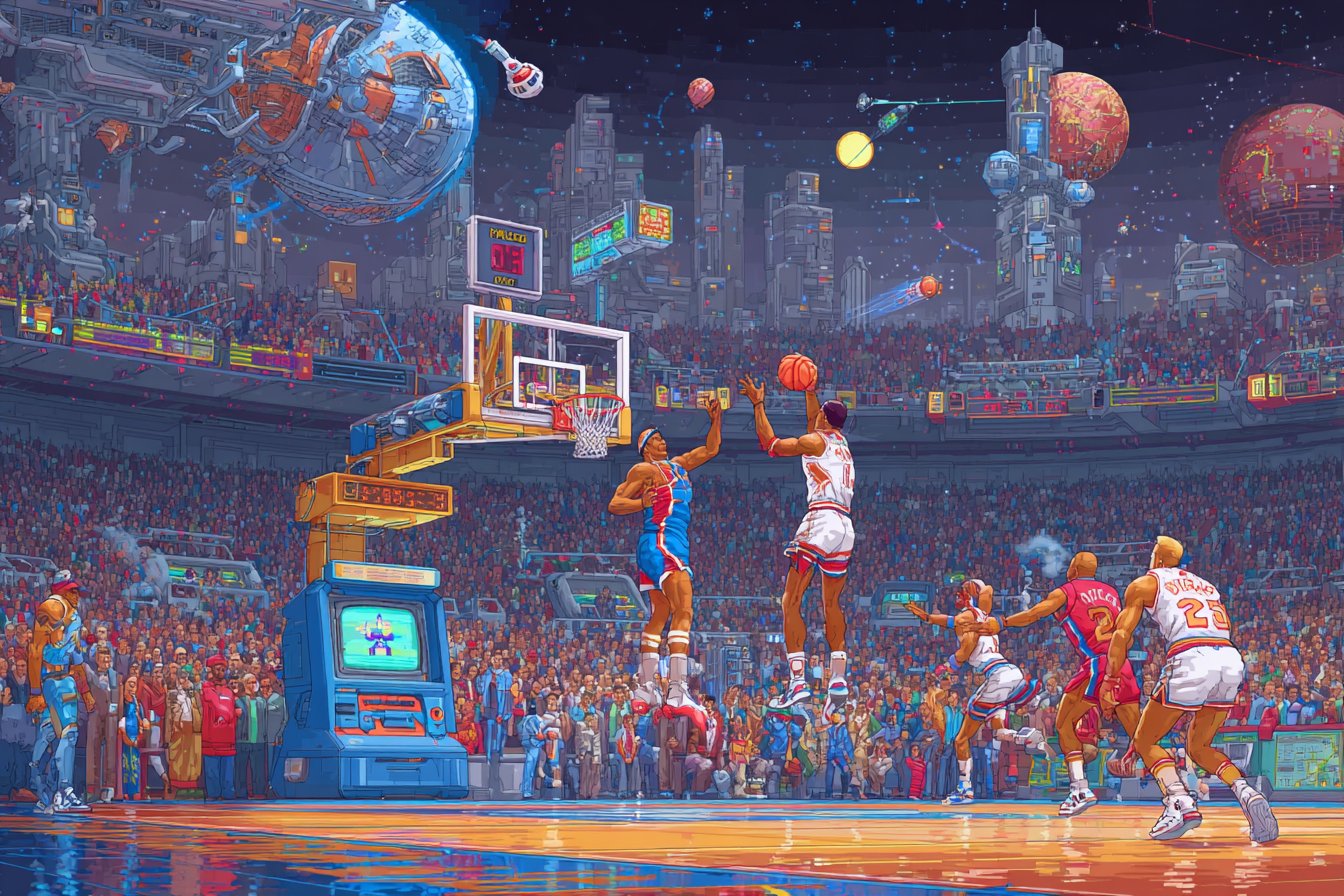
Joe here, and I’m prepared to start another argument with my team: NBA Jam is the best arcade basketball game ever made, and the best sports game, bar none. I know Tim’s gonna try to throw some FIFA nonsense at me, while Sam tosses out some frame data about how Street Fighter is the better competitive experience. But NBA Jam took what every simulation-focused sports game was aspiring to do in 1993 and said “screw that, let’s just make basketball fun instead.”
Released in 1993 (Wikipedia) by Midway (Video Game History Wiki), NBA Jam was the polar opposite of any number of serious basketball sims. While other games tried to recreate NBA strategy and statistics, Midway took a look at the sport and figured, “hey what if we put in a bunch of players who can literally ignite and jump twenty feet in the air?” The arcade version alone sold over 20,000 units (Wikipedia) and grossed $2 billion in lifetime revenue (Wikipedia). That’s not just successful, that’s “oh God we accidentally created a cultural phenomenon” successful.
The home console versions, published by Acclaim (Wikipedia), brought that hysteria to every major platform – Genesis, SNES, Sega CD, and Game Boy (MobyGames). By 1994, the console versions had sold 2 million copies (Wikipedia), and eventually sold 6 million total across Genesis and SNES by 2019 (Wikipedia). It became the top selling sports game franchise, selling 8.2 million copies overall (VG Sales Fandom).
| Developer | Midway |
| Platform | Arcade, Genesis, SNES, Sega CD, Game Boy |
| Year Published | 1993 |
| Genre | Arcade Sports |
| Players | 1-4 (2-on-2 basketball) |
| Our Rating | 9/10 |
The Arcade Formula That Actually Made Basketball Exciting
NBA Jam worked because it recognised one simple thing that the simulation crowd tragically overlooked: real basketball isn’t that exciting as a sport, much less as a video game. NBA games are start and stop, constant fouling, and strategic timeouts that grind everything to a halt. Midway simply took out anything that slowed the game down and cranked up what made basketball exciting.
The two on two format, four players total with no substitutions, was genius in its simplicity. No memorising complicated plays. Each player had stats that really meant something in actual play: speed described how quickly you could move up court, shooting affected range, and athleticism governed how high you could jump and dunk. This wasn’t information buried in menus but something you could feel immediately in play.
The controls were simple to use and hard to master. Just three buttons – shoot, pass, turbo – nothing tricky like different inputs for shooting and defending. Timing and positioning, not button coordination, made a good player. The pass was dangerous and unpredictable, a ball thrown in arcs rather than straight lines, and intercepted passes were a frequent occurrence. Turbo added the risk-reward dilemma – burn it for speed and power, but save it wisely or you’d be left flat-footed when it mattered most.
The “on fire” mechanic was really the magic ingredient that took NBA Jam from a decent arcade game to an unforgettable classic. Make three consecutive shots without your opponent scoring, and your player would literally catch fire. A player on fire had an insane increase to shooting percentage, moved faster, and could not be stopped from behind. The brilliant part, though, is that the fire was really a psychological weapon against opponents. When the fire started burning, the other player would panic, and often the result was an avalanche of insane decision making and bizarre shot attempts. Fire streaks were the momentum system of the NBA Jam universe and created ridiculously sublime tension.
What NBA Jam did differently from every other sports game on the market was make you feel like you were playing sports while at no point feeling like you were playing the actual sport it was based on. Before Jam, sports games were generally either wretched arcade efforts that bore no relation to the sport, or failed simulations that were about as exciting as watching grass die during a drought. Jam found the magic place in between. Shawn Kemp could jump impossibly high and hang there before throwing down a dunk. He could apparently take off from the charity stripe and slam the ball through the hoop so hard the rim would bend. These weren’t bugs or limitations; they were designed features built to replace realism with showmanship and energy.
Fouls were almost completely removed from the game. No free throws, no technical fouls, no flagrant fouls. The only fouls called were goaltending and the occasional pushing foul so blatant the ref couldn’t ignore it. Real basketball stops every thirty seconds for some tedious free throw situation; NBA Jam just lets you play.
The team selection wasn’t a gimmick at all but brilliant marketing camouflaged as gameplay design. Each team had only two players, usually its top stars, with exaggerated traits that made them recognisable even to casual fans. Shaquille O’Neal was an unstoppable monster under the basket but couldn’t hit a three-pointer to save his life. Reggie Miller could shoot from anywhere on the court but fell over if you looked at him sideways. This wasn’t just a difference in statistics; it was a difference in how you played offence, encouraging experimentation with different team combinations.
The announcer commentary by Tim Kitzrow deserves its own paragraph. “He’s on fire!” “Boomshakalaka!” “Anklebreaker!” These weren’t just cute gimmicks; they were perfectly timed cues that reacted to exactly what the player was doing. Alley oops got a different call from a standard dunk, three-pointers had a special celebration, and the fire announcements raised the tension during streak situations.
The Genesis Version: Arcade Perfection at Home
I get it, the sound chip in the SNES version is impressive, and technically it has the edge there, but the Genesis version of NBA Jam was the real deal. That’s the version everyone wanted, and that’s the version I played. The Genesis handled the fast paced action better, the controls were more responsive, and the slightly rougher audio suited the game’s aggressive personality perfectly.
The Genesis maintained a solid 60fps throughout, including during those impossible dunks from half court. The SNES version struggled with its graphics chip during the most spectacular moments, stuttering just when you needed it most. Those few milliseconds of frame drop cost the game precious speed and feel.
The controller worked brilliantly for NBA Jam, mapping all the functions to three buttons naturally. The D-pad precision was essential for the tight timing required for steals and blocks. The turbo button sat naturally under your thumb, encouraging the constant speed management that separated casual players from serious competitors.
Most importantly, the Genesis version preserved the arcade’s aggressive, in-your-face attitude. This wasn’t a polished, sanitised sports experience – it was playground basketball with supernatural abilities and trash-talking announcers. The Genesis’s edgier reputation suited NBA Jam perfectly, while the SNES’s family-friendly image seemed at odds with a game about setting people on fire and dunking with enough force to break backboards.
The Cultural Impact That Sports Games Still Haven’t Matched
NBA Jam generated $1 billion in its first twelve months (Wikipedia), which puts it in rarefied air for any video game, let alone a sports title. But the financial success was just the beginning of its cultural impact. NBA Jam created a template for arcade sports that dozens of games tried to copy, but none could replicate its perfect balance of accessibility and depth.
The game succeeded with both hardcore gamers and complete novices. Experienced players developed advanced strategies around turbo management, steal timing, and exploiting each character’s unique abilities. Casual players could jump in immediately and have spectacular moments without understanding the deeper mechanics. This broad appeal was unprecedented in sports gaming.
NBA Jam also influenced how we think about sports game presentation. The exaggerated player animations, the dynamic camera work, the over-the-top sound effects – these became standard elements that modern sports games still use today. Before NBA Jam, sports games tried to recreate television broadcasts. After NBA Jam, they tried to recreate the excitement of being there.
The game’s approach to licensing was revolutionary as well. By focusing on star players rather than complete rosters, Midway created a product that felt official and current without the massive licensing costs of full NBA simulation. This approach influenced countless sports games that followed, proving you didn’t need every bench player and coaching staff to create an authentic experience.
Critics were similarly shameless in their praise of NBA Jam, with IGN giving it a 9.0/10 in retrospective reviews (IGN), and a composite 92/100 aggregate score across the franchise’s lifetime (Metacritic). These weren’t courtesy scores thrown at a popular game, but genuine recognition of the crafting genius behind NBA Jam.
Why NBA Jam Still Matters in Gaming Today
What makes me lose my mind is how sports games today have entirely missed NBA Jam’s unique insight into what is entertaining about sports when stripped down into a video game. The current games in the NBA 2K series are triumphs of technical accomplishment, with gorgeous graphics and realistic player movement, but they’re also bloated and dull to play. They simulate everything about professional basketball accurately, except for the fun parts.
NBA Jam showed that you could put standalone arcade-style sports games in the market that serve an entirely different audience. We didn’t need every sports game to be an accurate recreation of the television broadcasts we already had. Sometimes we just wanted to grab a mate, pick our favourite players, and see who could score the most outrageous slam dunks.
NBA Jam tournaments became a regular part of the arcade and gaming circuit, developing a culture of players able to take apart the advanced mechanics hiding underneath the accessible gameplay. The meta-game of picking a character, positioning yourself on the court, and managing momentum over a series of games had enough depth to stay interesting long after the novelty wore off.
Modern retro gaming collections have kept NBA Jam accessible, but they can’t recreate the experience that made it special. NBA Jam was built for shared screens and local competition that encouraged trash talk and camaraderie in a way that online gaming never will. If Billy drained an impossible three-pointer to tie the game, you needed to see his face right then, not wait for an emoji.
Even today, NBA Jam is the perfect counter-weight to video gaming’s ongoing obsession with realism and complexity. Sometimes the best way to capture the essence of something is to blow it out of all proportion and retain only what is exciting and joyful. NBA Jam knows that video games don’t need to simulate reality – they need to be better than reality.
Choosing Chaos Over Simulation
Tim will say our sports video games today are objectively better than the older stuff. More complex, more realistic. He’s wrong, of course, but for an interesting reason. NBA Jam made the choice that no sports game has ever made: that it would be a video game first and a basketball simulation second. It wasn’t a compromise or a technical limitation; NBA Jam prioritised arcade fun over simulation strategy, over-the-top action over realism, and simple mechanics over surface-level depth. Hidden beneath an interface so easy anyone at your house party can pick it up and start playing is a deep understanding of player match-ups, time-limited windows to shoot, and systems of gaining and losing momentum that turn fire streaks into come-from-behind mechanics.