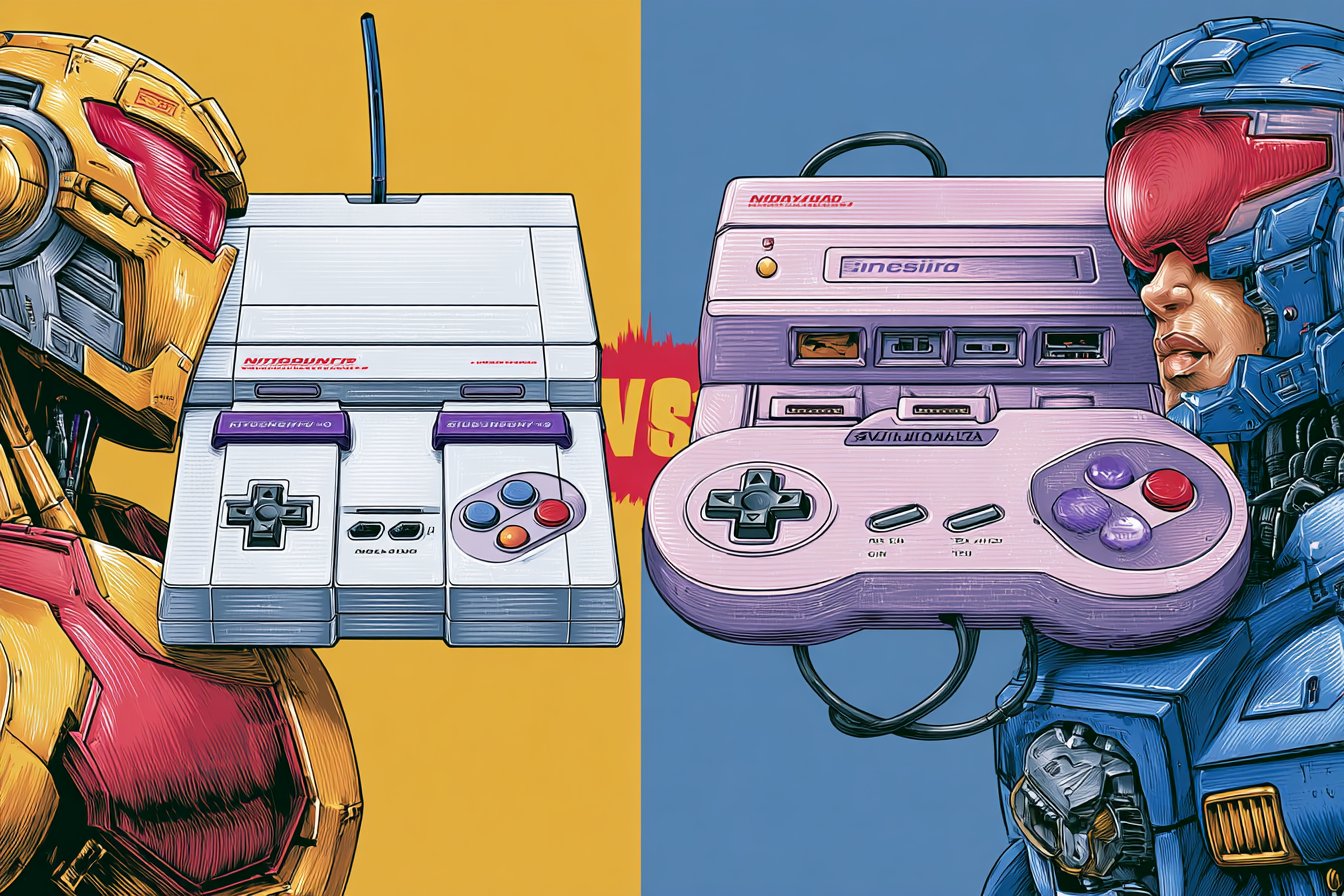
In 2011, I went into a barroom brawl that had been going on for twenty years. Now, everybody was arguing about something that happened when they were 12 years old. I had missed this the first time around – I was working construction, and raising a kid – but I’m 41 years old now and I’m trying to figure out which 16-bit system I want to buy first, and everybody wants to give me an opinion about blast processing.
My daughter is the main reason for all of this. When she graduated from college, she came home with both a SNES and a Genesis and put them together in my living room like she was setting up a chemistry experiment. “You have to see the console war,” she tells me handing me a controller as if it was a piece of history. I guess it is.
I wasn’t nostalgic myself; I didn’t grow up hearing playground debates or seeing magazine advertisements. To me they were just two plastic containers that looked pretty similar, each touting what I had missed during the heyday of 16-bit. So, I figured I’d play a few games on each and pick a favourite and be done with it. Easy peasy, right?
Three months later I owned both systems and about 40 games for them combined, and I was debating retro gaming enthusiasts online about sprite scaling techniques. My coworkers thought I was crazy. Maybe I was.
One of the big advantages of coming at the SNES/Genesis debate as an adult is that you can focus on the games themselves and not get caught up in the marketing hype that caused kids to believe one system was better than the other. Blast processing? Complete B.S. Mode 7? Just a fancy name for a neat graphics gimmick. What mattered was which console had the games I wanted to play, and in the end, it was both.
First, I played Super Mario World on the SNES because everybody said you had to play it. Fair enough — nice game, good level design, riding turtles was cool. Next, I played Sonic the Hedgehog on Genesis, because that seemed like the obvious opposite. Completely different experience. Mario was like careful platforming, thinking ahead for each jump. Sonic was like chaotic momentum-building, praying for the best.
They weren’t better or worse experiences — they were just different. However, the online flame wars about which was “better” were completely crazy. Adults screaming at each other about which represented better game design philosophies. I am reading this and thinking, “These are just different kinds of fun. Why does one have to be better than the other?”
It wasn’t until I started playing more games on each system that the technical differences were really apparent. In general terms, the SNES games looked cleaner, with that typical Nintendo look. The Genesis games had a grittier look, like the difference between a studio recording and a live rock show. Either way, neither was inherently better — they just approached the same hardware limitations differently.
Sound was where the divide hurt the worst. The SNES had those lush, orchestral-style soundtracks that made the games seem epic. The Genesis had that harsh electronic sound that worked well for some genres, but could be grating for others. I listened to the ocean sounds in Ecco the Dolphin on Genesis and thought they were haunting. Listening to the atmospheric soundtrack in Super Metroid on the SNES gave me chills.
Begun buying games for both systems, which my daughter found hilarious. “Most people take a side, Dad,” she told me. But I had no preconceived notions to defend. If a game sounded interesting and had good reviews, I would buy it, regardless of which console it was on. Practical approach that probably saved me from a lot of unnecessary brand loyalty.
The exclusive titles were what blew my budget wide open. I wanted to play Chrono Trigger? Only available on SNES. Wanted to play Phantasy Star IV? Only available on Genesis. Streets of Rage 2 or Final Fantasy VI — I couldn’t have played both on just one console. Honestly, I think Sega and Nintendo had this planned. Get people to commit to one ecosystem, then lock the good games to that ecosystem.
The fighting games showed the differences very well. Street Fighter II on the SNES had better graphics and sound, but the Genesis six-button controller was clearly designed for fighting games, whereas the SNES controller was clumsy for any game that required complex button combos. Ended up wasting a lot of money on different controllers, trying to optimise the experience on both systems.
Current prices for retro games are absolutely outrageous compared to what these items sold for when they were new in ’94. Some SNES games are selling for more than they did when they were brand-new in ’94, which seems weird considering they’re twenty-five year old technology. Genesis games are generally cheaper, which makes sense since Sega lost the overall marketplace battle, but the rare ones still sell for an arm and a leg.
Had some conversations with other collectors who had grown up and gone through the original console war, and their perspectives were fascinating. Guys my age who had taken sides as kids and remained loyal to them for decades, and were just beginning to branch out and try the “opposite” console as adults. Almost all of them admitted that the rivalry had been grossly exaggerated, and that both systems had tons of great games, but you could tell that the residual effects of that childhood brand loyalty were still affecting how they viewed things.
Reading the magazine coverage from the time is laugh-out-loud funny to read now. GamePro and Electronic Gaming Monthly treated each new release like it was a battle in a never-ending war, with comparison charts and technical dissections that probably flew right over most kids’ heads. I bet both of the marketing departments at Sega and Nintendo loved watching the gaming media do their promotional work for free.
However, the fact that the competition pushed both companies to create better games for players was the greatest benefit of the rivalry. Because of Sega’s presence, Nintendo was forced to make improvements to their games, and because of Nintendo’s massive market share, Sega was forced to innovate. Neither company could rest on their laurels, so we got better games across the board.
Each system also had its own respective technical problems that fanboys blissfully ignored. Yes, SNES slowdown existed — too many sprites on screen and everything slows down to slow motion. And yes, the Genesis had that awful sound chip that made some games literally painful to listen to. It wasn’t treasonous to admit to these problems, it was just honest.
The peripheral wars were probably the most absurd of all. Light guns, motion controllers, extra peripherals that doubled the price of your console for only a handful of games. Bought a Super Scope at a retro gaming convention, used it once and realised why light gun games are dead. That thing weighs like ten pounds and needs more batteries than a smoke detector.
International regional differences added another layer of complexity that I hadn’t expected. Some Genesis games were only released in Japan or Europe, different versions of the same game on different systems, licensing issues that prevented certain titles from being available in certain regions. Collecting became this research project into international game distribution, which was actually more interesting than I thought it would be.
The modding communities for both systems are impressive. People making new games for twenty-five year old hardware, and finding ways to push the limits of what the original developers thought was possible. Downloaded some ROM hacks that seriously improved upon classic games, which seemed like it shouldn’t be possible, but somehow worked.
Emulation vs original hardware became another debate that I got sucked into. Purists saying that you can’t truly experience these games without using original controllers and CRT TVs, pragmatists saying that emulation is fine enough, and much easier. Used both methods — and there are some small differences, but honestly, most people probably wouldn’t even notice.
My daughter was thrilled that she had gotten me hooked on retro gaming, though she was not thrilled when I started out-spending her on rare games. “This was supposed to be my thing,” she complained after I won an eBay auction for a complete-in-box version of Chrono Trigger. However, she had opened Pandora’s Box when she introduced me to this stuff.
The social aspect of retro gaming communities reminded me of why the console war was so intense in the first place. People base a part of their identity on these childhood experiences, and questioning someone’s favourite console is essentially the same as questioning their memory or their judgement. Learned to be diplomatic in the forum discussions, praising both systems, and quietly suggesting that maybe the rivalry was blown way out of proportion.
When I realised there was a cost-benefit analysis to collecting for both systems, I began to realise that some games were genuinely worth owning, while others were expensive solely due to rarity and not quality. Learning to distinguish between real classics and nostalgia bait that was wildly overpriced, probably kept me from spending tens of thousands of dollars.
The space needed to store the collection for both systems took over a large portion of my house. Game cartridges, controllers, cables, instruction manuals, and boxes if I was lucky enough to find them complete. Friends already thought the retro gaming thing was crazy, but when I converted an entire closet to game storage, they started joking about an intervention.
Playing these games without the emotional baggage of my childhood allowed me to appreciate the unique characteristics of what made each console special. The SNES excelled at atmosphere-based, story-driven games with stunning graphics. The Genesis excelled at faster paced action games and had a library of games that were more experimental, and willing to try weird things. Both approaches were valid.
The mentality behind the console war seems quaint now that everything is moving toward digital distribution and cross-platform play. Kids today will never know the tribalism of committing to one ecosystem, and being unable to play certain games because you bought the wrong plastic box. Good riddance, probably, but something has been lost when brand loyalty is no longer important.
After twelve years of collecting for both systems, I’m glad I didn’t commit to one side. I was able to experience the best of both worlds, without the artificially imposed restrictions of brand loyalty, and appreciate the technological and artistic differences without getting caught up in fanboy arguments. Sometimes being late to the party means you can enjoy the whole party rather than defending your corner of it.