King of Fighters ’98 Review: How SNK Perfected the Team Fighter Formula
Hello everyone, my name is Elena, and before Sam starts telling me about the importance of frame data and precision, and before Joe starts bashing KOF saying Fatal Fury is better, I want to tell you why King of Fighters ’98 is the ultimate team-fighting game. This is not just nostalgia; this is mechanical perfection, balance of rosters, and how SNK created what many would argue is the ultimate fighting game experience.
King of Fighters ’98 was released in Japanese arcades on July 23, 1998 (Wikipedia), followed shortly thereafter by the Neo Geo AES release in 1998 (MobyGames). King of Fighters ’98 is significant because it is the first game in the KOF series to not be tied to a specific storyline. In King of Fighters ’97, the final entry in the Orochi Saga, SNK completed their story and decided to roll back time (Wikipedia) to create a “Dream Match” with no storyline (KOF Wiki). By doing so, SNK was able to focus purely on refining the gameplay of KOF ’98. What resulted was fighting game perfection.
| Developer | SNK |
| Platform | Neo Geo MVS/AES |
| Year Published | 1998 |
| Genre | Fighting Game (Team-based) |
| Players | 1-2 |
| Our Rating | 10/10 |
King of Fighters ’98 earns its spot on our list of best Neo Geo games and exemplifies the difference between SNK and Capcom’s approaches to fighting games in the late 90s. While Street Fighter emphasised the abilities of individual fighters, KOF perfected the team dynamic and created a depth of systems that rewarded both individual skill and the strategic use of a team to fight as one unit.
The Team Battle Format Revolutionised Gameplay Design
While the 3v3 format of KOF ’98 (Wikipedia) may not be innovative now compared to modern fighting games such as Marvel vs Capcom and Tekken Tag, what is frequently overlooked is the extent to which the format affected the design of KOF ’98. Unlike Marvel vs Capcom’s chaotic tag system and Tekken Tag’s complex switching mechanics, KOF created a sequential elimination format that fundamentally altered the way players approached each match.
In KOF, each fighter enters a match at full health, however, the metre of your previous fighter carries into your next fighter. This creates an incredible amount of strategic decision-making regarding the management of your metre. Should you burn your first fighter’s metre for quick damage or should you save it for your anchor fighter for maximum effect?
The metre build-up of your fighters becomes a secondary meta-game within each match. Experienced players will manage their metre build-up through specific attack patterns and defensive options to maximise the effectiveness of each of their fighters. Additionally, the psychological factor of team order is critical to success. The order in which you choose your fighters for each round of a match can set the tone for each round, the middle fighter typically controls the flow of each round and the anchor fighter must endure the pressure of fighting against fresh fighters with potentially limited health.
I have personally seen professional tournament players spend more time deciding which fighters to choose than practising their combos, because team synergy is much more important than individual execution in high level competition.
One of the key factors of KOF ’98 that makes this formula successful is that character selection affects available strategies. For example, a grappler character such as Clark Still, operates very differently depending upon whether he is chosen as a point fighter or an anchor fighter. Clark, chosen as a point fighter, can quickly build metre and apply pressure to the opposing team. However, if Clark is chosen as an anchor fighter with a full metre, he is a completely different character with access to multiple command throws and super moves.
A similar scenario applies to other characters. The same character performs drastically differently based upon which position he is selected to play.
The elimination format of KOF ’98 also enables natural comeback mechanics without artificially inflating a team’s chances of winning. If you are down to your last character and facing a full team, you do not suffer from any inherent game system disadvantages. However, your last character does possess the opportunity to fully utilise his metre and the psychological benefit of having little to lose. Some of the most memorable KOF moments occur when a team falls behind to only be saved by a single, desperate character.
Perfection in Character Balance Across 38 Fighters
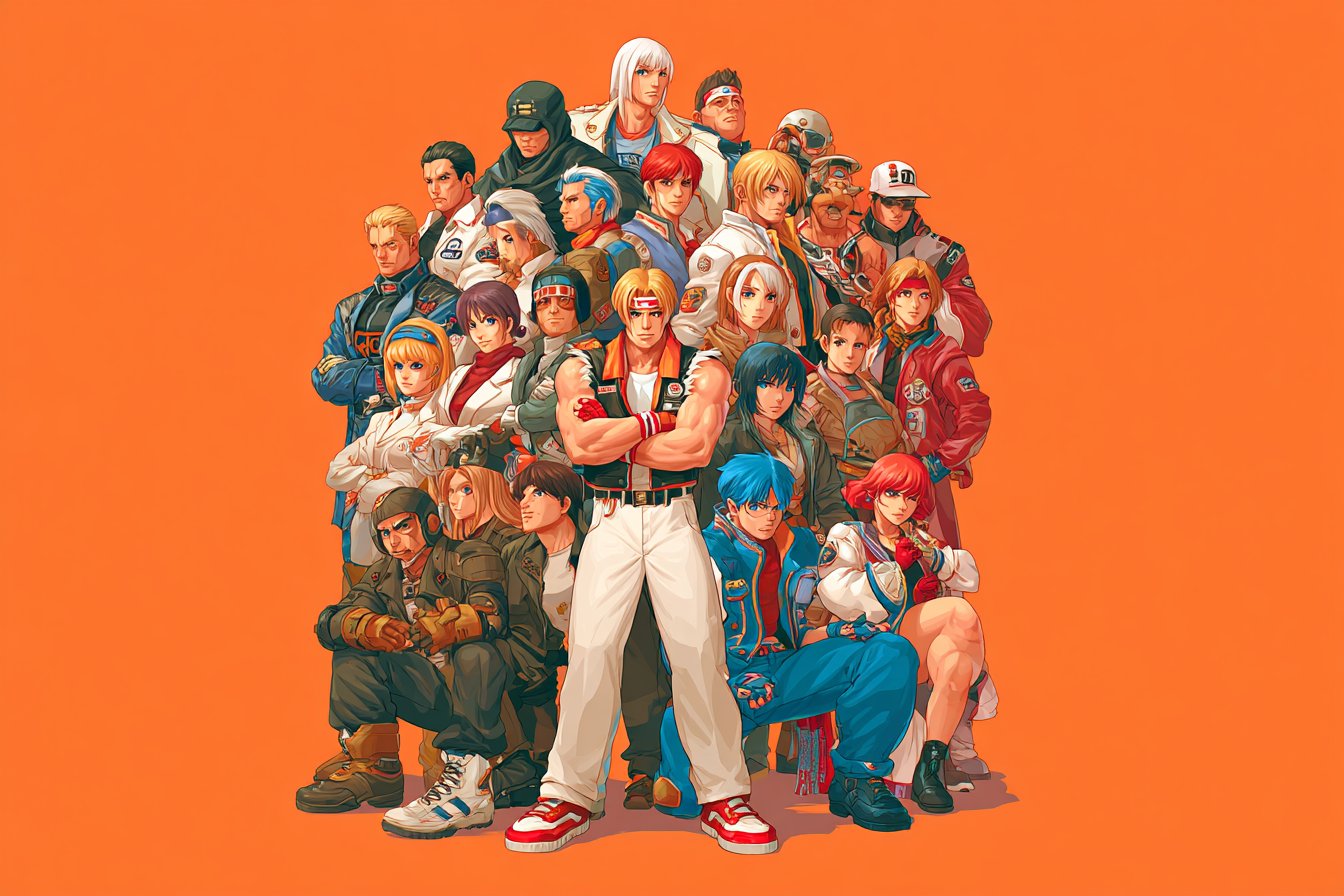
Another area where KOF ’98 excelled was in achieving character balance across its 38 fighters (Wikipedia). The KOF roster features a wide variety of fighters, each with distinct gameplay styles, and the results of competitive tournaments consistently demonstrate that nearly every character is viable at the competitive level (KOF Wiki).
It is worth noting that this was not an accident. The creators of KOF spent numerous revisions refining each character, adjusting the frame data, damage scaling, and move properties to ensure that every fighter possessed clear strengths and weaknesses without any single fighter dominating any other.
Terry Bogard, for example, plays completely differently than Iori Yagami and both fighters operate distinctly from Mai Shiranui. However, despite these differences, all three fighters are viable in competitive tournaments and feature large player bases.
To meet the preferences of a wide variety of fighting game enthusiasts, the character archetypes found in KOF ’98 encompass all possible fighting game preferences. Rushdown specialists, such as Kyo Kusanagi, excel at applying pressure and creating mix-ups. Zoners, like Athena Asamiya, control space with projectiles and anti-air options. Grapplers, such as Daimon Goro, punish defensive players with command throws and high damage potential. Technical fighters, like Geese Howard, reward players for executing their moves with precision with devastating combos and counter-attacks.
It is especially impressive how each character’s movesets complement the team battle format of KOF ’98. Characters are not simply individual fighters; they are designed to serve specific roles in team compositions. Some fighters excel as point characters, possessing strong neutral games. Other fighters work better in the middle position, building metre and offering versatile options. Anchor fighters, such as Rugal Bernstein, increase in danger as the match progresses.
The balance of characters extends to the properties of their moves. The frame data for the roster of fighters follows consistent rules that players can learn and internalise. Jump attacks have predictable startup and recovery frames. Special moves have predictable startup and recovery frames and follow logical risk/reward ratios. Super moves require the correct metre investment, but offer proportional damage and utility. This systematic approach means that learning one character will give you a greater understanding of the rest of the roster.
Innovative Systems to Reward Expertise
The striker assist system (MobyGames) and the Max Mode Power-Up System (Wikipedia) represent the height of SNK’s innovative spirit in terms of designing gameplay systems. These are not gimmicks; they are integral systems that create additional layers of strategy without overwhelming new players.
The striker system allows you to call eliminated team members for a brief assist attack. Although this sounds simple, the implementation of this mechanic is incredibly sophisticated. Strikers have limited uses per match, have different startup and recovery frames, and have different properties depending on which character you are calling. A Terry striker will provide different benefits than a Mai striker, and knowing when to use your limited striker calls will be critical in determining the outcome of close matches.
Striker calls also add a layer of mix-up potential and combo extension without disrupting the flow of the game. A well-timed striker call can extend combos for additional damage, create a window of opportunity for a difficult approach, or interrupt opponent pressure strings. However, striker calls have enough startup frames that they can be baited and punished by skilled players, thus maintaining the balance of risk and reward present in quality fighting games.
The Max Mode System serves two purposes: it is both a power-up state and a resource management challenge. When activated, Max Mode increases your character’s ability to perform actions, including extending combos, increasing damage potential, and granting access to powerful super moves. However, activating Max Mode consumes metre and has a limited duration, making the decision to activate and when to maximise the temporary advantage of Max Mode a strategic challenge.
What is particularly impressive is how the Max Mode System interacts with the team battle format of KOF ’98. Do you activate Max Mode early with your point character to gain a life lead? Do you save it for your anchor to stage a comeback? Do you use it to defend against opponent pressure and attempt to escape? The answer will depend on the current state of the match, the matchup between your fighters and those of your opponent, and the tendencies of your opponent, thus adding depth to the strategic decision-making process.
The combo system of KOF ’98 is notable for its ability to allow technically proficient players to execute impressive combos without requiring impossible-to-reproduce execution. Players with the technical skills can execute devastating combos that appear visually stunning and inflict a great deal of damage, however, the base game remains accessible to novice players who can still develop their skills using basic techniques. The slope of difficulty is perfectly balanced to encourage the improvement of novice players without presenting an insurmountable barrier to overcome.
Visual Presentation and Audio Experience on Neo Geo Hardware
The graphical presentation of KOF ’98 showcases the full potential of the Neo Geo hardware in the hands of experienced artists. Character animation is smooth and expressive and each fighter’s movement pattern and attack animations are unique to their personality. The sprite work of KOF ’98 is meticulously detailed and ranges from the physicality of clothing during special moves to the facial expressions of characters during super move animations.
Background design complements the fighting experience without detracting from the action. Each background tells a story and evokes atmosphere while providing sufficient visual clarity to support competitive play. Colour palette choices ensure that each fighter’s sprite is clearly distinguishable from the background of any stage.
Sound design produces one of the most memorable fighting game soundtracks ever composed. Each fighter’s theme song accurately reflects the personality and fighting style of the fighter and maintains the energy required to sustain the enthusiasm of players throughout long tournament sets. Sound effects provide critical auditory feedback for players to determine the accuracy of their timing and hits, with distinct sounds for different types of attacks and defensive options.
Loading times between rounds are essentially non-existent, supporting both competitive play and casual gaming experiences. Menu designs prioritise function over flashy graphics and include easy-to-use menus that grant instant access to training modes and versus play. These may seem like minor details, but they greatly affect the actual experience of playing the game for extended periods of time.
Frame rates remain consistent, even during the most intense sequences of combat, including the simultaneous use of super moves, striker assists, and particle effects. Consistency is critical for competitive play, where dropped inputs caused by inconsistent frame rates can result in lost matches. The technical stability of KOF ’98 is evidence of SNK’s proficiency of the Neo Geo platform after years of developing on the platform.
Cultural Influence and Competitive Legacy
KOF ’98 defined the model for team-based fighting games, and developers today continue to draw from the team dynamic, elimination format, and character balance philosophy of KOF ’98 when creating new entries in established franchises.
Competitive scenes surrounding KOF ’98 fostered some of the most memorable moments in fighting game history. The combination of team dynamics and the unpredictable nature of the team battle format created an environment in which upsets were common, and a creative team composition could defeat seemingly superior individual skill. The uncertainty of competitive play made for exciting experiences for both competitors and spectators.
KOF ’98’s long-standing presence in competitive tournaments is testament to the depth of its mechanical systems. For years after its initial release, major tournaments featured KOF ’98, and players continued to discover new strategies and ways to interact between fighters.
The evolving meta-game in competitive KOF ’98 was organic, emerging as players discovered new team combinations and countered popular strategies. Regional competitive scenes also produced distinct playing styles around the same game. Japanese players emphasised precise execution and the optimal number of combos. Mexican players favoured aggressive pressure and innovative team synergies. The regional scenes contributed unique strategies that enriched the total understanding of the potential of KOF ’98.
The influence of KOF ’98 goes far beyond the direct mechanical inspirations. The approach to character balance, where each fighter fulfils a specific role within a team composition, but is still viable as an individual fighter, became the benchmark for the design of rosters in fighting games. Modern developers still analyse KOF ’98’s character balance philosophy when creating diverse casts that resist tier lists.
Why King of Fighters ’98 is Still Important Today
We regularly rank KOF ’98 as the greatest KOF collection ever (Hardcore Gaming 101), and honestly, it embodies everything that made SNK special during its creative zenith. While KOF ’98 was among the costliest Neo Geo titles (NeoGeo Wiki), the price paid for an immense quantity of fun and mechanically rich gameplay that would reward long term study of the game.
By choosing to create a dream match without the burden of storytelling, SNK was able to focus solely on the refinement of the gameplay of KOF ’98. The results speak for themselves. All systems in KOF ’98 work together to produce an experience that is accessible to new players immediately, but is too deep for anyone to master. Casual players can appreciate the spectacle and fundamental mechanics of the game, while expert players can continue to find new and advanced techniques and strategies for years to come.
KOF ’98 proves that the true strength of fighting game excellence lies in its systematic design rather than in individual innovations. The team battle format, the balance of characters, and the advanced mechanics of KOF ’98 all combine to form a cohesive whole that exceeds the sum of its parts. KOF ’98 is a game that is respectful of both casual players and serious competitive players without sacrificing either experience.
For modern players, KOF ’98 is available via several compilation releases and digital platforms, although the original Neo Geo edition of KOF ’98 offers the definitive experience. KOF ’98’s influence on the design of fighting games continues today, with developers drawing from its team dynamic, character balance philosophy and elimination format when designing new fighting game entries.