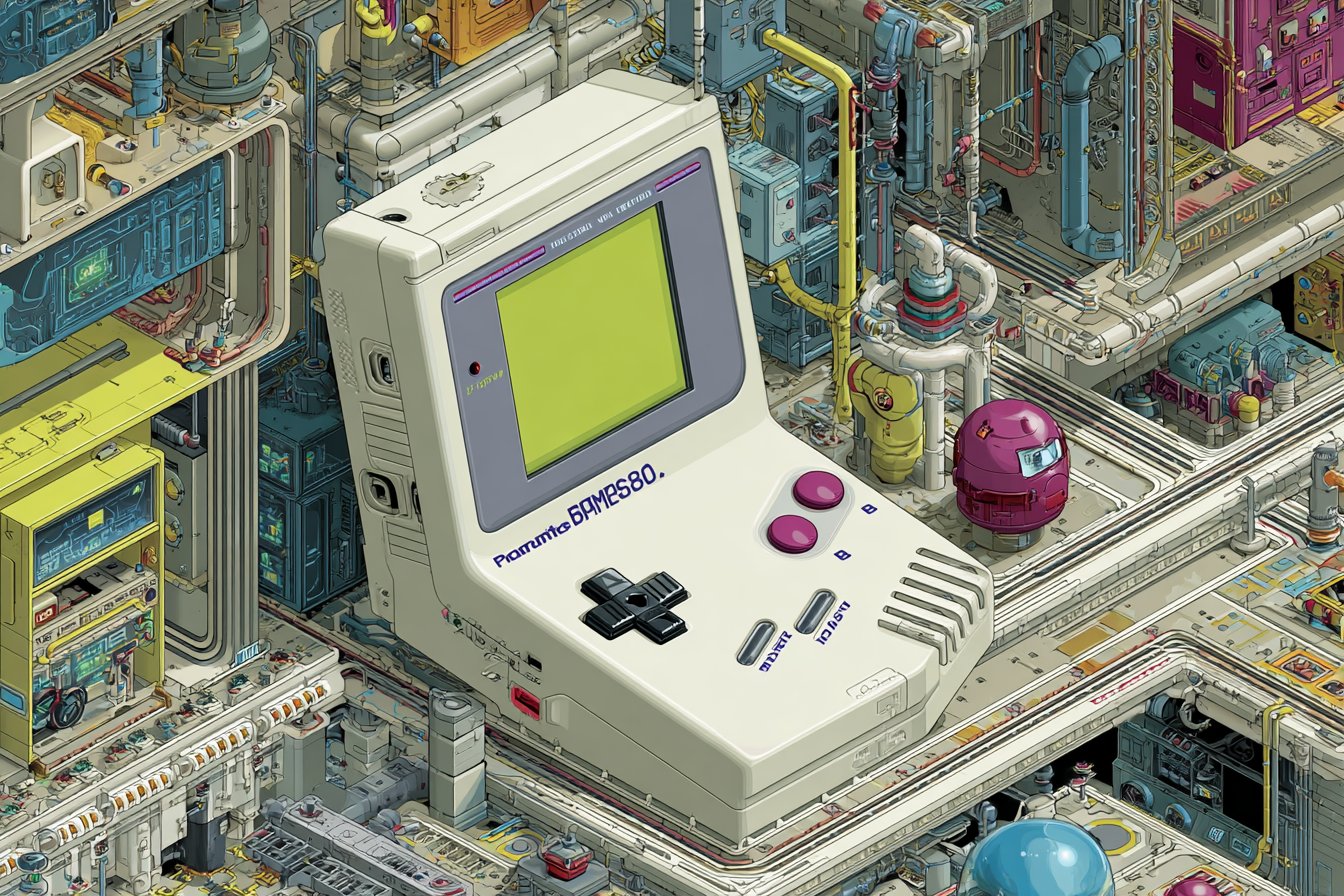
There are numerous reasons I’m a 42 yr. Old construction foreman and I’ve had so many vivid memories of obtaining my first handheld video game as a child. I purchased my first Game Boy at a garage sale in 2009 for $5. After my daughter said “retro handhelds”, I spent the next 3 hours trying to figure out why anyone would want to play games on a tiny, dimly lit screen.
When I purchased the Game Boy (an original grey brick model, with a cracked battery cover and Tetris permanently stuck in the cartridge slot), I was introduced to portable gaming as a 40-something man with no nostalgia for the product. The woman who sold it to me, included a carrying case and approximately six other games that she stated she “found in a box in the garage”. I paid the woman $5 for the Game Boy, hoping to sell it online for $20. However, I carried the Game Boy in my work truck for the next two years.
You may have heard, but what no one tells you about the first Game Boy is that it was built like a construction machine. I mean, it’s seriously durable. I dropped it off the tailgate of my pick-up truck onto concrete in the first week I owned it, and there wasn’t a scratch. It bounced. At the same time, I’ve seen modern smartphones break from falling off a couch cushion. Nintendo built the Game Boy to withstand use by humans, as I know firsthand from watching people destroy expensive equipment on construction sites.
The screen visibility issue that everyone complained about? Honestly, it wasn’t that big of a deal once you figured out the angles. It reminded me of reading blue prints in different lighting conditions – you adapt, find the right angle, develop ways of doing things. I’d sit in my truck during lunch breaks, positioning that small grey screen just so to get the right amount of light, and be completely absorbed in trying to beat my high score in Tetris. My crew thought I had lost my mind, this 50 yr. Old foreman crouched over a children’s toy from the 80’s.
Tetris however, isn’t a children’s game. The Tetris puzzle is pure problem solving, spatial reasoning, planning and dealing with randomness. It’s actually a perfect example of how the same cognitive skills used for planning and managing construction schedules and teams can be applied to a falling block game instead of building materials. I developed a competitive streak based on my high scores and I kept a little notebook in my glove compartment to track my best games.
The battery life was also interesting from a practical perspective. Four AA batteries lasting anywhere from 15-30 hours depending on usage – that’s incredible efficiency for a processor and display-based device. Today’s tablets run for about 8 hours of light use. The Game Boy ran for days of casual use on a single set of batteries. From an engineering standpoint, Nintendo made the decision to focus on maximizing functionality rather than maximizing the flash capabilities of the processor, made design choices that maximized the user experience relative to the physical constraints of the device. Smart choice.
Following my initial garage sale purchase, I looked for other games to accompany my Game Boy. Partly because of my curiosity about what else the system could do, and partly to see if there were other games I enjoyed, I started hunting down other games. Super Mario Land was a revelation – they crammed a full-fledged Mario platformer into a cartridge made for a tiny display, complete with that classic Mario feel regardless of the hardware limitations. The physics of Super Mario Land were slightly different from the NES versions of Mario that I was studying at the time, they were a bit more floaty, but they were definitely Mario. To experience that kind of excitement in something the size of a large paperback book was like magic.
Metroid II was when things really took off for me. Metroid II produced an atmosphere I didn’t think was possible on such limited hardware. Isolation, alien landscapes, and exploration – all of this was achieved perfectly on a handheld device. Playing Metroid II alone, usually late at night after working long hours, added to the feeling of isolation and loneliness on the alien planet. The black and white display actually contributed to the overall atmosphere, it was not a hindrance.
Link’s Awakening was the game that demonstrated why people became so attached to their Game Boys. Link’s Awakening was a complete Zelda adventure with dungeons, a story, memorable characters, and fit into something I could carry in my jacket pocket. The dreamlike quality of the story was complementary to the intimate, personal nature of handheld gaming. This was not something you played on a large TV with friends watching, it was your own private adventure, you and the game.
I became fascinated with the technical accomplishments of the developers using this hardware. How four channel audio could produce such recognizable and memorable music. How the developers could convey such character and emotion in sprite images that were only about 16 pixels tall. How developers could create levels that were successful in utilizing the limited screen area of the Game Boy without appearing too crowded. All of these were serious restrictions that led to creative resolutions.
I was amazed at the number of adults my age who recalled owning a Game Boy as kids. I started taking my Game Boy to job sites and we would discuss games during our breaks, share memories, and debate about our high scores. One of our electricians still had his entire collection of Game Boys in his basement. Our painter never had one but he was intrigued enough to let me show him mine. Now I was giving impromptu demonstrations of my Game Boy to the entire construction crew.
I learned about the link cable feature via a series of retro gaming websites. I ordered one from eBay and convinced my daughter to dig up her old Game Boy Colour. We spent hours playing head-to-head Tetris, something I would have never experienced as a kid since I wouldn’t have had access to this type of competition. She defeated me every time, but the experience of competing in portable gaming was new to me. It was a great bonding experience with my adult daughter over 20-year-old technology.
Apparently the accessory market for the Game Boy was huge back in the day. I began collecting some of the accessories – screen magnifiers, worm lights, carrying cases, even a steering wheel for racing games. Most of the accessories were purely functional, they resolved real issues with the base hardware. The magnifier significantly reduced eye fatigue. The light allowed us to play at night. They were not novelty products, they fixed real problems.
Pokémon was a whole different ball game when you’re experiencing it as an adult. I purchased Pokémon Red at a flea market around 2010, primarily to try to understand the hype surrounding the franchise. The addictive nature of collecting, the strategy buried in the fun and colorful interface, and how Pokémon utilized the Game Boy’s connectivity – it was pure genius. I eventually purchased Pokémon Blue as well, solely to utilize the trading aspect, although I had to trade between my two systems myself.
Managing the batteries became a legitimate skill set. I learned which battery brands lasted longer (Duracell), how to recognise the signs of dying batteries, and the importance of always keeping a supply of extra batteries in the truck. When the low battery indicator light appeared on the screen, you probably had 5 minutes of battery life remaining before you went dead – stressful. Modern smartphones with battery percentage displays and gradual degradation do not prepare you for the instant cutoff when the alkaline batteries are exhausted.
Comparing Game Boy to its competitor, Game Gear, provided an interesting comparison devoid of the effects of nostalgia. Game Gear had clearly better graphics and sound, a full colour display, backlit. But it consumed batteries like crazy, was much bigger than the Game Boy, and therefore more difficult to carry in most pockets, and the game library was not as robust. Nintendo’s decision to prioritize designing the Game Boy for maximum utility rather than raw processing power was ultimately the right decision.
The durability of the Game Boy continued to impress me. My garage sale Game Boy survived for two years of bouncing around in work trucks, being exposed to dirt on construction sites, and the occasional drop or impact. Although the screen developed some minor scratches, it still performed flawlessly. Compare that to modern smartphones that need protective cases and screen protectors to merely survive average use. There is a lot to appreciate about technology that is designed to last rather than to be discarded every few years.
Eventually, I acquired a Game Boy Colour. As it happens, the backward compatibility was flawless. All of my original games worked properly, with several offering colour options. However, I found myself returning to my original grey brick far more frequently than the Game Boy Colour, largely due to habit. It felt substantial, it felt right, and it felt like it was meant to be held in your hand.
Although the Game Boy Colour was technically superior, it did not possess the iconic quality of the original. Sometimes the original is able to capture that spark of genius that future models cannot replicate.
One of the things I found to be fascinating about the Game Boy experience was its lack of distractions. No internet connection, no software updates, no additional costs after purchasing the game. You inserted a cartridge, powered it on, and played until the batteries died or you lost interest. Simple. Uncomplicated. Calming.
To this day, I still occasionally take out my Game Boy and play it, especially in locations that do not have adequate cell phone reception. Airports, waiting areas, long lunch breaks at remote job sites. Even today, those simple games continue to entertain, continue to operate, and provide examples of the merit of developing a game that performs one task exceptionally well. Not a bad legacy for a technology that predates many of my coworkers.
The Game Boy demonstrated that portable gaming is not a smaller version of console gaming – it offers its own unique characteristics and design challenges. Nintendo understood this instinctively and designed a product that thrived in its limitations, rather than attempting to force console gaming into a handheld format. Sometimes the best answers come from acknowledging the limitations and not fighting against them. A pretty good lesson from a little grey brick I purchased for five dollars at a garage sale.