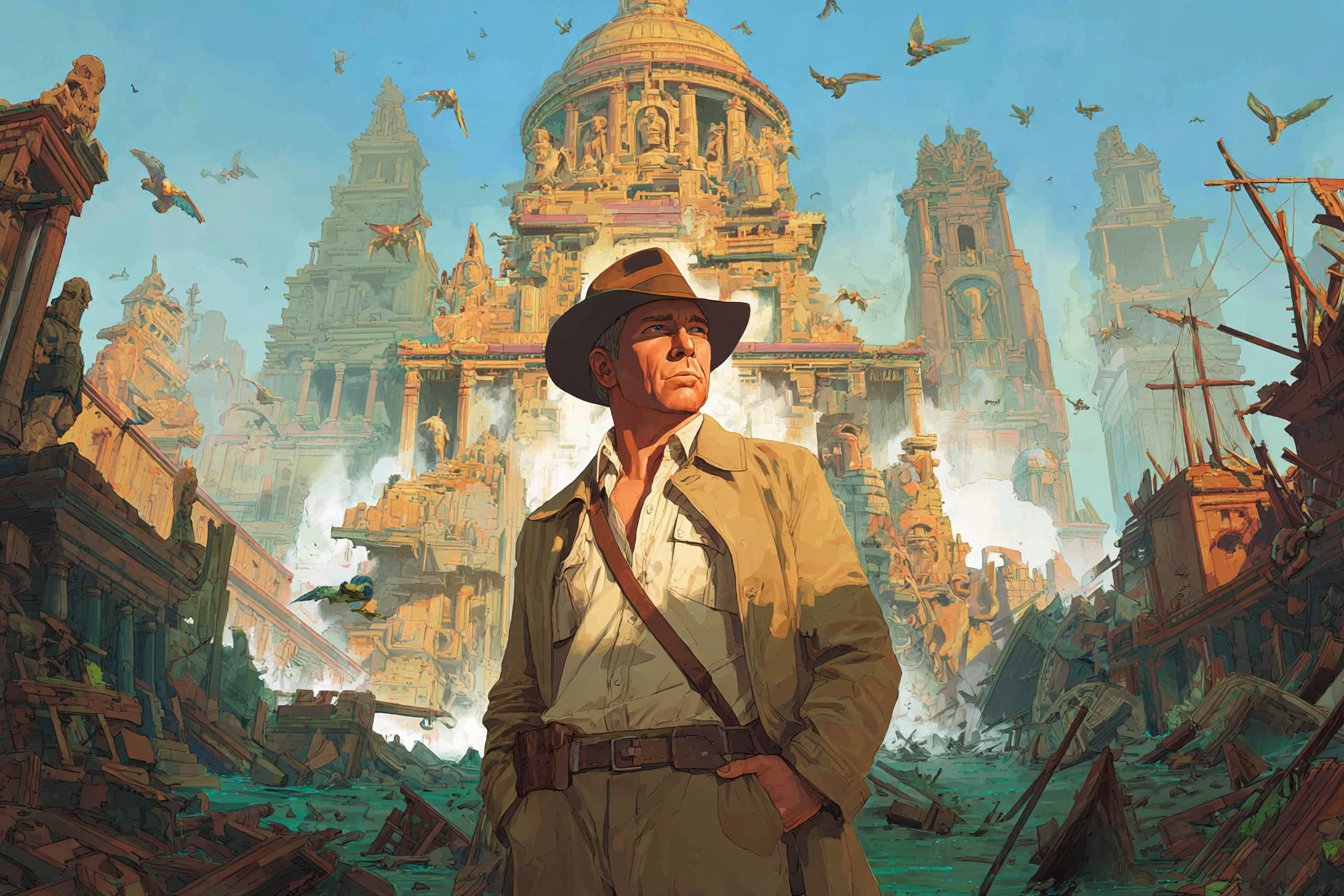
Tim wrote this review so we get the view of someone who found out about this classic way after everybody else decided that it did indeed count as the 4th Indiana Jones movie. So here’s why the 1992 point and click adventure game is the definitive Indiana Jones experience outside of the original trilogy.
When LucasArts combined their SCUMM adventure game engine with the Indiana Jones licence they produced something truly remarkable. Fate of Atlantis was not your typical cash grab tie in product. The game successfully recreated the global archaeological adventure that Indiana Jones fans are accustomed to whilst also delving into myths that the movies rarely explored. The game released in 1992 at the height of the point and click adventure game era. LucasArts perfected the formula that would make games like Monkey Island and Day of the Tentacle become legends.
What made Fate of Atlantis stand out wasn’t merely its visuals or clever puzzles although both were exemplary. What the game got right was that it understood Indiana Jones better than many of those working on official sequels. It brought the essence of archaeological discovery the tension of academic curiosity versus Nazi threats and that great balance of pulp adventure and historical mystery that made all of the best Indiana Jones stories so compelling.
| Developer | LucasArts |
| Platforms | PC (DOS), Amiga, FM Towns |
| Release Year | 1992 |
| Game Genre | Point and click adventure |
| Number of Players | Single player |
| Our Rating | 9/10 |
It achieved this position amongst our Top 10 Adventure Games of the 90’s because it epitomised all that made the adventure game genre so brilliant during its commercial heyday. But more importantly Fate of Atlantis is the Indiana Jones story that Crystal Skull should have been.
The Best Adventure Game That Captured the Spirit of Adventure
Where Fate of Atlantis excelled compared to later Indiana Jones media is that it understands a key element of the Indiana Jones character: he is an archaeologist first and an action hero second. The opening sequence of the game sets this up perfectly. Rather than being thrust into a massive chase scene or some elaborate action sequence you break into a college to steal an artefact; using your knowledge and wits not your whip or fists.
By 1992 LucasArts had polished their SCUMM point and click interface to perfection. The interface became intuitive without sacrificing complexity. You could study objects extensively experiment with various approaches to solving problems and interact with the environment in a manner consistent with Indy’s role as an archaeologist.
Verb based commands (e.g. Look Use Talk etc.) encouraged experimentation with the game environment yet maintained a coherent narrative.
However it was how puzzles related to character development that was the true brilliance of the game. Solving challenges required you to think like an archaeologist/historian. You would examine artefacts to uncover historical clues piece together mythological references and utilise your knowledge of academia to progress. This wasn’t simply combining random items to solve a puzzle; these were puzzles that required the type of intellectual curiosity that drives the process of real archaeological work.
The three path structure halfway through the game exemplifies this design excellence. Players were able to select either Team Wits or Fists paths to access the same story elements yet with varying approaches. The Wits path focused primarily on solving puzzles through pure deductive reasoning based on your knowledge of archaeology. The Fists path introduced more action sequences and physical challenges. The Team path provided a balance of both of the above and also included dynamic interactions with the companion character Sophia Hapgood. Each path played differently yet was still consistent with the overall story line of the game allowing players to experience different aspects of the Indiana Jones adventure.
This was not simply an example of clever game design it was an example of character design. Players could express different sides of the Indiana Jones character through their chosen path of play thus making the experience feel personalised and true to the original source material.
How Did This Differ From Other Licence Based Games?
Whilst most licence based games of the late 1980s and early 1990s were mere cash grabs with recognisable characters placed on top of generic gameplay Fate of Atlantis approached the licence as a chance to create a story that could only be told under the umbrella of the Indiana Jones franchise. The plot of the game was not simply “Indy battles bad guys with MacGuffin item”. It was a story about archaeological discovery Nazi occult research and the types of historical mysteries that made the movies entertaining.
Mythological research done for the game was of an academic level worthy of research papers. Atlantis was not treated as generic lost civilisation nonsense. The writers studied Plato’s actual dialogues incorporated real archaeological theories about Bronze Age civilisations and created an Atlantis that felt rooted in historical possibility yet still fantastical enough to be fitting for a pulp adventure. When Indy talks about the Minoan civilisation or mentions specific archaeological sites the information is factual.
The character development of the female companion Sophia Hapgood was far superior to the standard female companion character seen in many licence based games. Sophia has her own area of expertise motivation and character development that complements Indy’s journey without seeming secondary to him. Their relationship develops through their shared interest in Atlantean culture and the intellectual curiosity they develop through their experiences together not through romantic tension or damsel in distress type dynamics.
The Nazi villains were credible due to their representation of real world historical evil not cartoonish villains. The Nazi villainous characters Klaus Kerner and his archaeological team represent not only physical dangers to Indy but also pose intellectual competition. They are not simply obstacles to be overcome they are academic rivals whose research methods raise real questions regarding the ethics of archaeological responsibility. This adds a layer of thematic importance to the adventure that elevates the experience from simple obstacle course adventure to something with greater consequence.
Doug Lee’s Indiana Jones voice acting is especially notable capturing Harrison Ford’s delivery without mimicking him. Lee’s performance captures the spirit of Indiana Jones whilst retaining the distinction necessary to establish itself as a unique interpretation. The supporting voice acting for the rest of the cast maintains a similar quality contributing to dialogue that enhances the puzzle solving experience.
Technological Advancements & Creative Vision
Given the technological capabilities of LucasArts in 1992 Fate of Atlantis accomplished a high degree of visual storytelling that matches the ambition of its narrative. The VGA 256 colour graphics of the game create visually stunning environments that are believable and exotic without relying on orientalist clichés. Every environment has a visually distinct style that maintains an aesthetic unity as part of a single Indiana Jones experience.
The animation in Fate of Atlantis was particularly impressive in terms of character interaction and puzzle feedback. The animations of Indy capture the personality of the character through body language whether he is studying an artefact or reacting to a danger. The game uses visual storytelling well conveying character relationships and plot developments through gestures and facial expressions instead of solely through exposition.
The music composition and sound effects in Fate of Atlantis are equally impressive. The music scores evoke the spirit of John Williams’ Indiana Jones film scores without directly mimicking them producing original compositions that are adventurous in tone whilst still maintaining their individuality. The sound effects add to the puzzle solving experience by providing auditory cues to help the player determine if they are on the correct path to solve a puzzle or if they are progressing towards a solution.
The pacing of the game balances exploration and story development well. Unlike many adventure games that dump large amounts of exposition early in the game or rush through plot developments Fate of Atlantis allows the player to absorb the atmosphere of each environment and continue the narrative at a steady pace. Whilst the player can spend time examining the backgrounds and interacting with optional dialogue without losing sight of the important elements of the story.
In fact the technological limitations of 1992 era hardware ultimately contributed to the experience rather than detract from it. The pixel art forced the artists to concentrate on the essential visual elements resulting in some of the most memorable and iconic images of any adventure game ever created. The compression of voice samples resulted in clear and understandable dialogue that contributed to the characterisation of the game.
These technological limitations led to creative solutions that were sometimes more effective than the seemingly limitless resources that modern games enjoy.
The Story That Should Have Been Crystal Skull
Fate of Atlantis is successful as an Indiana Jones experience because it understands what made the original trilogy great whilst exploring new areas of the franchise. The Atlantis storyline provided scope for epic adventure without reusing the terrain of the previous films. The ancient advanced civilisation provided opportunities for fantastic technologies and esoteric knowledge that did not rely on supernatural elements that may contradict the grounded approach to fantasy that defines the series.
The depiction of 1939 as the game’s setting was believable without being weighed down by unnecessary historical detail. The Nazi antagonists were a credible threat because of their historical basis for malevolence. The competition between Indy and the Nazis for the location of Atlantis created real stakes where the pursuit of scientific knowledge (archaeology) intersects with the consequences of politics. This was not simply a MacGuffin hunt; it was an examination of how knowledge acquired through archaeology can be exploited by totalitarian governments.
Romantic relationships developed naturally between the characters as a result of their shared adventures rather than as a result of forced romantic subplots. The partnership between Indy and Sophia developed from their shared curiosity and respect for each other’s areas of expertise. The relationship was formed as a result of their prior relationship as colleagues and therefore did not require much backstory.
Modern Accessibility & Legacy
Modern users can easily set up to play Fate of Atlantis today thanks to digital distribution and community support. The game is available on both Steam and GOG and both versions include the enhanced CD ROM edition with full voice acting. The ScummVM project has ensured that the game will run on modern operating systems and includes additional functionality such as save state management and graphical filter options.
Supporting documentation for the game is widely available via PC Gaming Wiki for players who wish to customise their experience or troubleshoot compatibility issues. The game runs smoothly on modern hardware whilst retaining its original appearance.
Decades after its initial release community resources for Fate of Atlantis remain active. GameFAQs contains numerous comprehensive guides and forums for players looking for puzzle solutions or wishing to explore alternate solution paths. The three path structure of the game encourages players to replay the game using different paths and HowLongToBeat offers accurate completion time estimates for players planning to complete the game.
Influence on Later Games
Fate of Atlantis set the bar for later licensed games in terms of licensed storytelling. The method of integrating character development with puzzle design used in Fate of Atlantis has influenced later LucasArts adventure games and has continued to inspire modern developers who look back on Fate of Atlantis as a model for adapting existing franchises into interactive media.
Retrospective critical acclaim continues to recognise the game as an example of excellence in both storytelling and design as evidenced by ratings on Metacritic.
Resources such as MobyGames and SteamDB preserve technical information about the game for future accessibility for gaming historians and newcomers alike.
Why This Is Still the Best Indy Experience
Fate of Atlantis demonstrates that interactive media can elevate beloved characters and worlds rather than degrading them. Fate of Atlantis succeeded as an Indiana Jones experience because it understood that a good licensed game must provide a compelling story that validates the existence of the game as opposed to relying solely on the name of the property. Fate of Atlantis created an authentic Indiana Jones experience that felt essential rather than supplemental to the mythology of the character.
As Joe continues to argue that the point and click adventure genre had passed its commercial peak by 1992 he misses the reasons why Fate of Atlantis continues to endure. Fate of Atlantis was not simply a technologically superior game for its time it was a narratively ambitious experience that retains impressive qualities today. The three path structure the attention to archaeological authenticity and the ability of puzzles to advance the character development were all innovations that demonstrated how interactive storytelling can explore character and theme in ways that linear media cannot.