There is no doubt that the best way to enjoy Street Fighter II is at an arcade. I will admit that I was immediately hooked upon entering the Pizza Ranch in July 1991, and observing a high school kid doing things in a video game that I didn’t know existed. The kid was playing Guile, the military dude with the super long hairdo, and he was launching those curved energy blasts while yelling “Sonic Boom!” in a digitized voice unlike anyone I’d ever heard in an arcade.
Prior to spending all of my allowance money (less than 15 minutes), I was glued to the chair. What I was witnessing was not simply another beat-em-up where you walked to the right and punched everything in sight. This was something entirely new, and at the age of 13, I recognised it as being new.
I had played the original Street Fighter at the Southdale Mall approximately two years earlier. I personally found the original to be a horrible game. Only one playable character, very rigid controls, and special moves that were extremely difficult to execute (special moves were basically mythical creatures) and therefore, rarely occurred. The sequel was a whole different ballgame. Not only were there eight playable characters, but each of them had unique personalities and fighting styles, and the controls reacted to input; it was as if comparing a bicycle to a Ferrari.
As my mother picked me up at 4 pm, I spent the entire ride home telling her why she needed to take me back to the arcade the following day with more quarters. “It’s educational,” I said to her. “I’m learning… uh… hand-eye coordination.” She was clearly skeptical of my claims; however, she ultimately conceded to allow me to ride my bike back to the arcade the following day.
The next day, I returned to the arcade for the remainder of the summer. I had been saving my birthday money for months to buy new games for my SNES, however, I ended up putting all of that money into this machine like it was a parking metre. My friend Jake referred to the arcade as my “expensive girlfriend,” since I was spending so much time and money at it than any rational thirteen-year-old should be spending.
The SNES port finally arrived that fall, and I was as aggressive as possible in lobbying for the cartridge. I drew up charts detailing how much money I would save by not going to the arcade (of course, I completely ignored the reality that I would have gone regardless). I pledged to perform extra chores. I even offered to give up my Halloween candy, which in retrospect was a ridiculous bargaining chip, since I would never have followed through with that commitment.
Eventually, my dad relented and agreed to allow me to get the cartridge after I agreed to clean the garage without complaint for the remainder of the year. Cleaning the garage was worth every second of sifting through Dad’s broken lawn equipment and paint cans.
Playing Street Fighter II at home was similar to having your own personal arcade. While the SNES version was far from perfect – several of the colours were duller than the arcade version, and a couple of the voice samples sounded like the characters were talking through a mouthful of marshmallows – the ability to play whenever you wanted, without constantly feeding the machine quarters was pure magic.
Jake and I would spend literally hours playing the game. Hours. I would frequently come stumbling into the living room around midnight to find Jake and myself still huddled around the TV, our eyes bloodshot from staring at the screen. “You boys are going to go blind,” Mom would say, then would turn off the console, knowing that neither of us had the self-control to quit.
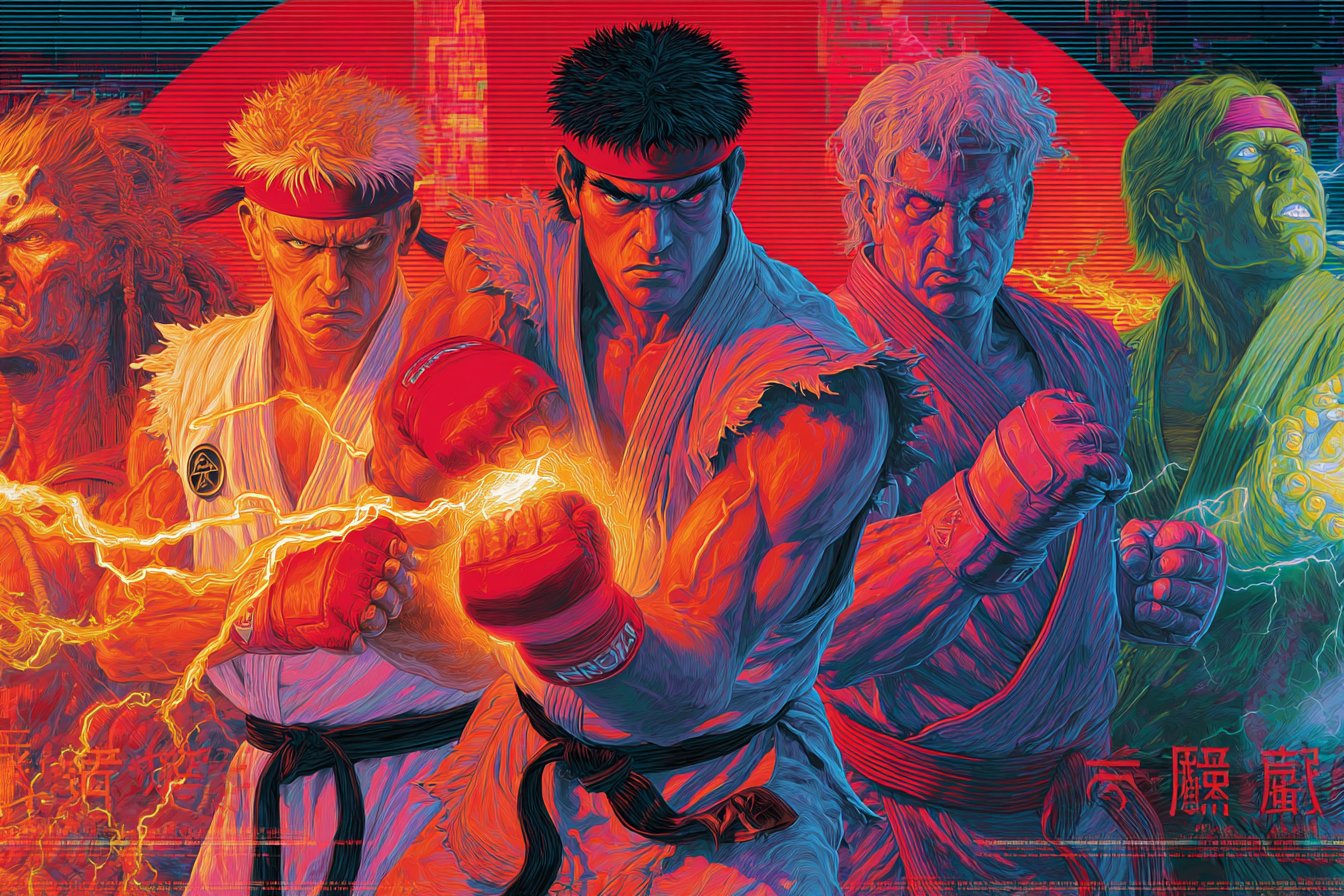
Each player developed their own character, and the character you selected reflected something about who you were as a person. I was a Ryu fan from the beginning to end – basic, perhaps, but I liked the simplicity. Clean input, reliable moves, and little flair. Jake preferred Zangief simply because he loved the spinning piledriver; however, he never learned to execute it effectively.
Tom, my older brother, selected Guile because the flat top resembled his G.I. Joe action figure, and Guile’s moves were simpler to execute than the majority of the other characters.
Practicing the special moves became an obsession. I practiced the Ryu Dragon Punch motion – forward, down, down-forward + punch – until my thumb hurt from pushing the D-pad. The timing had to be precise, and the motion had to be smooth and deliberate. When I executed my first clean Shoryuken on the computer, I jumped up and yelled so loudly that the family dog started barking, and my mom ran downstairs to see if I was okay.
Street Fighter II’s competitive environment was unlike anything I had previously experienced. The Pizza Ranch began hosting weekly tournaments with a $5 entry fee, which was equivalent to $50 to me at the time. I saved my money for two weeks to enter, lost in exactly one round, and was thoroughly beaten by a college student using Dhalsim who appeared to know combinations I had never seen or heard of before.
However, I wasn’t upset about losing. I was fascinated. I watched this guy play for an additional hour, attempting to learn how he connected moves, how he spaced his attacks, and why he used certain moves at certain times. It was as if I was watching a chess grandmaster, except instead of pieces on a board, he was using fireballs and flying kicks.
Information traveled differently back then. Someone would arrive from another city with new techniques, and suddenly, everybody at your local arcade would attempt to master them. I recall this one person arriving from Minneapolis saying he had figured out a way to play as the boss characters, which sounded like utter nonsense until he actually did it. Turns out, Champion Edition had already been released in other areas, and we were still playing the original version like Neanderthals.
My friend’s older brother worked at Electronics Boutique, and somehow managed to obtain the Japanese version of Street Fighter II Turbo months before it hit stores in the United States. We treated that cartridge like it was solid gold. Every day after school, Jake and I would ride our bikes to his house and sit around the TV, amazed by the increased speed of the gameplay and new moves, as well as the new secret character that you could unlock with a weird button combination at the character select screen.
The competitive nature of Street Fighter II was what separated it from all other games. Most arcade games involved beating the computer and achieving a high score. Street Fighter II was about beating other people, and it changed the genre. It wasn’t enough to be good enough to defeat the computer – you needed to grasp the spatial relationships, timing, and psychological aspects of the game. You had to be aware of what your opponent was thinking, and one step ahead of them.
Jake’s mom believed we were members of some sort of cult, due to the amount of strange incantations we would chant while practicing. “Hadouken! Sonic Boom! Tiger Uppercut!” We would repeat those phrases while practicing the joystick motions, trying to build the necessary muscle memory to perform the moves. To outsiders, it probably looked quite bizarre – a group of young kids huddled around a television, shouting martial arts phrases, and performing distinct hand motions.
The sound effects became part of our daily lexicon. We would shout “Hadouken!” when tossing a basketball, “Sonic Boom!” when tossing a frisbee, and “Tiger Uppercut!” for almost any type of jump. I got some odd looks from my basketball coach when I began adding Street Fighter II sound effects into my free throw practice; however, my shooting percentages actually improved, so he didn’t gripe too much.
One of the most impressive features of Street Fighter II was how deep the game was. The combo system was not a design feature initially – it was a bug that Capcom decided to keep since it generated interest from the players. At the time, we had no idea that this was the case. All we knew was that occasionally, if you timed your attacks properly, your opponent wouldn’t be able to block between hits. It was as if we were discovering hidden treasure every time we found a new combo.
I still remember the first time someone explained to me that you could chain Ryu’s crouching medium kick into a Hadouken. I was completely blown away. I spent the next three hours learning how to execute that relatively simple two-hit combo perfectly.
It may seem crazy today, but landing that combo was a huge milestone for me.
Capcom continued to issue updated versions of the game for years. Champion Edition allowed you to play as the boss characters, which felt like unlocking the secrets of the universe. Turbo increased the speed of the gameplay and added new moves. Super Street Fighter II added four new playable characters and refined the overall system. With each update, it felt like Christmas morning – new tricks to learn, and a chance to master.
In my view, Street Fighter II established the standard for all future fighting games. The six-button layout, the special move inputs, the principle of balance among characters, and the emphasis on timing frames – all of these innovations originated in Street Fighter II. Each subsequent fighting game was evaluated based on whether it met the standard that Street Fighter II established. Mortal Kombat had its fatalities and realistic-looking characters, but the controls were better. Killer Instinct had its combos and killer soundtrack, but its characters were not as evenly matched. Virtua Fighter had its 3D graphics and realistic martial arts, but it lacked Street Fighter’s personality.
Even today, I still have my original SNES cartridge in my game room, complete with a faded price sticker from Electronics Boutique that I left intact. Sometimes, friends who also grew up during the 90s will come over and we’ll fire up the old SNES and play a few rounds. After thirty-plus years, my muscle memory is still active. Quarter-circle forward for Hadouken, quarter-circle back for Tatsumaki, forward-down-down-forward for Shoryuken – it is like riding a bike.
A little over a week ago, I took my nephew to a retro arcade bar designed for adults looking to recapture their youth. They had an original Street Fighter II: Champion Edition cabinet tucked away in the corner of the bar, complete with the traditional six-button layout and the distinctive Sanwa joystick click. I gave him a token, picked Ryu, and showed him the basics.
He picked up the fundamentals faster than I did at his age. Had the Dragon Punch motion down in less than ten minutes, had clean Hadoukens in twenty. “Wow, this is really fun for an old game,” he said, and I will take that as a compliment from a generation that grew up with modern fighting games featuring 50+ playable characters and live display of frame data.
Thirty years later, and Street Fighter II still draws crowds. Still generates that same feeling of awe and competition that I felt as a thirteen-year-old kid with a pocket full of quarters and a warm summer afternoon awaiting me. That is a sign of something truly exceptional – when it can produce a shared bond across generations and remain enjoyable and relevant for decades after it was released.