Elena here, and if you’re anything like me, you have no idea about half the European strategy games that came out before StarCraft. But let’s be honest; when Blizzard released this RTS on 31 March 1998 via Metacritic, it did more than just enter the fray against Command & Conquer and Age of Empires. It became a sport.
After spending years cataloguing obscure strategy titles from publishers you’ve likely never heard of, released only in Germany or France, StarCraft stands apart in gaming history. Not simply because it was the first RTS – that title goes to games such as Herzog Zwei or Dune II. Nor simply because it introduced the most innovative mechanics – many other European developers were experimenting with asymmetric factions and resource management systems. What made StarCraft iconic was that it managed to strike an exact balance of strategic depth whilst being easily accessible to new players.
By the end of 1998 StarCraft would sell 1.5 million copies via Wired, and ultimately reach a total of 11 million via Wired. However, raw sale totals do not begin to describe the actual phenomenon. In South Korea, StarCraft went beyond gaming and became a national form of entertainment, complete with professional leagues, televised competitions, and celebrity status players. TIME placed it in their All Time 100 Video Games list, and quite frankly, this honour was long overdue.
What is perhaps most intriguing is that a Western-created strategy game had the greatest cultural impact in another region entirely. This fact secured its spot in our list of the best PC strategy games and has impacted culture far beyond the normal boundaries of gaming.
| Developer | Blizzard Entertainment |
| Platform | Windows, Mac |
| Year Published | 1998 |
| Genre | Real-Time Strategy |
| Campaign Length | About 26 hours |
| Our Rating | 9/10 |
Three Factions With Distinctive Strategies
In most strategy games, designers will tell you that their game has asymmetrical balance, but in reality, there is very little difference in how they play. Throughout the 1990s European developers tried to innovate with different approaches – games like Siedler II had completely different economic systems and Seven Kingdoms had unique cultural mechanics. But StarCraft achieved something that no other game has ever done – three factions with distinct strategic approaches that also happen to be perfectly balanced.
The Terran faction is your standard military science fiction – marines, tanks, drop ships. Their buildings can be built and then moved, their units are individually weak but cost effective in large groups, and their strategy is centred around defensive placement and precision attacks. From years of playing strategy games where human factions were the standard, the Terran’s design may seem deceptively familiar until you realise how much of a difference their mobility and versatility give them in terms of strategic options.
The Protoss units are individually powerful but expensive, and rely on energy shields and advanced technology. Their buildings require a pylon power grid to produce energy, which creates spatial puzzle elements when constructing a base. Perhaps more importantly, the Protoss’ production is based upon warping in units rather than producing them directly, which means timing is absolutely critical. You cannot simply queue up replacements for lost units, you must manage production cycles and resource production.
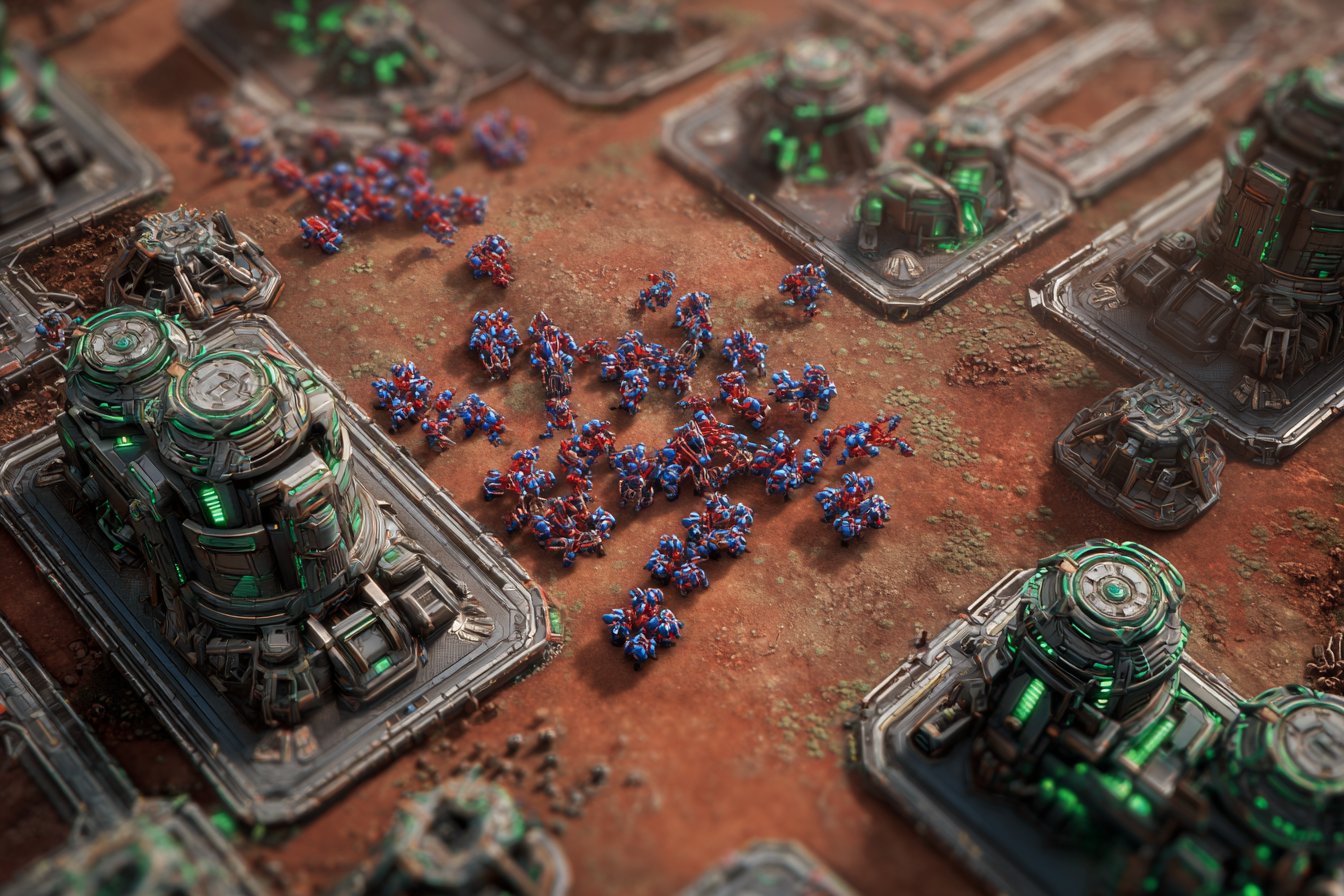
The Zerg faction operates on entirely different principles. They consume resources to evolve into biological units, their buildings are living organisms that require “creep” to survive, and their entire strategy is centred around overwhelming numbers and rapid expansion. Zerg players do not build bases, they occupy territory. They do not construct armies, they raise swarms.
One of the things that is interesting about the difference in these factions is that the difference in how they are played cascades through every level of gameplay. Terran players focus on defensive positioning and gaining technological advantages. Protoss players must manage powerful and expensive units whilst keeping a complex economic infrastructure intact. Zerg players focus on rapidly expanding and dominating resources through sheer force of numbers. Each faction requires vastly different strategic thought processes.
It is worth noting that these are not just cosmetic differences with the same underlying mechanics. There are fundamentally different resource management, base building, unit production, and tactical execution methods between factions. Once you have completed the main story campaign with all three factions (which will take approximately 26 hours via HowLongToBeat), you will understand just how much they differ in terms of strategy.
Strategic Depth That Can Be Played at Many Levels of Skill
I have recorded a great deal of strategy games from Europe that offer an enormous amount of complexity – titles like Europa Universalis or Hearts of Iron offer simulation-level complexity for serious players. However, in most cases, the complexity of strategy games is too high for new players to follow. StarCraft accomplishes something rare – it offers a wide range of strategic depth and complexity that is scalable from beginner-friendly gameplay to professional-level competition.
The basics are easy to understand – collect minerals and gas, build buildings, train units, destroy the enemy base. New players can win using basic strategies – build a lot of units, go attack the enemy base, repeat until you win. The interface is clean and user friendly, the animation of the units clearly shows what each one does and can do, and the campaign introduces new concepts at a gradual pace.
However, under this accessibility, StarCraft has an incredible amount of strategic depth. Resource collection is more than simply collecting minerals and gas – it involves timing expansions, allocating workers, and managing supply. Building bases is a spatial puzzle that includes defensive placement, efficient production, and expansion planning. Combat mechanics involve positioning, focusing fire, micro-management, and tactical retreats.
Build order complexity is the key factor that separates casual from serious play. Professional players commit to memory specific sequences of resource allocation, building construction, and unit production to maximise their production rate down to the second. They know exactly how many workers to have, when to expand, and exactly how to allocate resources in order to get the maximum efficiency that casual players never consider.
Players who are more advanced use various tactics including harassment strategies, economic warfare, deception, and multi-pronged pressure. Professional matches contain incredible amounts of micro-management – players manually control every unit in battle to maximise combat effectiveness through exact positioning and timing. Players exploit range advantages, terrain features, and formations in order to gain an advantage in combat.
What allows this scalability is that casual strategies remain viable and advanced strategies provide a clear advantage. Serious players can always find additional layers of optimisation and strategic refinement, regardless of whether they have been playing for weeks or months.
The Korean Phenomenon and the Birth of Esports
Nowhere is StarCraft’s story more unique than in South Korea. This Western-designed strategy game became a national phenomenon in South Korea and evolved into a type of entertainment that was no longer considered a hobby, but rather a competitive sport. Korean Premier Tournaments were broadcast nationally and attracted huge television audiences. Celebrity players emerged. Infrastructure that defined competitive gaming for decades was established.
The timing of this was ideal. South Korea invested a tremendous amount of money in developing its internet infrastructure during the late 1990s. As a result, nearly everyone in South Korea had access to high-speed internet at home. Internet cafés (PC Bangs) provided a cheap and accessible platform for people to play games. The design of the multiplayer component of StarCraft was uniquely suited for competitive formats.
StarCraft created a professional StarCraft league in South Korea that mirrored traditional sports. Teams had major corporate sponsors. Players were paid substantial salaries. Television covered professional StarCraft matches. Fans followed their favourite players with the same fervour that they would follow a football player. Even the South Korean Air Force formed a StarCraft team made up of top players who were finishing their military service. StarCraft was not just a video game – it was a national entertainment.
The strategic depth that impressed Western gamers became spectacular artistic performances in the hands of Korean professionals. Competitive matches contained incredible examples of micro-management, innovative strategic thinking, and tactical execution that elevated the gameplay to an event. Commentators analysed the build orders, resource management, and strategic decision-making of the players with the same intensity as a football analyst.
This cultural impact did not stop at South Korea. International audiences watched StarCraft competitions outside of South Korea. Professional gaming leagues modelled themselves after the structure of the Korean StarCraft leagues. And the structure of competitive gaming was designed after StarCraft formats.
Esports today owes a debt to the Korean StarCraft leagues. Twenty-five years later, StarCraft is the model for competitive strategy games. StarCraft’s influence can be seen in modern MOBAs, RTS games, and competitive gaming infrastructure. For anyone interested in strategic gaming or competitive design, StarCraft is not only historically important – it is the ultimate example of how to create strategic gameplay that is deep, balanced, and engaging.
The original version runs on contemporary systems via PCGamingWiki, with a remastered version released on 14 August 2017 via Blizzard News, which retains the original gameplay whilst offering updated graphics. This remastered version continues to attract new players, whilst preserving the core of the original game. That’s true preservation – maintaining the original experience whilst making it accessible to modern gamers. The speedrunning community continues discovering optimisations via Speedrun.com, proving the game’s enduring appeal.