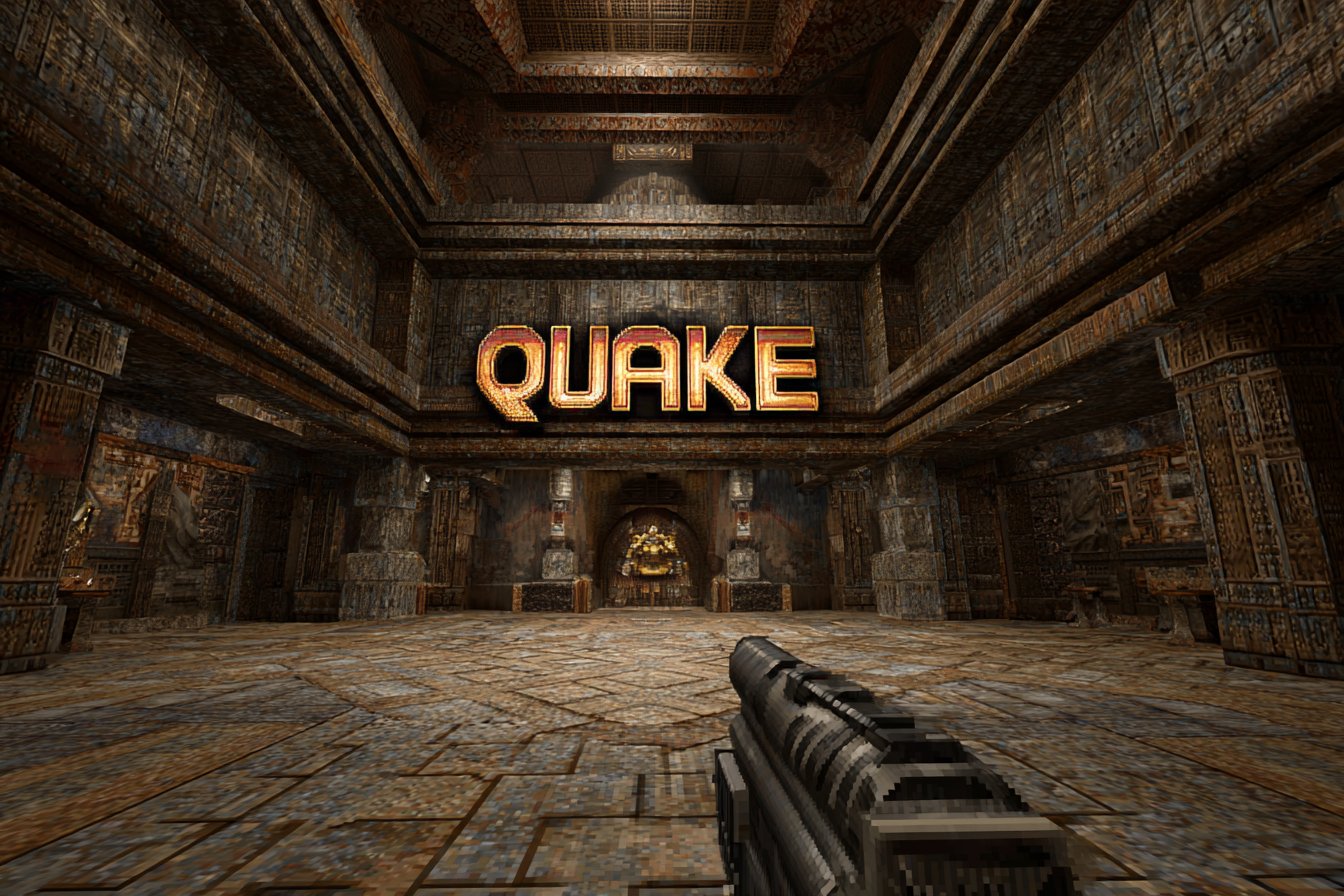
Hey Timothy here, I am going to tell you the truth right up front. As of 2026, I did not get to see the impact Quake had when it came out in 1996. I missed the jaw-dropping moment when gamers got to see real 3D environments versus the clever 2.5D tricks Doom did. I was not there for the hardware war it spawned or the explosion of modding that happened around it. But playing it now, almost thirty years later, I can clearly see why Quake cut the gaming world in half between “pre-quake” and “post quake”.
id Software released Quake in June 1996 (DOS Days) and GT Interactive (MobyGames) published it. Quake was not just another shooter. It was id Software’s follow-up to Doom and id Software completely tossed out the 2.5D formula that Doom had perfected and started again from scratch using true 3D polygonal environments. The tech advance was huge, but it also changed how shooters felt to play once and for all.
| Developer | id Software |
| Publisher | GT Interactive |
| Platform | DOS, Windows |
| Year Published | 1996 |
| Genre | First Person Shooter |
| Campaign Length | 5 hours main story, 20-25 hours completion |
| Our Rating | 9/10 |
When I look at this game now, I do not think it is the technical achievement that is the most impressive to me, I think it is the confidence with which id Software totally abandoned every aspect of what worked with Doom. Doom had the iconic demons, that hellish theme, those unforgettable sounds from the weapons. Quake took a completely different path and developed this strange Lovecraftian medieval fantasy world that, to be honest, feels a little bit disjointed in terms of theme. But, none of that matters when you are actually playing the game, because the movement and shooting feel absolutely perfect.
A Revolution in 3D That Would Change Everything
The first thing you will notice about Quake is the movement, not the graphics. In Doom, you move on flat planes with some vertical elements, but everything is basically 2D movement with height tricks. Quake lets you look up and down, jump across gaps, and navigate really 3D spaces. Comparing Quake to Doom after playing Doom first shows how drastically different the two games are.
Level design uses the new 3D capabilities to the fullest extent. Levels go up and down, have multi-storey buildings that actually exist in 3D space, have platforming sections that would have been impossible in Doom’s engine. Bunny hopping, the speed running technique that speed runners use today (Speedrun.com), was born from the physics of the system allowing for diagonal movement and jumping. The physics system was not broken and it is still a great example of the power of physics in modern video game design.
The frame rates on period hardware were usually very choppy, but the base movement system of Quake was so solid that it still feels very responsive today. With modern source ports, the issues of performance have been fixed, and the player gets to enjoy the same Quake experience as the one that existed back then.
The weapons are worth mentioning, because they feel totally different from Doom’s arsenal. The shotgun has a deep, meaty thud when you fire it. The super shotgun reloads with a nice mechanical click-clack sound that is almost pure audio joy. The rocket launcher fires slower but more powerful rockets. The lightning gun fires electric rays that crackle and pop. Each weapon has its own unique characteristics and feels physically substantial in a way that a lot of modern shooters have trouble replicating.
What Made Quake So Different From Everything That Came Before
One of the things that I noticed immediately about Quake when I played it fresh, was the pacing of the game. Doom was primarily about clearing room after room of demons as fast as you possibly could. Quake is more about exploring and fighting monsters. The levels in Quake are maze-like, with many hidden areas and secret rooms, and multiple paths through most of the levels.
Enemy design also reflects the difference in pace between the two games. Whilst Doom had swarms of predictable demon enemies, Quake has fewer, more deadly enemies that behave differently. The Fiends jump across levels. The Shamblers absorb a ton of damage and shoot lightning bolts. The Death Knights attack with swords in close combat. Each type of monster forces you to fight them in a different way and the encounters often combine several types of monsters forcing you to solve tactical problems to survive rather than simply run and shoot.
Finally, the atmosphere of Quake is significantly different than Doom’s. Doom was inspired by metal albums and was a hellish, demon-filled world. Quake is more akin to a fever dream combining medieval castles, alien technology, and cosmic horror elements. The music of Quake was composed by Trent Reznor and features ambient industrial sounds rather than driving rock music. It is creepy in a way that complements the odd-looking brown and grey aesthetic.
I did not care for the theme of Quake at first. Coming from modern games with clear art direction and coherent themes, Quake’s blend of medieval fantasy, sci-fi tech, and Lovecraftian weirdness feels disorganised. However, after spending time playing it, I began to appreciate the way the disorganisation creates a sense of being lost in a strange alien realm where nothing really makes sense. The uncertainty of Quake’s theme becomes a part of the experience.
Technical Innovations That Still Impress Today
Some technical aspects of Quake are still very impressive even today. For example, the lighting system produces dramatic shadows and moods that many modern games strive to produce. The flickering of torches, the muzzle flash produced by each weapon, and the differing lighting styles of various areas all help create a strong atmosphere that is not possible with polygon counts alone.
Another area that is worth noting is the texture work. Yes, the textures are all mud brown colours by today’s standards, but they have a tactile quality that sells the world’s physical properties. Rock walls look like rock, metal surfaces look like metal, and organic growths look disturbingly realistic. The colour palette may be muted, but the visual consistency across the various environments is high.
The water effects of Quake were revolutionary in their day and are still acceptable today. Water ripples, reflects light, and creates distortion in your view as you swim. Swimming sections feel confined and hazardous rather than just being puzzle movement.
The Sound Design Was Possibly the Best Part of the Game
The sound design of Quake is probably the best part of the game. Every surface in the game has a unique footstep sound. Each weapon has its own unique audio signature that allows you to identify the threat by sound alone. The ambient noise creates a constant sense of unease without being overwhelming. When you listen to the ambient noise with good headphones, you will hear layers of audio that enhance navigation and create a sense of place.
Why the Campaign Is Still Enjoyable Today
At approximately five hours to complete the main story (HowLongToBeat), Quake’s campaign feels short compared to modern games. However, it does not waste any time. Almost every level introduces you to a new concept, new enemy combinations, or new environmental obstacles. The difficulty curve of Quake is gentle enough that you learn the movement system quickly, but tough enough that you must master the movement system and switch weapons in order to beat the game.
The philosophy behind the level design of Quake is to encourage exploration and discovery rather than purely linear progress. Most of the levels in Quake have multiple paths, hidden areas with valuable items, and secret rooms that reward exploration. This encourages you to explore the levels thoroughly because you will find different routes for speed runners and explorers alike. Some of the secrets are hidden so well that you will feel like you solved a puzzle in order to find them.
Boss battles add variety to the gameplay. Each boss battle forces you to employ different tactics and test your mastery of the movement system and weapon switching. The last boss battle forces you to employ advanced movement techniques such as telefrags in a way that is a natural extension of the movement system and not some arbitrary gimmick. The boss battles feel epic without requiring artificially inflated difficulty spikes or other restrictions.
The save system of Quake is suitable for its age. The ability to save at any point prevents frustration whilst maintaining the pressure of difficult sections. Death feels meaningful because you lose progress, but you do not lose so much progress that it is discouraging. This balance keeps combat encounters tense and rewarding without punishing you for failure.
Modern Legacy and Availability
Quake is still very accessible today via multiple channels. The Steam version contains the original game and its expansions with modern compatibility fixes. Source ports like QuakeSpasm allow you to upgrade the graphics and performance of the original game whilst retaining its original gameplay. The original game runs perfectly on modern systems with a minimum amount of configuration (PCGamingWiki).
The speedrunning community continues to keep Quake alive with their continuous development of new movement techniques and route optimisation methods. Watching speedrunners bunny hop through levels in less than twenty minutes illustrates the depth of the movement system that most casual players will never experience. The continued existence of new techniques and routes almost thirty years later shows that the foundation systems of Quake remain stable.
Countless mods were developed for the Quake engine by modding communities that developed completely new games within the Quake engine. Team Fortress was originally a Quake mod. The number of single-player campaigns, total conversions, and gameplay modifications of Quake is endless and has allowed Quake to live past its initial lifespan. The tools and documentation provided today for developing Quake content is better than ever.
Many modern indie shooters reference the design philosophies of Quake. Games like DUSK, Amid Evil, and Ion Fury directly reference Quake’s movement systems, weapon design, and level design. The influence of Quake’s design philosophy has also influenced mainstream shooters to adopt Quake’s method of 3D navigation and physics-based movement.
Conclusion About a Foundational Stone
Quake has a Metascore of 94. Not just for the technical achievements of 1996, but for the stability of its core systems today. When I played it fresh, I was impressed by how modern it felt. The movement is tight and responsive, the weapons are enjoyable, and the level design rewards speed and exploration. Any technical limitations that were a big deal in 1996 are mostly gone due to source ports and modern hardware.
This is not a perfect game. The theme is confusing, some levels take longer to finish than they should, and some of the enemy types start to repeat themselves towards the end. However, these are minor complaints compared to what Quake accomplished. Quake set the standard for 3D shooters that today’s developers still follow. Every modern First Person Shooter owes some of its design to Quake’s innovations in movement, level design, and multiplayer foundations.
If you are a new gamer wondering if this old game is worth your time today, the answer is, yes, absolutely. Quake is not only important historically, it is also fun to play today. The campaign of Quake provides 20 to 25 hours of content for completionists (TrueSteamAchievements). Additionally, the modding community has created virtually limitless additional content for Quake. Furthermore, understanding Quake is important to understanding how modern shooters evolved and why certain design choices became standard in the industry.
This is essential gaming history that is also an excellent game in its own right. Sometimes historical titles feel outdated when you play them years after they were released. Quake still feels current, timely, and influential in ways that support its legend. It pulled PC gaming into true 3D and laid the groundwork for the designers of today’s shooters to build upon.