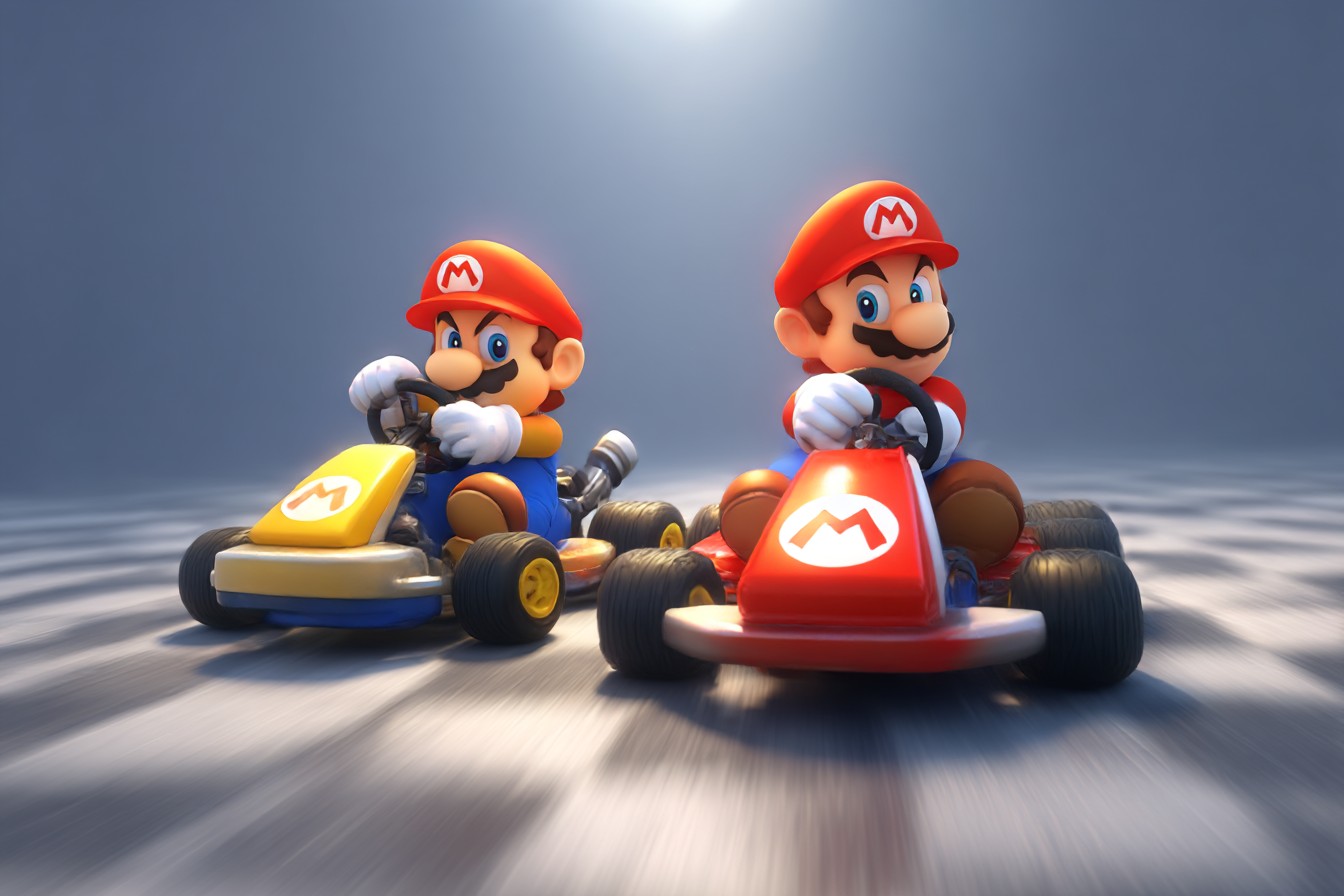
Right, I’ll tell you straight up why Mario Kart 64 is the best kart racer ever made, and it’s got nothing to do with nostalgia. I’ve been running these cabinets for years, watched thousands of people play it, and the thing still draws crowds like nothing else. David here, and while the lads argue constantly about which Mario Kart deserves the crown, I’m settling this once and for all.
Released in Japan on December 14, 1996 (Retro Media Library Fandom), followed by North America on February 10, 1997 (Wikipedia) and Europe on June 24, 1997 (IMDb Release Info), Mario Kart 64 didn’t just improve on Super Mario Kart. It completely reimagined what kart racing could be. The original SNES game was clever, sure, but playing it now feels like driving through treacle. Mario Kart 64 took that foundation and built something that, twenty-seven years later, still feels brilliant.
It’s no surprise it landed in our list of the best N64 games, and quite frankly, it’s a shining example of how Nintendo understood what made their hardware special. The four controller ports didn’t just provide a technological benefit, they were an invitation to chaos.
| Developer | Nintendo EAD |
| Publisher | Nintendo |
| Platform | Nintendo 64 |
| Year Published | 1996-1997 |
| Genre | Kart Racing |
| Players | 1-4 |
| Our Rating | 10/10 |
The Racing System That Truly Rewards Skill
There’s something most people miss about Mario Kart 64: it’s not simply about having items to use. The racing itself is fantastic. The handling model offers a perfect blend of arcade accessibility and actual skill expression. All eight characters, Mario, Luigi, Peach, Yoshi, Toad, Donkey Kong, Wario, and Bowser (Mario Wiki), offer meaningful differences in how they play rather than just cosmetic ones. Mario is the all-rounder, Toad and Peach accelerate quicker but have lower top speeds, while Bowser and Donkey Kong lumber about like freight trains but become almost unstoppable once they get going.
The powerslide system is where Mario Kart 64 truly shines in terms of depth. Hold the shoulder button through corners, rock the stick left and right to build up sparks, release for a speed boost. Sounds simple, right? But mastering it properly means understanding how each track’s corners flow, when to initiate slides, and how to chain boosts together. I’ve watched players take years to perfect their lines through Wario Stadium and Rainbow Road.
What makes Mario Kart 64 truly special is how the item system rewards skilled players rather than punishing them for being good. In later entries, being out in front basically means getting hammered with bad items. In Mario Kart 64, skilled players have genuine tools to defend themselves. Banana and green shell blocking are intentional features, not happy accidents. Holding items behind your kart, timing your releases, using the track geometry to block incoming attacks, it’s all part of the design. The blue shell exists, but it doesn’t end your race the way it did in later games.
What really matters is how the rubber band AI actually functions. Rather than simply catching up to whoever is ahead, the computer receives better items when it’s behind and worse ones when it’s leading. This creates incredible comeback situations without the game becoming completely unbalanced. When you’re leading, you need to drive defensively. When you’re behind, you’ve got the tools to fight back. Not perfectly balanced, but engaging in ways that pure simulation racing never achieves.
Track Design That Hasn’t Been Surpassed
The 16 tracks (Wikipedia) in Mario Kart 64 represent some of the finest circuit design in any racing game. Each one has multiple racing lines, hidden shortcuts, and environmental hazards that create different experiences every lap. Take Royal Raceway, with its massive shortcut that requires perfect timing and positioning. Or Wario Stadium, where the track surface changes affect your handling and create new strategic considerations.
Rainbow Road deserves special mention because it’s essentially three different tracks depending on your skill level. Beginners follow the main path and focus on not falling off. Intermediate players discover the shortcut jumps and start shaving seconds off their times. Advanced racers transform it into a completely different experience, using every barrier bounce and optimised line to achieve times that seem physically impossible.
Track themes aren’t merely decorative elements either, they affect gameplay in meaningful ways. The ice patches in Sherbet Land change your handling model. The narrow bridges in Jungle Parkway create different tactical considerations. DK’s Jungle Parkway forces you to think carefully about positioning because one mistake sends you into the river for a massive time penalty.
What Nintendo understood is that the best tracks aren’t just visually appealing, they create environments where interesting racing actually happens. Good circuits have multiple viable routes, risk versus reward decisions, and enough complexity to reward repeated play without overwhelming newcomers. Mario Kart 64’s tracks achieved that balance perfectly.
Battle Mode Excellence
The four battle arenas (Nintendo Life) represent some of the purest multiplayer gaming ever created. Block Fort, Skyscraper, Big Donut, and Royal Raceway each create completely different tactical scenarios. This isn’t just racing with weapons, it’s proper arena combat that demands spatial awareness, timing, and positioning.
Block Fort is the standout. Four coloured blocks connected by narrow bridges, with item blocks spawning in predictable locations. The vertical element adds layers of strategy: do you camp the upper levels for defensive positioning, or risk the lower areas for better item access? The sight lines between blocks create those brilliant cat-and-mouse scenarios where positioning matters as much as weapon accuracy.
The balloon system creates perfect tension. Three hits and you’re out, but skilled players can avoid damage for long stretches through clever movement and defensive play. Getting eliminated means watching the rest of the match unfold, which significantly raises the stakes and makes every single hit feel genuinely impactful.
What really sets these battles apart is how they scale. Two players creates intimate duels with lots of positioning games. Three players introduces proper alliance dynamics. Four players turns everything into beautiful chaos where literally anything can happen. The arenas are sized perfectly for each player count, never feeling empty or overcrowded.
Multiplayer Dynamics That Created Legends
I’ve witnessed every type of gaming group walk through the doors of the pub, and Mario Kart 64 accomplishes something unique. It produces these perfect moments of shared experience that people remember for years. The four-player support (Mario Wiki) wasn’t just a technical accomplishment, it was a social revolution.
Split-screen performance holds up remarkably well. Yes, the framerate takes a hit with four players, but it’s consistent enough that you adapt quickly. What matters more is that every player enjoys the same experience, with nobody disadvantaged by technical compromises. Each quadrant of the screen provides enough visual information to race competitively.
The magic happens in how the game creates narratives. Someone gets blue-shelled on the final straight. Another player finds a shortcut and suddenly threatens to win. A perfectly timed item use completely flips the script in the last corner. These aren’t just game mechanics, they’re story beats that generate genuine emotional reactions.
The roster of eight characters, Mario, Luigi, Peach, Yoshi, Toad, Donkey Kong, Wario, and Bowser (Mario Wiki), gives every player a distinct identity without overwhelming choice paralysis. Each character has a clear personality expressed through their handling characteristics and voice clips. When Bowser laughs after landing a shell hit, it feels personal. When Toad squeaks in frustration after getting hit, it’s genuinely funny.
Technical Achievement and Lasting Impact
Mario Kart 64 became the second best-selling N64 game behind Super Mario 64 (Mario Wiki), and that success wasn’t accidental. Nintendo EAD created something that pushed the hardware intelligently rather than just showing off. The track geometry is far more complex than the original, but the framerate never suffers as a result. The character animations are simple yet expressive. The sound design is crisp and functional.
The rubber band AI that everyone loves to hate is actually clever programming disguised as cheap difficulty. Rather than making opponents faster, the game adjusts item distribution and slight speed modifications based on race position. This creates the illusion of closer competition without breaking the simulation entirely. Not perfectly fair, but engaging in ways that strict realism would never achieve.
The control scheme deserves recognition for its elegance. The N64 controller may seem archaic today, but Mario Kart 64 uses it perfectly. The analogue stick provides precise steering control that the D-pad simply couldn’t match. The shoulder buttons handle powersliding naturally. The face buttons manage items and acceleration without feeling cluttered.
Most importantly, this defined the template that every subsequent kart racer follows. Items as equalisers, character-specific handling, track design that balances spectacle with gameplay, multiplayer modes that create social experiences. Every modern kart racer is essentially trying to recreate what Mario Kart 64 achieved naturally.
Why It Still Matters Today
Mario Kart 64 isn’t just historically significant, it’s still the best way to experience kart racing. The newer entries add visual polish and online play, but they’ve never captured the same balance of skill and chaos. Double Dash was clever but gimmicky. Wii added motion controls but sacrificed precision. The modern games are fine, but they feel designed by committee rather than crafted by people who understood exactly what made racing fun.
Playing it today requires some effort. The original cartridges work perfectly if you can find them, though you’ll pay premium prices. The Virtual Console versions on Wii and Wii U are solid alternatives that maintain the gameplay feel. Emulation works well enough for single player, but you lose the authentic controller experience that matters for competitive play.
The community keeping this alive deserves recognition. Time trial leaderboards still get updated. Speedrunners continue discovering new techniques decades later. Tournament scenes exist around the world where players compete at absurdly high levels. The game supports this dedication because the systems have genuine depth that rewards practice.
Carl thinks I’m being overly sentimental about this one, and Joe keeps insisting that F-Zero X is technically superior. Both of them are missing the point. Mario Kart 64 isn’t great because it’s fast or technically impressive. It’s great because it understands that the best multiplayer games create stories that people want to retell. Every race becomes an anecdote. Every session generates moments worth remembering.
Twenty-seven years later, Mario Kart 64 remains the definitive example of how to make competitive gaming accessible without sacrificing depth. It’s brilliant game design disguised as simple fun, and that’s exactly why it still matters today.