Management Simulators That Were Fun To Play
Bullfrog Productions built management games that really worked. And the best example of that is Theme Hospital. Released in 1997 for Windows, this was a true management simulator. The company took the boring world of health care and made it laugh-out-loud funny without laughing at anyone.
When Bullfrog made management sims, they kept them fun to play. Not many games have done that before or since. Other business sims became bogged down in data entry, statistical analysis, etc. But this one included patients floating around with giant, inflated heads and machines that would inflate and deflate those heads. It is a true management simulator and comedy masterpiece. I am not aware of any other game that can do that.
| Developer | Bullfrog Productions |
| Publisher | Electronic Arts |
| Platform | PC (Windows), PlayStation |
| Year Published | 1997 |
| Genre | Business Simulation / Management |
| Players | Single Player |
| Our Rating | 9/10 |
Theme Hospital earned an 86% Metacritic rating, and sold more than four million copies. So, if you are looking for a business simulator with humour and a real challenge, look no further than Theme Hospital. It did not rely on flash-in-the-pan humour, but rather on a true management simulator that was humorous.
Realistic Management Systems
One thing I love about Theme Hospital is the fact that beneath all the humour, the management systems used in this game are truly effective. For example, you are not only building and operating a hospital from scratch, but you are also responsible for hiring and training doctors and nurses, purchasing the right equipment for your hospital, treating patients and providing adequate staffing to handle the workload. In addition to all of these tasks, you must manage the finances of your hospital. All of the essential elements of a successful business are here, but they are presented in a way that is easy to follow and does not overwhelm the player with a vast amount of micro-management.
I believe that the reason this works so well is because the systems are transparent. You can see patient satisfaction, employee burnout, efficiency of rooms, and a number of other factors displayed clearly in visual form. If something is not going well, you can quickly determine what is causing the problem and how to correct it. For example, if patients are waiting too long for treatment, you can hire more employees or build more treatment rooms. If your employees are burnt out from working too much, you can provide them with more break rooms and recreational areas. If your equipment breaks down frequently, you can hire more maintenance personnel. The feedback loop is instant and easy to understand, which is important in a management game.
In terms of financial management, the game is well-balanced. You are not overwhelmed with budgetary details, but you do have to make smart decisions to succeed. Over investing in expensive equipment early in the game may limit your ability to expand. Paying employees poorly may lead to high turnover. The feedback loop is once again instant and easy to understand, which is key to a good management game.
As the game progresses, new diseases are introduced, new treatments become available, and new challenges arise. As you progress through the game, the difficulty increases, but never becomes frustrating.
A Sense of Humour That Does Not Get Old
Another area in which Theme Hospital excels is in its humour. The humour is not limited to silly jokes, but rather it is woven into the fabric of the entire game. The absurdity of the diseases is a great starting point for the humour. Bloaty Head disease requires the Inflate-o-matic machine to inflate and deflate the swollen heads of patients. Hairyitus turns patients into walking carpets that require the Electrolysis machine to remove. Alien DNA causes patients to mutate into extraterrestrial beings that require reverse engineering to treat. Again, the names of the diseases are funny, but each disease has specific requirements for treatment rooms, equipment, and staff expertise.
The genius of the game is that the absurd medical conditions are still valid gameplay mechanics. Bloaty Head patients must receive treatment quickly or their heads will explode. Alien DNA patients are contagious and can infect other patients and create outbreaks if they are not quarantined. The humour is not just a distraction, but rather it complements the gameplay and adds another layer of enjoyment to the experience.
Announcements in the game are also very funny. “Will the person who continues to drop their gum under the chairs please stop? Someone sat on it and now he is stuck.” “Do not die in the hallways.” “The hospital administrator would like to remind staff that patients are here for their treatment, not for target practice.” The announcements are funny, but they are also a response to actual events in the game.
The patient and staff animation systems add another layer of humour to the game. Patients walk around looking confused, sit down with a thud when they get tired, and respond to their treatment. Staff members develop personalities and behaviours that make them seem like individuals rather than simply a collection of numbers. When a doctor finally quits due to exhaustion, you feel like you lost a team member, not just a unit of production.
The visual style of the game is cartoon-like, yet not childish. The medical equipment is clearly recognisable as hospital equipment, but with obviously absurd elements added. The Inflate-o-matic machine looks like it could actually inflate someone’s head.
Technical Quality That Holds Up Well Even Today
The technical quality of Theme Hospital is outstanding, particularly given that it was released in 1997. The user interface is clear, fast, and intuitive. Adding rooms to the hospital is achieved through simple drag and drop actions that work as expected. Adding equipment, hiring staff, and adding resources all utilise similar and intuitive interfaces.
I should give a special mention to the pathfinding engine. It actually works. Patients navigate the hospital layout without getting stuck or lost. Staff move between areas of the hospital efficiently based on their job assignments and priority. You can build a multi-storey hospital with a lot of rooms and floors, and patients and staff can find their way through it without any problems.
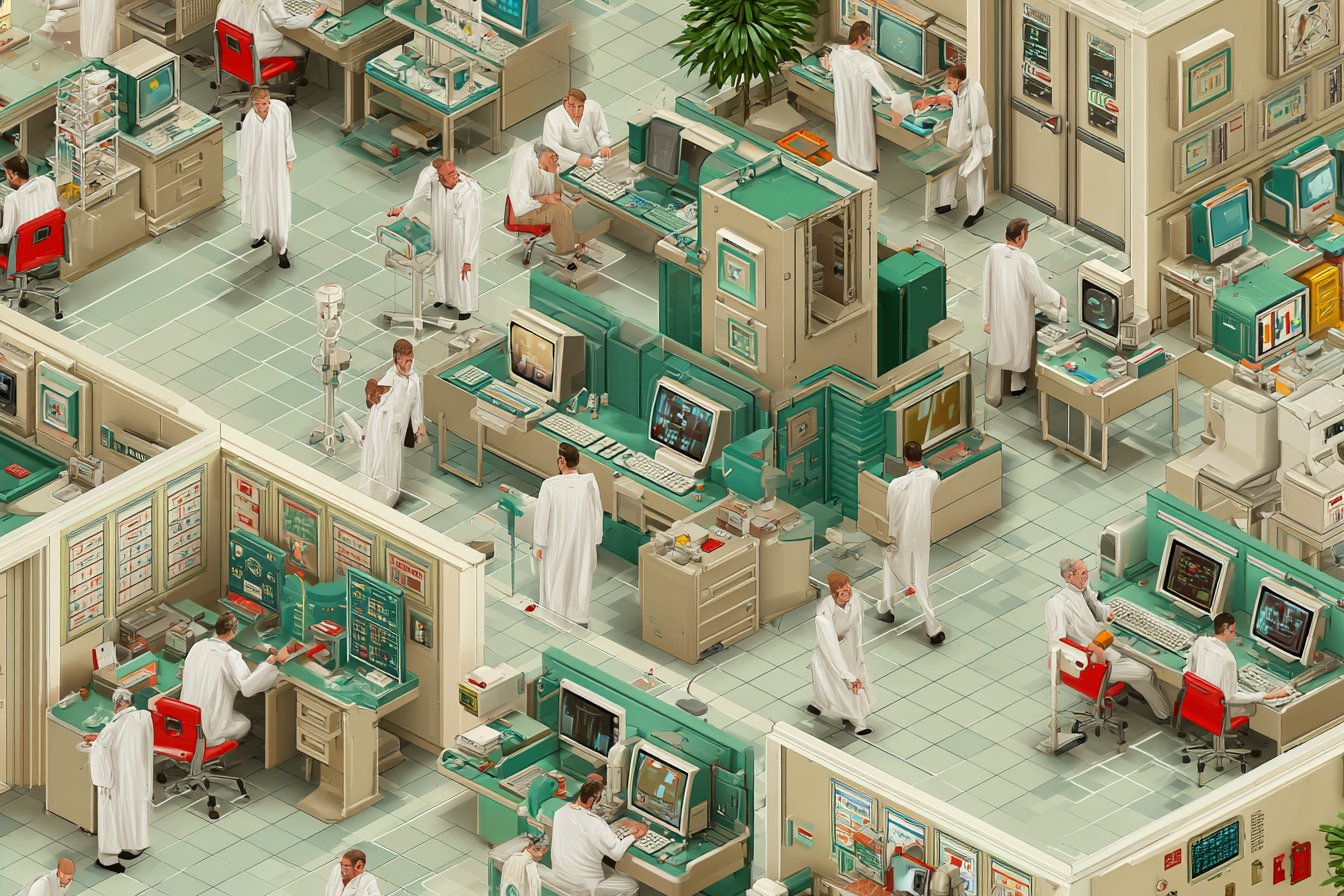
The graphics hold up surprisingly well for a game from the late 90s. The isometric view allows for a clear overview of your hospital and is detailed enough to show individual patients and staff members. The art style is timeless, and focused on clarity and character, rather than realism. Every element of the game is immediately readable, which is critical in a management game where you are required to digest a lot of visual information quickly.
The performance of the game is also rock-solid, regardless of the size of your hospital. I’ve seen hundreds of patients and dozens of staff members roaming around in my hospital and the game ran smoothly, and the frame rate remained stable. The load times are minimal, and the save system is reliable.
The sound design in the game is fantastic. There is a constant background noise of sounds that fit the environment of the hospital. Machines hum, patients talk, staff walk, and occasionally a medical emergency occurs. The atmosphere of the hospital is completely immersive, and the sound does not interfere with the gameplay.
How It Compares To Modern Management Games
When I played Theme Hospital recently, one of the first things I noticed was how much better it is than most modern management games. Most modern business sims focus on adding unnecessary complexity to the game for the sake of complexity, and bury the player in endless menus and statistics without giving them a clue what any of the stats mean.
Theme Hospital presents everything in plain sight. You can see your hospital working, identify problems instantly, and take action to resolve them. You don’t have to worry about complex formulas or vague causality. When you make changes to your hospital, you see the results immediately.
The pacing of the game is also far superior to most modern games. The length of each level allows you to build a large and complex hospital and try out different strategies, but not so long that you lose interest. The campaign structure is designed to allow you to build and improve your hospital progressively, and it is varied enough to prevent repetition and boredom.
Two Point Hospital, the spiritual successor to Theme Hospital developed by some of the same people at Bullfrog, is an excellent game in its own right, but it consciously followed the template established by Theme Hospital rather than trying to reinvent the wheel. This speaks volumes about how well-designed the original game was.
Playing Theme Hospital Today
Theme Hospital is available for download from GOG where it can be played flawlessly on modern Windows systems. The GOG version comes with all the necessary compatibility patches to ensure that the game plays correctly, eliminating the need to use DOSBox or other emulation tools.
If you are curious about the time commitment involved, HowLongToBeat reports that the primary campaign takes approximately 20 hours to complete. However, if you plan on building efficient hospitals, you can easily spend 50+ hours playing this game, and it still feels like a brand-new experience.
For any technical issues you may encounter, PCGamingWiki has extensive technical documentation to help resolve any issues you may experience. However, I found that the GOG version generally resolved most compatibility issues automatically.
The game is fully scalable to modern monitors, and contains all of the typical quality-of-life features you would expect.
There is still an active community of fans of the game who are continuing to discuss strategy and share their creations. The game is designed well enough that fans are still finding creative ways to optimise their hospitals decades after the game’s initial release.
Why Theme Hospital Is An Essential Game
Theme Hospital succeeds because it embodies a basic principle of game design: that humour and functional game design mechanics are not mutually exclusive. The humour does not distract from the gameplay; instead it adds another layer of enjoyment and memorability to the game.
Diseases are humorous, but they are also puzzles to be solved. Employees have personalities, but they are also functioning parts of the game with clear rules and behaviours. Announcements are comedic, but they are also valuable feedback regarding the performance of your hospital. The game integrates the humour into every aspect of the game design, and does not sacrifice any aspect of the game for the sake of the humour.
This is a level of design maturity that few games achieve. Most games that attempt to incorporate humour do so through reference and one-liners, and do not integrate the humour into the game design itself.
Accessibility is also a major factor. Anybody knows what a hospital does and why patients need to be treated. The humour of the game makes the underlying complex game design accessible without dumbing it down. Players learn the more advanced game mechanics as they go, and are entertained throughout.
After 25 years, Theme Hospital remains the gold standard of how to create management games that are both enjoyable and challenging. It demonstrates that business simulations can be entertaining, accessible, and fun to play. It shows us that sometimes the best way to portray the complexities of a subject is to include the humour and humanity in the presentation.