I am John, and I need to make a statement prior to this review. Whilst the rest of my teammates are arguing ad nauseum over whether Monkey Island or Day of the Tentacle represented LucasArts at its zenith, they are all forgetting the true masterpiece. Sam and Max Hit the Road didn’t simply perfect the adventure game format. It demonstrated that American developers could create something with a true subversive edge, whilst still producing content suitable for children. Released in 1993 (Wikipedia).
In addition to being a successful adventure game, Sam and Max Hit the Road was Steve Purcell’s comic book creations successfully translated into an interactive medium. So successful was this translation that every other adventure game since Sam and Max’s release has seemed stodgy in comparison.
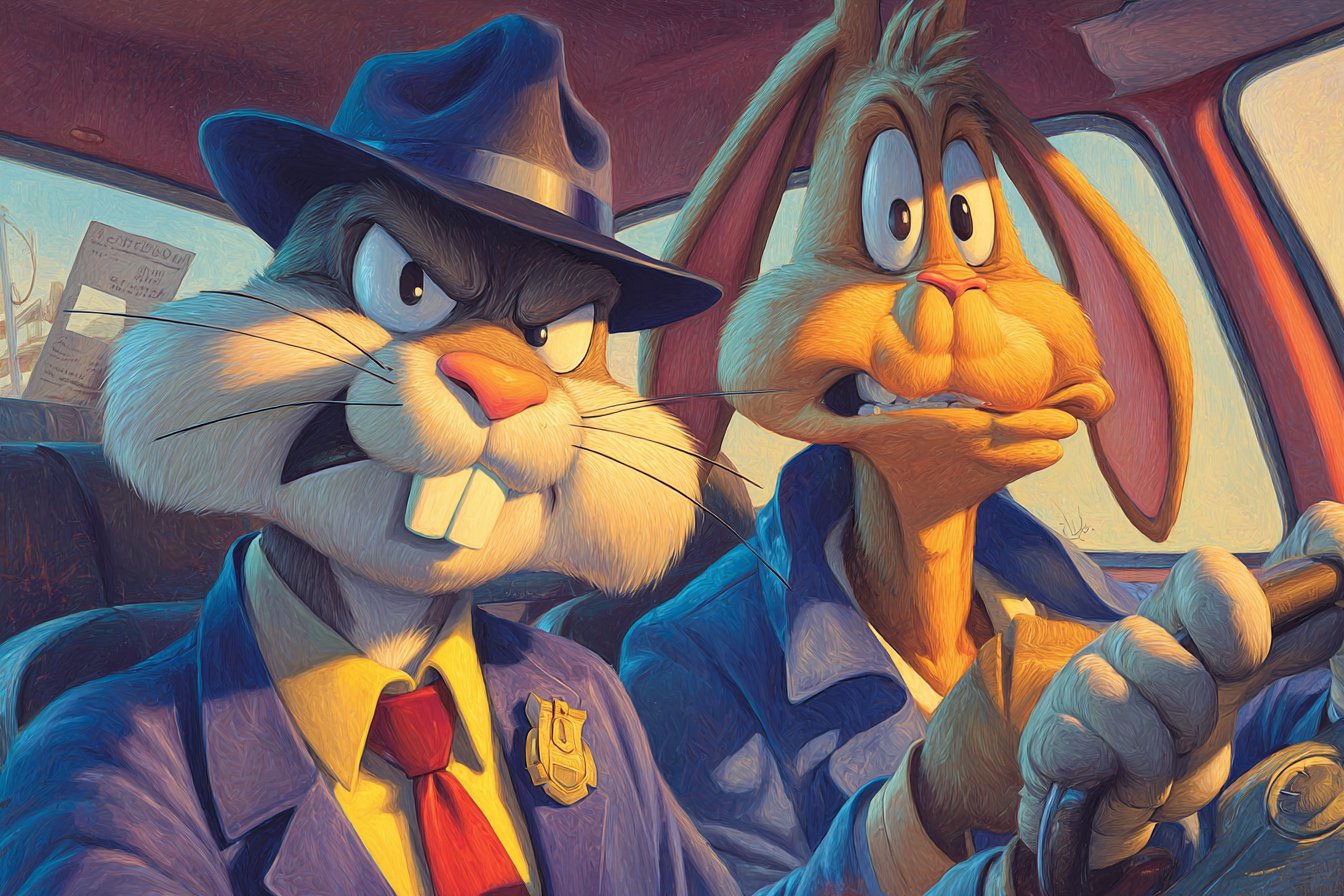
Sam and Max Hit the Road appeared at precisely the correct time in adventure game history. LucasArts had already established their reputation with the Monkey Island and Indiana Jones franchises, but had never produced anything quite this unconventional. The game follows Sam, a six foot canine detective in a blue suit, and Max, his hyperactive rabbity thing partner, as they investigate the disappearance of a Bigfoot from a carnival sideshow. The investigation quickly escalates to a cross country road trip through America’s most bizarre roadside attractions.
The humour in Sam and Max was only one aspect of its success, although that will be addressed in due course. The key innovation of Sam and Max Hit the Road was how it utilised that humour to make failure fun.
| Developer | LucasArts |
| Platform | PC (DOS), Mac |
| Year Published | 1993 |
| Genre | Point-and-click adventure |
| Players | 1 |
| Our Rating | 9/10 |
Sam and Max Hit the Road belongs in our rankings of the best PC adventure games, and it is the quintessential example of how American developers could produce innovations comparable to those of their European counterparts, if only they stopped being so risk averse.
The Conversation System That Revolutionised the Genre
Sam and Max Hit the Road did not merely have good writing. It revolutionised the way adventure games could manage conversation. Unlike many LucasArts adventures, Sam and Max made every possible choice in conversation valuable. Max’s answers to questions were not just humorous, they were wildly unpredictable and unhinged. With Sam and Max, you could threaten carnival workers, insult everyone you meet, and generally behave as the sociopathic lagomorph that Max is.
The beauty of Sam and Max Hit the Road lies in how the game handled the consequences of these choices. A typical adventure game punishes you for the incorrect choice by preventing access to vital information. Sam and Max reversed this paradigm. The more outrageous Max becomes, the more entertaining his responses become. NPCs will respond with confusion, horror, or occasionally matching Max’s wildness with their own bizarre remarks. The game rewards experimentation instead of penalising it.
Steve Purcell realised that many adventure games felt artificial in terms of their dialogue trees because designers forced players to guess which response they wanted them to give. Sam and Max Hit the Road solved this by creating each player choice to feel like a reflection of the characters in the game. Sam would always be the rational straight man, attempting to conduct detective work in earnest. Max would always be chaos incarnate, interested in violence, food, and mayhem wherever he goes. You were not guessing which response the game wanted. You were deciding which character’s method of approaching the problem would work best.
The voice acting in Sam and Max Hit the Road merits special consideration here. Bill Farmer provided Sam’s voice with the perfect deadpan delivery, treating every bizarre scenario with detached professionalism. Nick Jameson’s Max was pure manic energy, delivering threats and nonsequiturs with equal fervor. The chemistry between these two voices created a believable partnership between Sam and Max. You felt like these two had been partners for years, with Sam resigned to Max’s behaviour and Max genuinely fond of Sam, even though he never shows it.
Designing Adventure Games That Make Sense
Most adventure games released in 1993 suffered from what I will refer to as “designer brain”. Puzzles that made perfect sense to the individual who developed them, but left players randomly clicking objects to see if something worked. Sam and Max Hit the Road largely avoided this pitfall through its adherence to internal consistency, even when that internal consistency was utterly insane.
Sam and Max Hit the Road’s puzzles operated on a dream logic basis, rather than a world logic basis, but they remained consistent within that basis. If there was a possibility that something was supposed to be interactive, it probably was. If Max indicated a desire to destroy something, there was likely a way to allow him to do so. The solutions frequently involved developing a relationship with the characters rather than mechanically solving abstract puzzles.
Consider the Mystery Vortex sequence, where you have to navigate a tourist trap that defies the laws of physics. Rather than create realistic physics puzzles to overcome the obstacles in the Mystery Vortex, the game accepted its absurdity. The solution to the Mystery Vortex requires an understanding of how tourist traps function as commercial entities, not as spatial areas. You’re not solving engineering problems. You’re figuring out how to exploit a commercial system designed to extract money from tourists.
The inventory system supported the game’s approach to puzzle design. Sam carried everything in his jacket, and the game frequently commented on the impossibility of such an arrangement. When you attempted to combine items in Sam’s inventory, you received customised responses that reflected the personalities of both Sam and Max. Max might have expressed disappointment that he couldn’t use a certain item as a weapon, or Sam might have explained why a seemingly logical combination was impossible.
This attention to failure states created an environment where players enjoyed experimenting with different approaches. You were never punished for attempting unusual combinations. You were entertained by them. The game seemed to be designed by individuals who understood that players spend the majority of their time playing adventure games incorrectly identifying solutions. Therefore the game encouraged experimentation rather than discouraged it.
The Road Trip Format That Maintained Momentum
Many adventure games struggled with pacing. Players would become stuck on a single puzzle and lose momentum for the remainder of the game. Sam and Max Hit the Road solved this issue using its episodic road trip format. Each destination was self contained enough that you could make significant progress regardless of whether you were stuck on a specific puzzle at another destination.
The map screen in Sam and Max Hit the Road served a purpose greater than simply selecting levels. The car driven by Sam and Max became a character in its own right, along with a radio that featured era-specific music and commentary from the duo regarding their current destination. The sensation of travelling across America with Sam and Max was integral to the game’s charm. You were not simply solving puzzles. You were embarking on a journey with these two characters.
Each destination possessed a unique identity, yet contributed to the overall story arc. The World’s Largest Ball of Twine was not only a puzzle location. It was a clever sendup of roadside America, complete with a zealous curator that treated the attraction as if it were the Smithsonian. Frog Rock combined the genuine awe-inspiring quality of geology with the blatant commercialisation of geologic features in a manner that felt uniquely American. The game understood that roadside attractions operate in a state of tension between the awe inspiring and cynical.
Additionally, the road trip format enabled multiple legitimate methods of progressing through the game. If you were stuck at the carnival, you could leave and start investigating the Mystery Vortex or visiting Stuckey’s. Frequently, items or information obtained at one location would cause previously inaccessible puzzles at other locations to become solvable. The game rewarded exploration thoroughly without ever leaving you feeling lost.
The pacing of the game developed naturally towards the finale without ever feeling hurried. By the time you reached the last act of the game, you had spent sufficient time with Sam and Max to develop a genuine affection for their partnership. The road trip was not simply a vehicle for the game’s plot. It was a form of character development through shared experiences.
The Technical Innovations Beneath the Cartoon Aesthetic
Sam and Max Hit the Road appeared to be a cartoonish Saturday morning show. However beneath this cartoonist aesthetic lay some very innovative technical developments. The SCUMM engine was further developed to generate more detailed backgrounds and smoother character movement than previous LucasArts adventure games. The 256-colour VGA graphics in the game made optimal use of the colour palette to create vibrant, detailed environments that felt hand drawn rather than generated.
The character animation deserves to be highlighted. Max’s idle animations were the epitome of character-driven detail. Max would constantly fidget, scratch himself, glance around with impatience, and sometimes draw out guns with no discernible reason. These animations were not solely technical demonstrations. They were constant reminders of Max’s personality. Sam’s more subdued animations illustrated his professionalism and his patience equally effectively.
The sound design was vastly superior to the mere voice acting in the game. Every location had its own ambient sound that added to the atmosphere of the area. The carnival was loud and chaotic. Frog Rock was eerily silent and distant. The Mystery Vortex used distorted audio to emphasise its reality warping properties. These were not simply background noises. They were examples of environmental storytelling.
LucasArts employed iMUSE, their interactive music system, in a highly advanced fashion. The soundtrack to the game would adapt dynamically based on your actions and location in the game, but it did so in such a subtle manner that most players would not have even noticed the changes. The music was always fitting to the moment and never called attention to itself as a technical achievement.
Cultural Influence Extending Beyond Video Games
Sam and Max Hit the Road achieved success that extended beyond financial success and critical acclaim. The game demonstrated that adventure games could incorporate truly subversive themes whilst maintaining accessibility to the broader audience. The game’s humour was sufficiently biting to appeal to adult audiences, yet not graphic enough to exclude younger players.
The impact on later adventure games was immediate and evident. Games such as Full Throttle and The Curse of Monkey Island borrowed Sam and Max Hit the Road’s approach to character-driven dialogue and consistently logical systems. The game demonstrated that adventure puzzles did not have to be artificially difficult to be enjoyable.
Perhaps more important, Sam and Max Hit the Road demonstrated the ability to translate a licence into a successful interactive media product. Rather than attempt to recreate Steve Purcell’s comics exactly, the game understood what aspects of the source material made the comics effective and adapted those elements into adventure game mechanisms. The end result was a game that felt distinctly a Sam and Max product, yet was clearly a video game.
The speed running community has welcomed Sam and Max Hit the Road (Speedrun.com), and speed runners continue to discover new and creative ways to break the puzzle sequences in the game. Observing experienced speed runners navigate the dialogue trees at a high rate of speed illustrates the sheer volume of optional content available in the game. Even after completing Sam and Max Hit the Road several times, the vast majority of players have missed large portions of the game’s dialogue and interaction with the characters.
Enjoying Sam and Max Hit the Road Now
Modern players may enjoy Sam and Max Hit the Road through several digital formats (Steam Store) (GOG). The game appears to have held up incredibly well visually and the voice acting is still excellent. The puzzles in Sam and Max Hit the Road remain logically sound within the game’s absurd universe. Any technical issues that existed in the original DOS version of the game (PCGamingWiki) have been rectified in modern re releases of the game.
It typically takes approximately 8 to 12 hours to complete Sam and Max Hit the Road (HowLongToBeat), providing enough content to feel like a worthy investment of your time without overstaying its welcome. Most important to me, Sam and Max Hit the Road is one of the few adventure games that rewards replay. There is simply too much optional content in the dialogue trees for you to miss entire sections of conversations and character interactions on your first playthrough.
For new players to the adventure game genre, Sam and Max Hit the Road provides an excellent primer to the genre. The puzzles in Sam and Max Hit the Road are designed to be forgiving and the game’s design encourages experimentation. As a result, you will rarely, if ever, feel completely stuck or punished for trying things differently.
For seasoned adventure game players, Sam and Max Hit the Road serves as a reminder of what the genre can achieve when it stops taking itself so seriously.
Sam and Max Hit the Road demonstrated that adventure games do not have to choose between intelligence and entertainment. The game can be intelligent, funny, subversive and accessible to the masses simultaneously. Thirty years after its release, Sam and Max Hit the Road remains the benchmark for character driven adventure games, and is a testament to why American developers deserve to be considered amongst the European developers who pioneered the adventure game genre.
One of the things that was so great about Sam and Max Hit the Road was this: it recognised that the greatest adventure games are not about solving puzzles. They are about spending time with interesting characters in interesting worlds. All the rest is simply mechanics.