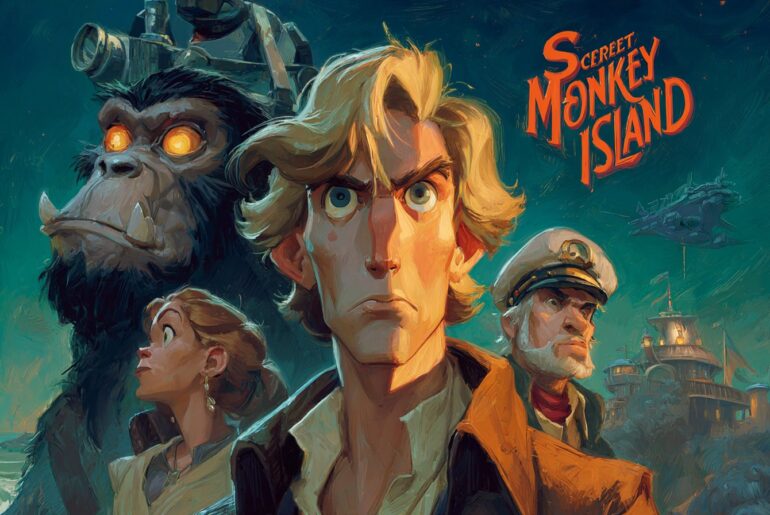
Escape from Monkey Island Review: The 3D Experiment That Divided Fans
The first thing about Escape from Monkey Island is that LucasArts took a huge risk by moving Guybrush Threepwood into the third dimension. Half the fans of the adventure game community went wild with excitement and the other half were terrified. As someone who has been a fan of the series since the early 1990s and spent countless hours with this divisive title, I can tell you that both groups had legitimate concerns and that the truth is much more complex than the two extremes.
Escape from Monkey Island was released in November 2000 in the United States (Wikipedia), which marked a massive departure from LucasArts’ prior work on the Monkey Island series. The game was developed starting in 1998 (Wikipedia), which provided the team ample time to grapple with the many technical hurdles associated with transitioning beloved 2D characters into 3D. Escape from Monkey Island was LucasArts’ first serious attempt at updating their adventure game format utilising their GrimE engine (the first 3D Monkey Island game) (Wikipedia) that was used to create Grim Fandango. The stakes could not have been higher, as Escape from Monkey Island would be the final LucasArts Monkey Island (LucasArts Wiki) game in the series.
| Developer | LucasArts |
| Platform | PC, PlayStation 2, Xbox |
| Year Published | 2000 |
| Genre | Point-and-click adventure |
| Players | 1 player |
| Our Rating | 6/10 |
Honestly, I think I should let you know where Escape from Monkey Island falls in our rankings of the best adventure games. It did not make the cut, and there are certainly reasons for that, but that does not mean it is completely without value, especially when you consider the sheer technical scope and the near-impossible job of topping the artistic achievement of Curse of Monkey Island.
The Shift to 3D: Big Decisions and Poor Outcomes
The transition to 3D fundamentally changed the way Monkey Island games felt to play. While Curse of Monkey Island refined the 2D adventure game formula by using gorgeous hand-drawn animation and perfect pixel-based interaction, Escape thrust players into a world of polygonal characters and tank controls. The GrimE engine, which was originally built to support Grim Fandango, was not specifically designed for the type of whimsical pirate adventure that Monkey Island demands.
The way you controlled Guybrush felt clumsy compared to simply clicking wherever you wanted him to go. Rather than the seamless, responsive point-and-click interface that defined the series, you now had to utilise keyboard controls to move your character around 3D environments. This was not inherently terrible on PC, where most adventure game enthusiasts were accustomed to navigating with a keyboard, but it immediately created a barrier between player and character that did not exist previously.
Camera angles were sometimes cinematically impressive, but often obscured critical interactive elements or made navigation confusing. There were instances where I would spend upwards of five minutes trying to determine how to get to an obviously visible item because the camera angle made the path to it unclear. In all the 2D Monkey Island games, if you could see something, you could interact with it. That simple rule of thumb no longer applied.
Guybrush’s character animations also suffered significantly. The gestures and expressions of Guybrush, so skilfully depicted in the artwork of Steve Purcell for Curse of Monkey Island, became stiff and mechanical in 3D. Facial animations during conversations lacked the charming and personable qualities that made the earlier games so endearing. It was not that the 3D models were poorly constructed, per se, but they could not replicate the expressiveness of hand-drawn sprites.
Voice Acting Shines in a Hit-or-Miss Game
In one area, however, Escape from Monkey Island was truly exceptional: voice acting. Dominic Armato returns (IMDB) as Guybrush, and he performs admirably throughout. He delivers the outrageous dialogue and preposterous situations with the exact same comedic timing as the earlier games.
Alexandra Boyd’s portrayal of Elaine is much more substantial and interesting than she was in earlier games, and gives her character actual agency in the storyline.
The supporting cast varies in quality, but for the most part maintains the high standards set by Curse of Monkey Island. The Australian accent of the new villain Ozzie Mandrill may come across as a tad over-the-top, but it fits the increasingly cartoonish tone of the game. Perhaps most impressively, the voice direction continued to maintain continuity with Curse of Monkey Island, even though the visuals were vastly different. Characters spoke as if they were the same people, even though they appeared to be different.
Michael Land’s music (Soundtrack Wiki) continues the series’ long-standing tradition of excellence in audio design. Music is dynamically generated by the iMUSE system based upon location and situation, and therefore adapts to player actions. While the music did not reach the height of the memorable themes found in the earlier games, it maintained the Caribbean flavour that defines Monkey Island.
Story, Puzzles, and Overall Design
Escape from Monkey Island is composed of four acts and multiple locations (Wikipedia), taking Guybrush and Elaine through a plot concerning corrupt politicians, land development schemes, and the typical supernatural pirate nonsense. The story is more focused than the somewhat meandering middle section of Curse of Monkey Island, but it lacks the emotional weight and character development that made the earlier games so special.
As far as puzzle design goes, Escape from Monkey Island is both the game’s biggest strength and most frustrating weakness. When the game designs its puzzles correctly, it successfully recaptures the clever lateral thinking that made the series so famous. The returning insult conversation trees (Monkey Island Fandom) function beautifully, expanding on the swordfighting concept of the first game with monkey kombat and political debates with NPCs that require precise attention to their dialogue patterns.
However, the game suffers from the aforementioned 3D interface issues in several puzzle designs. There are inventory combinations that appear logical but require you to search in 3D space to execute them properly. Certain environmental puzzles rely upon camera angles that do not clearly display interactive elements. The infamous monkey kombat system, while a clever concept, becomes tiresome when you are required to perform extensive sequences repeatedly solely because of confusion related to the 3D interface rather than errors in reasoning.
Additionally, the game’s difficulty curve appears irregular compared to the earlier games. There are some sections that are almost insultingly easy, and there are others that demand leaps of logic that seem unfair rather than challenging. The game appears undecided about its intended audience — at times it treats players as newcomers to the adventure genre, and at other times it assumes players possess intimate knowledge of the series’ lore and conventions of the adventure genre.
A Mix of Technical Ambition and Practical Failures
Each of the platforms (PC, PS2 and Xbox) (Wikipedia) utilised a slightly different method of handling the game, and these differences added to the problems experienced overall. The PC version, while not flawless, presented the most stable and responsive gameplay of the three platforms. The console versions, especially the PS2 port, suffered from a highly publicised and problematic motion control system (Wikipedia) that made the already clunky interface even more frustrating to use.
Using consoles highlighted the poor adaptation of the GrimE engine to various input methods. What worked reasonably well on PC with keyboard and mouse turned into an unpleasant experience on console controllers. The load times between areas, already noticeable on PC, became considerably worse on console versions. This was not simply a small technical glitch — it actually changed how the game felt to play.
The graphics, although impressive for the year 2000, have aged poorly relative to the timeless nature of the pixel art of the earlier games. The 3D character models and environments appear dated in a way that hand-drawn sprites never will. If you decide to play Escape from Monkey Island today, you will encounter early 3D graphics that lack both the technological advancements of modern games and the artistic longevity of good pixel work.
How Escape Works Regardless of Its Issues
While Escape from Monkey Island is an imperfect game, it shows how LucasArts was able to continue to be the leading developer of adventure games even while taking some questionable technical risks. The writing, although not reaching the level of Secret or LeChuck’s Revenge, maintains the series’ irreverent humour and clever pop culture references. There are numerous laugh-out-loud moments distributed throughout the game, particularly in character interactions and background details.
The game approaches continuity in the series with respect, yet without being too rigid. The references to the earlier games feel organic and not forced, and the new characters generally fit nicely into the existing world of Monkey Island. The game’s conclusion, although not entirely satisfying, resolves the loose ends of the earlier games in logical ways.
Most importantly, Escape from Monkey Island is a Monkey Island game regardless of its technical flaws. All the elements that made the series so special — humour, clever puzzle design, memorable characters, and the pirate-themed Caribbean atmosphere — remain in the game, albeit filtered through an awkward 3D interface.
Legacy and Current Day
Playing Escape from Monkey Island today requires patience and an understanding of the game’s outdated interface. Compared to modern adventure games, the interface will feel antiquated, and the graphics have not aged well. However, the game is still accessible via digital distribution, and patient players can still find enjoyable moments despite its dated appearance.
Escape from Monkey Island’s influence on subsequent adventure games was negligible, as the market for traditional adventure games shifted rapidly away from the genre shortly after its release. However, the courage shown by LucasArts in attempting to modernise a beloved franchise while maintaining the core essence of the series deserves recognition, even if the execution was less than the vision.
For series completionists and historians of the adventure game genre, Escape from Monkey Island is an important transitional point in the evolution from traditional point-and-click adventure games to modern 3D adventure games. It is not essential playing, but it provides insight into how beloved franchises struggle to adapt to changing technologies and shifting audience expectations.
Conclusion: An Ambitious Failure or A Flawed Success?
Honesty dictates that I cannot recommend Escape from Monkey Island to new fans of the series. New fans should start with Secret, followed by LeChuck’s Revenge, and definitely play Curse of Monkey Island before deciding whether or not to play this one. For fans who have played all of the previous Monkey Island games and wish to see the continuation of the story, Escape contains sufficient true Monkey Island moments to warrant the frustrations of the dated interface and the questionable design choices.
Escape from Monkey Island’s 6/10 rating reflects its position as a flawed but occasionally brilliant addition to the Monkey Island series. It is neither the catastrophic failure that some critics portrayed, nor the successful modernisation that LucasArts envisioned. Instead, it serves as a fascinating example of how technical ambition can both complement and detract from creative vision.