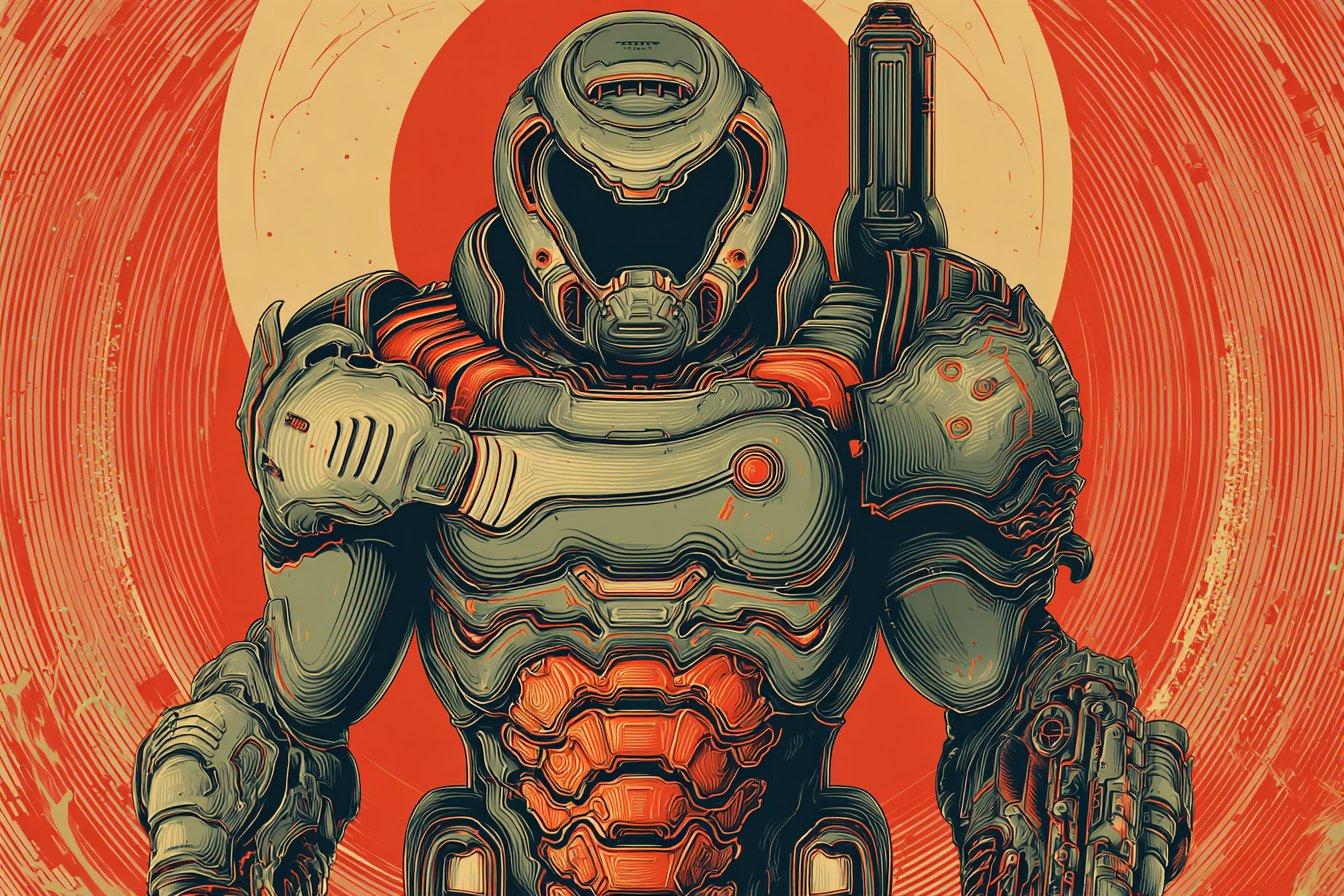
Tim here and I’ve got to say that I’ve had some concerns since I started my retro gaming journey. Everyone seems to rave about this game called Doom, how it changed everything, how it essentially birthed the first-person shooter as we know it today. Since I’ve come to this game completely cold, without experiencing the supposed revolution it brought, I was sceptical of how good a 30-year-old game could be. Well, I was wrong. Doom is really bloody good.
Released on 10 December 1993 via id Software by id Software, Doom was more than just another game release. It was a cultural phenomenon that defined the first-person shooter via Encyclopedia Britannica. With a Metacritic metascore of 94 via Metacritic, Doom scored higher than many modern shooters do today. However, high scores don’t explain why something is successful or if it will stand the test of time.
I have now spent a significant amount of time playing Doom and I think I can finally understand what everyone was going crazy about. This isn’t just history; it’s a game that still functions fantastically in 2026, even without the nostalgia glasses.
| Developer | id Software |
| Publisher | GT Interactive |
| Platform | PC (originally DOS) |
| Year Published | 1993 |
| Genre | First-Person Shooter |
| Main Story Length | About 5 hours |
| ESRB Rating | Mature 17+ via ESRB |
| Our Rating | 9/10 |
As one of the top classic PC games that still matter today, Doom earned its place on that list and, in honesty, it may be the most important game on that list.
A Combat System That Never Gets Old
What immediately stands out to me about Doom is the flow of combat. Compared to many modern shooters, the combat in Doom feels smooth and fluid. The character moves quickly, the guns react instantly, and the enemies react as soon as you touch them. There is little-to-no lag in input, no delay in animations, and there are no reload mechanics to slow the pace of the game. You see a demon, you shoot it, and it either falls dead or fires back at you. Simple as that.
The progression of weapons in Doom is excellent. You begin with a pistol that is underwhelming but functional, and once you find a shotgun, you realise that the shotgun is a great tool for closing distance to an enemy. When faced with multiple enemies, you’ll switch to the chaingun and lay down suppressive fire. The rocket launcher is great for taking down tough enemies in an open environment, and each weapon serves a purpose based on the situation. For the majority of encounters, the shotgun will be your “go-to” gun, however, you will use the chaingun for encounters with multiple enemies and use the rocket launcher for tougher demons in open environments.
Each enemy has a unique behaviour pattern, but they vary enough to keep the experience interesting. Zombie-men shamble towards you and fire off predictable shots. Pinkies will run directly at you, making them relatively easy to dodge, but very deadly in large numbers. Cacodemons will float around firing off fireballs that arc across the screen. Each enemy type will require different positioning and a choice of weapon. As you encounter more enemies, you will learn to prioritise threats – kill the Sergeants with shotguns first, deal with the melee rushers second, and clean up the zombie-men third.
Doom’s health and armour system encourages aggressive play instead of staying hidden behind cover. To find health packs and armour pickups, you must continue to move forward. If you remain stationary, you will get surrounded and killed. The game rewards movement, map familiarity, and quick decision-making. It is pure action without the complexity that many modern shooters add to the mix.
What Made Doom Revolutionary
It is difficult to comprehend how significantly different Doom was from all other games available in 1993. Although first-person views were available, nothing moved as smoothly or looked as detailed as Doom did at the time. The id Software engine that created Doom allowed for rendering of complex 3D environments at acceptable frame rates on 1993-era hardware. That is truly impressive technology for the time period.
However, the technical accomplishment would have meant nothing if the game design had not been so focused. Doom eliminated everything unnecessary. There is no inventory management, no complicated controls, and no cutscenes that interrupt the action. You move quickly, you shoot things, you find keys to unlock doors, and you proceed to the next area. The simplicity of this design loop is still effective today.
The level design of Doom deserves special recognition. Each area of the game feels like a legitimate location – military base, tech facility, hell dimension – but they are designed solely to facilitate the flow of gameplay. The rooms are connected logically, secret areas reward exploration, and the layout of the area directs you to your objective without appearing forced. As the game progresses, the area designs become increasingly complex, adding switch-based puzzles and key-hunts that never feel like a chore, thanks to the constant flow of combat.
Doom was also one of the first games to utilise the concept of shared experiences. The original release of Doom included tools to allow players to create custom levels and modifications. Immediately, players began building their own content, thereby extending the life of the game indefinitely. The concept of a community of players creating their own content for the game became a standard practice for PC gamers, and although Doom was not the only title to pursue this path, it was certainly one of the first to wholeheartedly adopt it.
Technical Quality That Still Impresses
Although the Doom engine was revolutionary in 1993, I am impressed by how well the visuals hold up today. The pixel art textures used in the game have a gritty industrial feel that fits perfectly with the hellish atmosphere of the game. The detail of the sprites used for enemies and weapons is sufficient to be readable during intense moments of action, yet stylised enough to appear ageless. Many modern games struggle to strike a balance between clarity and atmosphere.
The sound design of Doom is equally impressive. Each weapon has a distinct and pleasing sound signature. The shotgun sounds like a pump-action rifle, the chaingun sounds like a machine gun firing rapidly, and the rocket launcher sounds like an explosion. You can identify the type of weapon being fired simply by the sound it makes. Audio cues from the enemies assist with spatial awareness. You hear a Pinkie’s distinctive growl and know to cheque your flanks for him. You hear the Cacodemon’s floating sound and know to look up.
The music in Doom was composed by Bobby Prince and is perfect for the action-based gameplay. Heavily influenced by heavy metal bands, the music riffs propel the action forward. The music loops seamlessly during long firefights and does not become repetitive or intrusive. Some of the music appears to be based on popular metal songs of the time, but it is a perfect fit for the game.
Optimisation of performance was critical to the success of Doom and continues to be impressive today. Doom will function correctly on virtually any hardware developed in the last two decades. Load times are instant. You can jump into any level at any time and play for as long as you wish. Modern games that force you to download large patches and compile shaders before beginning play can learn a lot from Doom’s instant accessibility.
The Impact That Changed Everything
Whilst playing Doom today, I continually recognise elements of gameplay that were standardised in later first-person shooters. The concept of a weapon wheel, where each tool is suited for a specific task. The emphasis on player movement and positioning versus staying behind cover. The balance between projectile and hitscan-based weapons. The manner in which enemies telegraph attacks via both audio and visual cues. None of these elements were created by Doom, but it refined and popularised them.
The modding community of Doom that formed around it established many of the template models for gaming today. Modding allows players to create content for games and extend the playability of games far beyond the intended lifespan of the game. Speedrunning communities, total conversions, player-created content – all of these concepts were adopted as standard practices in gaming, largely due to the modding community established by Doom. Doom even has speedrun leaderboards via Speedrun com with routes optimised to the smallest degree possible to extract every single second of time savings from the game’s movement mechanics.
The cultural impact of Doom extended beyond the gaming world. Doom was portrayed as a violent example of a video game in the media in the 1990s, resulting in Doom receiving a Mature 17+ ESRB rating via ESRB. Doom was even blamed for decreased workplace productivity as office networks became clogged with multiplayer Doom sessions. Whether or not the moral outrage generated by the media was warranted is debatable, but it demonstrated that video games had entered the mainstream.
Playing Doom Today
The original version of Doom is easily available through multiple digital storefronts. Steam lists a release date of 3 August 2007 for the store release via Steam Store making it available to modern systems with the least amount of hassle. GOG also lists Doom as part of classic Doom releases via GOG with extra support for running on older versions of Windows.
If you are new to the series, I would suggest playing the original campaign first. The campaign will give you approximately 5 hours of main story length via HowLongToBeat. This should provide you with enough time to become familiar with the core mechanics of the game without spending too much time on it. The difficulty curve is well-balanced – challenging enough to require learning and practising new skills, but fair enough to avoid frustrating you.
The modding community surrounding Doom is still extremely active, three decades after the game was first released. Source ports such as GZDoom offer modern features such as widescreen resolutions and full-screen anti-aliasing whilst maintaining the original gameplay of Doom. Total conversion mods create entirely new games using the same engine as Doom. Brutal Doom is an example of a total conversion mod that adds modern features such as blood and gore effects to the game. The Cacowards award the best community creations of the year. This continuous creative output is why Doom feels fresh and relevant today.
Why Doom Still Matters
Coming to Doom with no nostalgic memories of playing it as a child, I am impressed with how confidently it executes its vision. Modern shooters are often unsure of what they want to be – are they a tactical simulation, a cinematic experience, a competitive arena, a narrative-driven adventure? Doom has always known what it is: pure action gaming distilled to its most fundamental components.
Whilst the 5-hour main story length of Doom may be shorter than many modern shooters, every minute of it is focused and engaging. There is no padding, no fetch quests, no lengthy cutscenes to break up the action. You are consistently moving forward, encountering new challenges, and discovering new locations. It is impressive how much variety id Software was able to pack into such a small package.
That focus and confidence is why Doom is timeless. Whilst many games from 1993 are outdated due to technological limitations and design conventions that have not stood the test of time, the fundamental design loop of Doom remains as compelling today as it was thirty years ago. Fast movement, responsive controls, clear visual feedback, and immediate results for player actions – none of these aspects of good design ever go out of fashion.
Doom provided evidence that video games could be legitimate entertainment products that garnered widespread mainstream attention, for better or for worse. It demonstrated the possibility for player-generated content and community-supported longevity. Perhaps most importantly, it set many of the templates for first-person action that developers continue to follow today.
Regardless of whether you are discovering Doom as a result of this article, or if you played it as a child, I believe that anyone can appreciate Doom as a vital piece of gaming history that happens to still be a lot of fun to play. The rarity of finding a product with both historical significance and continued entertainment value is rare in any form of media. Doom earned its reputation as the first shooter that started everything, and surprisingly, it is still worth starting today.