Look, I’m just going to be honest with you about Command & Conquer: Tiberian Sun. It sundered our community when it was released on 27th August 1999 (Wikipedia), and, like, we’re still arguing about it to this day. Joe believes it’s the peak of the series’ ambition, Tim thinks it betrayed everything that made the first one special, and my feelings lie somewhere in the middle where I admire what Westwood were trying to do even if they failed in the execution.
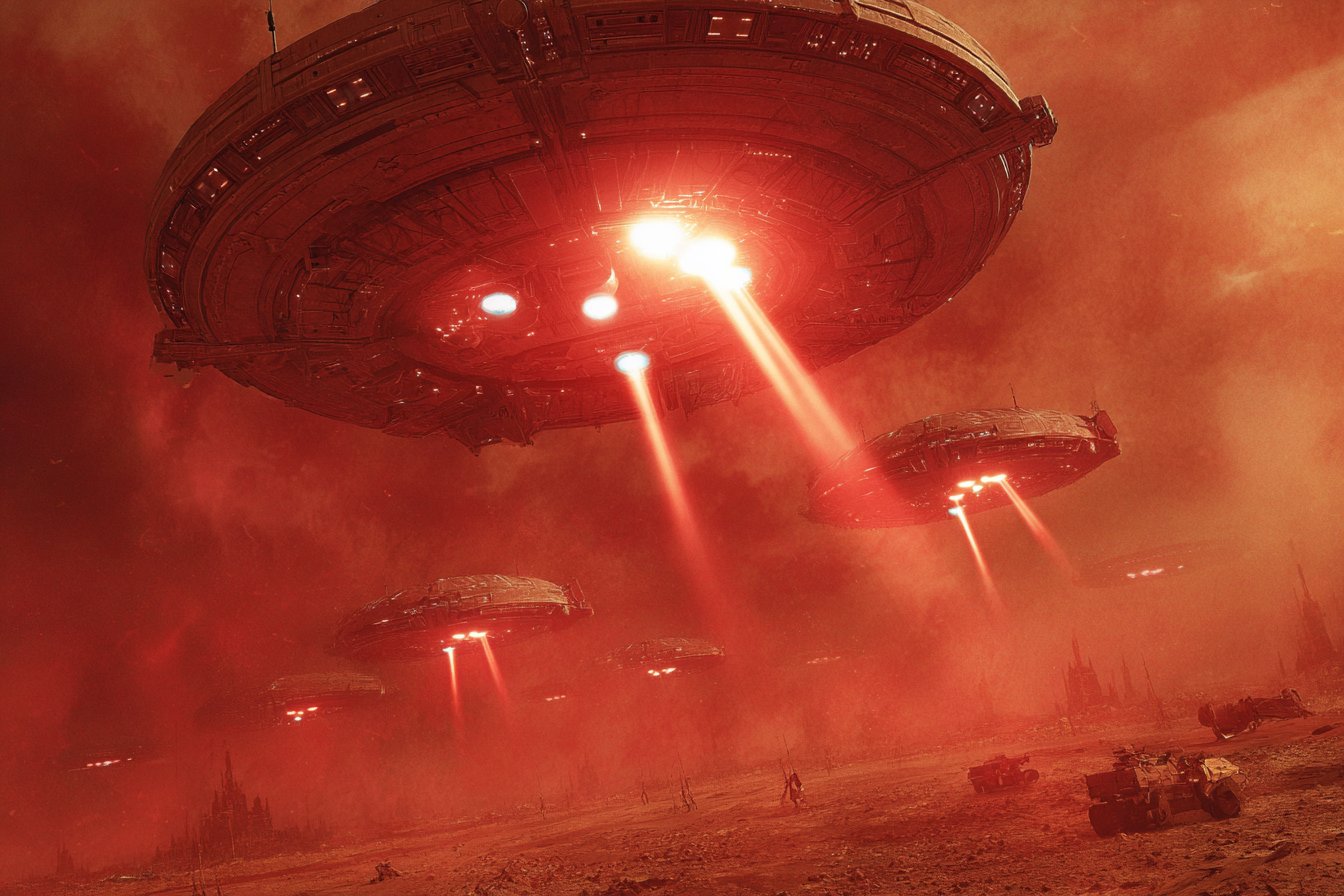
This was the most radical departure for Command & Conquer yet. Instead of games that goofily riffed on alternate history, Tiberian Sun plunked you down in a truly dark future – Earth invaded and then terraformed by an alien substance, Tiberium. It was love-it-or-hate-it stuff for fans who fell hard for the earlier games that started us down this path.
| Developer | Westwood Studios |
| Platform | Windows |
| Year Published | 1999 |
| Genre | Real-time Strategy |
| Players | 1-8 (online multiplayer) |
| Our Rating | 7/10 |
The World Has Become Alien to Us
What Westwood got so right is that they 100% committed to this vision of a world gone. Twenty years after the first war over Tiberium, Earth isn’t just ruined, it’s alien in a way we’ve never seen. Tiberium wasn’t merely something with a pleasant blue sheen you could start your mining empire off of. It’s infected the ecosystem and mutated it into something truly strange. Blue zones are spots where you can kinda sorta set up a base, yellow zones are toxic wastelands, and red zones are pure crystalline devastation. Unless you’re some form of creature that eats stone or whatever, you have no business being there.
These are not Command & Conquer’s immaculate stopovers in the middle of nowhere. Maps included twisted Tiberium trees, strange alien fauna, and atmospheric effects that made every environment feel actually hostile. The weather system added ion storms that could disable your electronics and provide the enemy tactical advantage (GameFAQs Review). Underground tunnels made you consider the battlefield in multiple dimensions, something other RTS games had refused to even try.
The visual design was dynamic with all of this. Where the equipment in the original C&C was reminiscent of military hardware in desert and temperate settings, Tiberian Sun’s equipment looked truly futuristic. GDI had become a high-tech planet policing unit specialising in hover technology and other improved weaponry. The Brotherhood of Nod had accepted cyborgification and stealth technology as well. Everything feels like it belongs in this brave new world, from the upbeat Wolverine mechs to the vomit inducing Cyborg Commandos.
But herein lies the problem. This miraculous transformation turns out to come at the expense of accessibility of the game itself. One of the things that made original C&C so appealing is that the units were immediately identifiable on first sight. A Medium Tank, an Apache, you immediately know what it does because it looks familiar. Unit identification all but required study in Tiberian Sun since the units are all new and all strange. The barrier to enjoyment in the core gameplay shot up a rudimentary fortification and subsequently made it difficult for casual players who had enjoyed previous games in the franchise to rise above military obscurity.
Combat Systems That Reached Too Far
Combat systems reached for the stars, maybe too often. You could hover over terrain features that might block traditional ground units (GameFAQs Review). You could have subterranean units that would allow you to control the ground above compared to ground that might block your vehicles. Simply dig a tunnel, pop here, and off you go. These things sound powerful and tactical. Why settle for just plain air assets? The terrain became destructible, making your explosive weapons invaluable or you could leave a crater worn in dejected solid. Want to create a clear path through there? Just bomb it to hell.
These systems added tactical depth absent from previous games in the franchise. Underground APC rushes to drop off infantry right inside of enemy bases. Hover units that could rush them from below entirely using unconventional flanking manoeuvres over cliffs and over water. The Subterranean APC becomes an express delivery service, appearing behind enemy bases, dropping off engineers or commandos and leaving. Making itself camouflaged, what a surprise.
The asymmetry of factions reached a new level here. GDI has access to technology and units of enormous power at their disposal. The Mammoth Mark II walker comes to mind as well as the absolutely devastating Ion Cannon. Nod relies on stealth, speed and cyborgification, cloaked units, tunnelling vehicles, and the Mobile Construction Vehicle, a massive truck-like behemoth that can drop off anywhere on-map specific locations. Each faction had to be approached with fundamentally different gameplay paradigms.
However, these ideas exposed balance problems that would haunt Tiberian Sun throughout its life. How do you effectively deal with someone who transfers half the force into the ground? Wisely, stealth detection isn’t optional anymore. It’s part of a build order choice now, reinforcing rigid build orders. This applies to weapons as well, where eliminating complexity makes it easier for grabbing the gun to be less troublesome, yet makes an army terribly difficult to control.
Pathfinding on a battlefield now required more than just looking at the ground. Dropping pathing units into the subterranean part of the game played hell with them, and often the AI controlling them into an attack would get confused by the situation of going around the item being attacked or else just bash into a wall.
Technical Ambition Meets Reality
To say the absolute least, Westwood was a bit ambitious with their engine in Tiberian Sun. Added weather effects, dynamic lighting, and way cooler animations add a ton more depth than a night/day cycle. The night/day cycle benefits the Nod side quite nicely. Ion storms would sweep across maps, frying radar and electronics but throwing up visually stunning clouds. The cutscenes kept the series’ live-action cinematics, but went much darker with them, with Michael Biehn voicing GDI Commander McNeil and James Earl Jones voicing GDI Director. They looked nicer than previous Command & Conquer games, with better special effects and action, and more elaborate set design.
But just as a powerful car with fancy controls crashes off the track if the brakes go out, the added feature of Tiberian Sun led to quality issues. Memory leaks would cause it to slow down in longer matches. The network code floundered with the extra data that had to get sent during games with all the new terrain and with more complex units. Many players ended up crashing as well as desyncing here, a problem unseen in older Command & Conquer games as they didn’t have as much going on.
System requirements were high for a game released in 1999. Where the original Command & Conquer could run on a lower end Pentium system, Tiberian Sun needed a more powerful machine to push all those lovely graphics, as well as to give units some complex behaviour. This made it much less accessible than Age of Empires II happily playing along in the background on an acceptable number of older computers.
The Firestorm Expansion’s Missed Opportunity
The Firestorm expansion’s birth on 7th March 2000 (CnC Wiki) raised ideas on to address weak-points of the Tiberian Sun release as well as add complexity with itself as well. Receiving CABAL, an AI antagonist that both GDI and Nod would have to get used to, they got a new enemy. New toys like the Juggernaut and Reaper gave some additional play options.
These new units were even more specialised and fitted to specific situations. The campaign asked players to understand concepts of unit combination and specialisation that most might not have ever learned in the base game. So instead of reworking aspects of the game that would make it easier for most players, Firestorm went in the opposite direction, adding additional units and mechanically complex unit types.
The modding community seemed more receptive to the tools provided with Firestorm than with Tiberian Sun, and conversion mods would soon become a draw for players approaching the game with disappointment. These mods offered solutions to balance, as well as built in content, but like Firestorm’s additions, it seems disconnected from players’ thoughts on these mechanics. Balance patches arrived after the game’s release, but not frequently, and the things that players see as problems take a while to address.
Commercial Success Despite Division
Despite divisions amongst the old fans, Tiberian Sun was a successful commercial title. The game shipped 1.5 million copies at launch (Wikipedia), and the success would continue, particularly in Europe, with VUD Platinum status for 200,000 copies and Double Platinum later, for 400,000 sales (Wikipedia).
Gaining new players who enjoyed the more science fiction elements and the technical ambition of its campaign, Tiberian Sun received good reviews. Most acknowledged the departure from the format the series had set. The pack, including Firestorm, kept sales momentum well into newer players before learning what they would appreciate more when finally approaching C&C (Metacritic) in catering to them. The multiplayer though would be smaller than we saw in Red Alert. Because of the complexity barrier and tech issues we recognisably lurked. Mods for balance were less elegant, but they were there and tournament play we saw was high tier, but it was never as much as we saw in the game’s release.
The Other Side
Looking back twenty-five years later, Tiberian Sun would serve as Westwood at its height, at least in terms of ambition and technical prominence, but also as a harbinger of the once finely functioning myriad-faced Command & Conquer series identity crisis. The environmental storytelling is impressive. The commitment to its post-apocalypse vision admirable. The technical impact on real-time strategy as it burgeoned in the late nineties laid groundwork in fragile three-dimensional battlespaces that come to characterise myriad later RTSes.
Yet at the same time it highlights the dangers of catering primarily to innovation over intuitive approachability. Tiberian Sun succeeds as a science fiction experience but falters as Command & Conquer. The complexity creep begins here, marking the software staking its further claim out into the further technological future but gradually leaving behind the casual audience that had made the original games cultural touchstones. The remaster discussions always seem to stall on Tiberian Sun as the classic bold innovation that didn’t get the tone quite right. Where C&C and Red Alert’s core conceit is captured readily again on modern systems, Tiberian Sun’s specific design decisions and compromises seem more antiquated. Its innovations all seem taken by another game or told wholly they needed not to be told. The mechanics of it all feel exemplary and perhaps futile and futureless. And that’s a shame.
The Game That Changed Command and Conquer
Tiberian Sun finishes ahead on its own merits. It’s not a bad real time strategy. Cut off from its sexy newfangled concessions and wrapped in bright colours. It can stand there on its own as an ambitious sci-fi strategy, something of amuse to art truism and technical vision.
For newcomers today approaching this terrarium and other Tiberian suns, you’ll find a pearl in the dark. You know what I mean? Screaming in the holographic backdrop, frowned upon, but it gives a sense of supra coastal immersion that was photogenic.
For veterans of the series and lore a bittersweet widower. The survivor we date but miss what could have been. In classic Conqueror fashion position gaver way for and sacrificed basic accessible military action for complex futuristic fighter-cockpit-based politics portraying chaos. Wherever you come down on novelty versus approachability, poetic licence versus fetishising mechanics, can’t ignore its stamp on the next stuff to follow.