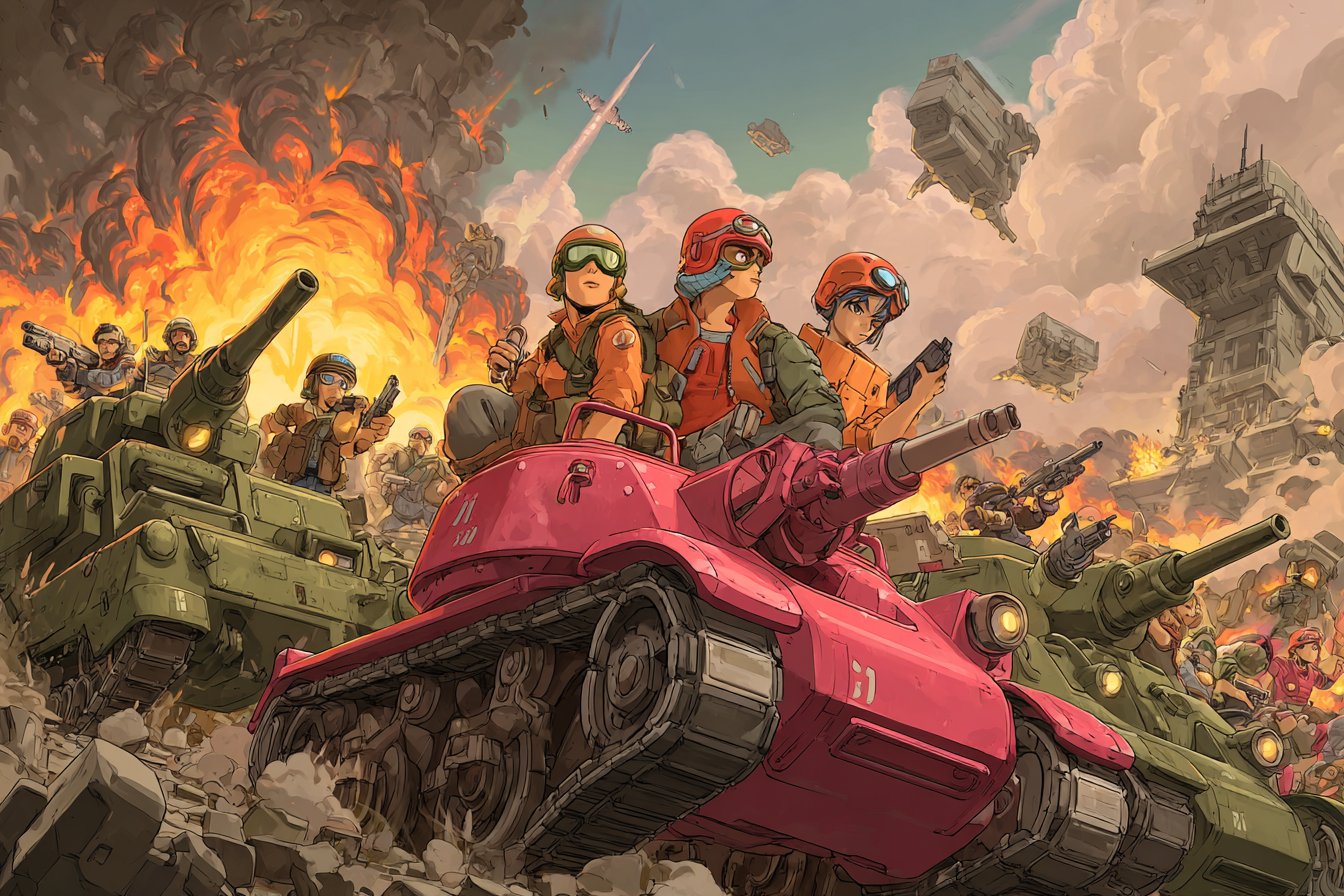
Marcus here, and I want to talk about something that has been bothering me about the way people discuss portable gaming. Tim continually claims that mobile strategy games are basically the same thing as those on Game Boy Advance showing that he has no idea about the technical brilliance that is Advance Wars. Advance Wars was more than a strategy game that simply ran on a handheld; it was a prime example of optimising complex systems on severely constrained hardware whilst still delivering a level of strategic depth that far exceeded most strategy games on PCs.
When Advance Wars released on September 10 2001 it accomplished something very unique – it showed that turn based strategy could perform fantastically on a portable device without sacrificing the depth that made the genre interesting. Intelligent Systems had been creating Wars games in Japan since the Famicom days but Advance Wars was the first time the series would appear in the West and would show techniques for designing portable games that would affect the industry for years to come.
Advance Wars received a Metacritic rating of 92 however more notably from an engineering standpoint it resolved fundamental issues regarding displaying large amounts of complex information on a very small screen whilst still allowing for responsive controls and deep tactical gameplay. This is why Advance Wars is still a notable achievement in terms of engineering that should be studied.
| Developer | Intelligent Systems |
| Publisher | Nintendo |
| Platform | Game Boy Advance |
| Year Published | 2001 |
| Genre | Turn based strategy |
| Players | 1 4 (local multiplayer) |
| Campaign Maps | Over 100 battlefields |
| Our Rating | 9/10 |
Advance Wars reached our list of the top Game Boy Advance games because it showed that complex strategy gaming could succeed on portable devices as long as the engineering behind it was correct.
Information Density and Interface Engineering
One of the key things about Advance Wars is how it resolved the fundamental issue of presenting large amounts of tactical information on small screens. The Game Boy Advance’s 240×160 pixel display seems comical compared to modern displays however Intelligent Systems successfully implemented an interface that displayed an abundance of tactical information without being too overwhelming to the user.
The cursor system was fantastic engineering. Rather than stuffing unit statistics into the main view of the screen the game utilised contextual information panels that would appear based on cursor position. For example hover your cursor over a unit and you will receive health ammo and fuel statistics for that unit. If you hover your cursor over terrain you will see movement restrictions and defensive bonuses for that particular piece of terrain. This method helped keep the battlefield free of clutter whilst providing instant access to critical information.
The map designs were also able to operate under strict technical constraints whilst still providing strategic complexity. Each tile had to hold information such as terrain type defensive values for the terrain movement costs for different types of units moving through that tile and possibly building information. The data structure had to be optimised to allow for smooth scrolling and fast path finding calculations on the GBA’s 16.78MHz ARM7TDMI processor.
Additionally the fog of war calculations are also worthy of note. In traditional real time strategy games calculating line of sight can consume a significant amount of CPU cycles and Advance Wars was no exception. However Advance Wars had to calculate the visible area for multiple unit types with different sight ranges across potentially hundreds of tiles of a map. The solution was elegant: pre calculate the visible areas of all units for all possible locations on the map and then update the visible areas of all units whenever a unit moves. This eliminated the need for the CPU to recalculate the line of sight for every single unit on the map for every single frame.
Finally the movement prediction system was also exemplary of the engineers’ ability to optimise for the hardware. When a unit was selected the game immediately highlights all tiles that the unit is capable of accessing factoring in the movement costs of the terrain fuel limitations of the unit and zones of control for enemy units. This required path finding algorithms that could process complex rulesets whilst also providing immediate visual feedback to the user. With only 256 KB of working RAM this level of real time calculation optimisation was vital.
Strategic Systems That Actually Matter
What sets Advance Wars apart from mere board game conversions is the strategic systems were designed specifically for the medium and not merely adapted from existing mediums. The CO Powers system is a perfect example of this. Each commanding officer has unique passive abilities and special powers that may be activated after taking damage. This was not just aesthetic fluff – it generated real strategic decisions regarding timing placement and resource allocation.
The unit balance was also mathematically precise in ways that few of the supposed “more complex” strategy games ever achieved. Each unit has specific attack values against other types of units thus creating a rock paper scissors relationship that is complex enough to matter yet simple enough to memorise. Infantry is cheap and may capture buildings but is vulnerable to indirect fire. Tanks are strong but expensive and slow. Anti air units counter helicopters but are weak against ground units.
The terrain system adds levels of complexity that most players never fully appreciate. Plains offer no defensive advantage but allow for maximum movement. Forests offer camouflage and defensive advantages but impede movement for most units. Rivers can only be crossed at designated points thus creating natural choke points. The interactions between unit types terrain effects and movement costs create tactical puzzles that require true strategic thought to resolve.
Weather effects are another example of how to add meaningful complexity without overwhelming players. Rain reduces movement for most units but has a larger impact on air units. Snow slows down movement for most units and reduces visibility. Sandstorms in desert maps create temporary cover. These are not aesthetic additions – they force players to adjust their strategies according to the environmental conditions.
The supply system is arguably the least appreciated aspect of the game’s design. Units burn fuel to move and ammunition to shoot. This creates natural limits on aggression and requires players to think about logistics in addition to combat. Burning out of fuel leaves units stranded. Burning out of ammunition turns expensive tanks into expensive targets. The decision of when and where to resupply becomes a strategic consideration not just routine maintenance.
Technical Achievement Despite Hardware Limitations
The sprite work in Advance Wars is some of the best examples of optimisation work on the Game Boy Advance. Each unit type required multiple animation frames for movement attack and idle states plus damaged versions. The colour palette limitations mean that each sprite had to fit within strict parameters whilst being visually distinguishable and legible at the game’s resolution.
Map scrolling in Advance Wars is remarkably smooth given the technical constraints of the hardware. The GBA’s tile based graphics system was well suited for the tile based maps typical of strategy games however keeping map scrolling smooth whilst updating unit positions animation frames and interface elements required careful memory management. It appears the designers understood the hardware’s strengths and designed to them rather than against them.
Audio compression was another technical challenge that was solved elegantly. A memorable and varied soundtrack is necessary for a game with over 100 battlefields but the GBA’s storage limitations necessitated extreme audio compression. The solution was a modular approach where musical themes could be mixed and matched to create variety without storing entirely new music files for each map.
The AI in Advance Wars was complex enough to present a legitimate challenge to players without requiring a ton of processing power. Enemy commanders had to analyse multiple possible movements take into account unit matchups consider the terrain advantages/disadvantages and develop plans spanning multiple turns. On a system with limited processing power this required efficient analysis functions that could rapidly evaluate the state of the board without having to perform an exhaustive number of calculations.
Managing player save data was critical to a portable strategy game with extensive campaign play. Players needed to save in the middle of a mission save progress across multiple battle modes and track statistics for hundreds of maps. The solution was to store compressed save states that included all game state data whilst still fitting inside the cartridge’s limited battery backed RAM.
Why Advance Wars Was Important To Portable Gaming
The delay of the European launch due to the September 11 attacks means that many players played Advance Wars much later than they originally intended to however when it finally arrived it demonstrated something important about what portable gaming could do. Advance Wars was not a simplified version of a complex genre – it was a game specifically designed to excel on portable hardware.
The local multiplayer feature of Advance Wars was another major technical achievement. Multiple Game Boy Advance systems could be connected for competitive head to head battles with each player viewing their own screen only. This required the synchronisation of the game state across multiple systems whilst maintaining responsive gameplay. The communication features that were available in the original version but missing in later ports represent some of the most advanced network coding in the history of the platform.
The influence on subsequent portable strategy games was immense. The information presentation techniques the interface design solutions the strategic systems design – all of these became models for how to translate complex genres to portable hardware. Whilst modern mobile strategy games use similar design principles they generally lack the mechanical depth and technical polish of the original.
Current Perspective and Technical Legacy
Playing Advance Wars today demonstrates how well the technical solutions developed for the original game have held up. The interface is still easy to understand and respond to. The strategic depth still presents real challenges to the player. The visual design is still clean and legible. None of these characteristics are coincidental – they are a direct result of the engineering choices that emphasised functionality along with form.
Re releases and ports of Advance Wars demonstrate both the strengths and the weaknesses of the original design. Portions of the game that stick to the original design and controls work well. Portions of the game that attempt to modify the controls for alternative input methods often suffer because the game was specifically designed for the GBA’s control layout and screen proportions.
From a technical standpoint Advance Wars addressed several of the same issues that many modern games continue to grapple with: providing clear displays of complex information on small screens developing sufficient strategic depth without over complicating the gameplay and achieving rapid performance under strict hardware constraints. The solutions employed in Advance Wars are worth examining not only for historical context but for practical application in current development.
The game demonstrated that portable does not necessarily imply simplified. Complex genres can work effectively on hardware with severe constraints if the engineering is executed with care and the design is oriented towards the strengths of the hardware rather than the limitations. This is a lesson that continues to be applicable as gaming progresses across increasing numbers of diverse hardware platforms with disparate capabilities and constraints.
Advance Wars was not just a great strategy game that happened to run on a handheld – it demonstrated how thoughtful design and engineering can generate experiences that are uniquely superior because of their platform not in spite of it. That is an achievement that is deserving of recognition and study.