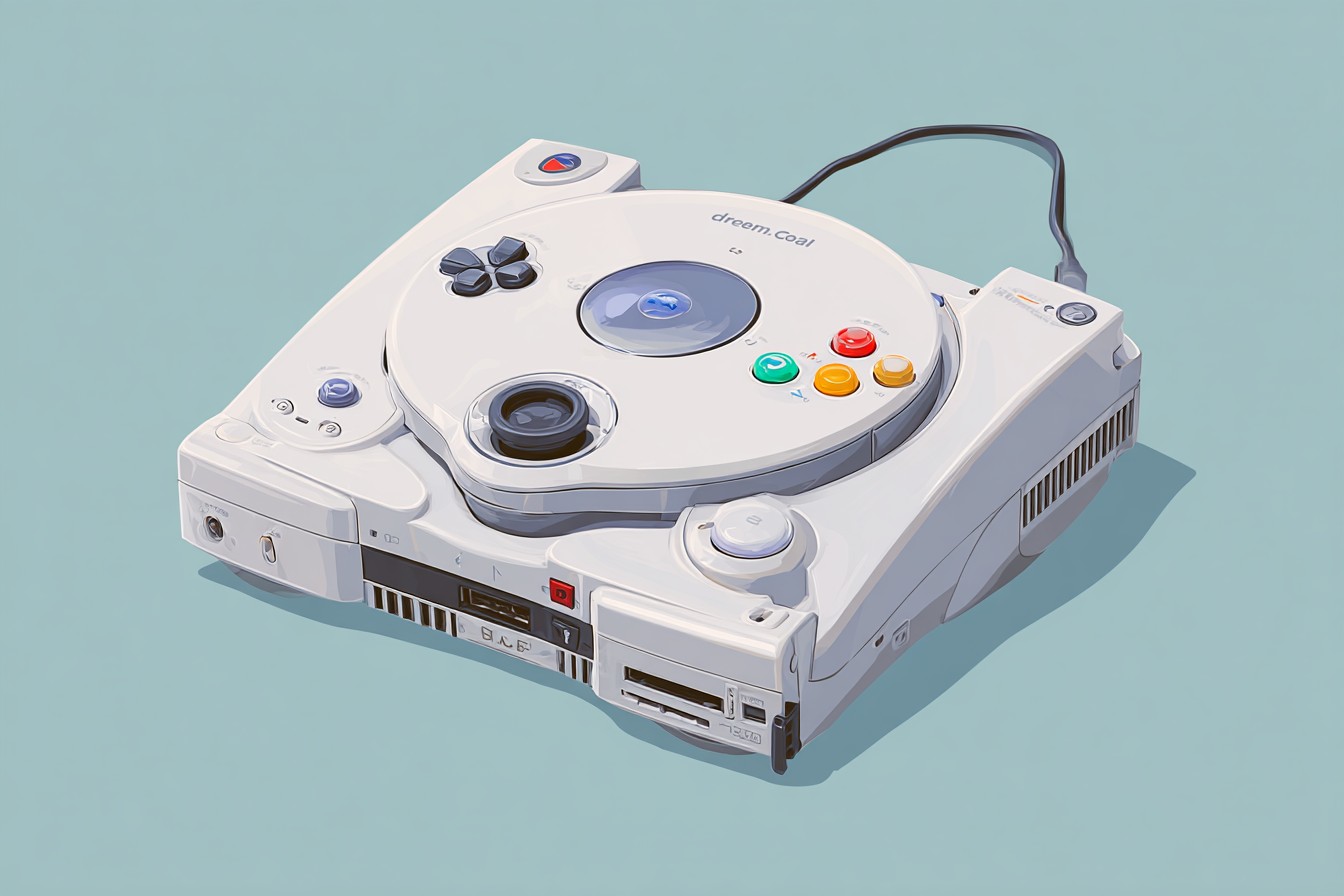

In many cases, the reason something fails can be more informative than the reasons something succeeds. The failure of the Dreamcast is more instructive than its success as it shows that great games are not enough to win the console war. Sega produced an incredible console, supported it with incredibly good software, established an internet-based infrastructure years before anyone else, and yet, still lost completely.
To understand why, you need to realize that console dominance is based on much more than the quality of the software available for it.
Dreamcast was released in Japan in November of 1998 and in North America in September 1999. The Dreamcast was Sega’s final console prior to them abandoning hardware production altogether. The Dreamcast was technologically advanced at the time; 128-bit processor, 16 MB of RAM, built-in modem for internet based play, etc. The games for the Dreamcast were fantastic. The internet connectivity of the Dreamcast was revolutionary for the time. In terms of any criteria for measuring success as a console, the Dreamcast was a successful console. However, commercially it was an abject failure resulting in Sega ceasing to produce hardware.
Worldwide, the Dreamcast sold about 10 million units before being discontinued in 2001. The PlayStation sold over 100 million units. The PlayStation 2, released the same year the Dreamcast was discontinued, sold over 150 million units. These numbers demonstrate the scope of the Dreamcast’s failure. The Dreamcast failed due to the fact that the market had already chosen the winner of the console wars before the Dreamcast was released.
What Was Good About the Dreamcast?
The Dreamcast was technologically innovative. It had a built-in modem and internet-based gaming capabilities before the internet was standard on consoles. Games such as Phantasy Star Online demonstrated that console users desired internet-based gaming capabilities. The Dreamcast had internet-based multiplayer capabilities before the PlayStation had this capability. The Dreamcast was truly ahead of its time in this area.
The Dreamcast had some very good games. Shenmue was a large-scale adventure game that demonstrated what could be done with the technology available. Jet Set Radio demonstrated that cel-shading could be done effectively and influenced many games for years to come. Soul Calibur was an arcade-quality port. Power Stone demonstrated that there was room for creative multiplayer fighting games. Skies of Arcadia was a solid JRPG. The Dreamcast had a wide range of high quality games. The quality and diversity of the games available for the Dreamcast deserved commercial success.
The controller was designed well and the VMU (Visual Memory Unit) was innovative. The VMU was essentially a small LCD screen built into the controller. The memory card contained a VMU, allowing the user to view information from the games while playing them. The controller was ergonomically designed and functioned well. The Dreamcast felt modern and cutting-edge in design.
Sega was very aggressive in their marketing efforts and they believed in the Dreamcast. They formed alliances with third parties to ensure they had access to quality titles. They were actively engaged in supporting the Dreamcast. From an effort standpoint, Sega did everything right when it came to launching and supporting the Dreamcast.
Why Did the Dreamcast Fail?
However, despite all of the above successes, none of them mattered as the market had already decided who would win the console wars. The PlayStation had dominated the previous console cycle. Many game developers had relationships with Sony. Retailers were stocking PlayStation titles. Parents were familiar with the PlayStation brand. The momentum in the market was almost insurmountable.
When the Dreamcast launched in 1999, the PlayStation 2 was already known to be coming in 2000. Knowing that a more powerful console was going to be released, retailers didn’t feel comfortable investing in the Dreamcast. Gamers held off buying the Dreamcast until the PS2 was released. Developers were already working on games for the PS2. As a result, the Dreamcast entered a market where the decision had already been made.
DVD was another key factor. The PS2 came with a built-in DVD drive, which provided immense value to consumers in 2000 when DVD players cost $300+. The Dreamcast used a proprietary medium called GD-ROM. In hindsight, it seems clear that including DVD functionality would be incredibly valuable. At the time, Sega chose to focus on developing games instead of incorporating DVD functionality into the Dreamcast. Unfortunately for Sega, this turned out to be a critical error. Consumers purchased the PS2 in part because of the low-cost DVD playback capabilities. The Dreamcast was unable to provide this level of value to consumers.
Immediately after the release of the Dreamcast, major publishers began to lose interest in providing third party support. Electronic Arts, one of the largest game developers, was initially hesitant to commit to the Dreamcast. EA was deeply involved in the development of PlayStation titles. To commit to the Dreamcast would require them to divert resources away from their very profitable PlayStation development. Ultimately, most major game publishers made the economically rational decision to support the existing market leader (the PlayStation) rather than take the risk of supporting the emerging challenger (the Dreamcast).
Sega’s financial situation was extremely weak. The company had lost money for several years prior to releasing the Dreamcast. The Saturn, the console that preceded the Dreamcast, was unsuccessful. As a result, Sega was already in poor financial condition before the Dreamcast was released. This weakened financial situation limited Sega’s ability to aggressively market the Dreamcast. It also prevented Sega from providing significant incentives to game developers to create content for the Dreamcast. Finally, it prevented Sega from absorbing the loss of a slow launch.
Timing Of The Release
Unfortunately, the timing of the Dreamcast’s release was particularly unfortunate. To launch a console in 1999 with a more powerful console already announced to be released in 2000 was disastrous. People simply told each other “Wait for the PS2” and the momentum for the Dreamcast was irreparably damaged. Furthermore, the stores that carried the Dreamcast had too many Dreamcasts in stock, which was an additional disincentive for people to buy the console.
The timing of the DVD issue was unfortunate for the Dreamcast. Although the inclusion of DVD functionality would ultimately prove to be an essential feature for a next-generation console, the timing of the introduction of DVD technology coincided perfectly with the launch of the Dreamcast. One year earlier or one year later, DVD technology may not have been widely adopted. In either case, the Dreamcast would have been able to capitalize on its technical superiority.
Finally, the U.S. was experiencing a recession in the early 2000s that resulted in reduced consumer spending. This reduced consumer spending negatively affected the Dreamcast’s chances of gaining traction in a crowded marketplace filled with entrenched competition. If the economy had been stronger, the Dreamcast may have been able to establish itself as a viable alternative to the PlayStation.
What The Dreamcast Could Have Done Differently
Was there anything Sega could have done differently to avoid the failure of the Dreamcast? Possibly. If Sega had delayed the launch of the Dreamcast to coincide with the launch of the PlayStation 2, the timing of the Dreamcast’s launch may have appeared less desperate. If Sega had included DVD capability in the Dreamcast, it would have provided the Dreamcast with a value proposition that was equal to that of the PlayStation 2. If Sega had secured EA’s exclusive support for the Dreamcast, it would have had the type of titles that mattered. If Sega had a stronger financial position, it could have provided developers with more attractive options to create games for the Dreamcast.
However, all of these are conditional. The fundamental issue was that the market had coalesced around the PlayStation and it was virtually impossible to reverse that momentum.
The Dreamcast proved a number of important lessons. First, the quality of the software available for a console does not guarantee success. Second, the position of a console in the market, the relationship between developers and manufacturers, the timing of a console’s launch, and sheer luck can all have a huge impact on whether or not a console achieves success.
Legacy of the Dreamcast
As a result of the failure of the Dreamcast, Sega abandoned hardware development. Instead of continuing to compete with Sony and Nintendo in the hardware arena, Sega became a third-party developer. Abandoning hardware development allowed Sega to save a tremendous amount of money by no longer having to fund R&D, manufacturing, and marketing efforts. Additionally, Sega’s financial struggles may have been exacerbated by their continued involvement in the hardware arena. As a result of abandoning hardware development, Sega likely earned more revenue per dollar from their games.
The community surrounding the Dreamcast has never disappeared. There is still an active group of enthusiasts creating games and modifications for the Dreamcast. The Dreamcast represents a point in time in the history of Sega when they were confident, innovative and concerned with providing the best experience for the gamer. The failure of the Dreamcast does nothing to diminish this accomplishment.
The Dreamcast demonstrated that innovation and quality games do not necessarily translate to commercial success. The Dreamcast had superior online gaming capabilities than its competitors. The Dreamcast had innovative games. The Dreamcast had a forward-thinking design. Yet, the Dreamcast was still defeated by market forces that were outside of its control.
Lessons From the Dreamcast
The failure of the Dreamcast demonstrates that success in the gaming industry depends upon many factors occurring simultaneously. Games are important. Hardware is important. Third-party support is important. Timing in the market is important. Economic conditions are important. When all of these factors occur together, success occurs. When any or all of these factors fail to occur together, excellent products will fail.
The Dreamcast was not a poorly designed console. It was an exceptional console released at a time when the market had already chosen the winner. This is a sad but important lesson about the business side of the gaming industry and how markets function. The Dreamcast’s legacy is that it proved Sega could develop exceptional hardware and software. That they still lost, proves a very important point about how markets behave and the degree of control that a challenger has against an entrenched leader.

Joe’s a history teacher who treats the console wars like actual history. A lifelong Sega devotee from Phoenix, he writes with passion, humor, and lingering heartbreak over the Dreamcast. Expect strong opinions, bad puns, and plenty of “blast processing.”
0 Comments