I’m Sam, and I want to get one thing settled after our team meeting. Tim said that action RPGs with cooperative gameplay are “basically button masher games with stat sheets.” Honestly, that’s a pretty big deal — and I think he’s never actually played Secret of Mana.
I get that the genre can seem overwhelming to someone just getting into it, but to dismiss one of the most important cooperative experiences in video game history simply because the combat may seem simple at first glance? That misses the whole point.
What Secret of Mana showed us about cooperative gaming that no one else had shown us before was that you could have the deep, stat-based progression of a traditional RPG with real-time combat that three players could enjoy together seamlessly. It wasn’t just a technical achievement — it was also a bold creative decision. Released in Japan Aug 6th, 1993 (Square Enix) and Oct 3rd 1993 in NA (Wikipedia) in a time when cooperative RPGs didn’t really exist yet, Secret of Mana represents Square at their most experimental and ambitious.
| Developer | Square |
| Publisher | Square |
| Platform | Super Famicom |
| Year Published | 1993 |
| Genre | Action RPG |
| Players | 1-3 (local co-op) |
| Our Rating | 9/10 |
How It Earned Its Place in Our Rankings of the Best Super Nintendo Games
We ranked Secret of Mana among the best Super Nintendo games because it was able to accomplish something that still feels incredible today: it took the complexity of menu-based combat and adapted it into real-time combat without sacrificing any of the strategic depth. What does that mean? There are a lot of action RPGs out there that choose to focus too heavily on button mashing, while others become too convoluted with too much to manage in terms of systems. Secret of Mana found the perfect balance.
The Charge System That Encouraged Coordination in Real-Time
From a design standpoint, the charge system for weapons in Secret of Mana created a natural flow that pushed players to coordinate with each other instead of just hacking wildly. Every weapon charged up differently, allowing you to delay attacking to build up a bigger strike, but also giving you the opportunity to lose momentum and create openings for your opponent. While the timing mechanism itself was purely functional, it fundamentally changed how combat happened when you had more than one player involved.
When you have three active players, each capable of using a variety of weapons and casting magic, you suddenly find yourself in this beautiful dance where one player is building up a major strike with a heavy sword, another is laying down defensive magic, and the third is ready to fire off a quick combo. In cooperative mode, the AI will control any unassigned players, but when real players are making split-second decisions about positioning, timing, and resource allocation, the entire experience comes alive.
The magic system worked extremely well with this kind of setup as well. Using magic would pause the game temporarily and allow a player to select a spell from a menu. On paper, this should have broken the flow of the game, but in practice, it created opportunities for teamwork and strategy. A team of three players would often have a player position themselves to receive a healing spell while the other two held their ground against enemies. They would also coordinate a large magical attack with a flurry of melee attacks to maximise the damage window.
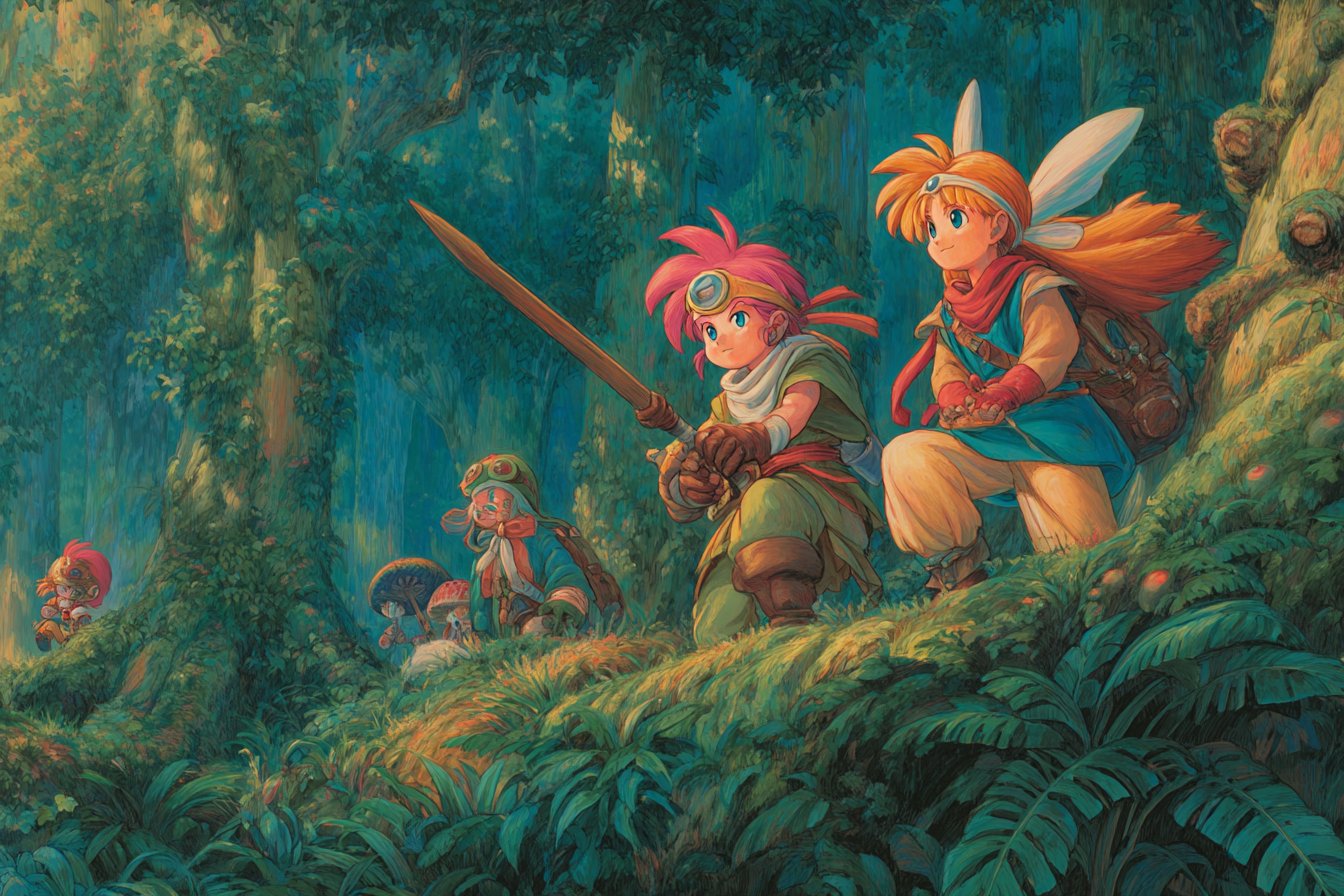
A key part of what made this work so well was how the weapon progression system allowed for different character builds and roles, but didn’t lock players into specific ones. The boy could start with a sword and upgrade to any weapon, the girl could begin with magic, but grow incredibly proficient with certain types of weapons as she levelled them up, and the sprite could specialise in magic, but also had preferences for certain types of weapons. With three players, teams could decide how they wanted to approach a fight based on the weapons they had found and upgraded, rather than relying on set roles for each member of the party.
Why Was Secret of Mana So Revolutionary?
In 1993, cooperative RPGs basically didn’t exist in a meaningful way. You could play turn-based RPGs where you could take turns controlling party members, but there were few games that allowed for real-time cooperative combat with fully developed characters. Secret of Mana changed that completely.
The technical achievement alone is worth mentioning. The SNES was able to handle three active characters, each with their own inventory, equipment, magic systems, and weapon skills, and maintain smooth real-time combat with cooperative input. Most action games of the time couldn’t even come close to handling two players without experiencing slowdown or input lag. Secret of Mana handled three players smoothly, and with complex RPG systems under the hood.
Where Secret of Mana really innovated was in how naturally the cooperative elements of the game emerged from the underlying mechanics, rather than feeling added-on. The charge system caused players to favour timing and coordination over button mashing, the magic system provided natural support roles without forcing players to specialise in healing, and the weapon upgrades allowed players to choose how to specialise their characters based on the materials they gathered and how they wanted to play, rather than being locked into pre-defined classes.
The Ring Menu System
One of the smartest design decisions in Secret of Mana was the ring menu system for selecting items, casting spells, and equipping equipment. When you wanted to perform a task such as casting a spell or using an item, you would press a button to open a circular menu around your character that paused the action for that player while allowing the other players to continue fighting. At first blush, this appears to be a clumsy solution, but in reality, it solved several problems elegantly.
Firstly, it maintained the real-time flow of the game. Instead of pausing the action for everyone to allow one player to make a decision, the ring menu allowed the other players to continue fighting while one player accessed the menu. Secondly, it made complex tasks easily accessible via a controller. Navigating the menu of a traditional RPG using a d-pad and two buttons would have been a chore, but the ring menu made navigating the menu easy.
Thirdly, the ring menu system created natural opportunities for cooperative play. When one player needed to heal themselves, the other players would automatically know to protect their position. If one player was searching through their inventory for a particular item, the other players would automatically try to keep the enemies off them. None of this was scripted; it came naturally from how the menu system worked.
The Progression Systems
The ring menus integrated nicely with the weapon and magic progression systems as well. As players upgraded their weapons with Weapon Orbs they found throughout the world, they unlocked new charge levels for their weapons, changing how those weapons felt to use. Spells became stronger and had new effects as players levelled up, making the circular menu for magic selection always feel fresh with new options appearing and older spells becoming more powerful.
These progression systems kept the 22-hour long main story (HowLongToBeat) feeling diverse and enjoyable. Rather than simply increasing statistics, players were unlocking new tactics and more efficient methods to coordinate with their teammates. By the time players reached the end game, players who had invested time in upgrading different weapon types could create combos that felt truly satisfying to perform.
Hiroki Kikuta’s Soundtrack That Defines a Generation
I’ve listened to a number of game soundtracks over the years, but Hiroki Kikuta’s soundtrack for Secret of Mana stands out from the rest. The soundtrack was more than just background music — it told a story that supported the cooperative experience in every way. The way “Fear of the Heavens” built tension during boss fights, or the way “The Oracle” created a sense of wonder and mystery during quiet moments between battles.
What made Kikuta’s music fit so perfectly with the cooperative gameplay was how it responded to the emotional rhythm of playing with friends. The combat tracks had enough energy to keep battles exciting, but left enough room for communication. The exploration music created atmosphere without being distracting when players needed to coordinate and strategise. The boss themes created legitimate tension that made victories feel earned rather than inevitable.
The audio design in Secret of Mana also complemented the music beautifully. The sounds of the various weapons were unique enough that players could tell what their teammate was doing without looking. The spells had audio cues that helped with timing and coordination. Even the sounds used to access the menu system were designed to work with multiple players accessing different systems at the same time, without causing confusion due to overlapping audio.
Attention to audio detail matters more in cooperative gameplay than you might realise. When three players are playing together, visual cues become more complicated because everyone is focused on different parts of the screen. Audio becomes critical for keeping track of what your teammates are doing, and Secret of Mana nailed it.
Why Does Secret of Mana Still Feel Relevant Today?
You can clearly see by now that Secret of Mana revolutionised cooperative gameplay in RPGs. While we’ve certainly seen advancements in graphics, complexity, and online multiplayer capabilities, the fundamental magic of three players working together in real-time RPG combat has yet to be improved upon by most modern games. That’s not to say that Secret of Mana doesn’t have its limitations — it’s definitely an older game, and it certainly hasn’t aged perfectly. However, that’s not the point.
The fact that the original version of Secret of Mana was updated and re-released in 2018 (Square Enix) to include better graphics, but retain the exact same cooperative gameplay speaks volumes about the quality of the original design. You can play Secret of Mana today through a variety of collections and remastered versions of the game on modern hardware, and the experience translates perfectly. The cooperative gameplay in Secret of Mana doesn’t feel dated because it was solving fundamental design issues rather than riding a trend.
Perhaps the most surprising thing is how well Secret of Mana scales with the number of players. Playing solo feels like a solid action RPG where you switch between characters strategically. Playing with two players creates a strong partnership where players cover for each other’s weaknesses. Playing with three players is a true team effort where each player takes on a distinct role that complements the others.
While most cooperative games either shine best with a specific number of players or force cooperation, Secret of Mana feels natural regardless of how many players you have.
Critical Reception and Influence
According to Metacritic, the critical reception of Secret of Mana is reflected in its score of 83. However, that’s not the true test of whether or not Secret of Mana was successful. The influence that Secret of Mana had on basically every cooperative action RPG that followed it is far greater. Games like the Tales series, the Crystal Chronicles games, and even modern indie titles like Children of Morta all draw their cooperative DNA from what Secret of Mana pioneered.
The Impact of Secret of Mana on Cooperative Gaming
Tim can keep arguing all day long about how shallow action RPGs are, but he is entirely missing the point. Secret of Mana demonstrated that you could have deep character progression, strategic combat, and meaningful cooperation all within the same game without sacrificing any element. Also known as Seiken Densetsu 2 in Japan (Wikipedia), Secret of Mana was Square at its most innovative, and created a game that felt natural to play cooperatively, and was also technically revolutionary.
What makes Secret of Mana an essential title isn’t just that it was first to do cooperative action RPGs well; it’s that thirty years later, it is still one of the best examples of how to do it right. The charge system, the ring menus, how the magic and physical combat systems complemented each other, and the natural role specialisation that emerged from the weapon system — none of these are outdated mechanics. They are timeless design solutions that modern games could benefit greatly from learning.
If you’ve never had the chance to experience Secret of Mana with two friends sitting side by side on a couch, then you are missing out on one of gaming’s greatest cooperative experiences. And if you believe that action RPGs are simply button mashers, then I think you are simply mistaken about Secret of Mana. Some games establish genres. Others transcend them. Secret of Mana did both, and that’s why it is an essential piece of gaming almost three decades later.