Joe’s been going on and on about Streets of Rage for weeks now, so I’m happy to take over for this post because I wanted to talk about something else entirely – basically, the fundamentals of the whole thing. As usual, we’ve been arguing about arcade hierarchies and I’m sick of hearing about it, so I thought I’d give the nod to a game that should be recognised for changing the face of gaming culture as a whole. Whilst Pac-Man is a classic, it’s a lot more than that – it’s the moment arcade gaming went from being a niche oddity to a global craze that will forever change the way we enjoy entertainment.
Released in 1980 by Namco via Museum of the Game, Pac-Man entered the gaming world at the height of the arcade gaming Wild West era when developers were trying to figure out what a video game really could be. Originally named Puck Man in Japan, the name change for the Western market was due to the fact that this simple maze game would have to function across many different cultures and languages in a way that no game had ever attempted before.
The sales numbers tell the story of an unprecedented level of success. Over 100,000 arcade units were sold within a single year, with a whopping 293,822 arcade units installed in seven years. However, the number of installations merely scratches the surface of the overall impact. Pac-Man generated arcade revenue of £3.5 billion U.S. dollars from 1980 to 1999 according to Guinness Record listings, whilst some estimates indicate the total amount of revenue generated by Pac-Man at arcades to be as high as £13 billion U.S. dollars. Success does not begin to describe the magnitude of this figure – it’s the kind of money that changes the face of an industry.
| Developer | Namco |
| Platform | Arcade |
| Year Published | 1980 |
| Genre | Maze / Action |
| Players | 1-2 (alternating) |
| Our Rating | 10/10 |
With this type of recognition, it earned its place among the most important arcade games of all-time, and is the ultimate example of how simple mechanics can create endless hours of entertaining gameplay, when implemented with precision.
The Genius Behind The Maze
At first glance, Pac-Man may seem like a ridiculously simplistic maze game that eats dots and avoids ghosts, however, the simplicity of the concept is a major part of the game’s brilliance. The true genius behind Pac-Man is in its ability to create layers upon layers of decision-making, keeping players feeding quarters into the machine for decades.
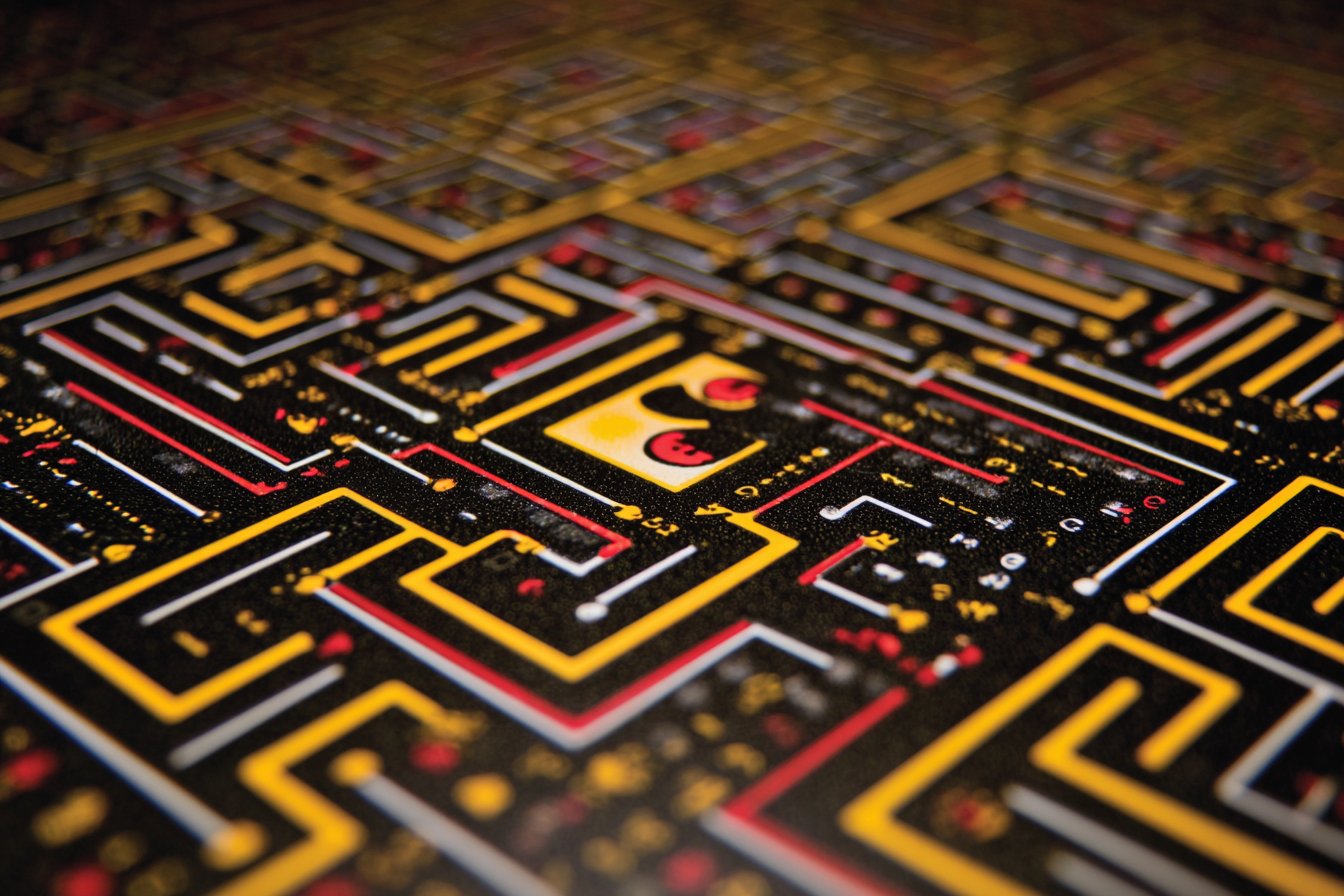
The maze itself is a masterpiece of spatial design. Every corridor width, every turn angle, and every tunnel placement is strategically placed to serve a specific purpose in the gameplay. The maze is not randomly generated, it’s deliberately designed to create strategic choke points, escape routes, and risk/reward opportunities. The tunnels that connect the left and right side of the maze are not just visually interesting – they’re critical components of the game’s strategic layer. The ability to move from one side to the other quickly allows players to create opportunities for more advanced gameplay strategies.
Each dot has two functions. On the surface, collecting dots advances a player closer to completing a level, however, the placement of the dots also affects the pace of the level, as well as the positioning of the ghosts. The maze creates natural choke points that force players to make decisions regarding their safety vs. efficiency. Will a player choose to clean up the centre area first when they have power pellets available, knowing that if they do so, the ghosts will become slower and easier to eat? Or, will a player choose to stick to the perimeter of the maze and risk being trapped later by ghosts?
When players consume power pellets, the fundamental dynamics of the game are altered in a manner that still feels groundbreaking today. For approximately ten seconds, predators become prey. Ghosts turn blue, slow down, and become edible for massive point bonuses. There is nothing quite like the feeling of turning the tables on your pursuers and actively hunting them down for revenge. The timing of this mechanic creates a sense of urgency – players know exactly how long they have to find a vulnerable ghost before the power pellet wears off and the ghosts resume their normal behaviour.
The point value of each ghost reinforces smart gameplay by increasing exponentially with each additional ghost consumed. The first ghost consumed is worth 200 points, the second is worth 400 points, the third is worth 800 points, and the fourth is worth 1600 points. The exponential increase in ghost values creates a sense of psychological pressure on players. Players know that pursuing that fourth ghost requires a continued aggressive posture in the face of a growing threat. If a player fails to catch the fourth ghost, they leave a large number of points unearned.
Players who become more experienced with the game discover various exploitative strategies that allow them to take advantage of the game’s underlying systems. Rather than breaking the game, these strategies reveal the complexity of the game’s underlying systems. The ghost artificial intelligence follows predictable patterns, which experienced players can learn to exploit. The ability to learn ghost behaviours and manipulate the game’s AI does not reduce the game’s challenge – it adds a new level of complexity to the game that separates casual players from more serious students of the maze.
Why Was Pac-Man So Different Than Other Games?
Prior to Pac-Man, almost all arcade games were based on a very similar concept: destroy enemies before they kill you. Pac-Man reversed this concept by introducing a hungry player that consumes dots instead of destroying enemy spaceships. The change in metaphor allowed Pac-Man to attract a wider audience of players that might be turned away from the violence depicted in many of the other arcade games of the day.
Whilst Pac-Man was Japan’s highest grossing arcade game of 1980 (per Game Machine charts), the international success of Pac-Man was dependent on more than the game’s unique mechanics alone. Unlike other arcade games that require quick reflexes and pattern recognition, Pac-Man demands spatial reasoning and forward thinking. Instead of reacting to threats as they emerge, players must think ahead and consider the positions of the ghosts, available escape routes, and the best method to clear the maze.
The character design of Pac-Man also contributed significantly to the game’s appeal. The main character of Pac-Man, a simple yellow circle with a mouth, is one of the most recognisable video game characters of all time – a testament to the power of simplicity. The four coloured ghosts are cute and menacing at the same time, with distinct personalities that contribute to the game’s charm.
The audio design of Pac-Man also plays a significant role in establishing the game’s atmosphere using minimalist approaches. The opening music is instantly recognisable, and the “wakka wakka” sound effect of Pac-Man eating dots is mesmerising. When Pac-Man consumes a ghost, he makes a satisfying “chomping” sound that lets him know he successfully defeated his opponent. Like the graphics, the audio effects used in Pac-Man are minimalistic, but effective in establishing the personality and emotional tone of the game.
Initially, Midway produced 5,000 units of Pac-Man for the US prior to the game catching fire. Clearly, even distributors did not believe the game would be a huge success.
By 1987, approximately 300,000 arcade units of Pac-Man had been sold, placing it amongst the top five most distributed arcade games of all time.
Creating a Culture of Competition Through Perfect Gameplay Loops
What draws players back to Pac-Man is not simply the enjoyment derived from playing a fun game with great mechanics – it is the psychological manipulation that occurs through the creation of perfectly balanced risk and reward loops. The gameplay loop found in Pac-Man is based on a very simple premise – each level is built upon the same general framework. However, the difficulty of the gameplay increases with each subsequent level and the duration of time that players have access to power pellets decreases. This creates a sense of familiarity mixed with increasingly challenging gameplay that draws players back time and time again.
In addition to being a great game, Pac-Man is also incredibly cognisant of the player’s psyche. The game allows players to feel confident and capable early in the game as they learn the patterns of the ghosts and the optimal route to take through the maze. Once players have gained enough experience and confidence, the intermediate levels of the game provide a healthy dose of challenge without being overly difficult. Finally, the advanced levels of the game become extremely difficult and require players to execute perfect movements and timing. This gradual increase in difficulty creates a sense of accomplishment for players as they progress from one level to the next.
One of the largest factors in Pac-Man’s longevity is its ability to foster competition. High score tables are not simply leader boards – they are status symbols. To achieve a high score, players must complete the levels efficiently whilst earning as many points as possible by eating ghosts, collecting bonus fruit, and navigating the maze in the most efficient route possible. This multi-layered form of mastery creates an endless cycle of improvement for players.
The bonus fruit system adds another layer of complexity without adding a tremendous amount of complexity. Bonus fruit appear in the maze at specific intervals and award the player varying amounts of points. Players with experience know when the bonus fruit will appear and adjust their route accordingly. New players can ignore the bonus fruit and still play the game without losing focus on the core gameplay.
The ghost artificial intelligence creates a sense of personality through consistent behavioural patterns. Blinky always pursues the player directly. Pinky attempts to ambush the player from ahead. Inky’s movement is determined by both Blinky’s current position and the player’s current position, thus creating unpredictable but logical ghost behaviour. Sue heads straight for the bottom-left corner of the maze after she emerges from the ghost house. This creates a sense of predictability – experienced players know how to exploit individual ghost behaviours as opposed to viewing all enemies as identical.
The process of memorising the maze is a significant factor in serious players developing strategic thinking skills. Players with experience don’t only develop optimal routes – they internalise the entire spatial relationship system of the maze. They understand which corridors connect to each other, which turns provide escape routes, and which paths lead to dead ends. This level of spatial awareness converts Pac-Man from purely reactive gameplay to proactive strategic planning.
Technical Innovations Within The Constraints Of Arcade Hardware
The technological achievements found in Pac-Man are all the more impressive given the limitations of the arcade hardware at the time. Pac-Man was developed using a Zilog Z80 processor with 16 KB of ROM and 2 KB of RAM. Despite the limited resources, the development team achieved smooth character movement, sophisticated ghost AI, and responsive controls that still feel precise today.
The screen scrolling in Pac-Man was revolutionary for its time. Instead of using the traditional method of rapidly switching between sprite locations (commonly referred to as “sprite flicker”) used in many earlier games, Pac-Man utilised smooth continuous movement of the character sprites. The ghosts appeared to behave intelligently rather than randomly, requiring highly sophisticated programming within the severe memory constraints.
Collision detection in Pac-Man is flawless, and this is crucial in a game where precise positioning determines the difference between life and death. Players are able to navigate through tight corners and narrow passages without experiencing any frustration related to poor control. The eight-way directional input reacts immediately to player input, and provides for frame-perfect timing when the situation calls for it.
The visual design of Pac-Man maximises impact within technical limitations. The bright primary colours used throughout the game ensure that the game is easily visible under the typical lighting conditions found in arcades. The character sprites remain distinct and recognisable regardless of their speed of movement. The maze itself utilises simple geometric shapes to create visual interest without the need for complex graphics processing.
Audio programming in Pac-Man is deserving of recognition for producing memorable sounds utilising the primitive hardware of the time. Each game-related event has a distinct audio cue that provides immediate and clear information to the player regarding game-state changes. The background audio changes during power pellet mode to create a sense of atmosphere whilst simultaneously informing the player of the time remaining.
According to Encyclopedia Britannica, Pac-Man is a landmark arcade video game, and this recognition reflects the technical and cultural significance of the game beyond its commercial success.
How Did Pac-Man Change The Face Of Gaming Culture And Bring About Its Breakthrough Into The Mainstream?
Beyond its financial success, Pac-Man revolutionised how society viewed video games. Prior to Pac-Man, arcades were generally viewed as a domain for teenage males. With Pac-Man, the non-violent theme and easy-to-understand mechanics appealed to a much broader demographic, including female and adult players who may have otherwise avoided the social stigma associated with entering arcades.
The merchandise frenzy surrounding Pac-Man was unparalleled for video games. T-shirts, lunchboxes, breakfast cereal, board games, and even a hit song by Buckner & Garcia reached an audience far removed from the confines of the arcade. This was not simply product licensing – this was cultural assimilation that helped establish video game characters as legitimate mainstream entertainment entities.
Television and print media covered Pac-Man seriously as a cultural phenomenon, rather than writing it off as a passing fad. Pac-Man received coverage in mainstream publications, academic studies, and even philosophical debates about modern life and consumption. This legitimacy helped bring video gaming to the forefront of the public eye and gave the medium the respect it deserved as a valid form of entertainment.
Pac-Man also spawned a competitive gaming culture that produced some of the earliest celebrity gamers. Billy Mitchell’s record-breaking perfect scores were legendary in gaming circles and set the standard for competitive gaming personalities that continue to thrive today. These were not simply high scores – these were performances that drew audiences and media attention.
Pac-Man’s international success also showed that well-designed games could cross cultural boundaries. Whether in arcades in Japan, shopping malls in America, or amusement centres in Europe, Pac-Man performed equally well across the globe. The universal nature of Pac-Man’s gameplay mechanics demonstrated that video games could be truly global forms of entertainment, as opposed to simply niche regional offerings.
Where Can Players Find Pac-Man Today
Pac-Man’s legacy lives on through nearly every gaming platform ever created. The original arcade experience is available via MAME emulation, and provides a pixel-perfect recreation of the original experience for purists. Many modern arcade compilations contain faithful recreations of the original Pac-Man, with the same timing and feel.
Contemporary releases often include quality-of-life improvements like save states and rewind features, but these additions can actually diminish the original experience. Pac-Man was designed around quarter-feeding pressure and permanent consequences. Removing that pressure changes the fundamental risk-reward calculations that drive engagement.
The speedrunning community keeps Pac-Man relevant through competitive play and route optimisation. Watching expert players navigate the maze reveals layers of strategy invisible to casual observation. These communities preserve institutional knowledge about advanced techniques and maintain the game’s competitive legacy.
Mobile versions exist but often suffer from control compromises. Touch controls lack the precision of arcade joysticks, making frame-perfect movements difficult. The best mobile implementations use directional swipe controls rather than virtual joysticks, but neither approach fully captures the original’s responsive feel.
For authentic experience, seek out original arcade cabinets or high-quality MAME setups with proper joystick hardware. The tactile feedback and precise timing of original controls are integral to understanding why Pac-Man achieved such enduring success.
The Maze That Built an Industry
We can argue about which games deserve recognition as the greatest of all time, but Pac-Man’s cultural and commercial impact remains unmatched. This isn’t just nostalgia talking – it’s recognition that some games transcend entertainment to become genuine cultural touchstones.
Joe might prefer his elaborate beat-em-up combos, and Timothy might champion modern indie innovations, but none of us can deny that Pac-Man established the template for gaming’s mainstream success. It proved that simple mechanics executed perfectly could captivate global audiences and generate sustained commercial success across decades.
The game’s continued relevance speaks to timeless design principles that modern developers still study and emulate. Clear objectives, escalating difficulty, immediate feedback, and meaningful player choice remain fundamental to engaging game design. Pac-Man didn’t just influence arcade games – it established core principles that underpin effective game design across all genres.
Forty-plus years after release, Pac-Man remains instantly recognisable and immediately playable. That’s not just historical significance – that’s proof of design excellence that transcends technological limitations and cultural barriers. When we discuss gaming’s greatest achievements, Pac-Man isn’t just on the list – it’s the foundation everything else built upon.