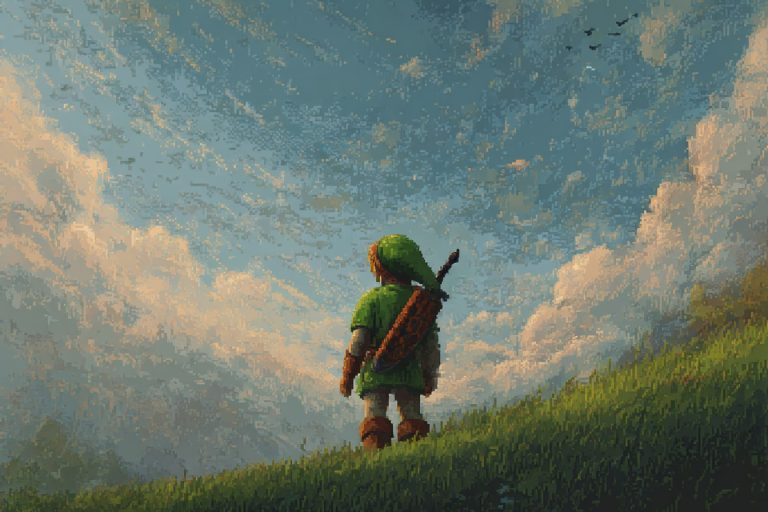

I’ll be honest — I’m a bit embarrassed to admit that I am relatively new to The Legend of Zelda; most people have fond memories of exploring Hyrule as kids. I was over 40 years old when I first started playing Zelda. My daughter had been pestering me for months to play A Link to the Past on her Super Nintendo, and I was continually stalling because, frankly, I thought it looked like kid stuff. What a mistake I made!
It was approximately 2011 (right after my second divorce), when I was questioning almost everything about my life. My daughter, Sarah, had come home from college for Winter Break and had set up her retro gaming collection in my living room. She had been trying to get me to start playing video games again for some time and showed me a bunch of classic games that I hadn’t grown up with. Most of them did not excite me, however, she was adamant that I was going to love this Zelda game.
“This one will be good,” she said repeatedly. “It’s got puzzles and exploration. It’s like… a construction project for your brain.” Since I am a sucker for anything that involves figuring out how things work and constructing something piece-by-piece, I humored her for twenty minutes before turning in for the night.
However, three hours later, I was still sitting on the couch, fully immersed in saving Princess Zelda from that dungeon. Sarah had dozed off in the recliner, but I wasn’t about to stop playing. There was something about how the game presented challenges and allowed you to work through them that was similar to the best parts of construction work – the feeling of satisfaction when you figure out exactly how all the pieces fit together.
The item upgrade system immediately hooked me (although I wouldn’t learn that’s what it was called until later). Each new tool you discovered (the boomerang, the lantern, the bow) solved the current challenge in front of you, but also changed the way you viewed all the places you’d previously visited. Suddenly those dark rooms were no longer barriers. Those enemies across gaps were now conquerable. It was like getting a new power tool that changed how you approached every single job site.
I recall spending an entire weekend stuck in what I would later learn was the Desert Palace, and I was so convinced that the game was broken because I could not figure out how to proceed. At the time, I hadn’t yet learned the Zelda rule that if you can’t make progress in the game, then you likely overlooked something obvious in front of you. I was about ready to quit when I noticed a slightly different colored area of wall. Bombed it. Secret passage. The thrill I felt when that wall came crumbling down was more exhilarating than completing any construction project I’d ever worked on.
The first time I completed that first game, it took me about two months of evening and weekend sessions. I played very methodically, the same way I construct buildings – slow, deliberate, making sure I thoroughly understood each step before proceeding. Sarah checked in on my progress periodically, providing a hint or two when I became truly stuck, but primarily allowing me to work through issues independently. It appeared she understood that figuring things out was half the fun for me.
When I stumbled upon the Dark World reveal, I almost had a heart attack. Just as I had mapped out what I thought was the entire game world, suddenly here’s another, complete, second version of everything – twisted and distorted. It was as if I had built a house and thought I was finished, only to realise there was a whole second floor I’d never seen. The way familiar locations were distorted into something evil but still familiar… I had never experienced anything like that in any medium.
Battling Ganon at the end was actually quite stressful. Over dozens of hours, I had developed an attachment to that little pixelated Link character, I knew his limits and capabilities, and now I had to face this giant pig creature wielding a trident. My hands were actually sweaty during that final battle. When the credits rolled and I saw Link put the Master Sword away in its pedestal, I felt a unique mixture of satisfaction and sadness. I had accomplished something substantial, but now it was over.
At that point, Sarah introduced me to Link’s Awakening. Then Ocarina of Time. Then Majora’s Mask. Next thing I knew, I was immersed in this entire franchise, working backwards through the last thirty years of Zelda’s history with the enthusiasm of someone trying to make up for lost time. My fellow construction workers thought I had lost my mind, but I didn’t care. I was enjoying myself more than I had in years.
Ocarina of Time was revolutionary, even for playing it many years after its initial release. The 3D world felt enormous compared to the top-down games. That first time entering Hyrule Field as Adult Link and seeing the magnitude of the world stretching out in front of you… it provided the same sense of awe I experience when standing atop a skyscraper I’ve helped construct and viewing the surrounding cityscape.
The Water Temple, however… Oh man… That thing almost killed me. I actually drew diagrams on graph paper to attempt to keep track of the various rooms I’d explored at each water level. It took me three weeks of evening sessions to navigate through that temple. The organizational skills I used to manage the sheer amount of information in that temple proved useful for managing the construction process, but it was still brutal. When I defeated Dark Link and obtained that Longshot, I may have performed a small victory dance in my living room. Don’t tell my crew.
Video game music is something special. I’m not a musical person – construction sites don’t lend themselves to melodies – but Koji Kondo’s scores got under my skin. That A Link to the Past main theme still sends chills down my spine. The Song of Storms from Ocarina still randomly pops into my head while I’m working. There’s something about how the music tells the story in conjunction with the visuals that I’d never experienced before.
I’ve played the majority of the major Zelda titles in recent years. I was initially skeptical of Wind Waker’s colorful graphics, but the ocean-based exploration evoked memories of the fishing trips I used to go on with my father when I was young. I felt like I was coming home after the Wind Waker’s creative departure from the typical Zelda style with Twilight Princess. Breath of the Wild totally changed my expectations for what a Zelda title could be – and provided the same sense of discovery I had felt when I first played A Link to the Past, but in an enormous open world.
To me, this series’ ability to maintain consistency across different generations of hardware and design philosophies is impressive. Regardless of whether it’s 2D or 3D, linear or open-world, the essence of the experience is the same – exploration, puzzle-solving, gradually mastering tools and techniques. It’s problem-solving wrapped in entertainment, which appeals to the problem-solving aspect of my brain that spends all day figuring out how to construct something efficiently and safely.
As I’ve continued to grow older and continue to play additional titles in the Zelda series, my relationship with Zelda has evolved. I recognise the patterns now – the three-act format, the dungeon progression, the way items block access to certain areas until you are able to obtain them. However, recognising the formula does not decrease my enjoyment. In fact, it is as if I am having a conversation with an old friend whom I know well, but who always seems to have something new to share.
Sarah and I still share our experiences with Zelda titles. We often exchange texts when a new Zelda game is released, we compare notes on challenging sections, and we debate which titles are the strongest. It is a common vocabulary for both of us, and it fills in some of the lost time when Sarah grew up and I was working nonstop. Fewer than fifty fathers and daughters in their fifties and twenties have heated debates regarding whether the timeline split adds or detracts from the overall narrative of the Zelda series, but we enjoy doing so.
In retrospect, I am amazed that it took me forty years to discover something that has provided me such joy. Being raised in poverty meant I missed out on a significant number of cultural references that others consider commonplace. However, approaching Zelda as an adult, unencumbered by childhood nostalgia, allowed me to appreciate the craftsmanship in these games in ways that I may not have as a child. The level design, the progression mechanisms, the subtle manipulation of player psychology to create feelings of discovery and accomplishment – all of it is sophisticatedly designed when you pay attention to how it is constructed.
Currently, I have most of the major Zelda titles in my game room, ranging from the original NES cartridge to the most recently released titles on the Switch. Visitors to my house think it odd to see all of these bright and cheerful fantasy games in a home owned by a rough-around-the-edges construction foreman, but I’ve long-since stopped caring what others think about my hobbies.
There is something reassuring to me about knowing that as long as Nintendo continues to produce Zelda titles, I will have these meticulously designed worlds to explore, problems to solve, and adventures to participate in. After more than a decade of catching up on this series, I finally feel like I understand why everyone has been raving about Zelda for the past 30 years. Sometimes the greatest discoveries are worth the wait, even if it takes four decades to find them.

0 Comments