I’ve been gaming long enough to recognize a pattern – games that are immediately beloved become sacred, and games that are quietly good get forgotten. Kirby 64: The Crystal Shards is the second type. It shipped late in the N64’s lifecycle. It came out in the shadow of Majora’s Mask and Paper Mario. Nobody was talking about it. So it just disappeared.
Then I replayed it recently and realized something – this is a masterclass in elegant game design. Not through revolutionary mechanics or technical achievement, but through understanding what makes platformers work and executing that understanding with complete precision. This is what happens when designers have constraints and don’t try to fight them.
What Kirby 64 Actually Does
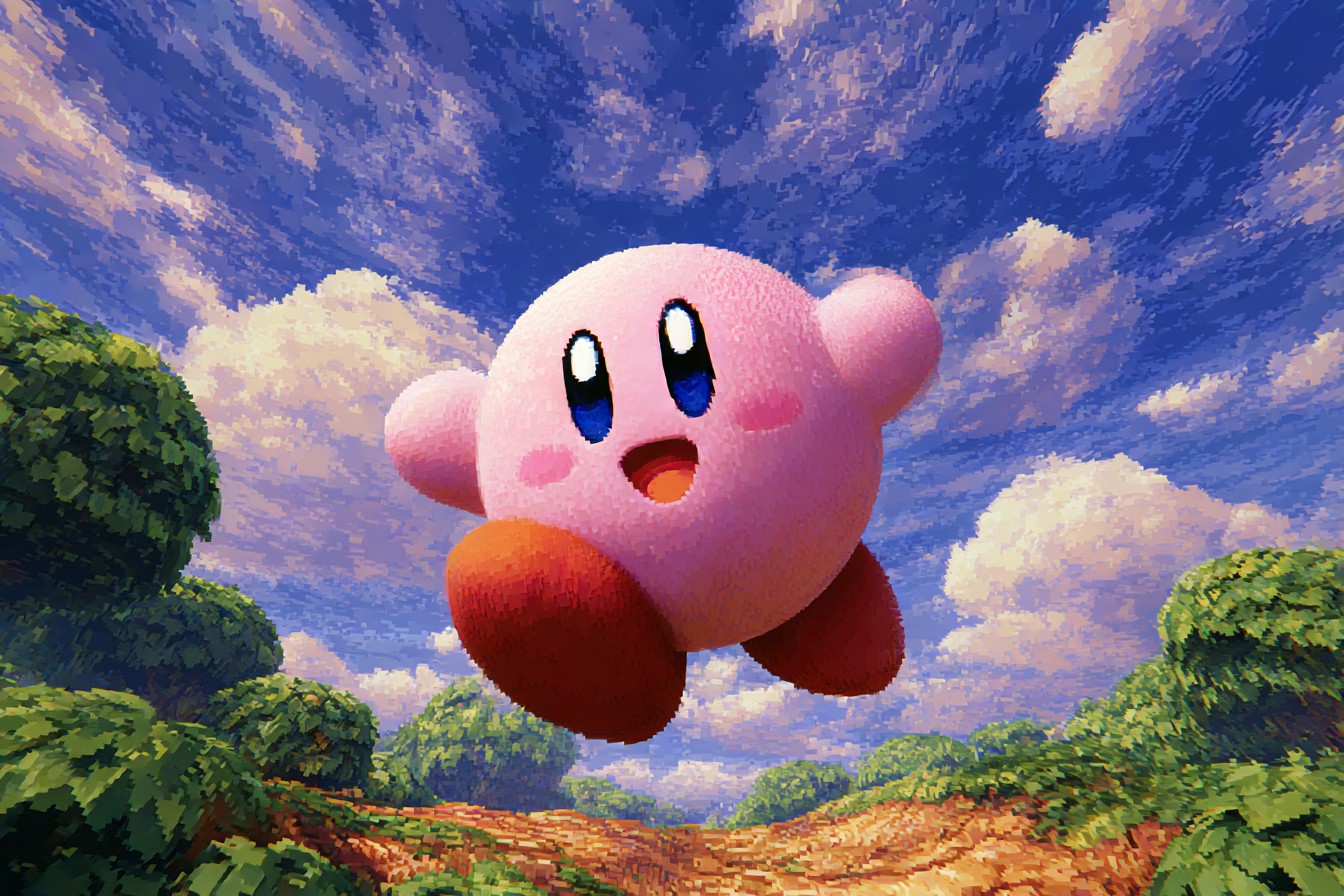
Kirby is a pink blob that eats things. He’s in a colorful world with various enemies that have different abilities. When Kirby eats enemies, he gains their powers – copy abilities like sword, fire, bomb, ice, beam, and others. The genius of Kirby 64 is the combination system – Kirby can combine two different copy abilities to create hybrid powers.
Combine bomb and rock and you get a bomb rock. Combine sword and fire and you get a fire sword. Combine ice and wind and you get an ice wind. There are dozens of combinations, and each one dramatically changes how you approach puzzles and platforming challenges. The sword-bomb combo is aggressive but unwieldy. The ice-wind combo is elegant and lets you control space with precision. The fire-beam combo is powerful but demands careful positioning.
What impresses me about this design is how thoughtfully the combinations are balanced. None of them feel useless. None of them feel overpowered. They’re all tools that solve different problems. You’re not collecting combinations for completion – you’re using them because they’re the right tool for the situation.
The level design accommodates the combination system. You’ll find an obstacle, have a copy ability available, and need to experiment with combinations until something works. Sometimes it’s obvious – this wall is icy so I need fire, but what else should I combine fire with? Sometimes it requires genuine thought. The game rewards experimentation without penalizing mistakes.
The Visual Design That Works Because Of Constraints
Here’s what technical people forget – Kirby 64’s pre-rendered backgrounds aren’t a workaround for N64 limitations, they’re an art direction choice that happened to solve technical problems. The hand-drawn aesthetic, the soft colors, the almost watercolor-style backgrounds – this is beautiful specifically because it’s stylistically committed.
Modern indie games have learned this lesson – strong art direction makes technical limitations invisible. Kirby 64 was doing this in 2000. The sprite-based Kirby contrasts beautifully with the pre-rendered environments. The character animations are smooth and expressive. The enemy designs are charming without being cutesy.
What strikes me is how readable everything is. You can see exactly where you can jump. Platforms are visually distinct from backgrounds. Enemies are immediately identifiable. This is clarity of design that modern games sometimes sacrifice for complexity.
The Level Design That Teaches Through Exploration
There are no tutorials in Kirby 64. You just start playing and immediately understand what’s happening. The early levels are gentle introductions to movement and basic copy abilities. By the midpoint, you’re dealing with complex combination requirements. By the end, you’re executing precisely-timed platforming with combination strategies.
Each world has a distinct theme. Dream Land is whimsical. Shiver Star is frozen and mechanical. Aqua Star is water-based. Ripple Star’s corrupted sections are dark and threatening. Pop Star has volcanic and celestial elements. Kracko’s Cloud domain is the final challenge. The progression from familiar to increasingly bizarre is well-paced.
The bosses are creative and fair. They teach you about specific combinations or skills, then test whether you’ve learned them. Dedede is a pure platforming challenge. Ado tests your combination strategies. Kracko demands precision. The final boss incorporates everything you’ve learned.
Optional content is substantial without being required. Secret rooms are hidden throughout levels. If you explore thoroughly, you’ll find them. They reward curiosity but don’t gate progression. This is exactly how optional content should work – enriching the experience for players who want it, but optional for those who don’t.
Why Nobody Talks About This Game
Kirby 64 came out in 2000, when the N64 was already aging and everyone was looking toward the GameCube. It’s a colorful platformer in a library full of dark action games and high-budget productions. It’s not immediately impressive – it doesn’t push hardware boundaries. It’s not trying to be cinematic or complex. It’s just a very good platformer.
Which is exactly why it’s undersold. Modern gaming has this bias toward complexity and ambition over elegance and execution. Kirby 64 is the opposite – it does something relatively simple with complete precision. That’s not marketable. That’s not exciting. That’s just… good.
The Design Elegance That Emerges From Constraints
The combination system is brilliant specifically because Kirby can only hold two copy abilities at once. If he could hold three or four, the combinations would become meaningless. The constraint is what makes the decision matter. Which two abilities do I need for this section? Do I switch combinations or try to make do with what I have?
The small levels (smaller than Super Mario 64’s) are efficient. Every room serves a purpose. There’s no padding. Progression is swift and satisfying. You’re not traveling massive distances between challenges – you’re constantly engaged. This is tight design made possible by accepting that smaller doesn’t mean less.
The gentle difficulty curve is actually sophisticated game design. Games that ease you in too slowly feel condescending. Games that spike immediately are frustrating. Kirby 64 finds the exact middle ground where each new challenge feels achievable but requires attention. By the final levels, you’re executing genuinely complex platforming with precise combination usage.
Does Kirby 64 Still Hold Up?
Completely. The controls are responsive. The levels are well-designed. The art direction is beautiful. The platforming is tight. The combination system creates genuine depth. Playing this today, the only dated element is the graphics quality – and even that holds up reasonably well because of the strong art direction.
The frame rate is consistent. The collision detection is fair. The respawn system is forgiving. There are no significant flaws – just a genuinely well-made platformer.
The Verdict
Kirby 64: The Crystal Shards is a masterclass in platformer design. Not because it invented anything revolutionary – it didn’t. But because it took established mechanics, added a clever combination system, designed levels that utilized that system perfectly, and executed everything with complete precision.
This is what happens when designers understand constraints and don’t fight them. The combination system is brilliant specifically because it’s limited. The levels are perfect specifically because they’re focused. The difficulty curve is excellent specifically because it respects the player’s learning progression.
If you’ve never played it, play it. If you dismissed it as a minor platformer, replay it and appreciate the elegance. If you make games, study how Kirby 64 creates depth within simplicity – that’s a master class in design thinking.
Rating: 9/10 – The underrated platformer that proves elegance beats ambition
Return to our full N64 rankings →