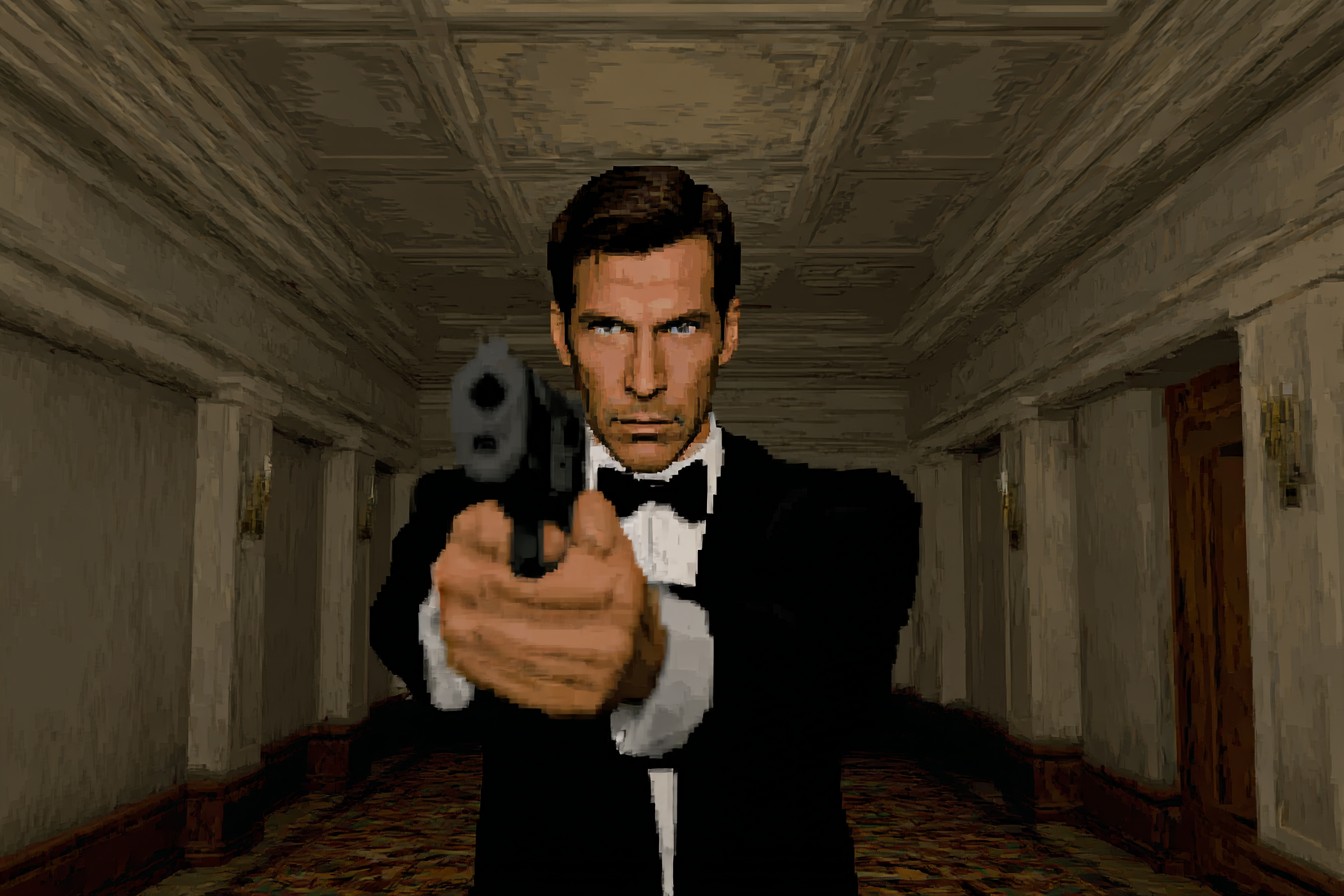
Here’s the thing about GoldenEye 007 that people who didn’t live through 1997 don’t understand – everyone said it was impossible. The FPS genre belonged to PC gaming. Doom proved it. Quake proved it. The idea that you could do a competent first-person shooter on a console controller was basically laughed off as fantasy by everyone who actually paid attention to technical specifications.
Then Rare released GoldenEye and proved that consensus wrong in the most devastating way possible. It didn’t just work – it was brilliant. And more importantly for console gaming’s history, it fundamentally changed what was possible on dedicated hardware. This is why I teach it in my history classes, honestly. GoldenEye’s success wasn’t just about making a good game – it was about timing, market positioning, and understanding that sometimes the impossible is actually just the unatttempted.
What GoldenEye Actually Proved
The game shipped with a single-player campaign that’s basically a love letter to the James Bond film franchise. Each mission is structured like a film sequence – you’re sneaking through a Soviet missile facility, infiltrating a weapons manufacturing plant, retrieving stolen helicopter schematics. The missions have specific objectives. Take out the guards quietly or go in guns blazing. Collect the specific item you’re after or just get out alive. The game respects multiple approaches.
Sean Bean’s character fires missiles at you from a helicopter. You’re fighting through a tank facility. There’s a dam level where precision and observation matter. The campaign is solidly five to eight hours depending on difficulty, and that’s generous by modern standards. It’s not padded. It’s not grinding. It’s focused, narrative-driven, and designed around the specific conceit of being a James Bond adventure.
But here’s what made GoldenEye matter historically – the multiplayer. Four players, split-screen, simultaneous combat in arenas that were small enough to support local play but large enough to offer genuine strategic depth. The Facility level is basically a multi-floor laboratory with weapons scattered throughout. Respawn points are distributed so you can’t just dominate one area forever. Item placement matters – the Golden Gun in one location, the body armor in another, the machine guns in obvious places but the best weapon in a location that requires some risk to access.
The weapon balance in that multiplayer was somehow perfect. The Golden Gun is overpowered but unreliable – you have limited ammo. The plasma rifle is useful but slow. The submachine guns are effective but short-range. The sniper rifle is powerful but punishing if you miss. Even the least equipped player has a genuine shot at winning because the game respected randomness enough to make come-from-behind victories possible but rewarded skill enough that the best player usually won.
The Technical Achievement That Everyone Ignores
I teach game history and I always have to emphasize – GoldenEye wasn’t technically impressive by 1997 standards. The graphics are chunky. The frame rate is capped at lower levels. The draw distance is limited. But here’s what everyone forgets – it was technically impressive for a console. PCs had been doing FPS games for years. Consoles hadn’t. The fact that Rare made it work at all was the achievement. The fact that they made it good was remarkable.
The control scheme is what actually mattered. Two players using the controller differently – one person controlling movement and camera with one stick while another player was handling targeting and aiming independently. Or if you were playing solo or online, using the buttons for camera control and the stick for movement. It required retraining your muscle memory, but once it clicked, it worked perfectly.
This is where I have to get a bit philosophical about gaming history – GoldenEye proved that innovation doesn’t come from pushing technical boundaries. It comes from understanding your specific constraints and solving problems within them. Rare didn’t have the processing power of a high-end PC. They had a cartridge console and limited RAM. They worked within those limitations and created something brilliant anyway. That’s the lesson people miss.
Why Oddjob Was Broken And Why That Matters
In multiplayer, Oddjob is universally banned. His hat weapon is essentially overpowered – it’s fast, it’s effective, and aiming at his small model is a nightmare. Everyone knew this. Nobody cared. Because the brilliant part of GoldenEye’s multiplayer was the implicit understanding that you could set custom rules. Different weapons allowed, certain characters banned, specific levels vetoed. The game shipped with enough flexibility that groups of friends could immediately figure out their own balance.
This is actually important for understanding how gaming communities work. GoldenEye didn’t have online matchmaking enforcing official rules. You had to negotiate with your friends. That meant the game could be unbalanced in specific ways and it didn’t matter because your group would just ban the broken stuff. It’s a feature, not a bug – the system was robust enough to handle intentional imbalance because the human element was part of the game.
Compare this to modern online gaming where balance patches are constant and breaking even one weapon sends everyone into a frenzy. GoldenEye worked because it trusted players to figure out their own rules. That’s either naive or brilliant depending on how you frame it – I’d argue it’s both.
The Multiplayer That Destroyed Friendships
I’m a history teacher, right? So I teach about significant cultural moments. I genuinely count GoldenEye’s multiplayer as one of those moments – it’s the game that proved local multiplayer FPS could work, which basically defined console gaming for the next decade. Before GoldenEye, you played fighting games and Mario Kart together. After GoldenEye, you played first-person shooters together.
The psychological impact of sitting next to your opponent on the same screen, watching them watch you, talking trash in real-time – it’s different from online play. There’s an immediacy to it. You can’t blame lag. You can’t rage quit without everyone watching you do it. There’s accountability to in-person gaming that’s harder to achieve online.
I watched friendships actually fracture over repeated GoldenEye defeats. I’m not exaggerating. People got angry. Because the game was competitive enough that losing felt like a genuine skill gap rather than just luck. Nobody gets personally devastated by losing at chance games. They do get upset when they lose because the other person is better at something they care about.
Does GoldenEye Still Hold Up?
The single-player campaign absolutely holds up. The mission design is still solid. The objectives are clear. The level design rewards observation and planning. It’s not a long game by modern standards, but it doesn’t need to be – it tells the story it set out to tell and then gets out of the way.
The multiplayer is chunkier than modern shooters, sure. The graphics are dated. The frame rate isn’t constant. But the core gameplay – the feel of the combat, the weapon balance, the arena design – it’s still engaging. You can play GoldenEye on an original N64 today and have a genuinely good time with friends.
The controls take adjustment if you’re used to modern schemes, but they work. They always worked once you understood them. This is where I have to push back against the narrative that old games just feel worse – GoldenEye feels different, not worse. Different isn’t the same as inferior.
Why This Mattered Historically
GoldenEye didn’t just prove console FPS could work – it proved that first-person shooters belonged on consoles. Before GoldenEye, FPS was definitively a PC genre. After GoldenEye, every major publisher wanted console FPS franchises. Halo existed because GoldenEye proved the market. Modern console gaming as we know it is basically built on the foundation that GoldenEye established.
This is what fascinates me as a historian – how one game’s success can pivot an entire industry. GoldenEye was technically impressive but not revolutionary. It was based on an existing IP. It wasn’t even the best-selling N64 game. But it was released at exactly the right moment when people were curious about what was possible on console hardware, and it answered that question perfectly.
The timing was crucial. Too early and the hardware wasn’t capable. Too late and everyone would have already made their assumptions about console limitations. GoldenEye landed in this sweet spot where it could actually change minds.
The Verdict
GoldenEye 007 isn’t just the best FPS on the N64 – it’s one of the most historically important games ever made. Not because it invented anything new, but because it proved that established genres could be reinvented for new platforms if you understood the constraints and worked within them intelligently.
The single-player campaign is a solid Bond adventure. The multiplayer changed what console gaming could be. The control scheme became the standard that worked for a generation. The balance was inspired. The level design was clever. Everything served the larger design goal of creating a great FPS experience on limited hardware.
If you’ve never played it, play it and understand why it mattered. If you played it with friends and have memories of terrible Oddjob matches and trash-talking across the controller divide, replay it and remember why that was special.
Rating: 10/10 – The game that proved console FPS could be brilliant
Return to our full N64 rankings →