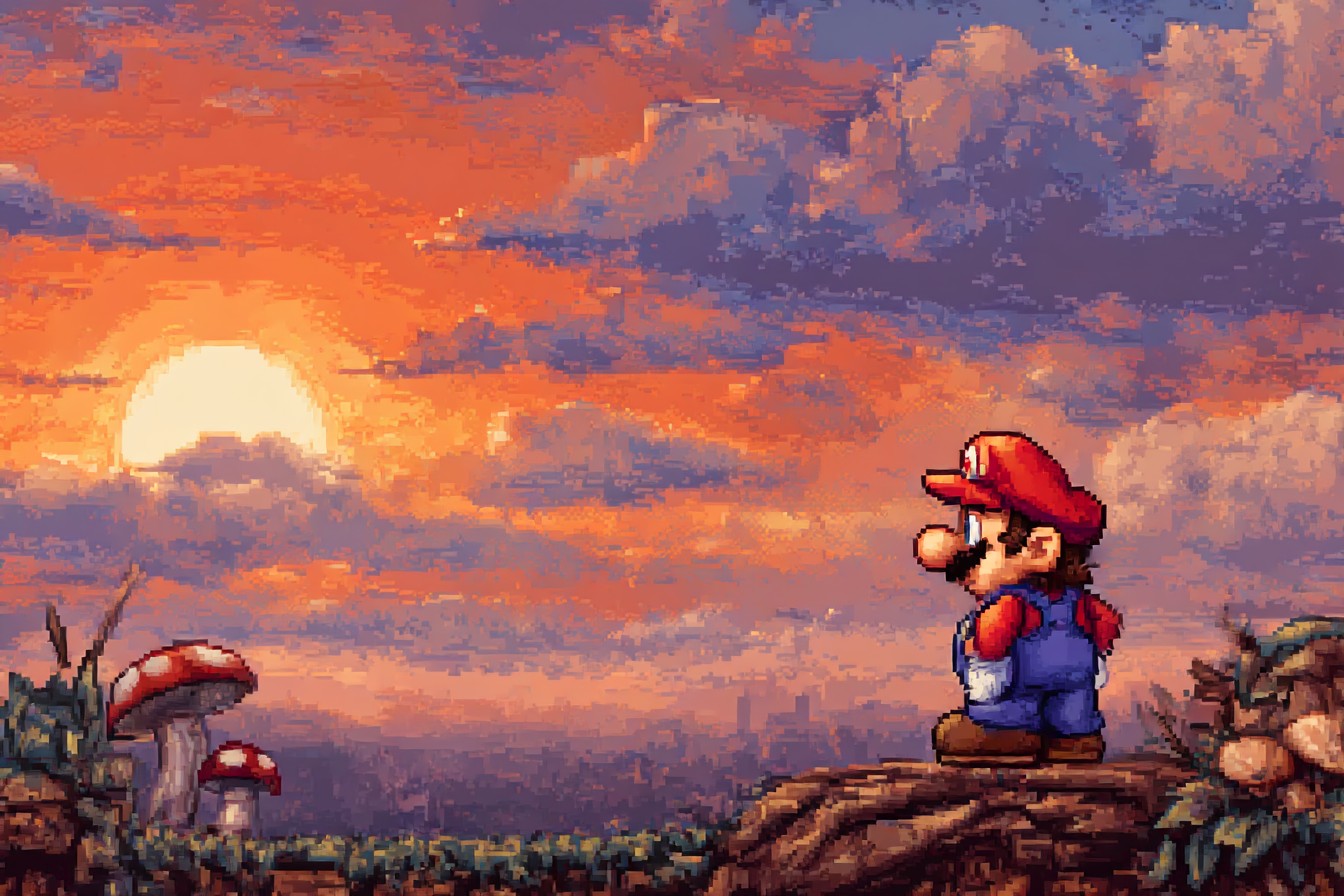
I came to Super Mario 64 late, which probably gave me an unfair advantage in understanding it. Most people who grew up with this game have it wrapped up in nostalgia – their first experience with 3D gaming, their first memories of the N64. I first played it in 2021, sitting in my basement after a long day at the construction site, with zero childhood attachment and just my own assessment of whether the design actually worked.
It does. Completely. And what strikes me most isn’t the technical achievement – though that’s obvious – it’s how efficiently the design communicates without any wasted motion. Coming from a construction background, I understand how systems work, how constraints force elegance, and how you can tell immediately when something’s been built by people who understood their limitations. Super Mario 64 feels like a structure designed by architects who knew exactly what the hardware could do and used every inch of available space.
What Super Mario 64 Actually Did
The N64 controller looked ridiculous when it first appeared. Three handles? An analog stick in the center? After growing up with directional pads, this seemed overcomplicated and awkward. Then you picked up Super Mario 64 and immediately understood why. The analog stick let Mario move in full 360-degree increments. You weren’t moving up, down, left, or right – you were moving in any direction you pointed the stick. Combined with a camera system that actually worked, you suddenly had true three-dimensional movement.
The game’s structure is deceptively simple. You’re in Princess Peach’s Castle, and you can walk into paintings that are portals to different worlds. Each world has multiple Power Stars hidden in different ways – some for reaching high places, some for solving puzzles, some for collecting coins, some for defeating challenges or bosses. You need a certain number of stars to unlock new doors in the castle and progress the story. It’s straightforward enough that a child can understand it in minutes.
But the execution is where Super Mario 64 becomes remarkable. Each painting leads to a world that’s self-contained but massive. Peach’s Castle grounds. Bob-omb Battlefield with its open area perfect for learning how to move and jump. Whomp’s Fortress with its obvious vertical progression teaching you how to think about 3D height. Cool, Cool Mountain with its racing segment and sliding challenges. Each area has multiple stars, but they’re arranged so you can tackle some immediately and others only after learning specific skills or collecting specific power-ups.
What impresses me is how tightly the camera system works once you understand it. You control Mario with the analog stick, and you control the camera with the C buttons. Initially that feels awkward and divided. By about thirty minutes in, it becomes second nature. The targeting system – aiming at enemies or objects with Z – locks the camera in a way that makes sense for that situation. The designers weren’t fighting the hardware constraints – they were designing around them intelligently.
The Level Design That Teaches Without Tutorials
Every Power Star in every level teaches you something. Bob-omb Battlefield is probably the easiest. You’re introduced to the basic movement, jumping, and ground combat. There’s a star for reaching the top of the mountain that teaches you about the level’s geography. There’s a star for defeating the boss, teaching you how the combat system works. There’s a star for collecting 8 red coins, teaching you exploration and observation.
The genius is that you can get three or four stars in Bob-omb Battlefield without being particularly skilled or observant, but getting all seven requires genuine mastery. You need to find secret areas. You need to figure out that some paths only open if you tackle challenges in specific ways. You need to understand the level thoroughly. The game never explicitly teaches this progression – it’s demonstrated through level design.
By the time you reach Tick-Tock Clock, you’re dealing with machinery that moves, timing-based challenges, and vertical spaces that require precision platforming. You’re not being taught these mechanics – you’ve already internalized them through gameplay. The level is just raising the complexity bar knowing you understand the fundamentals.
What strikes me about this design philosophy is how it respects learning curves. The first world is safe. You can’t fall off and die – you just get knocked back a bit. The difficulty escalates gradually. By the final worlds, you’re doing triple jumps off moving platforms over bottomless pits. But you’ve had enough practice that it feels achievable rather than unfair.
The camera system that I mentioned works because the developers understood one crucial thing: they didn’t need the camera to be perfect in every situation. They designed levels where the camera mostly stays out of your way. When it does get awkward, it’s usually in optional areas. For the critical path through the game, the camera is fine. That’s not a compromise – that’s smart design.
The Power-Up Progression That Feels Earned
You start Mario with just his basic moveset – jumping, kicking, punching, basic attacks. Then you gain access to power-ups that expand what he can do. The Wing Cap lets him fly, fundamentally changing how you approach vertical spaces. The Metal Cap makes him heavy and sink in water, but also immune to knockback. The Vanish Cap makes him pass through certain walls. Each one opens new areas and new possibilities.
What impresses me is that the level design changes to accommodate the available power-ups. You unlock a Wing Cap late in the game, and suddenly levels you thought you understood completely change because you can now access areas that were previously unreachable. You’re not retreading the same space – you’re discovering new facets of existing spaces.
This is exactly how good design works in construction. You have constraints, you work within them, and then when you gain new tools you can approach problems differently. The designers didn’t add power-ups for the sake of it – they designed levels where those power-ups unlock new possibilities. It’s elegant integration rather than tacked-on features.
Why The Camera Matters
Look, I know this isn’t glamorous to talk about. But the camera system in Super Mario 64 became the industry standard for third-person action games. That’s not accident. It’s elegant problem-solving. You’re controlling Mario and the camera independently, which sounds like it would be confusing. But because the game teaches you this system gradually and the level design is forgiving enough that imperfect camera positioning isn’t punishing, it works perfectly.
By the final level – Bowser’s Castle – you’re doing complex platforming with moving platforms, enemies trying to knock you off, and camera angles that would have been nightmare-inducing in a less well-designed game. But it works because the foundation is solid.
Does Super Mario 64 Still Hold Up?
Playing this fresh in 2021, yeah, it absolutely holds up. The graphics are dated but charming. The controls feel responsive and intuitive. The level design is still brilliant. The pacing never drags. There’s always something new to discover. The optional content doesn’t feel like padding – it feels like genuine additions to the world.
Some modern quality-of-life features would be nice – a quick-travel system for later stages, maybe some kind of objective tracking for side missions. But these feel like genuinely minor additions to an already solid experience. The core game doesn’t need fixing.
The Technical Achievement
From a pure construction standpoint, what Super Mario 64 did on the N64 hardware was staggering. The cartridge had to load worlds instantly with no loading screens. The texture memory was absurdly limited. The processing power was constrained. The designers had to be ruthless about optimization. Every texture mattered. Every polygon mattered. Every animation frame mattered.
The result is a game that looks clean and readable. Nothing is wasted. The art direction compensates for technical limitations – bold colors, clear shapes, excellent animation. You’re not distracted by technical shortcomings because the design is so confident that you barely notice them.
The Verdict
Super Mario 64 isn’t just the best 3D platformer on the N64 – it’s one of the best platformers ever made, period. Not “for its time,” just genuinely one of the best. The design is elegant. The controls are responsive. The levels are masterfully constructed. The pacing is perfect. The progression teaches without lecturing.
If you’ve never played it, play it. If you’re interested in how game design should work – how constraints lead to creativity, how teaching through gameplay is superior to tutorials, how systems should integrate rather than feel bolted on – play this and study it.
This is what happens when developers understand their hardware, respect their players’ time, and design with intention rather than padding.
Rating: 10/10 – The blueprint for how 3D platforming should work
Return to our full N64 rankings →
Timothy discovered retro gaming at forty and realized he’d been missing out on studying how great design actually works. A construction foreman by day, he approaches games the way he approaches buildings—understanding every piece, recognizing constraint-driven elegance, and appreciating when something’s been built by people who knew exactly what they were doing.
Timothy