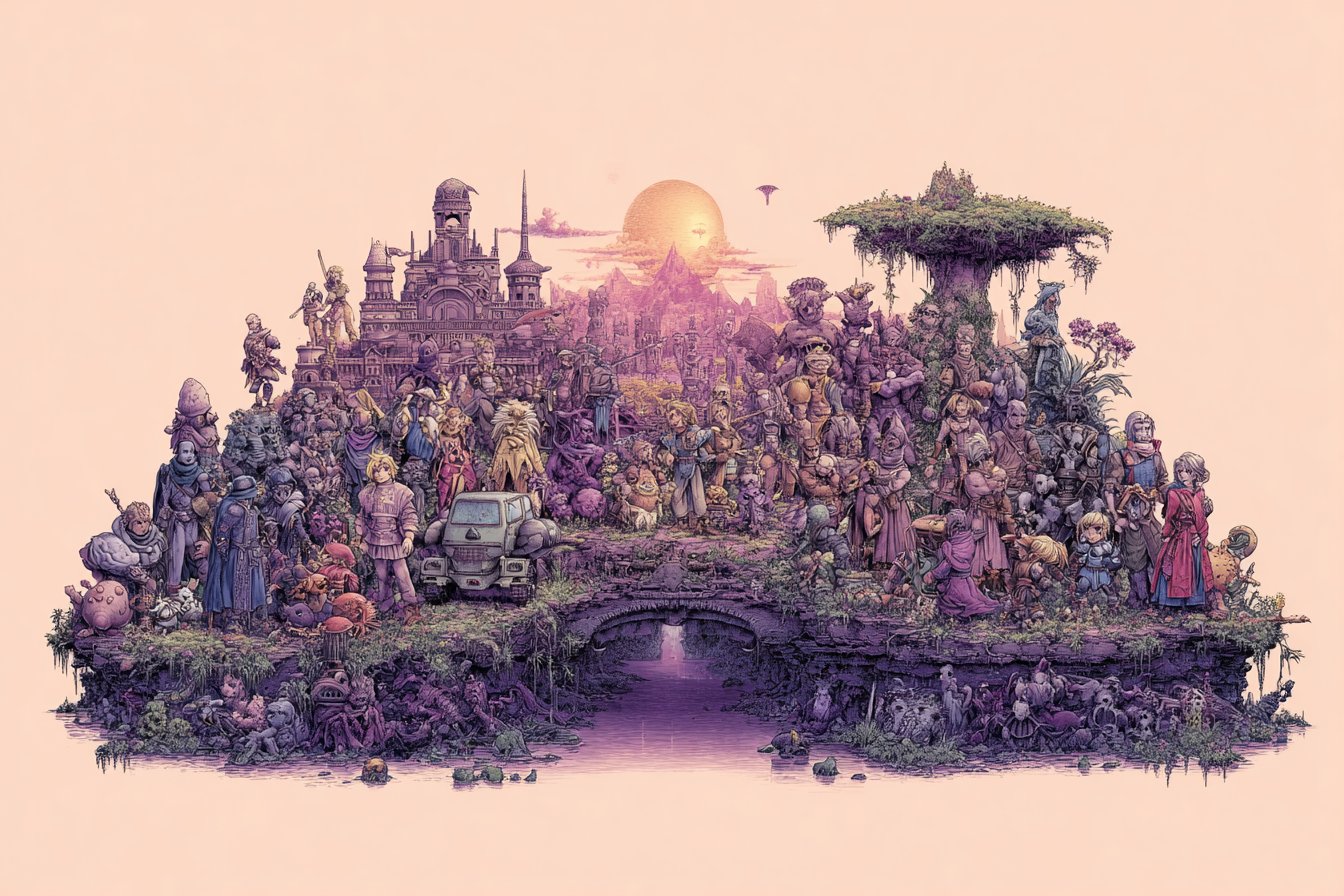
Release Date: December 6, 1992 (Japan) | Developer: Square | Platform: Super Famicom/SNES (16-bit cartridge) | ROM Size: 8 Megabits (1 MB total ROM) | Playtime: Main story 30–35 hours, Main + extras ~50 hours, Completionist 100+ hours | Sales: 2.07M (Japan), 2.5M+ worldwide (original + ports) | Critical Reception: 34/40 (Famitsu, 1992), Metacritic 86/100 (Pixel Remaster), ~87/100 (GBA Advance)
I didn’t get into retro gaming until I was forty years old. I had no rose-tinted glasses about these games. I didn’t experience any of them as a kid, so I had no “Oh yeah, I remember playing this when I was eight!” excuses. I approach every game from the perspective of a construction foreman wondering: does this actually work?
Few games work quite as well as Final Fantasy V. It answers the question most people didn’t know they should ask.
What if we took the job system and made it actually deep?
1992 Problems
There were two problems with asking this question in 1992. Timing. Final Fantasy V shipped in Japan on December 6, 1992(Wikipedia), then North America in 1999 via PlayStation as part of the Anthology collection. It was critically acclaimed at launch, scoring 34/40 from Famitsu. It sold 2.07 million copies in Japan, and around 2.5 million worldwide including ports.(VGSales) (ActivePlayer)
The problem is … Western audiences never played it. Not until PlayStation. Not until September 30, 1999.(Wikipedia) Seven years after it had already been critically praised and finished its lifecycle.

What They Actually Built
Jobs. Not classes. Jobs. Allow me to explain why that matters.
Each job in Final Fantasy V isn’t just something you select during character creation. You can freely switch jobs any time. Want your Black Mage learning monks skills? How about that White Mage learning how to thieves steal? Every job change maintains your learned abilities thanks to an Ability Point system.(Final Fantasy Fandom)
There’s an elegant simplicity to it. You can become anything. But you have to put the work in to discover these job combinations.
Think of jobs less like choices and more like ingredients. You have twenty-two potential ingredients to cook up a unique cocktail of abilities.(Final Fantasy Fandom) Want a mage that can fight? Learn embers from Black Mage, then switch to Fighter and learn warrior skills.
Want to play a plain old magician that can beefy-up allies and deal damage? That’s easy too.
Hell, you can just run around with a dancer who has literally every ability in the game and steamroll everything. It is kinda broken that way.(Final Fantasy Fandom)
And because FFV was only 8 Megabits of data on cartridge (1 MB total ROM)(Final Fantasy Fandom) (Wikipedia) that meant every job had to be compact. Every ability added to a job had to earn its place. It’s like Nelson asked himself with every job addition:
“Will our players enjoy fooling around with this? Does this job open enough possibilities that players will explore it?”
If a job didn’t satisfy these questions, it got cut.
Hard.
Why The Job System Works
Most games with jobs behave like actual careers. You pick something you enjoy, and you stick with it. Versatility or flexibility comes from picking the job that works best for a particular fight.
The brilliance of FFV’s approach is that your versatility increases as you learn more jobs. Flexibility isn’t found between jobs, it’s found within them.
Main story playtime will get you around 30–35 hours.(Final Fantasy Fandom) That’s not too bad. If you hunt down every extra, you’re looking at around ~50 hours.(Final Fantasy Fandom) But if you go completionist, pushing for every last job mastery, ABP grind, and superboss, you’re clocking in at 100+ hours.(Final Fantasy Fandom)
OK, time to level with you. Final Fantasy V doesn’t have the best story. Not by a long shot. It’s dang near undone by how lightweight everything is. After months of gaming you in IV with deep cutscenes and gut-punches, FFV just doesn’t aim to invest you emotionally. We care about the characters, sure. But nothing feels important.
Seriously, the only memorable moment is watchingthat gigantic lizard smash apart in an earthquake because someone got a little too ambitious learning an advanced job.
But …
What FFV lacks in narrative weight, it makes up for in pure, unbiased joy. Player agency. Exploration. Ability min-maxing. There’s nothing here that punishes you for digging deeper, and everything you discover feels earned.

Why The West Didn’t Get This
Square didn’t bring Final Fantasy V West because they thought it was too complex for audiences.(Wikipedia) Specifically they thought the job system would be too much work.
They’re not wrong. FFV assumes you’re going to tinker. But … that’s where I think Square severely underestimated Western gamers.
They didn’t love FFV, they were protective of their audience. “These players won’t know what to make of the job system. They want simpler stories. We have to guide them.” So instead of localizing Final Fantasy V, Square went with IV.
Thank God they did.
Final Fantasy IV was gorgeous, it was story-rich, and it was released here in the US as Final Fantasy II. The West fell in love with cinematic FFs.
And here’s the real problem. They missed out on Final Fantasy V, but they didn’t know they missed out on Final Fantasy V.
By the time FFV gotported to PlayStation in Japan (1998) and as Final Fantasy Anthology for PC by North America on September 30, 1999,(Wikipedia) western players had alreadybuilt up expectation for what a Final Fantasy should be based off of FFIV.
The emotion. The moments that would take me months to save-up Squares to buy FFIV.
When Final Fantasy V hit, it was too little too late. Western players already knew what a Final Fantasy was supposed to look like. FFV was never able to break-out because western players who hit FFV in 1999 had already learned FF through currency.
Does It Hold Up Today?
Pixel Remaster scored Metacritic 86/100, while the GBA Advance version clocks in at ~87/100.(Wikipedia) (Final Fantasy Fandom) Recent scores recognise just how deep the jobs are and how many jobs there actually are. It’s viewed as a cult classic these days, with praise for how it aged post-localization.(Wikipedia)
Jobs in FFV are leagues ahead of VI’s Esper system. FFV is smoother. Magic feels earned rather than abstract numbers. Bosses know when you’re sidestepping their design and punish you if you wander in empty-handed.
That said, it is 1992. Everything about FFV shows its age. Leveling up means scrolling through an antiquated menu to switch jobs mid-battle. Dodging random encounters is a necessity. Some high-level enemies feel outright impossible without grinding a level or two higher.
But what doesn’t age? The ethos. The pure elegance of a game that doesn’t tell you how to play it. FFV encourages you to experiment. The job system punishes you not trying things out.
It respects you as a player.

Final Thoughts
Yeah I said it. Final Fantasy V respects you as a player. Here’s the thing about not experiencing a game as a kid: you judge them solely on quality. Nothing else matters.
Is the story good? Sure, up to a point. Does it have deep lore and excellent dungeons? FFV has those too. Ask yourself this:
When was the last time you played a JRPG and could become anything you wanted?
FFV rewards creativity, and it offers you the freedom to actually play the game how you see fit. If there’s a complaint I have, it’s that FFV doesn’t give you enough jobs. More would have fit on the cartridge absolutely. FFV is an absolute gem of a game.
It’s a shame so few Western players got to experience it in 1992.
Rating: 8/10 – Job system perfection that the West took seven years to play
Click here to return to our Complete Final Fantasy Rankings →