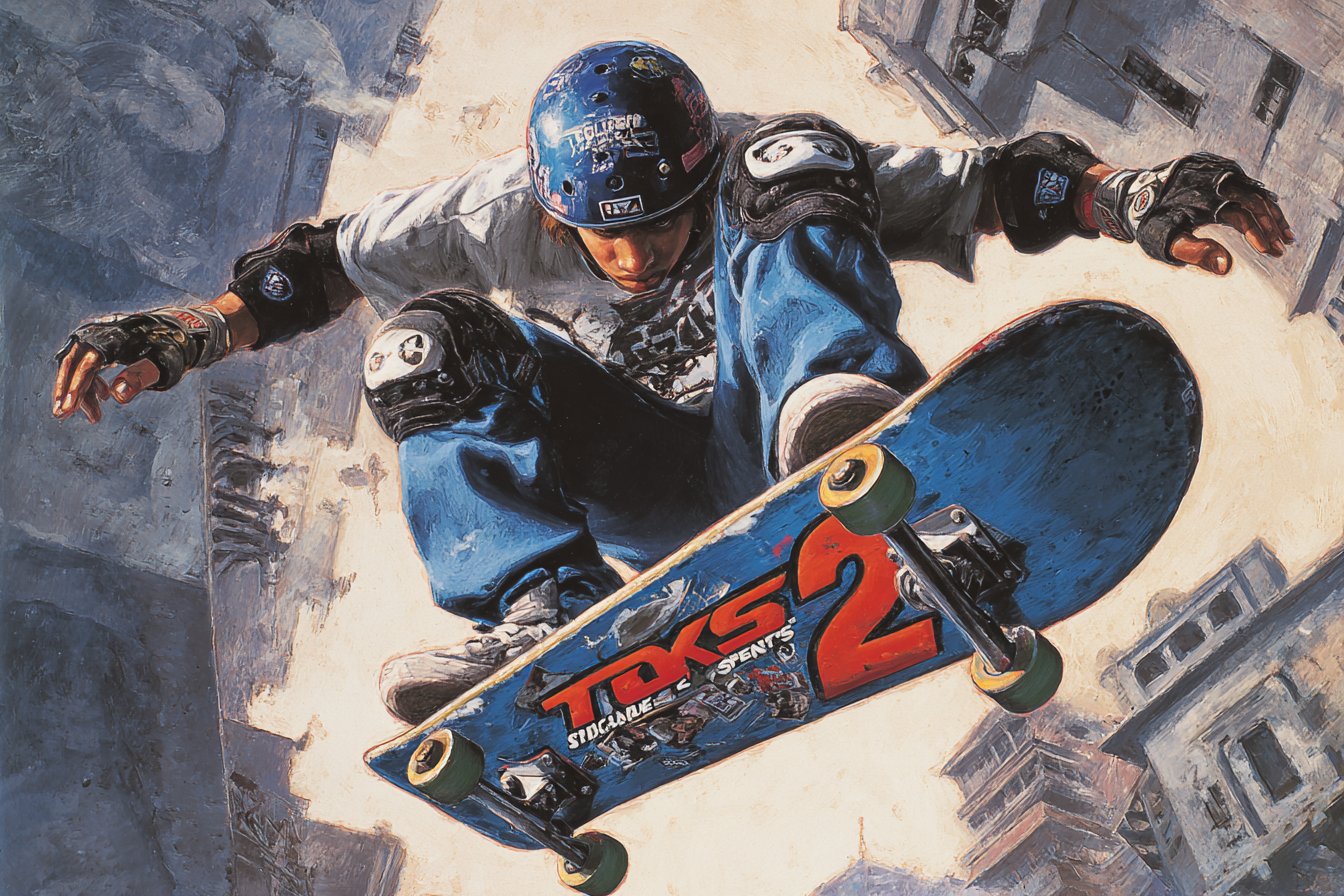
OK, fair warning, I’m going to sort of step off the Amiga soapbox for a second to defend a game that actually worked on crap. “Listen to this guy whining, why not stick to bloody Sensible Soccer and leave the console reviews to guys that understand them, eh?!” Well, here’s the deal. I grew up in the age of computer gaming then watched the slow slide into console dominance, and Tony Hawk’s Pro Skater 2 was one of those games that for once opened my eyes as to why everyone was dumping their Amigas for PlayStations. It was released for the PlayStation on September 20, 2000 in America (Tony Hawk Games Fandom). And it wasn’t just another sports game cash-in. It was the year skateboarding went mainstream from the niche it once occupied, and it was proof that sports games could have as much mechanical sophistication as any of the strategy games I’d waste my life playing on my Amiga. The first game was OK, but THPS2 changed everything with manual balance tricks (MobyGames) and a create-a-skater feature (MobyGames) so skating was no longer a simple arcade experience but something approaching simulation, and yet just as accessible as it once was.
| Developer | Neversoft (PS1/PC), Treyarch (Dreamcast) |
| Publisher | Activision |
| Platforms | PS1, N64, Dreamcast, PC, Mac, GBC, GBA, iOS |
| Release Date | September 2000 (PS1) |
| Genre | Sports/Skateboarding |
| Players | 1-2 (various multiplayer modes) |
| Our Rating | 9/10 |
One of the all-time great sports games, and it’s a shame that today’s skateboarding games have lost the spirit of what made THPS2 so excellent. You know what the thing about Tony Hawk’s Pro Skater 2 was? It was complex but not inaccessible, and never pretentious.
The Manual System That Changed Everything
Manual tricks changed everything in the second instalment of THPS. In the first game, combos were limited to what you could do in a single grind or air sequence. Manuals allowed players to bridge disparate portions of each level into long, flowing lines. Once players had landed from trick states, they could balance on the front or back of their boards while rolling along the ground, still maintaining combo multipliers while transitioning into more complex manoeuvres.
What made the manuals brilliant, though, was that they shifted the way players thought about the levels. They became collections of cleverly connected trick lines rather than a series of isolated spots. Warehouse, the familiar face returning from the original game, suddenly offered dozens of new routing possibilities if players could manual from the halfpipe area across to the rails and quarter pipes on the other side. School II became a masterclass in flow, with lines connecting the gym area to the outdoor sections in ways that rewarded those who understood the geometry of each space.
The balance mechanic added real skill without being punishing. Rather than making balancing a chore, THPS2 calibrated things so that after a few practice runs you could modulate your manual balance naturally, though you had to break early enough to avoid coming off the board entirely. You couldn’t just hold the manual indefinitely as the balance metre would slowly shift, demanding constant micro-adjustments that became second nature over time.
Not only did that add a risk-reward element absent from the original, it also introduced a strategic question into the mechanical. Do you attempt to manual across a long flat section to connect two high-scoring areas, knowing a single mistake ends your combo? Or do you play it safe and start fresh with a lower base multiplier? These decisions happened in real time, adding a layer of thought to what could have been purely mechanical execution.
Create-A-Skater: Personalisation Done Right
The create-a-skater feature (MobyGames) offered some of the greatest character depth available in a sports title of that era. This wasn’t just cosmetic dress-up. Letting players distribute stat points across different skating disciplines had a real impact on how you approached the game. A vert skater gained more air time and rotation speed but sacrificed rail balance and ground speed. A technical street skater might be brilliant at flip tricks and grinds but struggle when the halfpipe sections came around.
What impressed me about the stat system was how it encouraged multiple playthroughs with different builds. Make a speed-focused skater and suddenly levels like School II demand you actually use that speed to reach certain platforms in time. Make a balance-heavy character and suddenly a grinding line in Skate Street Ventura that seemed impossible becomes very much doable with the right rider underneath you.
The customisation went beyond stats too. Board graphics and clothing choices felt meaningful rather than superficial, especially for players who were part of THPS2’s formative cultural moment. After spending dozens of hours perfecting combo routes with a particular character build, that virtual skater started to feel like a genuine extension of your own skating identity. Casual players could build a balanced character that served them well enough across most situations, while more experienced players could min-max specialised builds that excelled in specific modes or levels. Accessible without compromise on depth.
Level Design That Rewarded Exploration
The levels in THPS2 sometimes looked like rehashes on the surface. Take Warehouse, which superficially resembles its predecessor. But just adding more grind rails and gap opportunities meant that even if you knew the original layout cold, you still had to relearn your paths entirely.
School II was a tour de force in worldbuilding. It felt like a real school campus with distinct zones devoted to different skating disciplines that still made believable spatial sense. The gym offered vert ramp challenges, the outdoor sections varied street obstacles, and the connecting hallways and stairwells became the creative manual zones tying it all together.
What set THPS2’s levels apart from other extreme sports games was an understated authenticity to skating culture. These were believable environments where real skaters would actually ride. Skate Street Ventura had the genuine atmosphere of being inside an actual skate park, mixing street obstacles and transitions that felt lifted straight from the late 90s scene.
The objective system encouraged thorough exploration of each level whilst teaching genuine skating concepts. Collecting the SKATE letters required basic navigation and gap recognition. Cash collecting prompted you to find alternate routes and hidden spots. High score challenges demanded proper combo construction and level routing knowledge. These weren’t mindless collectathon tasks. They were structured lessons in becoming a better virtual skater.
Technical Achievement Within Hardware Constraints
Working within PlayStation hardware meant real limitations, but Neversoft’s engine made intelligent compromises that prioritised gameplay fluidity above all else. The frame rate stayed solid even during complex trick sequences, which was crucial when timing determined everything at the combo construction level. Loading times between levels were reasonable for CD-ROM based hardware, and transitions from menu to gameplay felt immediate enough not to break the flow during extended sessions.
The Dreamcast version featured smoother textures than the PlayStation original (Wikipedia), showing how the core engine could scale up when hardware allowed. That said, the PlayStation version remained the definitive experience, partly because that’s where everyone played it, but also because the technical constraints forced design decisions that ultimately benefited the gameplay.
You know what impressed me about the technical side? The collision detection was consistent and honest. In a game where spatial understanding determines success or failure, a physics system you can rely on is everything. Rails had proper magnetism without being forgiving to the point of meaninglessness. Quarter pipe transitions maintained momentum appropriately. Gap recognition worked intuitively even when charging into complex lines and pushing the geometry to its limits.
Audio implementation enhanced the skating without getting in the way. Engine sounds, board impacts, and grind noises provided essential timing feedback without cluttering the mix. The soundtrack integration allowed music to fade and return naturally during certain gameplay events, maintaining atmosphere without breaking the spatial awareness the game demanded.
Soundtrack and Cultural Impact
The thing about THPS2’s soundtrack was how perfectly it captured the meeting point between skateboarding culture and mainstream musical accessibility. This wasn’t licensed music thrown together by marketing departments. It was a curated collection that reflected what skaters were actually listening to while also introducing mainstream audiences to things they might never have stumbled across otherwise. Rage Against the Machine’s “Guerrilla Radio” and Lagwagon’s “May 16” established an authentic connection to skating without being inaccessible to players who weren’t embedded in the scene. The punk and hip-hop selections reflected skateboarding’s musical diversity without feeling tokenistic, and most importantly they added to the flow of the game rather than distracting from it.
The cultural impact extended well beyond the game itself. THPS2 brought skateboarding terminology, personalities, and aesthetics to millions of players with no previous connection to the scene. Terms like “manual,” “kickflip,” and “50-50 grind” became familiar gaming vocabulary. Professional skaters like Tony Hawk became mainstream celebrities rather than niche athletes. The game respected skating and made it accessible to newcomers without dumbing down the trick complexity or sanitising the rebellious elements. It just communicated them in a common language.
Platform Variations and Legacy
The game eventually appeared across multiple platforms (Wikipedia) with varying degrees of fidelity to the source. The Nintendo 64 version, released in August 2001 as the final N64 game officially released in Europe (Wikipedia), demonstrated how core gameplay can hold up even when things go a bit wrong graphically. The PC port by LTI Grey Matter (Wikipedia) offered prettier visuals while maintaining the essential gameplay feel.
More unusual was the Game Boy Colour version, which transformed the 3D skating experience into side-scrolling and isometric perspectives while including 13 skaters (Wikipedia). Even in that dramatically stripped-down format, the core appeal of trick combination and score progression held up. The iOS port released in 2010 and removed in 2014 (Wikipedia) showed both the enduring appeal of the game and the difficulties of preserving classic titles across evolving platforms. Touchscreen controls could never replicate the precise input the original demanded, but the attempt showed how much appetite there still was for this style of skating game.
Why THPS2 Still Matters Today
When I look back over 20 years, one thing stands out about Tony Hawk’s Pro Skater 2 above everything else. Most sports games never manage this: THPS2 made non-participants genuinely understand and appreciate the skill and creativity involved in its subject matter. Before THPS2, skateboarding was largely invisible to mainstream culture. After THPS2, it had an aesthetic language all of its own and a level of recognition it had never previously enjoyed.
Why? Because it respected those who skated while still managing to be accessible to complete newcomers. It didn’t oversimplify skating mechanics into something shallow, and it didn’t baffle players with impenetrable complexity. It found that sweet spot where authentic and entertaining could meet without either side making concessions. That is a legacy worth defending, even from someone who still reckons the Amiga could have done it better with the right custom chipset optimisation.