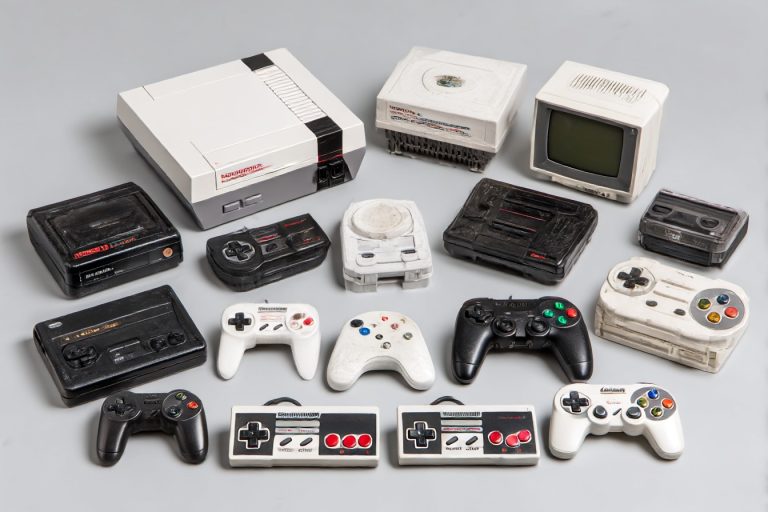

While I’ve been in IT Management for 15 years and understand that recommendations should be practical and not purely theoretical; “the best” is a subjective term without the correct context. What is the best retro console for a collector may be entirely different than what is the best for a gamer. What is the best for someone with a budget of zero dollars is going to be entirely different than the best for someone who has a budget of thousands of dollars and wants the authenticity of the original hardware. In order to determine which retro gaming console is best to purchase today, you must determine what is important to you.
The retro gaming market is saturated with multiple options. Hundreds of different systems were produced between 1983 and 2005. Each of those systems have their own individual set of games, aesthetic designs, and price points. Some of those systems are extremely rare and expensive. Others are inexpensive and common. Some have thriving communities of collectors while others have no one paying attention to them. When you start into retro gaming, the very first decision you must make is which system you want to begin with, and that decision will ultimately dictate what games you’ll be able to play and how much money you’ll have to spend.
To put this simply, there isn’t one single “best” retro gaming console. However, the best retro gaming console for you personally does exist. To find it, you must identify what draws you to a particular system and make your choices accordingly.
If You Want The Iconic Systems
For those looking for the most iconic 16-bit console available, the SNES is your best bet. The library of games available for the SNES is simply incredible. You have titles such as Super Metroid, The Legend of Zelda: A Link to the Past, Super Mario World, and Donkey Kong Country — to name only a few of the countless, truly incredible exclusive games. Many of the games from back then continue to hold up incredibly well today. The controller is also incredibly comfortable. And, the system itself is built to last. As far as pricing goes, consoles themselves are generally pretty affordable — you’re looking at anywhere between $80-$150 for a working unit — and games can cost anywhere from $10 for a loose copy to upwards of $300+ for a complete, rare game.
The SNES is a great option if you want to go with a safe bet. It’s hard to go wrong with this one. The games are great, the system is reliable, and there is a huge community of gamers out there who are always happy to lend a helping hand if you ever get stuck on a game or need help finding one to add to your collection. The only real downside to using the SNES is that prices have been driven up due to high demand, so you won’t really be able to find any hidden gems at bargain prices.
On the other hand, the Nintendo 64 is the way to go if you want to experience the best 3D gaming from the era. While the library of games available for the N64 is smaller than that of the SNES, the quality of the games available is consistently high. Titles such as Super Mario 64, The Legend of Zelda: Ocarina of Time, Perfect Dark, and GoldenEye — each and every one of these is an exclusive title that is truly amazing. The N64 controller is also instantly recognizable and either you love it or you hate it. The N64 is also still a very reliable piece of hardware and will likely remain so for many years to come. A good-condition N64 console will typically cost around $100-$200, and loose copies of popular N64 games can easily sell for $30-$50.
The N64 is a great option if you want to experience the best of 3D gaming from the late 90s. Since the N64 is specifically designed for 3D gaming, you aren’t going to be able to duplicate the same gaming experiences on the SNES. The only real drawback to using the N64 is that games are going to cost you a lot more than they would if you chose to use the SNES, and once you start collecting, things can get very expensive very quickly.
Finally, the original PlayStation is a vastly underrated retro console. Not only did the PlayStation have a staggering number of titles released during its lifespan, but the sheer variety of genres represented among those titles makes it a great option for anyone looking to expand their gaming horizons. Whether you prefer JRPGs, action games, sports games, puzzles, etc., the PlayStation has got you covered. Additionally, since consoles for the original PlayStation are dirt cheap ($50-$100), and games for the system are similarly priced ($5-$20), it’s possible to build a massive collection of games for the PlayStation for a fraction of the cost of what you’d pay for a comparable collection of games on other retro systems.
Overall, the PlayStation is a great option if you want to focus on building a large collection of games at a low cost. The only thing that could possibly discourage you from using the PlayStation is that you may find yourself spending hours searching through thrift stores, garage sales, and flea markets to find titles that you didn’t know existed, and when you do finally find them, they may or may not be worth the time and effort of hunting down.
If You Want Something Different
If you’re interested in experiencing the 16-bit era through a lens that differs from that of the SNES, the Mega Drive (Genesis) is the system for you. Specifically, the Mega Drive has a great selection of games in certain genres (sports, arcade-style translation, action, etc.), and the games themselves tend to feel differently than those found on the SNES. Additionally, the Mega Drive has a controller design that is distinctively different from that of the SNES. Finally, the Mega Drive is also a very reliable system. Consoles can be purchased for anywhere from $60-$120, and games can be found for anywhere from $5 for a loose copy to $100+ for a rare, complete copy.
If you want the alternative perspective on the 16-bit era that the Mega Drive provides, and you don’t mind having fewer games available than you would on the SNES, then the Mega Drive is the system for you. Keep in mind that the SNES library is significantly larger, and you may end up feeling as though you’re missing out on some of the best that the 16-bit era has to offer.
If you want to try something completely different from the typical Nintendo and Sony systems of the past, the Dreamcast is your best bet. While the library of games available for the Dreamcast is relatively small compared to that of the SNES or PlayStation, it is uniquely diverse. Titles such as Shenmue, Jet Grind Radio, Soul Calibur, and Power Stone, among many others, give the Dreamcast a distinctly different gaming culture. Consoles for the Dreamcast are also generally affordable ($80-$150), and games for the system are equally affordable ($10-$40), mainly because the library of games is much smaller than that of the PlayStation or SNES, and thus hasn’t yet become a target for serious collectors. Another major advantage to using the Dreamcast is that the online capabilities of the system still work today via private servers, allowing users to enjoy online gaming as it was originally intended.
The only drawbacks to using the Dreamcast are that the library of games is relatively small, so you’ll run out of new games to play faster, and as the Dreamcast grows older, hardware failures are becoming more common.
Finally, if you want to experience the world of retro gaming with a system that is closer to modern gaming than many of the older systems, but still feels retro enough to satisfy your desire for old-school gaming, the GameCube is your best bet. The library of games available for the GameCube is strong and focused almost exclusively on the GameCube. The system is also both reliable and built to last. As the GameCube grows older, games are becoming increasingly collectable, and the value of both the system and the games will continue to increase over time. A good-condition GameCube console will typically cost between $100-$200, and games for the system can be found for anywhere from $20-$100+, depending on the rarity and condition of the game.
In summary, the GameCube is a great option if you want to bridge the gap between retro gaming and modern gaming. You’ll experience the modernity of newer console controllers that feel good in your hands today, but the classic gameplay of older games that will transport you back in time. The only downsides to using the GameCube are that it may be too modern for some retro gamers, and not modern enough for those who want to experience the latest and greatest in video games.
Budget Considerations
When considering purchasing a retro gaming console on a tight budget, the original PlayStation is your best bet. Consoles for the original PlayStation can be found for anywhere from $50-$100, and games can be bought for as little as $5-$20, making it possible to build a massive collection of games for a relatively small amount of money. In fact, it is entirely possible to spend $200 and end up with dozens of games and a fully functional PlayStation console.
If you have a moderately-sized budget, you’ll be able to afford either a SNES or a Mega Drive. Both consoles are relatively affordable ($60-$120), and games for both systems can be found for anywhere from $10-$50. The main difference between the two systems is that the SNES has a significantly larger library of games available, so while you may end up spending more money overall, you’ll have a wider selection of games to choose from.
If you have an unlimited budget, then you can essentially collect whatever you want, whenever you want. The rarest and most valuable games for the SNES and N64 can cost hundreds of dollars each, but if you want to build a complete collection of the best games on your chosen system, it’s entirely possible.
Practical Recommendations
First and foremost, choose a retro gaming console that you’re attracted to visually. If you like the look of the SNES, then go ahead and buy a SNES. If you like the N64 controller and aesthetic, then buy an N64. If you’re drawn to the arcade-style games available on the Mega Drive, then buy a Mega Drive. Ultimately, it’s the aesthetic appeal of the system that will determine whether or not you’ll actually play the games.
Next, consider the community of enthusiasts surrounding the system you’re interested in. The SNES and PlayStation have huge, active communities of collectors and gamers alike. The N64 has a dedicated group of fans, although it’s slightly smaller than the SNES/PlayStation community. The Dreamcast has a hardcore cult following of fans who are passionate about the system and the games available for it. Ideally, you want to choose a system that has a strong community behind it, so that you’ll be able to get help and advice when you need it.
When starting to build your collection, consider buying loose games instead of complete-in-box versions. This will allow you to test your taste in games without dropping $300 on a complete version of a game you might end up not liking. Once you’ve played a game and determined that you like it, you can always go back and purchase a complete version of the game.
Lastly, think about your physical space and equipment. Some retro gaming consoles require a lot of space, while others require special cables or adapters. Some retro gaming consoles require you to use a CRT TV in order to get the full, unfiltered experience of playing the game as it was originally intended. Before making a purchase, consider your space and equipment needs in order to ensure that you have everything you need to properly enjoy the games.
Ultimately, think about your time commitment to playing retro games. Are you interested in trying dozens of different games, or do you want to focus on a single system and try to build a collection of games for that system? Do you want to collect, or do you want to play? Do you want to spend money on investment pieces, or do you want to spend money on actual playable games?
Honest Assessment
Unfortunately, there is no single, universally accepted best retro gaming console. The best retro gaming console for you is the one that fits your interests, budget, and preferences. If you like the SNES, buy a SNES. If you like the PlayStation, buy a PlayStation. If you’re unsure about what to buy, the SNES is the safest bet. It’s impossible to go wrong with the SNES’ incredible library of games.
Don’t feel pressured to buy multiple systems. Choose one system and learn everything about it. Build a collection of games for that system. After you’ve done that, you can decide if you want to explore other systems. Collecting multiple systems can quickly become overwhelming. Learning one system and loving it is infinitely better than owning three systems and being ambivalent towards all of them.
The Best Time to Buy Was Five Years Ago…
The best time to buy a retro gaming console was probably five years ago, when prices were lower. If you missed that boat, the second-best time to buy a retro gaming console is now. Retro gaming console prices are continuing to rise, so the console you want to buy today will cost you more than it will tomorrow.

John grew up swapping floppy disks and reading Amiga Power cover to cover. Now an IT manager in Manchester, he writes about the glory days of British computer gaming—Sensible Soccer, Speedball 2, and why the Amiga deserved more love than it ever got.
0 Comments