
We all knew that arguing over the top 10 N64 games would lead to another round of ruined relationships. Carl had to step in as mediator for our increasingly heated debates. Joe remained mired in a bitter resentment toward the Genesis, and thus tried to de-rank anything on the list. Tim finally found the N64 at the tail end of its life span and started spouting off all sorts of novel, yet annoying, opinions based solely on his “fresh perspective”. Sam insisted upon doing frame-by-frame analysis of multiplayer balance. John wouldn’t stop whining about how the Amiga could have done 3-D better. In the end, however, after three weeks of yelling back and forth via Slack and having a virtual meltdown during a Zoom call about Majora’s Mask, we finally came to a consensus on these 10 games.
The N64 changed everything in 1996. We finally had 3-D gaming that actually worked. We had analog stick controls that were revolutionary after decades of using digital pads. We had cartridge-based gaming, allowing for instant loading of game worlds without having to wait for a disk to spin. And, above all else, the N64 controller looked like an absolute lunatic had taken a 3-D printer to a mad scientist’s lab bench, but somehow fit perfectly in your hand. And, finally, we had a library of games that was so aggressively innovative that even the most die-hard Sony fans among us had to admit that Nintendo had pulled off the transition to 3-D gaming in ways that the original PlayStation never really could.
Quick Rankings
Super Mario 64 – The game that started 3-D platforming. The Legend of Zelda: Ocarina of Time – 3-D Zelda perfection. The Legend of Zelda: Majora’s Mask – Ambition bordering on madness. GoldenEye 007 – The game that proved consoles could do a first person shooter. Perfect Dark – The sequel to GoldenEye that was actually better. Banjo-Kazooie – Collect-a-thon peak before the genre imploded. Star Fox 64 – On rails shooting that still feels amazing. Mario Kart 64 – Friendly competition in glorious 3-D. Kirby 64: The Crystal Shards – The underrated gem that no one talks about. Paper Mario – An RPG that proved Nintendo was capable of creating an adventure game.
Rankings
1. The Legend of Zelda: Ocarina of Time (1998)
| Genre | Action-Adventure |
| Developer | Nintendo EAD |
Ocarina of Time took every aspect of A Link to the Past that was perfect, and placed those elements inside of a fully-realized 3-D world. For example, Link could now move around in full 3-D space, climb walls, use objects as platforms, solve puzzles that required actual spatial reasoning, and engage in battles that actually depended on positioning. Additionally, the time-travel element – where you play as young Link in the past, and then jump ahead to adult Link in a world that has been altered – allowed for two completely different experiences to exist within one cohesive world. And, finally, bosses that require you to learn enemy attack patterns, track the movement of enemies in 3-D space, and time your attacks to hit the enemy perfectly. All of this combined to make the most memorable experience in 3-D gaming history.
What makes it untouchable: The moment you start to play the Ocarina and discover that you can manipulate time itself. The songs on the Ocarina that change the world state – such as playing Epona’s song to obtain your horse, playing the sun’s song to navigate through the Shadow Temple corridor, or playing Saria’s song to solve puzzles that seem impossible. The z-targeting system that became the basis for third-person action games for the next 20 years. The sense of scale in Hyrule Field – where the field felt enormous despite the N64’s technical limitations. The progression from the childlike wonder of the beginning to the horror of watching a world die in the future. The final battle against Ganon, which tested every skill you had learned. Ocarina of Time was not just a great game; it was the basic formula for how to do 3-D adventure gaming that still holds true today.
Does it still hold up? Ocarina of Time is literally the gold standard for every 3-D action-adventure game ever released. Breath of the Wild essentially threw away half of Ocarina’s convention, but Ocarina’s DNA is still evident in every major adventure game released in the last 25 years.
Read Carl’s argument for why Ocarina of Time is the game that changed everything →
2. Super Mario 64 (1996)
| Genre | Platformer |
| Developer | Nintendo EAD |
Mario 64 didn’t just take Mario into 3-D; it established what 3-D platforming even was. The camera system that allowed you to decide where to look while Mario moved independently. The analog stick controls that allowed you to move Mario in full 360 degrees. Power Stars were hidden throughout Princess Peach’s castle that rewarded exploration and experimentation. Six large paintings in the castle that acted as portals to six entirely different worlds, each with multiple power stars that were hidden in a variety of ways – some for reaching them, some for completing puzzles, some for performing challenges that required precision and skill.
What makes it untouchable: The camera system that set the bar for all subsequent 3-D games. The amount of creative ideas crammed into a single world – more than many games contained in their entire experience. How Peach’s Castle changed as you collected Power Stars – paintings disappeared, new areas opened, and short cuts became available. The sheer creativity of the Power Star challenges – a mine cart ride through lava in Lethal Lava Land, a submarine in Dire Dire Docks, racing a penguin down an icy mountain. The responsiveness of the controls once you learned to use them correctly. The ability to approach challenges in multiple ways. Mario 64 wasn’t a theoretical exercise in game design – it was an exercise in perfecting game design principles applied to practice.
Does it still hold up? Yes. While the camera can become a little wonky in certain places, the basic platforming, the level design, and the exploration – it all still feels as fresh today as it did in 1996. Every 3-D platformer released since owes a debt of gratitude to Mario 64’s development of the genre.
Read Timothy’s discovery of Super Mario 64 as the gold standard of 3-D design →
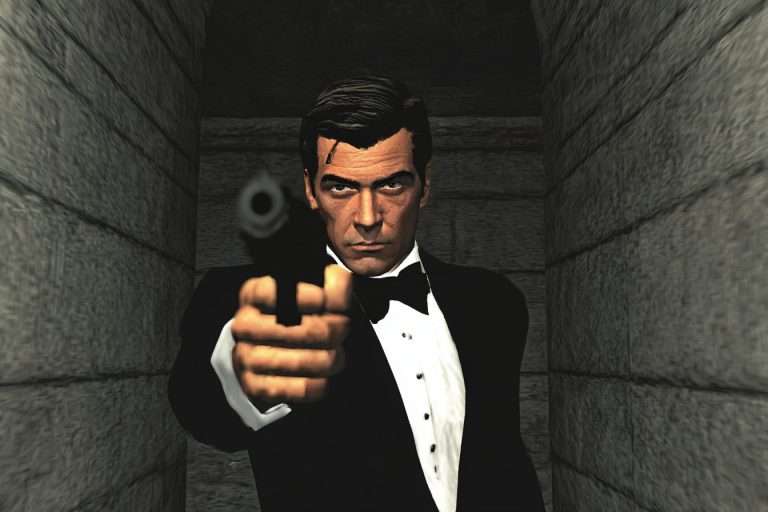
3. GoldenEye 007 (1997)
| Genre | First Person Shooter |
| Developer | Rare |
GoldenEye 007 proved that FPS games could be played on a console. Before this, everyone believed that the controller couldn’t handle precision aiming, console gamers didn’t want complex games, and James Bond games were notoriously bad. Rare looked at all of that and said “watch this.” The Single Player campaign was structured around mission-based gameplay that included objectives that had to be completed by stealth, observation, and precise methods instead of simply running and gunning. The Multiplayer portion of the game was also destructive – four players could fight each other in real-time in split screen mode using weapons that were perfectly balanced, so that even the worst player could get a lucky kill with a good weapon spawn.
What makes it untouchable: The control scheme that made console FPS controls work. The mission structure that allowed you to approach objectives in multiple ways – you could complete missions silently or go in guns blazing, you could take out guards quietly or create chaos. Oddjob’s Hat weapon in multiplayer – a weapon that everyone banned because it was cheap but everyone used anyway. The Facility level – where four friends could literally spend hours fighting each other and never get bored of it. The cheat codes that unlocked everything – invincibility, big heads, etc… Rare understood that games needed to be fun first, balanced second. GoldenEye was both, and that made it devastating.
Does it still hold up? The Single Player campaign is still an excellent Bond game – it’s a great example of what a Bond game should be. The Multiplayer is a bit clunky compared to modern shooters – the movement speed and reaction time are slower, and the graphics are obviously dated – but the fundamental design of the multiplayer is still incredibly solid, and it is still an endless source of entertainment if you can find a copy of the game and an N64 with four controllers.
Read Joe’s historical explanation of how GoldenEye changed the landscape of console gaming forever →
4. The Legend of Zelda: Majora’s Mask (2000)
| Genre | Action-Adventure |
| Developer | Nintendo EAD |
Majora’s Mask is the result of a developer saying, “Let’s do the opposite of everything we did in the previous game.” Instead of the open Hyrule Field, Link is stuck in Termina with a 72-hour clock that resets every three days – you lose your Stolen Ocarina to Skull Kid, and you must restart from the same point every morning. Instead of being able to visit eight dungeons in any order, you must rush to complete as much as possible in three days. Instead of one magical transformation, you have three magical masks that completely transform how Link plays – Deku Scrub Link is small and floats, Goron Link is invincible but slow, and Zora Link is fast in water but slow in the air. Instead of one epic storyline, you have dozens of smaller character stories that unfold over the three days – you can actually influence the outcome of peoples’ lives, cause tragedies, or help redeem others.
What makes it untouchable: The pure, unadulterated courage of the design. Nintendo took the most loved game on the console and said, “We’re going to make a completely different game, and you will either love it or hate it.” The Rani’s Fountain transformation scenes that are basically creepy. The Skull Kid relationship that is both sad and bizarre, but somehow works perfectly. The time loop format that makes every playthrough feel important – you’re not just collecting items; you’re managing time and deciding which characters you care about the most. The Transformation animations that are so elaborate that they slow down the frame rate of the game, but convey everything you need to know about what is happening. The smaller dungeons, but packed with ideas. The Elegy of Emptiness boss that is probably the most disturbing thing Nintendo has ever put in a game.
Does it still hold up? As mentioned earlier, Majora’s Mask is polarizing – people believe it is a masterpiece, and others believe that the time constraints ruin it. However, both perspectives are valid. Regardless, everyone believes that it was a bold and daring attempt in a way that few games have attempted to do.
Read John’s passionate defense of Majora’s Mask as Nintendo’s most courageous design decision →
5. Perfect Dark (2000)
| Genre | First Person Shooter |
| Developer | Rare |
Perfect Dark was released two years after Goldeneye, and Rare simply stated that they had proven that console first person shooter could work; therefore, they would release the “better” one. Joanna Dark is a spy working for the Carrington Institute that is investigating a conspiracy surrounding alien technology and corporate espionage. The single-player campaign in Perfect Dark features more objectives than Goldeneye did, more weapons, more types of enemies, etc… The multi-player in Perfect Dark uses the exact same format as the one in Goldeneye but improved the weapon balance, added additional game modes, and included a completely separate game-with-in-a-game called Combat Simulator where you can customize your own encounters.
What makes it un-touchable: Rare’s absolute technical mastery at the pinnacle. The graphics in Perfect Dark are superior to Goldeneye’s, despite both being on the same hardware. The AI in Perfect Dark is smarter — the guards communicate, coordinate, and will flank you. The weapons in Perfect Dark are more creative — tranquilizer darts, proximity mines, rocket launchers that can be useful. The Combat Simulator mode allows you to create countless custom matches with different weapon sets and enemy configurations. The fact that you can essentially play this game forever due to the customization options. Joanna’s voice acting that made her seem like an actual character. The story in Perfect Dark that was actually intriguing rather than simply stop the bad guy.
Still holds up? The campaign is arguably better than Goldeneye when you’re not viewing it through the eyes of nostalgia. The multiplayer may be slightly clunky compared to modern standards, but the design itself is rock-solid. This is the game that deserved far more accolades than it received, and was largely overlooked by Halo when Halo became the dominant force in the first-person shooter landscape and Perfect Dark was released.
Check out Samuel’s technical review of how Perfect Dark perfected what Goldeneye started →
6. Banjo-Kazooie (1998)
| Genre | Platformer |
| Developer | Rare |
Banjo-Kazooie was the collectathon platformer done perfectly before everyone else decided to copy the model, ruin it by having every game feature 500 collectible items spread throughout 50 levels, and then claim that it’s a “collectathon.” Banjo-Kazooie follows the journey of a bear and bird duo as they explore five gigantic, interconnected worlds that include secrets, shortcuts, hidden areas, and collectables that require different skills to access. There are jiggy pieces that unlock new worlds and shortcuts. Musical notes that unlock new areas. Honeycombs that upgrade your health. Mumbo tokens that allow you to transform into various creatures, including termite, pumpkin, crocodile, walrus, and many others. Each creature changes how you approach puzzle-solving and platforming challenges.
What makes it untouchable: The charm and personality of the game. Banjo and Kazooie’s banter. The worlds themselves, each uniquely designed — Treasure Trove Cove is a pirate-themed ship, Clanker’s Cavern is an underwater industrial setting, Gobi’s Valley is a desert pyramid setting with Sphinx puzzles. The challenge of locating all of the collectables without a guide. Some of them are obvious, some require genuine observation and experimentation. The boss battles are creative and enjoyable, unlike frustrating ones. The Grunty’s Lair boss battle rush is both difficult and fair. The humor is consistently funny, from terrible puns to meta-humor to entertainmentally bizarre characters.
Still holds up? Absolutely. The platforming feels tight, the controls respond perfectly, and there is enough content in each world to keep you occupied for hours without feeling like you’re playing filler content. This is the collectathon template that works, which makes it infuriating to see how many games failed to replicate the success that Banjo-Kazooie achieved so flawlessly.
View Timothy’s admiration of Banjo-Kazooie as the greatest collectathon design →
7. Star Fox 64 (1997)
| Genre | On-Rails Shooter |
| Developer | Nintendo EAD |
Star Fox 64 built upon the foundation of the original Super Nintendo Entertainment System (SNES) version in nearly every possible way. The Rumble Pak was a special peripheral that allowed the controller to vibrate during gameplay, which seemed silly at the time but provided an incredibly effective means of communicating important information. Star Fox 64 introduced multiple paths through each level, allowing you to choose whether to take the most direct path or discover a shortcut and/or alternative path. Additionally, the boss battles in Star Fox 64 were significantly more challenging than those in the original. Furthermore, the multiplayer dogfighting mode, which featured four players competing against one another in real-time, was groundbreaking for the Nintendo 64. The personalities of Fox McCloud and his team were fleshed out in detail — Falco’s pride, Slippy’s nervousness, Peppy’s wisdom. The ability to pilot an Arwing through meticulously crafted environments, where the restrictive nature of on-rails shooters didn’t necessarily equate to restriction, but rather a specific sense of freedom.
What makes it untouchable: The understanding that on-rails shooters can be anything but linear. The creative design of the stages that encouraged observation and skill — identifying shortcuts, studying enemy behavior, and timing your attacks perfectly. The Rumble Pak implementation that made you feel every explosion and collision. The creative designs of the boss battles that pushed your knowledge of combat and positioning to the limit. The branching design of the stages that made replaying the game feel like discovering new paths. The arcade spirit of Star Fox 64 that recognized that enjoyment was far more important than perfect balance. The fact that you could complete the entire game in approximately 30 minutes, but wanted to play it 50 more times.
Still holds up? Yes, but only with the Rumble Pak attachment. The gameplay is tight, the stages are cleverly designed, and the arcade spirit still shines through. Modern shooters are certainly more complex, but Star Fox 64 demonstrated that elegance executed perfectly is much more satisfying than complexity executed poorly.
Read Joe’s analysis of how Star Fox 64 perfected arcade sensibilities on modern hardware →
8. Mario Kart 64 (1996)
| Genre | Racing |
| Developer | Nintendo EAD |
Mario Kart 64 did not improve upon the formula established by the original Mario Kart for the Super Nintendo Entertainment System (SNES), but rather elevated the formula to 3D and made it enjoyable and polished enough to remain one of the most playable games of all time. The eight characters compete in 3D races on courses that looked impressive when they were released and still hold up relatively well today. Battle Mode, where the focus is on destroying each other with items instead of racing. The item balance is surprisingly perfect — red shells that track you down relentlessly, blue shells that destroy the leader, green shells that bounce you off the wall and onto your opponents, lightning that destroys everybody. The variety of the tracks ranges from simple circuits such as Mario Raceway to extremely technical challenges such as Bowser’s Castle with its extreme jumps.
What makes it untouchable: The local multiplayer that can break up friendships just like the original Mario Kart did, but in 3D. The creative design of the tracks that encourage learning shortcuts and optimal racing lines. The fact that anyone can win, regardless of their skill level — item drops often allow less-skilled players to pull ahead of more skilled players. The unique characteristics of each driver — the difference between the drivers’ acceleration and braking rates and speed make each choice meaningful. The thrill of pulling off a near-perfect drift boost at the last second and passing the AI by a hair. The absurd satisfaction of hitting another driver with a red shell just as you cross the finish line.
Still holds up? The graphics are dated. The camera can be annoying. However, the base racing mechanics, item balance, and track design all feel satisfying. While later Mario Kart games offer more technical depth, Mario Kart 64 is still fun.
Read Samuel’s analysis of the item balance that made Mario Kart 64 work →
9. Kirby 64: The Crystal Shards (2000)
| Genre | Platformer |
| Developer | Nintendo 64DD / Hal Laboratory |
Kirby 64: The Crystal Shards is the game nobody mentions that deserves more discussion than it receives. The power-up system that allows Kirby to combine two different Copy Abilities to create hybrid powers — combination rock-bomb, combination sword-beam, combination ice-wind. The level design that encourages experimentation — you’ll encounter obstacles, attempt different combinations to find a solution, and eventually stumble upon a secret area that no one thought existed. The gorgeous pre-rendered backgrounds that make the game appear almost hand-drawn. The difficulty curve of the game that gradually increases from easy to challenging and welcomes younger players, yet provides enough challenge for older players.
What makes it untouchable: The total lack of pretentiousness. This is not attempting to be dark, edgy, or overly complicated. This is a platformer about a pink ball that eats things and gains powers, and it executes this concept perfectly. The combination mechanic appears simple, yet creates immense depth — not only in terms of gameplay, but also in terms of how you explore the game. The boss battles that teach you about your powers while providing a challenge. The music that is charming and memorable, yet never invasive. The artistic polish that made a colorful platformer look better than games costing 10 times more. The fact that it demonstrated you can create a fantastic platformer without a groundbreaking mechanic — you just need to execute and be charming.
Still holds up? Completely. It is a perfect example of how technical constraints led to creative solutions. The pre-rendered backgrounds on cartridge forced the artists to become more meticulous in their artwork. The combination system created puzzle solving and exploration. The result is a game that is elegant rather than bloated.
Read Carl’s appreciation for Kirby 64: The Crystal Shards as an underrated platformer →
10. Paper Mario (2000)
| Genre | RPG |
| Developer | Intelligent Systems |
Paper Mario demonstrated that Nintendo can create non-traditional storytelling in RPGs. Mario is paper-thin (literally) and explores a world that is also two-dimensional visually, yet three-dimensional in scope. The turn-based combat system that encourages you to perform actions in real-time, not just select commands. Timing your attack to maximize damage. Timing your defensive action to minimize incoming damage. Your partners that have individual personalities and abilities that complement yours. A story that develops and includes emotional moments, rather than simply “rescue the princess.”
What makes it untouchable: The pure charm of the writing. Paper Mario’s voice acting, the banter between your partners, the personalities of the NPCs that feel distinct. The turn-based combat system that keeps turn-based battles engaging throughout the entire game without becoming repetitive. The exploration that rewards curiosity — you’re not following quest markers, you’re determining where to go based on conversation with NPCs and the environment. The boss battles that have personalities — Bowser is a threat, but he is also a character with motivations and growth. The fact that this game perfected the formula that the Thousand Year Door sequel would build upon, but the original showed the formula could work.
Still holds up? The writing holds up perfectly. The turn-based combat is still engaging. The exploration is still rewarding. The emotional moments are still effective. This game showed that RPGs don’t need to be 100 hour commitments to be meaningful — they just need to respect what they’re trying to do.
Read John’s analysis of how Paper Mario revolutionized Nintendo’s approach to RPGs →
The Games That Almost Made the Cut – And Why We’re Still Fighting About Them
Choosing the games for this list resulted in leaving off many games that could have easily fit into our Top Ten List. For example; Donkey Kong Country 2 – Wait, that’s an SNES game. Diddy Kong Racing – Some of us think this game is even better than Mario Kart 64. F-Zero X with the fastest speeds and best track designs. Conker’s Bad Fur Day which had ambition long before it turned into disaster. Extreme-G with the futuristic speed of its racing tracks. Wave Race 64 which perfected arcade-style water-physics. Kirby’s Air Ride – Which was weird and didn’t really work as a game, but was still very ambitious.
We argued over every single one of them. Sam fought hard for F-Zero X’s track design. John was adamant that Conker should be included on the same basis as Majora’s Mask. Tim pushed to move Kirby 64 up the list, since he believed most people don’t give the game the respect it deserves. Joe continued to argue that Diddy Kong Racing was more well-designed than Mario Kart 64. There were several times when Carl was forced to mute people from continuing their arguments. But at the end of the day, these ten games are the ones that represent not only the best of the N64, but also the games that defined what the N64 could do, and had the biggest impact on gaming in the decade that followed.
Your favorite did not make the cut? Well we understand. The N64 has such an incredible library that any top-ten will inevitably leave out someone’s personal favorite memory. So go ahead, comment with how you feel. We can take it. We’ve already spent weeks yelling back-and-forth about this list.
Read why this is John’s ultimate N64 game here

0 Comments