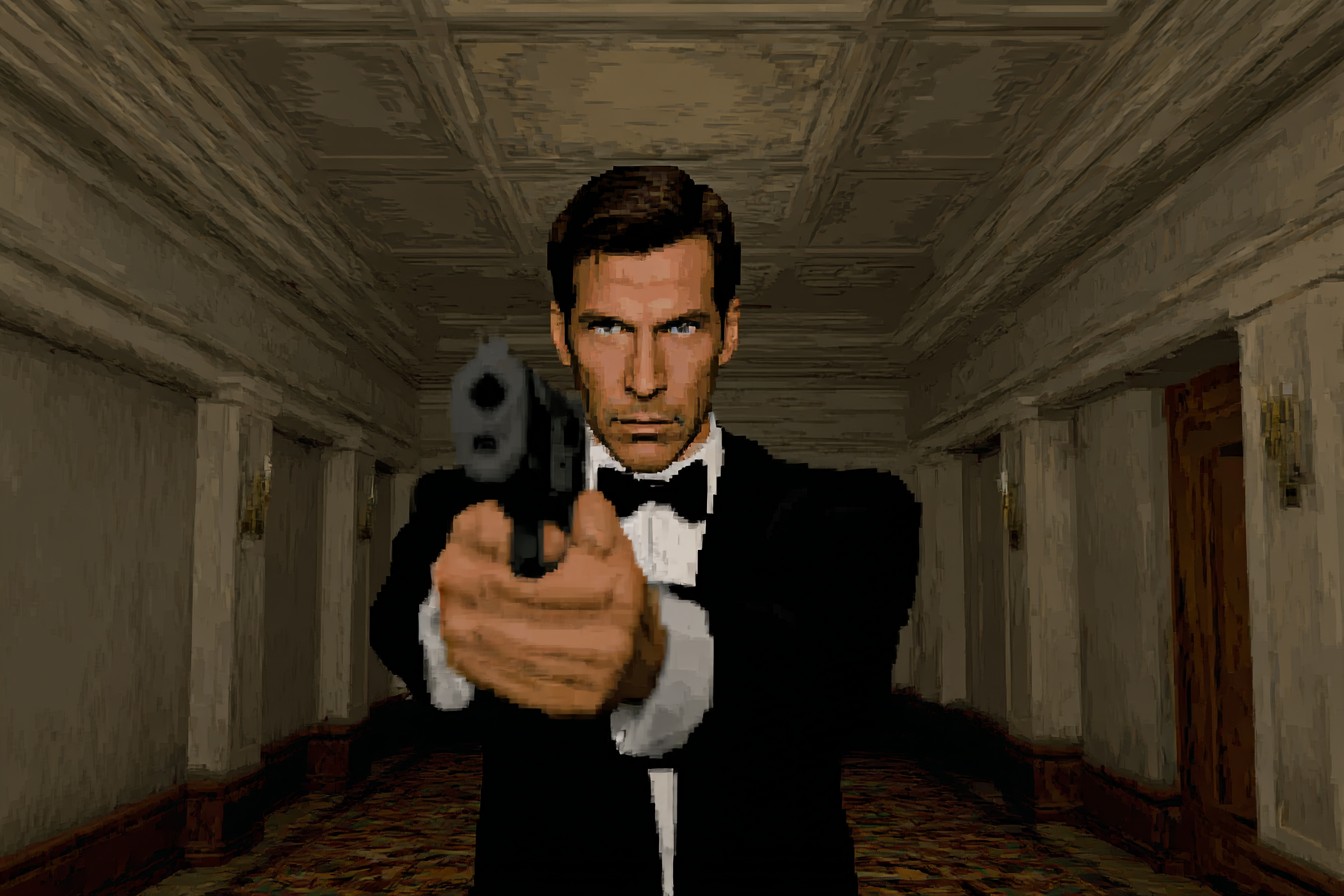

I am going to describe how I had my entire university experience hijacked by a James Bond video game and how this was actually brilliant. In the autumn of 1997, I finally acquired an N64, a really expensive piece of kit at the time; I had to save for nearly three months of my part-time job to afford it. I bought the console with the N64 bundle GoldenEye 007. To be fair, I was not that excited about it. I mean, the film was two years old at the time and, to be blunt, movie tie-in games are usually rubbish aren’t they?
Oh boy, was I wrong about that.
In my second year at Manchester University, I lived with three other guys in a flat in a typical student accommodation setting – thin walls, thin carpets and a TV that was older than I was. However, that ancient 21-inch CRT TV soon became the focal point of our lives as soon as we found the four player split-screen option in GoldenEye. Within a week of buying the game, our flat was basically a shrine to GoldenEye and people would drop by at all hours to join in the action, controllers would disappear and I am fairly certain my flat-mate Dave began to charge people 50p per cup of tea and biscuit for the extended gaming sessions.
You may find it hard to understand as a younger gamer, but console FPS games didn’t exist in the late ‘90s and the ones that did existed were largely rubbish. We’d all grown up playing PC shooters such as Doom and Quake using keyboard and mouse controls. The idea of having a true FPS console game with four people playing simultaneously on one screen… shouldn’t have worked. That bizarre-looking three-pronged N64 controller looked like something that was designed by aliens who’d heard of humans, but had never actually seen them.
But it did work… and it worked amazingly well.
It was the first time we managed to get all four controllers connected and loaded up the Facility map, that’s when it all clicked. The four player split-screen mode allowed you to see exactly what your opponents were doing, which gave rise to a fantastic psychological factor. You’d watch someone reload in their section of the screen and instantly rush them. You’d spot someone sniping from a fixed position with a rifle and arrange with another player to take them down. It was similar to playing poker where everybody’s cards are exposed, but that seemed to make it more strategic rather than less.
We developed house rules before the university administration could develop any of their usual pointless committees. Number one and most important rule: absolutely no Oddjob. Every single time. That little short guy was basically cheating incarnate – his smaller hit box made it virtually impossible to hit him with the inaccurate analog stick aiming. My flat-mate Steve said that choosing Oddjob was a legitimate strategy and continued to choose Oddjob until he went 20-0 in a match and the rest of us nearly chucked him out the window. After that, accidentally selecting Oddjob meant you lost your turn and received serious ridicule.
We took this more seriously than our actual course-work.
The maps quickly became as familiar as our own streets. Complex was a maze of corridors and camping spots. Temple had multi-story mayhem and that perfect sniper perch that everybody fought over. Archives… bloody Archives… where matches could go on forever as players would just camp in the bookshelves taking pot shots at each other. But Facility… oh Facility, was perfection. It was perfectly balanced, memorable and had that bathroom area where close quarters battles became legendary. I probably spent more time learning the layout of that fictional Soviet chemical plant than I did studying chemistry.
Watching screens became a huge moral dilemma that would make philosophy professors proud. Was it cheating to look at other players’ screens to keep tabs on where they were? We argued this for hours. My flat-mate Paul said it was impossible to help but see the other screens in your peripheral vision so attempting to ignore them was artificial. Dave said it was unfair to look at the opponents’ screens and therefore, was unsportsmanlike. The solution we agreed upon: peripheral vision was acceptable, but obviously turning your head to look at the other screens was unacceptable and would result in verbal abuse and possible controller confiscation. Very advanced thinking.
Proximity mines… bloody proximity mines. Some sadist at Rare must’ve had a lot of fun designing these. Initially, proximity mines were used strategically, and occasionally in a fight for control of a location. However, they soon became a tool for psychological warfare that would put even the best of MI6 to shame. We learned that you could place mines on body armour spawns, weapon pickups, and even on the underside of bridges. My specialty was attaching mines to the backs of doors – invisible until someone opens them and then… well, I earned some very creative threats against my person.
The weapon balance was also something unique. Everyone wanted the RCP-90 with its large magazine and decent damage output. However, the Klobb… the poor, pathetic Klobb. That gun was so pathetically underpowered that firing it was essentially telling everyone else on the map that you were over there and that you were poorly equipped. “I’m over here, I’m poorly armed, come kill me.” Although the guns were rubbish, they still had their place in the ecosystem.
We discovered ways to extend the experience of GoldenEye long past basic deathmatch style gameplay. “The Man with the Golden Gun” became our favourite mode for high intensity, strategic gameplay – one shot kills, random golden gun spawns across the map. Pure adrenaline rush. “Slappers Only” descended into absolute chaos, four adults running around the map trying to land melee attacks, usually descending into laughter within minutes. My personal favorite was “License to Kill” with pistols only – converted every match into a tense showdown between cowboys, where positioning and patience were more important than reflexes.
The unlocked cheats and options added this great progression element that encouraged us to keep returning to the single-player campaign. Most of us had beaten the single-player campaign within a few days and were into the multiplayer scene, but unlocking cheats and options required us to revisit those missions and complete them with specific time limits and difficulty settings. Dave became totally fixated on completing Facility on 00 Agent difficulty in under 2:05 to unlock the Invincible cheat. Watching him try to beat that record for the 15th time and seeing the rest of us all gathered around the TV yelling at it and drinking loads of cheap beer.
DK Mode – where everyone had huge heads and giant monkey arms – was hilarious. All the guns looked funny in those oversized arms and it was virtually impossible to miss a headshot. We usually broke out DK Mode towards the end of the night when everyone was half-drunk and the competitive fire had gone and we were just messing about.
The social aspect of it was everything, though. This wasn’t just about the game – it was about the whole experience. Four blokes squished onto a crap sofa, arguing about who got to use the nice controller (the one whose analog stick wasn’t completely loose) and sharing bags of crisps, making fun of each other’s awful tactics. When someone landed a truly insane kill, we all saw it. When someone died in a completely stupid way, the mocking started instantly.
By our third year, GoldenEye had basically taken over the entire student accommodation building. Other flats were challenging us to tournaments. Someone set up a proper bracket competition with teams from different floors. The finals were held in the common room with about thirty people watching and I swear it was more intense than any football match I’ve ever watched. We treated it like the bloody World Cup.
My mate Tony developed incredibly detailed strategies for each map, including hand-drawn diagrams detailing optimal routes and camping spots. He analyzed spawn patterns, weapon placement and even the timing of armor respawns. Meanwhile, I was just running round hoping to stumble upon some kills, but Tony’s scientific approach and my chaotic style seemed to complement each other perfectly in team matches.
After hundreds of hours of playing, the N64 controller became an extension of your hand. The strange three-pronged design of the controller that looked mental at first, actually worked incredibly well for GoldenEye. The analog stick for movement, C-buttons for strafing and looking around, and Z-trigger for firing all worked together in a way that after a small amount of practice, felt normal. However, I will admit that our controllers took a pounding. Analog sticks became loose, buttons stuck and the Z-trigger on my main controller eventually wore down to nothing, giving me a small speed advantage when drawing my gun, and led to claims of cheating.
A couple of years later, when Perfect Dark came out, we all thought it would take GoldenEye’s place as the definitive multiplayer game. Better graphics, more guns, customisable bots and improved in almost every way. But somehow… it didn’t hold the same magic. Maybe we were growing older, maybe university life was winding down, or maybe there’s just something special about your first love. Perfect Dark was objectively better in almost every way, but it felt like trying to catch lightning in a bottle again. There wasn’t the same fire.
When you look back now, GoldenEye was a perfect moment in gaming history. The novelty of multiplayer console FPS was still great enough to feel revolutionary, but online gaming hadn’t yet sucked everyone away from local multiplayer. You had to be in the same room, on the same TV, and share the same screen to see every triumph and disaster as it happened. The friendships that we formed from those gaming sessions remained strong long after university – I’m still mates with the majority of those guys and yes, we do occasionally pull out the N64 for old times’ sake when we’re all getting together.
The remake that was released recently is perfectly adequate, but it lacks a key element. Gaming with my old uni friends over voice chat was nostalgic, but it lacked the immediacy of the physical reactions – the satisfaction of landing an impossible shot, the genuine anger when someone lands a cheap proximity mine kill on you, and the ability to verbally abuse and potentially physically harm your opponents while sitting on the same sofa.
Sometimes I think about how my university experience would have been if GoldenEye had never been part of it. Possibly I would have studied harder, possibly I would have done better in my exams. However, the late-night gaming sessions created friendships and memories that have endured for decades. While I’ve played technically better games since then, none have captured that perfect blend of innovation, social interaction, and raw fun that caused four people to huddle around a small TV for hours on end. Sometimes, the stars just line up properly, and for a brief period in the late ‘90s, a game based on a two-year-old Bond film became the centre of our universe. And honestly? I wouldn’t have changed a thing about it.

Joe’s a history teacher who treats the console wars like actual history. A lifelong Sega devotee from Phoenix, he writes with passion, humor, and lingering heartbreak over the Dreamcast. Expect strong opinions, bad puns, and plenty of “blast processing.”
0 Comments