Disclaimer: This article doesn’t focus solely on Crash 4: It’s About Time. As we all know by now, it’s meant to set up my review of Crash 4, so there will be some major spoilers for the entire Crash Bandicoot timeline.
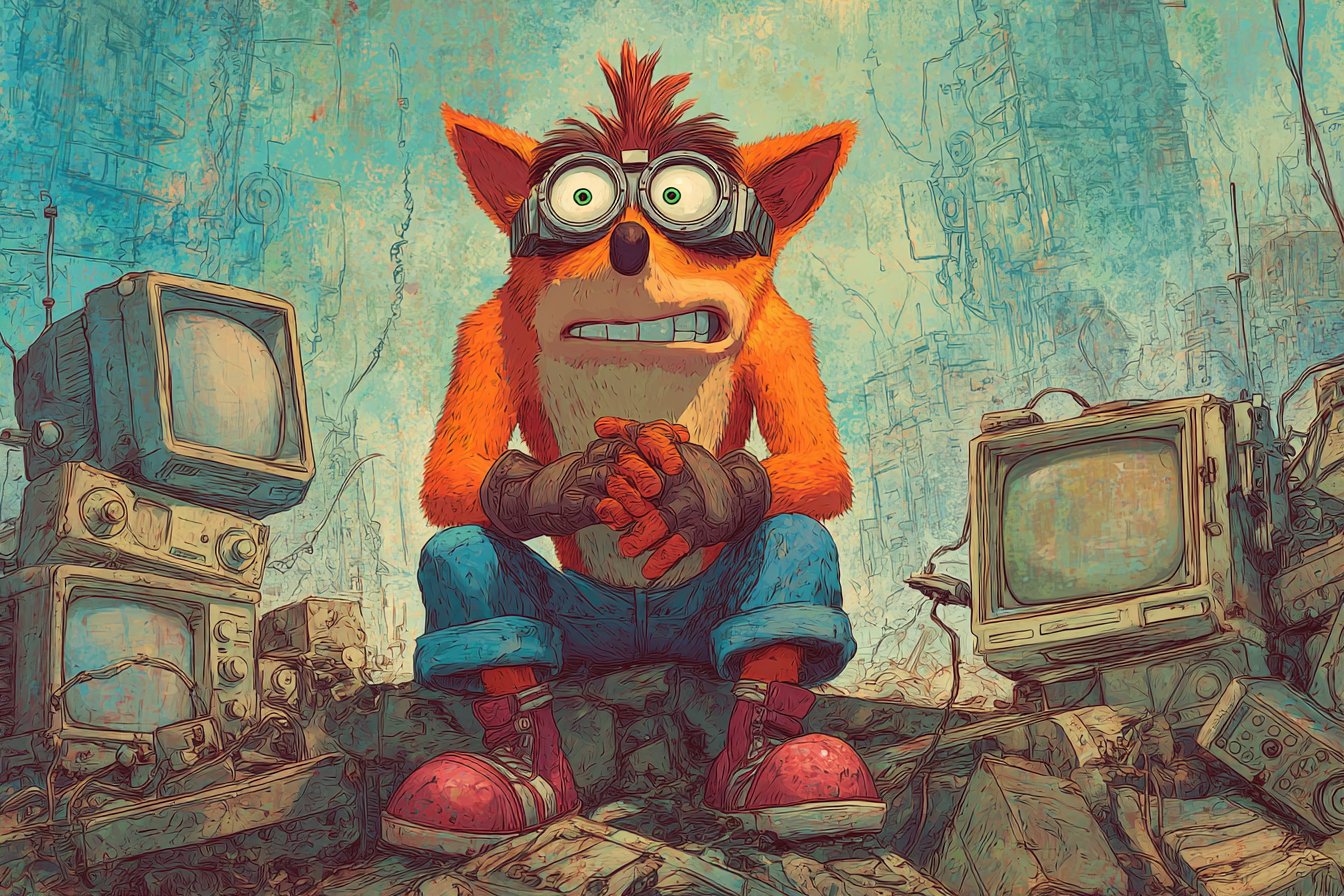
Crash Bandicoot has always felt like the PlayStation mascot. Growing up in America, Crash was everywhere. Orange boxes, toy stores, comic books, cereal cards; he was omnipresent. But I wasn’t American. I grew up in Manchester in the mid-nineties watching the birth of PlayStation from across the pond, and to me Crash always felt like they were forcing me to like their mascot.
Don’t get me wrong, I love the Crash games. They’re fantastic. But there’s this narrative that Crash was PlayStation’s Mario that I never really subscribed to. My experiences of European gaming just don’t align with that storyline.
Memory dictates that I first encountered Crash Bandicoot running right around the time Naughty Dog had enough momentum from their original PlayStation marketing campaign to start threatening sales of Sega Saturn and our beloved Amigas. It must have been late 1996/early 1997. My friend Dave had gotten PlayStation for Christmas and we’d spent box-daycamping out on his bedroom floor taking turns with this orange bundle of fur spinning around the most incredible 3D graphics I’d ever seen on a console. The colours were great! Bold and vibrant; a far-cry from the more muted palette Amiga games were known for (and yes, I know it’s cyan and blue, but babies).
That said what sticks out to me – and this is where US gaming culture completely derails from my experiences in Europe – we didn’t NEED a PlayStation mascot. We had characters. We had Dyszy the Egg from the Oliver Twins, we had all these amazing Amiga characters nobody talks about anymore. When Crash arrived he may as well HAVE BEEN AN IMPORT. Visually he was incredible, sure. Technically he was miles ahead of anything we were used to. But emotionally? He was an outsider.
And yes, he WAS an import! Of course he was! I know Naughty Dog tried to go for something universal with Crash’s personality and humour, but he still feels distinctly American to me.
Let’s talk technical though! FUCK did Andy Gavin and Jason Rubin ever know what they were doing when they designed Crash to be PlayStation’s mascot of 3D. Having grown up on years of 2D side-scrolling platformers on the Amiga and Mega Drive; seeing Crash come RUNNING at the SCREEN on those infamous “into the screen” levels was revelatory. Our games had sprites! Flat images that gave the illusion of 3D movement through cheap parallax tricks! Crash was moving through actual dimensions with a fully functioning camera! The animations were great too – so smooth. You could pick out each frame of Crash’s facial animations. It sounds stupid, but back then that detail was something else.
Don’t get me wrong, the first Crash game was hard as FUCK. Harder than a lot of European platformers I was used to playing at the time. GOD were those bridge levels tough. I spent hours upon hours trying to nail those bloody wooden platforms as chasms opened up beneath you out of nowhere. And getting knocked off a platform didn’t send you back to the start of the level like losing a life in Sensible Soccer would. It felt like such a waste. Though I have to admit, when you DID nail it? Clearing a level cookie cutter with all the boxes made you FEEL like a god.
And each subsequent entry fixed problems with the last. Which was NOT something you could say for games in general back then. Cortex Strikes Back gave you the slide and body slam mechanic which completely changed your interaction with the level design. Suddenly you could bust through certain boxes you never could before. It literally opened up the game and made you want to replay previous levels to see if there was anything you missed with your newfound abilities. I thought the hub world style mapping was great too. Reminded me of a lot of the better Amiga adventure games I used to play, giving you that real sense of journey when travelling between the more linear levels.
The polar bear levels in Cortex Strikes Back were bananas. Running around on the back of a gigantic polar bear, leaping gaps as scenery flies past you in the distance was like they took the vehicle stages from our favourite Amiga games, cranked them up to 11, and bottled it. They weren’t even THROWAWAYS levels you’d lumped in for giggles. They were actual challenges that required skill to complete. I must have replayed “Bear Down” 50 times trying to get the perfect run.
Everything just clicked in Warped. Time travelling? Vehicles? It almost felt like two separate games bundled into one. The flying levels, motorcycle mayhem, underwater swimming sections; they all played differently and taught you new skills you had to master. Implementing a time trial format was genius too. Suddenly you could take levels you’d already conquered under normal conditions and completely re-play them with speed in mind, rather than just seeing how long you could last.
But this is where it starts to get murky from a UK gamer’s standpoint. The Amiga was still going strong as Crash was making his leap to PlayStation. Worms had been released a couple of years previous by Teams17, Cannon Fodder released in Warped’s launch window, we even had our own little sub-culture of gaming going on that was pretty much indigenous to Europe. Crash was impressive, yes. But he wasn’t replacing our gaming experiences, he was supplementing them.
PlayStation flourished in the UK not because Crash replaced Mario for us. It did that because it offered games we couldn’t get on our Amigas.
I don’t think Europeans really bought into mascot gaming the same way kids in America did. We didn’t NEED that one character to represent us. We’d play Crash one night, crack on with Speedball 2 tomorrow, maybe fire up some Quake on the PC night after that. Gaming in Europe was nowhere near as tribal as it was in America. If anything I think we took that tribalism and mapped it to our little platform wars between PCs and Amigas.
Except Crash Team Racing. Nowhere near as murky as the platformers.
Released in 1999 when kart racing games were just starting to become a genre of their own, Crash Team Racing played like Naughty Dog were trying to make a game that could go toe-to-toe with Mario Kart 64 on its best day. AND THEY ALMOST PULLED IT OFF. CTR’s track design was fantastic. Naughty Dog managed to blend real-life racing circuits with their tried-and-tested Crash Bandicoot universe to create something familiar, yet unique to their own franchise. Weapons weren’t random like Mario Kart’s item boxes and Adventure Mode gave you an actual campaign to work your way through. Mario Kart 64 was just unlockable cup races.
I remember spending WEEKENDS taking turns with my university housemates playing local splitscreen tournaments of CTR. It was THE multiplayer PlayStation experience. Pizza boxes used as make-shift controllers, arguments over who had the cheap characters. It hit that sweet-spot of being fair enough that the best player usually won but having enough chaos and rubber band AI to keep everyone involved. Also, my now-wife bought it second-hand a few years later and damn if she didn’t get good at it. We had many matches that… probably weren’t good for our relationship.
Looking back at Crash now, it’s weird to think how differently his legacy has played out around the world. In America Crash has become this nostalgic benchmark for what PlayStation gaming was. THE mascot that signified Sony’s arrival into the console market. To me and thousands of other UK gamers he was just a fun series of games starring the same character. Sure we loved the quality. Sure we bought the games. But we didn’t have that attachment to Crash as this_iconic_character the way kids growing up in America did.
I think that’s why the global nostalgic spike for Crash with the release of the N. Sane Trilogy in 2017 felt so strong. I bought it because, well, like everyone else. I wanted to see how the retro PlayStation graphics held up under a legitimately remastered paintjob. The graphics were great! Don’t get me wrong. But what really surprised me was how GREAT the gameplay held up. These weren’t just pretty remakes – they were objectively HARD. Platforming games that required you to time your jumps and know your levels just as well as the original games.
As I worked my way through the remastered trilogy I found myself actually appreciating things about the games I didn’t even realise were there. The level design for one – every ledge, enemy placement, box; it was all so intentional. These levels weren’t lazily thrown together, or filled with unnecessary CPU paths to pad-out the gameplay. They were challenges. Challenges that taught you a new skill then pushed you to your limit on how well you could MASTER that skill.
It’s a philosophy you just don’t see much nowadays. Everything is either insultingly easy, or filled with unfair artificial difficulty ( RANDOMNESS).
Crash 4: It’s About Time played like the perfect sequel. The Quantum Masks allowed for new gameplay mechanics that expanded upon the Crash formula without upsetting the legacy of what made the originals so great. At the same time they highlighted just HOW punishing the originals could be. I almost thought my reaction time had slowed down with age before I remembered how BRUTAL those games used to be.
Crash to me will always embody that sweet-spot of gaming where developers were starting to understand how to take what made 2D platforming so great and translate that into a 3D space. The original trilogy managed to fine-tune many issues we take for granted now but were genuinely ground-breaking at the time. How do you keep 2D platforming precision and accuracy in a 3D world? How do you design a camera that shows the player EXACTLY what they need to see, without getting in the way? How do you make memorable characters when you’re restricted to polygonal masks instead of sprites?
Naughty Dog’s answers to these questions went on to influence generations of developers; myself included. Many of my favourite European developers even dabbled with adapting their 2D characters to 3D models after seeing Crash’s success (Hi Secret Of Mana! discussion of you). Crash may not have became the universal gaming mascot Sony wanted worldwide but the technological strides he made poured throughout the industry.
Playing Crash Bandicoot today, in 2024, you can really feel that transitionary period of gaming history. The point at which gaming was becoming mainstream just enough that tonnes of folks were picking it up, but niche enough that we all retained this little ‘gamer’ elitism about what we played. The original trilogy was out when I was in university; old enough to understand and appreciate the technical achievements, but young enough to get completely lost in just how F*CKING hard these games tried to be.
And that’s the kicker; whenever I pick up a Crash game nowadays I’m not just bathed in nostalgia. I’m playing through games that are legitimately good. Great, even. Sure the series may not have had the same impact on UK gaming that it did in America, but the games sure as hell earned their spot in gaming history through quality of their own merit. And honestly, that’s enough for me.