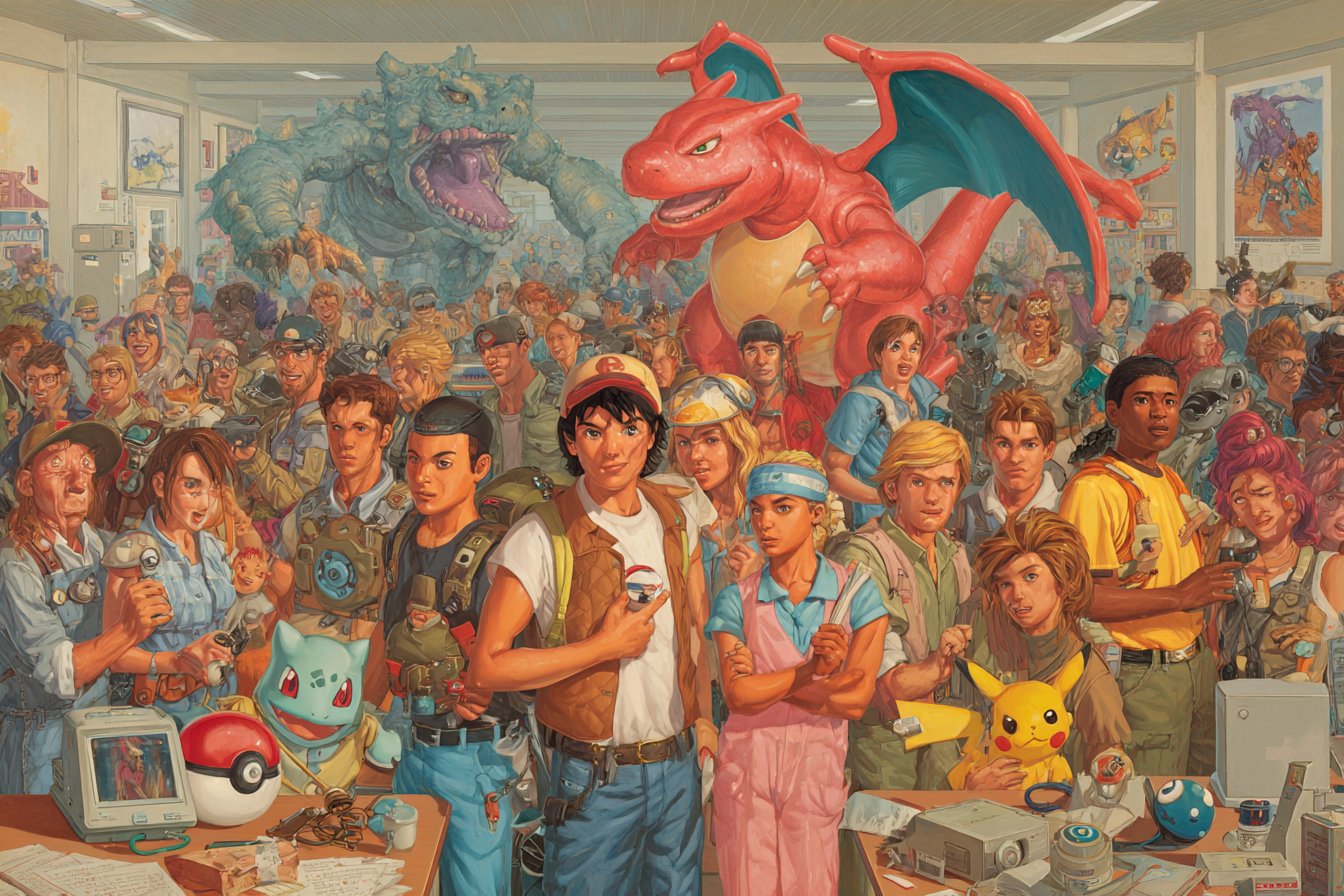
I’ll never forget where I was when I realised the entire social structure of Woodridge High School would change forever — it was during fourth period English class, Spring of ’98, when Scott Thompkins attempted to conceal his Game Boy beneath his desk.
We were supposed to be reading Catcher in the Rye in Ms. Harrington’s class (if you can call dragging your eyes across the pages “reading” Catcher in the Rye), but I could hear electronic chirps emanating from two rows in front of me. Scott Thompkins was crouched over something on his lap and muffling the chirps with his forearm as they occurred. When the bell rang, I accosted him. “What was that?” I asked, eyeding him suspiciously. He looked at me like he was going to invite me into some kind of secret club and pulled out a grey cartridge with a red Pokékid on it. “Pokemon,” he exclaimed. “It’s a Japanese Game Boy game where you catch Pokémon and fight them. Dude, you have no idea.”
I spent practically all my paycheck from washing dishes ($127 at $4.75/hour) on Pokémon that following weekend. Scott had gotten Blue and briefed me on all the differences between our games with unparalleled passion usually reserved for discussing sports or females. Different Pokémon in each game, he explained. You needed to trade in order to catch’em all. When I asked him how many Pokémon there were to catch and he said “151”, both my mind was blown and my life’s new goal was set.
What I didn’t know at the time was that Pokemon was about to dismantle whatever social hierarchy existed at Woodridge High School. By that May, it no longer mattered who you dated or who made the football team — if someone had a more complete Pokédex than you, they were the popular kids.
One thing adults will never understand about Pokémon — my mom definitely didn’t when I walked in the door with “another videogame” — is that Pokémon is, while sold as a videogame, so much more than that. Satoshi Tajiri and his team at Game Freak married the thrill of collecting with competition and player-to-player cooperation in a package that only looks childish on the outside. You aren’t just playing a game, you’re taking part in a larger community spreading across the world.
I immediately decided I wanted Charmander as my starter Pokémon. Well, immediately after staring at my options for around thirty minutes. Did I mention I was sixteen? Picking your starter Pokémon was monumental. This wasn’t choosing your character in a videogame. This wasn’t even picking your weapon in an RPG. This was choosing who you’d be fighting alongside for the next however-long-you-played-Pokémon. Sure, you could catch new ones later, but your starter was your starter. I picked Charmander because it was cool. That about sums up my decision-making capabilities at age 16.
We spent a good week trading favorite type combos and trying to hatch our Eggs. School chatter wasn’t about who hated Mr. Henderson’s pop quizzes anymore or whether or not Emily Morgan and Jake Bauer were dating (they weren’t…ugh) or what we were doing that weekend (usually the mall) — we were debating type matchups and who evolved what fastest. Andy, who previously only talked about himself in relation to the new snare drum he got for his birthday, found out he was a tactical mastermind as he explained to me how his Alakazam could defeat just about any Pokemon. Matt, who could quote you every NFL stats you cared to know, started crunching numbers to figure out the most efficient ways to level.
Game Linking was, without exaggeration, the best thing to happen to Nintendo’s Game Link cable. Th that thin, white cord represented was not lost on us. You had to trust someone with your game in order to trade Pokémon with them. Especially when it came to evolving trades. Having your Pokémon turn into another one in someone else’s hands required you to give up that sense of ownership and place trust in another human being. To this day I break into sweat recalling how Dave hovered his index finger over the B button while I was trying to trade over my Kadabra, threatening to pull away from the trade at the last second. “Don’t even think about it,” I half-threatened myself. Silence consumed our table for the remainder of lunch.
“I was kidding!” Dave exclaimed through laughter. I didn’t talk to Dave for the rest of the day.
Mining was genius. Brilliant, even. By allowing each version of the games to have certain Pokémon that didn’t exist in the other, Nintendo ensured we’d have to talk to one another to catch’em all. Someone with Blue wanted a Sandshrew? You better have one they want on your Red game, otherwise you’re dead in the trading games. Copies were exchanged underneath tables, and suddenly communication was necessary in order to take part in this underground economy forming throughout the school halls and bus rides. Library? Please. We congregated in the corner away from Mrs. Cleary’s desk as far away as possible, headphones in so she couldn’t hear the beep-boop-beep sounds our Game Boys made when linked together. Negotiations were made. How could a Pinsir ever be worth a Scyther?! Blue player disagreed.
Stories and myths about Pokémon spread like wildfire. Viral isn’t a word that could compare to anything until social media came along, but if there was ever a time it applied, it was to Pokémon. “Mew is under the truck next to the S.S. Anne,” everyone knew. But no one ever found it. I spent a Saturday morning trying every conceivable button combination to get that truck sprite to move. I was just being impatient; I kept telling myself. Obviously someone was making this stuff up. Except it was coming from the same “my brother’s friend’s cousin who works for Nintendo” so who was I to question?
Glitches, on the other hand, were 100% real. And if we found one, we all wanted to know about it. MissingNo, the colorful mess of pixels you encounter when you surf too far down south from Cinnabar Island after talking to the老人was both feared and worshipped. Not only could he overflow your bag with any items you desired (infinite Rare Candies, anyone? ), but catching him was pretty badass itself. Sure, when Blair McCarthy’s entire save file became corrupted from catching too many MissingNos, we were all slightly terrified that could happen to us. But it only made us want to catch that pesky Pokémon more. “He screwed up,” we’d boldly proclaim. But we had no idea what we were doing was glitches. We were just kids playing games.
My quest to complete my Pokédex was a serious one. The amount of organization I put into that task did not carry over into my homework, let me tell you that much. I had a spiral notebook that I bought for Biology my sophomore year but quickly repurposed for greater things. It consisted of handwritten notes on where I found each Pokémon, organised by location, as well as detailed descriptions on how to evolve them (and trade them). I cracked that book open more than any of my school textbooks that year.
I actually finished my Pokédex fairly early on. What took forever was getting that final Pokémon to register as caught. I sat at 149 Pokémon for probably six months, until I somehow managed to snag the elusive Tauros. Safari Zone never failed to annoy me. Like nature walks, but with less walking and more Boo scares. Each safari had a limited amount of steps you could take, you couldn’t battle (otherwise your Pokémon would leave), and they tended to run away if you so much as sneezed at them. I eventually memorized each map and took notes on how to complete each safari zone with the most Pokémon.
Tauros decided he wanted to show up right when I was about to give up. The entire lunch table at remembers my celebration. I tried to act cool, but a sprawling avalanche of noise came from my table that caused Mr. Lopez to walk over from his usual spot next to the soda machines. “Everything okay, guys?” He eyed our group of Game Boys warily. We told him we were working on math homework. As soon as his back was turned, everyone crowded around to admire my complete Pokédex. For a solid ten minutes, I was King.
Watching the Pokémon anime on TV only compounded the obsession. We analyzed every episode as if our lives depended on it. “Ash sucks!” Josh yelled when Ash lost another gym battle. “He should have evolved his Charmander by now.” We criticized each move they made like we were sports commentators.
And then the Pokémon Trading Card Game happened. Now it wasn’t enough to catch Pokémon — you also needed to collect their cards. Parking lots across America were converted to bustling marketplaces after school as students traded, sold, and bartered cards for cash and other cards. I traded someone a holographic Blastoise for Jake Miller’s lunch money for a week. His mom packs the best sandwiches. Turkey with cranberry sauce. divine. Go ahead and laugh at how I traded away one of my best cards for lunch…Jake already had three Blastoises and was clearly playing the long game.
Pokemon cards were eventually banned from school grounds after what will forever be known as “The Charizard Incident”. You know, the whole Jake Carlton, three eighth grade boys, one holographic Charizard Pokémon card situation in gym class that involved dodge balls stuffed into pockets. Details were never revealed, but Pokémon cards were banned from school property. Period. Lessons were learned, and suddenly game cartridges were easier to sneak into school than a deck of cards.
The one thing that will always stand out to me about Pokémon was how it united us all. Kids I never talked to before would sit at our lunch table and discuss strategy. I watched the captain of the football team, a senior, trade Pokémon behind the gym with some freshman tech nerd. Pokémon didn’t care what clique you hung out with or who your parents were — these were the new social circles.
Teams became serious business. I settled on Charizard, Alakazam, Gyarados, Jolteon, Gengar, and poor Nidoking who was burdened with all the HM moves nobody else wanted. We had heated debates over what the best team was. “Special stats are overpowered in this generation,” Dave would proclaim, counting on all Psychic-types. He wasn’t wrong. But there was no cooler picking your team that way. I kept Charizard on my team through all my revisions because hey… he was my starter Pokémon.
Competitive battling grew organically between lunches and bus rides home. We made our own rules — no legendaries, no doubles — and took over the back of the bus hosting tournaments. Jason Mills was our champ for months with his finely tuned team until Sarah Chen upset him with some crazy ice strategy. She wasn’t our champ for long because Jason returned with a fully ice-counter team. What started off as cute little monsters had layers of complexity we were only beginning to appreciate.
Link battling was a beast of its own. You couldn’t simply react to what you saw on screen — you had to predict what your opponent would do. Would Dave switch in his Alakazam like he always did? Or was he expecting me to think that? Link battling was a mental game as much as a strategic one.
As cool as Pokémon was, I watched teachers and parents miss the educational opportunities it brought to kids across the country. Probability with encounter rates. Resource management with PP and in-game currency. Economic principles with the trading process. Biology with type advantages and evolution. Vocabulary with Pokémon descriptions. I learned the words “resilient” and “stalwart” from Pokemon. Pokémon didn’t teach me to read, but it helped me become a better writer. Mrs. Harrington may not have approved of Pokemon as an educational tool, but she sure did love getting my essays back….