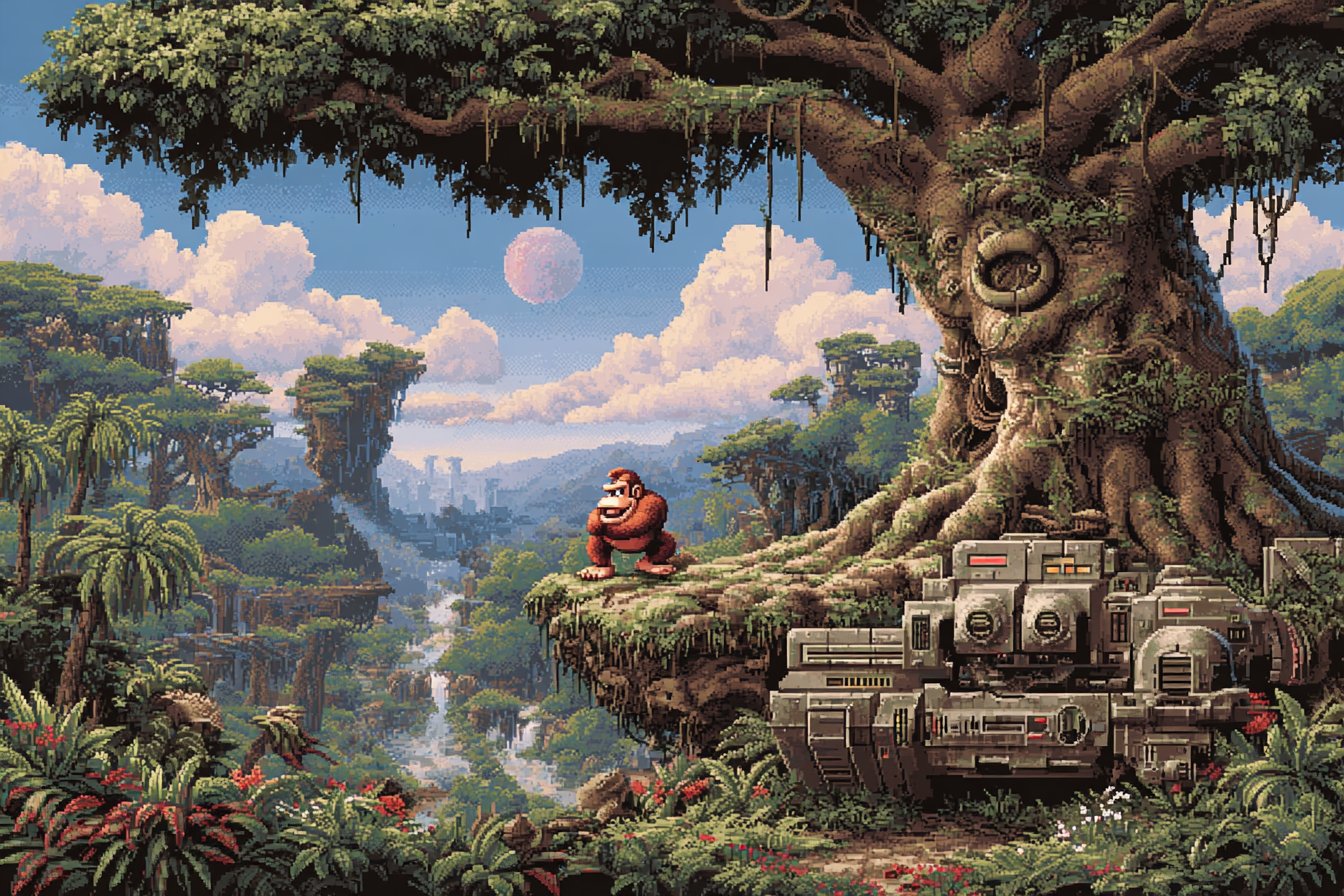

The Game That Proved 16-Bit Could Still Compete With 32-Bit
I’ve been gaming since the Atari 2600. I maintain a collection of CRTs humming quietly in my Minneapolis basement, a shrine I’ve curated over decades. My background is accounting, which means I think in systems and details. I understand manufacturing. I understand how to make every dollar count. Donkey Kong Country is the perfect example of technical innovation paired with commercial strategy. It wasn’t just a successful game. It was a calculated move by Nintendo to prove that the SNES could still dominate even as 32-bit systems were arriving. It was Rare proving they understood hardware architecture better than anyone else. It was the moment that changed Nintendo’s relationship with Rare forever.
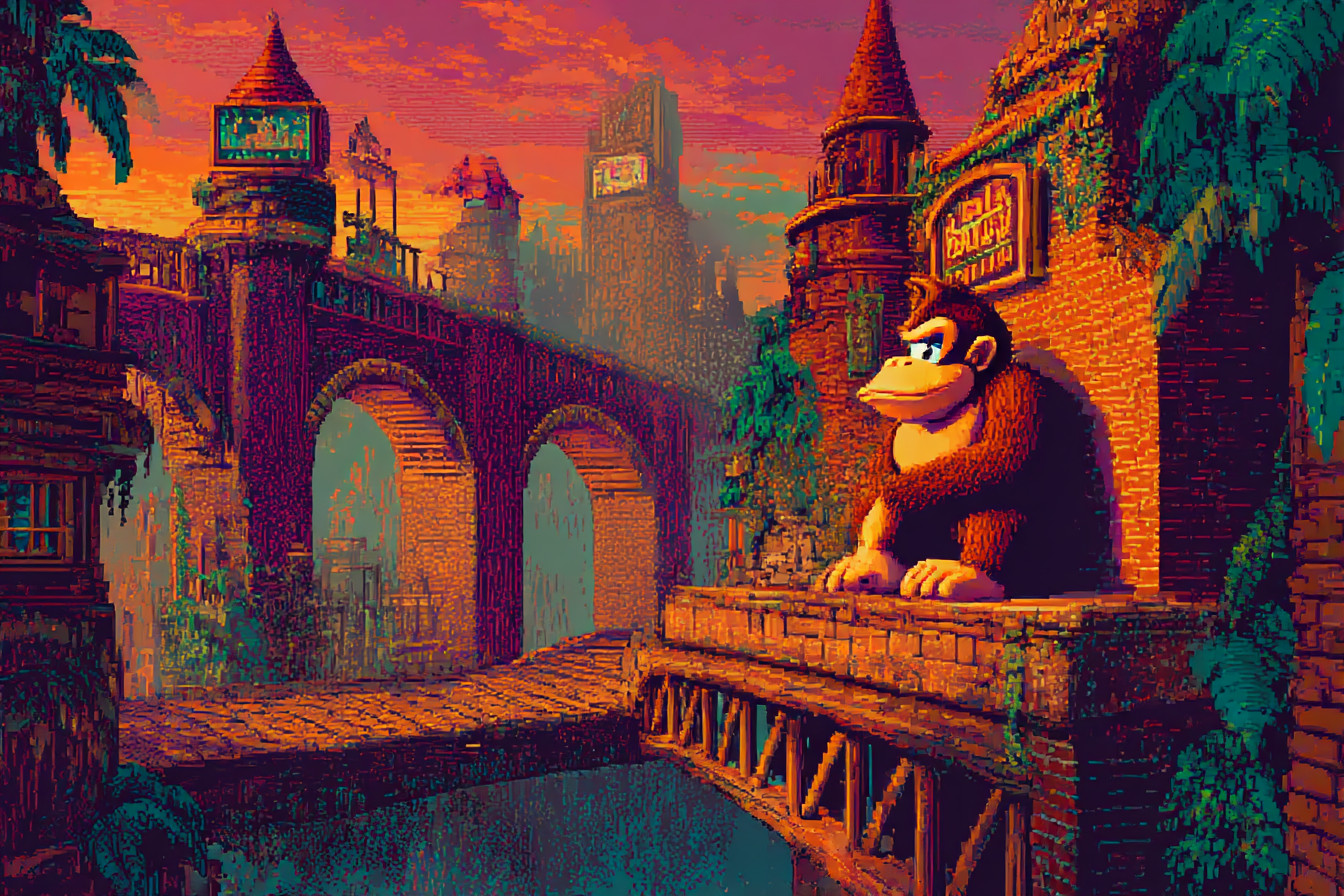
Donkey Kong Country was a 1994 SNES platformer by Rare and Nintendo that became one of the console’s biggest system-sellers, with around 9.3 million copies sold worldwide. But those numbers don’t capture what DKC actually represented: a masterclass in how to use cutting-edge technology within severe hardware constraints.
Donkey Kong Country Game Statistics
| Specification | Details |
|---|---|
| Release Date | November 1994 (North America and Europe, Japan) |
| Developer | Rare |
| Publisher | Nintendo |
| Platform | Super Nintendo Entertainment System |
| Genre | Side-scrolling Platformer |
| Playable Characters | Donkey Kong, Diddy Kong |
| Worlds | 6 main worlds + final boss area |
| Main Stages | Around 40 stages |
| Game Modes | Single-player, 2-player co-op and alternating |
| Cartridge Size | 32 megabit (4 MB) |
| Lifetime Sales | 9.3 million copies worldwide |
| Sales Ranking | 3rd best-selling SNES game (after Super Mario World and Super Mario All-Stars) |
| Launch Performance | 500,000 copies in first week, 1 million in two weeks |
| First Holiday Season | Approximately 6 million copies |
| First Week Revenue | $15 million (US) |
| First Holiday Revenue | $400 million (worldwide) |
| Best-Selling Donkey Kong Title | All-time best-selling DK game |
The Technical Problem: Making Next-Generation Graphics on 16-Bit Hardware
By 1994, the SNES was five years old. The PlayStation and Sega Saturn were arriving. 32-bit systems were the future. The SNES was supposed to be obsolete. But Nintendo and Rare understood something crucial: you don’t need more processing power if you’re smarter about how you use the hardware you have.
Donkey Kong Country used pre-rendered 3D models created on Silicon Graphics (SGI) workstations and converted them to 2D sprites for the SNES. This sounds simple in concept. In execution, it was revolutionary. You create your characters and environments as full 3D models on expensive workstations. You render those models from every angle at high quality. You then convert those rendered images into sprite data that the SNES could display. The result looks like next-generation graphics running on hardware from 1990.
The game used advanced sprite compression and streaming to fit detailed character and background art into the 4 MB ROM. That’s the engineering achievement that impresses me. You have 32 megabits of storage for an entire game. You need to store detailed character animations, multilayered parallax backgrounds, pseudo-3D effects, level data, music, sound effects. Everything. And Rare made it fit.
The compression had to be aggressive but also fast enough to stream at runtime. If decompression took too long, you’d see loading stutters. The SNES couldn’t afford that. Rare had to develop proprietary compression algorithms that the 3.58 MHz CPU could decompress in real time without impacting gameplay performance. That’s not trivial engineering.
The Visual Achievement: Making Graphics That Looked Impossible
Donkey Kong Country featured detailed multi-layer parallax backgrounds, pseudo-3D effects (mine carts, rotating stages, snowstorms), and smooth animation. The character animation in particular was revolutionary. Donkey Kong and Diddy Kong had many frames per movement, giving a more fluid look than typical SNES titles.
Critics at the time called it “next-generation graphics” on 16-bit hardware. They weren’t being hyperbolic. When you first loaded DKC, your immediate reaction was confusion. How is this running on an SNES? The sprites were detailed. The animation was fluid. The backgrounds were complex. This looked like a 32-bit game.
The technical achievement was understanding that you don’t need advanced hardware if you pre-compute your assets. The 3D rendering was done offline on SGI workstations. The SNES just displayed the pre-rendered sprites. This is a completely different approach from games that generate graphics in real time. Games like Final Fantasy VII generate polygons in real time on the PS1. DKC doesn’t. It displays pre-rendered images. But visually, it’s more impressive than many PS1 games.
This approach has limits. You can’t rotate sprites dynamically. You can’t scale them as much as real-time 3D allows. You’re locked into the angles and positions that were pre-rendered. But within those constraints, the visual quality is exceptional.
The Design Philosophy: Building Around Constraints
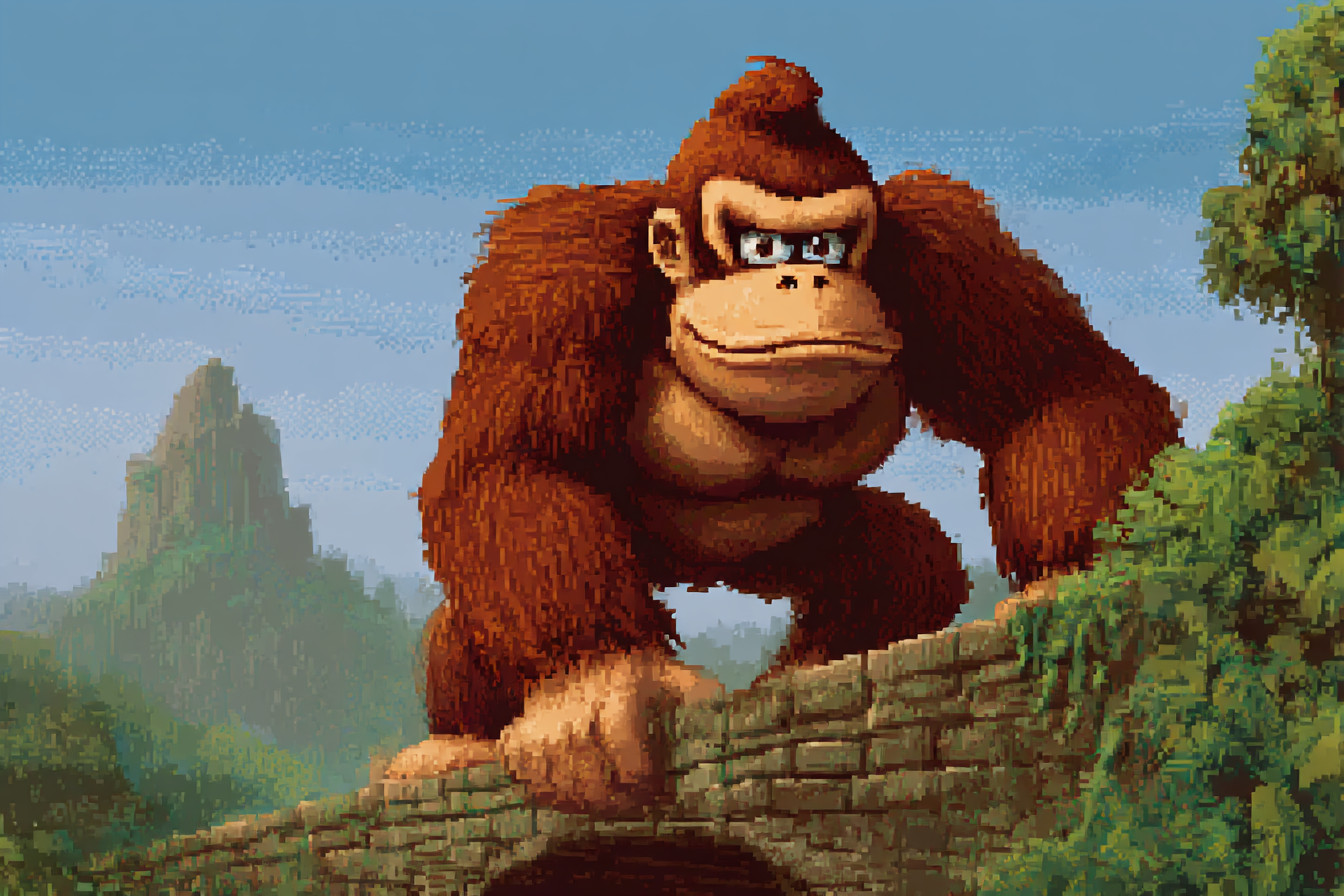
The tag-team system let players switch between Donkey Kong (stronger, better at defeating larger enemies and ground-pounding) and Diddy Kong (faster, more agile, better jump arc). This wasn’t just a gameplay feature. It was a design decision that created gameplay variety within the cartridge size limit.
Instead of having one character with all abilities, you have two characters with complementary abilities. This doubles the gameplay variety without doubling the animation and sprite data. Donkey Kong’s ground pound uses a different set of animations than Diddy Kong’s high jump. But you can swap between them mid-level. The level design takes advantage of this by requiring specific character abilities to progress.
The game featured 6 main themed worlds plus a final boss area, with around 40 main stages including standard platform stages, mine-cart stages, underwater levels, and barrel-cannon gauntlets. That level variety would normally require massive amounts of unique art assets. Rare solved this by creating thematic worlds with distinct visual styles. Monkey Mines has industrial machinery. Vine Valley has jungle vegetation. Gorilla Glacier has ice and snow. Each world uses a different visual palette, making the cartridge space feel larger than it actually is.
The Audio Achievement: Sophisticated Music on Limited Hardware
The soundtrack was composed primarily by David Wise (with Eveline Fischer and Robin Beanland also credited). The atmospheric mix features ambient tracks (Aquatic Ambience) and upbeat jungle/industrial themes, with heavy use of sampled instruments on SNES sound hardware.
This is where I need to stop and acknowledge something important. The SNES has 8 channels of ADPCM audio via the SPC700/DSP. DKC’s composers understood this hardware intimately. They created music that used the SNES’s strengths: layered instruments, dynamic mixing, sophisticated sound design. The result sounds professional. It sounds composed. It doesn’t sound like chip music. It sounds like a real soundtrack.
Aquatic Ambience is the standout track. It’s ambient and atmospheric, but it’s also musically sophisticated. There’s melody, harmony, and depth. It conveys the underwater environment without being simplistic. That’s the mark of composers who understand their hardware and use it brilliantly.
Commercial Strategy: The Fastest-Selling Game of Its Era
This is where the accounting background matters. DKC set a record at the time for fastest-selling video game, with over 500,000 copies sold in about a week, reaching 1 million units in roughly two weeks. During its second week in the US, it reportedly generated around $15 million in revenue, outperforming the top film and album of the week.
These numbers are staggering. In a single week, DKC generated more revenue than most games generate in their entire commercial lifespan. This wasn’t accidental. Nintendo and Rare planned this launch strategically. They created a visual spectacle that would capture attention. They released it at the right moment in the holiday season. They marketed it aggressively. The result was a cultural moment.
By the end of the first holiday season, DKC had sold approximately 6 million copies with an estimated $400 million in worldwide revenue. That’s not just commercial success. That’s market dominance. That’s a game that defined the holiday shopping season.
The Strategic Importance: Nintendo’s Investment in Rare
DKC’s success led Nintendo to acquire a substantial minority stake in Rare, cementing Rare as a key second-party developer in the N64 era. This is the real story behind DKC. It wasn’t just a successful game. It was proof that Rare understood hardware in ways that most developers didn’t. It proved that Rare could deliver technical achievements on Nintendo hardware. It proved that Nintendo could trust Rare with marquee franchises.
This relationship would lead to GoldenEye 007, Banjo-Kazooie, and Perfect Dark on the N64. Games that defined the console. Games that were only possible because Nintendo had already seen what Rare could do with the SNES.
The Lasting Impact: Extending the SNES’s Commercial Life
DKC influenced later pre-rendered platformers and helped extend the commercial life of the SNES against newer 32-bit consoles. The SNES was supposed to be dying by 1994. The 32-bit generation was here. Games should be moving to new hardware. Instead, DKC proved that the SNES could still deliver commercially and technically competitive experiences.
This mattered. It meant publishers continued developing for the SNES. It meant the system remained commercially viable longer than it should have been. It meant Nintendo didn’t have to transition the entire market to new hardware immediately. The SNES lived for several more years as a commercial platform, largely because DKC proved it could still compete.
Does It Still Hold Up?
I’ve played DKC extensively. The graphics are distinctive because of the pre-rendered approach. The character animations are fluid. The level design is solid. The difficulty is well-balanced, progressing from accessible early levels to challenging late-game content.
The platforming mechanics aren’t revolutionary. You jump, you roll, you use animal buddies, you collect items. These are standard platformer mechanics. What makes DKC special is the execution. The controls are responsive. The level design is thoughtful. The difficulty curve is excellent. Every element works together.
The thing that hasn’t aged as well is the collectible hunting. Modern players expect clearer feedback about how many collectibles you’ve found and where you need to go. DKC makes you search for K-O-N-G letters and animal tokens without much guidance. Some people find this exploration rewarding. Others find it frustrating. That’s a design philosophy difference, not a flaw.
The music still holds up beautifully. The soundtrack is so good that it’s been covered extensively by orchestras and arranged by musicians. That’s the mark of truly excellent composition. The music transcends its technical limitations.
Conclusion
Donkey Kong Country was a technical achievement, a commercial phenomenon, and a strategic move that changed Nintendo’s relationship with Rare. It proved that you didn’t need cutting-edge hardware to deliver next-generation experiences. You needed smart design, technical expertise, and understanding of your constraints.
9.3 million copies sold. $400 million in first-holiday revenue. The third best-selling SNES game. The best-selling Donkey Kong title ever. These numbers represent more than commercial success. They represent a moment when Nintendo proved it could still dominate even as new hardware was arriving.
From an engineering and business perspective, DKC is fascinating. It’s a case study in how to maximize limited resources. How to create visual spectacle within severe constraints. How to leverage technical achievement into commercial success. How to strengthen a business relationship through demonstrated capability.
That’s why DKC matters. Not just as a game. But as proof of what’s possible when you understand your hardware deeply.
Rating: 9/10 — The technical masterpiece that extended the SNES’s commercial life and changed Rare’s trajectory

Samuel’s been gaming since the Atari 2600 and still thinks 16-bit was the golden age. Between accounting gigs and parenting teens, he keeps the CRTs humming in his Minneapolis basement, writing about cartridge quirks, console wars, and why pixel art never stopped being beautiful.
0 Comments