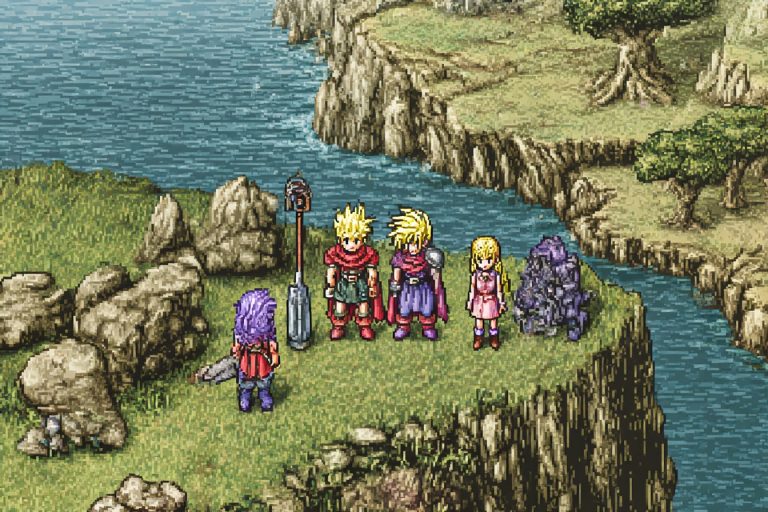

Release Date: July 19, 1991 (Japan) / November 23, 1991 (NA) | Developer: Square | Platform: Super Famicom / SNES | Cartridge Size: 6 Megabits (768 KB) | Playtime: 20–35 hours | Sales: 1.44M (Japan), 400K (NA), 2.5M+ worldwide | Critical Reception: 32/40 (Famitsu), 32/40 (EGM), 5/5 (GamePro)
I spent my career debugging games before the industry transformed beyond recognition. I’ve shipped titles, maintained impossible constraints, and watched developers try to squeeze miracles out of hardware that was never supposed to be capable of what they demanded from it. Final Fantasy IV is the game that taught me why constraints breed elegance.
When I first shipped code, we had 256KB of RAM to work with. We watched every byte like it was gold. Every redundant instruction cost us frames. Every inefficient lookup table was a crime against performance. By the time Final Fantasy IV arrived in 1991, developers had figured out how to speak the SNES’s language fluently. And Square, at that moment, was speaking it like poets.
What Final Fantasy IV Actually Accomplished
The Active Time Battle system wasn’t revolutionary because it was complicated—it was revolutionary because it was efficient.
Think about what this system required: simultaneous timers for up to four player characters, up to four enemy combatants, individual speed stats that had to scale meaningfully without breaking the math, animations that couldn’t just play out at a fixed framerate but had to account for variable execution times, and all of this running on the 65816 processor while Mode 7 rotation effects were potentially rendering in the background for airship sequences.[en.wikipedia]
From a hardware perspective, this was madness. The SNES wasn’t designed for this kind of complexity. The ROM size was only 6 Megabits total—768 KB of actual cartridge space for everything: code, sprite data, music, dialogue, enemy AI patterns, all of it.[en.wikipedia] You couldn’t just allocate unlimited memory to track battle states. Every variable had to serve multiple purposes. Every bit of data had to earn its place.
But Square solved it. They created a system where the ATB timer could be elegantly paused for menu navigation without losing its state. Where speed stats could be genuinely meaningful without creating mathematical breakpoints that would trivialize encounters. Where the system was simple enough for players to understand but sophisticated enough that boss fights felt like actual tactical engagements.
That’s engineering elegance. That’s what happens when constraints force you to think clearly.
Why the Story Mattered
Most RPGs before Final Fantasy IV treated narrative as an afterthought—a series of fetch quests strung together by dialogue boxes. Square understood something different: if you’re going to ask players to spend 30 hours in your world, the characters have to matter emotionally, not just mechanically.
Cecil’s arc from Dark Knight to Paladin wasn’t just visual progression—it was the player literally watching a character transform through the story, his abilities changing to reflect his philosophical shift. That required building character progression into narrative beats, which meant designing dungeons that would force specific character compositions at specific moments. It meant creating encounters where mechanical failure had narrative weight.
Rydia’s loss of her mother. Yang’s sacrifice. Tellah’s final stand casting Meteor despite the spell killing him. These weren’t random story moments—they were mechanical consequences written into encounter design. The game made you feel failure through both narrative and gameplay simultaneously.[finalfantasy.fandom]
When Kain betrayed the party, it wasn’t just dialogue—your party composition shifted. Your tactical options changed. You had to adapt mid-campaign. The story and systems were speaking the same language.
That’s not accident. That’s someone understanding how games actually work.
The Technical Achievement Nobody Talks About
Here’s what gets me about Final Fantasy IV: the 65816 processor in the SNES ran at approximately 3.58 MHz. That’s slow by any measure. To put this in perspective, modern smartphone processors run at gigahertz—literally 1,000 times faster. And yet somehow, on this antique hardware, Square managed to render complex battle animations, handle sprite scaling through Mode 7, stream music from the S-SMP audio processor, and maintain stable framerates.
How? Ruthless optimization. Every sprite had to be reused. Every animation frame was calculated to save memory. The AI pattern tables for enemies were compressed using techniques that wouldn’t become standard practice in the industry for years. The music itself was composed knowing exactly what the audio chip could and couldn’t do—arranging orchestral pieces knowing the technical limitations before a note was written.[en.wikipedia]
The cartridge itself was packed so efficiently that when Square released an updated version (1.1) after a brief recall in Japan due to an AI glitch, they couldn’t add new content—they could barely fix the bug without losing cartridge space. That’s how tight the margins were.
This is what people mean when they talk about “16-bit elegance.” It’s not nostalgia. It’s genuine technical achievement within brutally constrained parameters.
The Battle System That Changed Everything
The Active Time Battle system has been copied approximately five thousand times since 1991. Most copies miss what made it work.
The genius wasn’t the timer itself—it was knowing when to stop the timer. When you open the menu, the world pauses. This seems obvious now. Back then, it wasn’t. Games could have designed real-time menus, constantly scrolling options while enemies attacked. Square chose differently. They understood that players needed cognitive space to make meaningful decisions.
This created a fascinating balance: the game felt urgent because you couldn’t idle indefinitely, but you could still think tactically. Your speed stat genuinely determined turn order without becoming the only stat that mattered. A slow character with the right ability could be more valuable than a fast character with bad options.
Boss design proved this constantly. The fight against Scarmiglione required you to address specific threats in sequence, not just optimize DPS. The Antlion forced you to manage resources over time. Golbez’s encounters built in complexity as you acquired new party members—each fight taught you how to use new tools.
By the time you reached the Lunar Trials and the final confrontation with Zeromus, the game had taught you to think in three dimensions: damage output, resource management, and adaptation to unexpected party compositions. That’s not complicated. That’s elegant.[finalfantasy.fandom]
What Actually Holds Up Today
The core experience holds. The character work is stronger than people remember. The story beats land—even knowing what’s coming, the emotional moments still register. The music is genuinely beautiful, composed with such care that it’s still being performed by orchestras.
The mechanics work cleanly. The Esper system creates genuine customization without overwhelming the player. The difficulty curve, outside a few notorious spikes (the Floating Continent escape sequence, the Lunar Tower’s brutal encounters), feels thoughtfully calibrated.
But yes—the random encounter rate is punishing by modern standards. The translation, while charming, occasionally feels awkward. The difficulty spikes can feel arbitrary rather than fair. The post-game World of Ruin’s open-endedness was revolutionary at the time; now it occasionally feels directionless.
The Pixel Remaster version smooths these rough edges—updated translation, quality-of-life improvements, an option to hear Uematsu’s score performed by orchestra instead of the original hardware MIDI synthesis. But the original SNES cartridge is still completely playable if you can tolerate the encounter rate and accept that this is how games felt in 1991.
I replay it every few years. Not for nostalgia. Because it’s a masterclass in how to design within constraints. Every decision matters. Nothing is wasted. That’s a lesson that still applies to game design today, even though we work with vastly more powerful hardware.
Why This Game Still Matters to Me
As someone who spent decades maintaining systems and understanding the impossible constraints developers face, Final Fantasy IV represents something I don’t see often: a game where technical brilliance and artistic vision aligned perfectly.
The storytelling served the hardware constraints. The hardware constraints forced elegant solutions. The elegant solutions enabled the storytelling. It was a closed loop where everything fed into everything else.
That doesn’t happen by accident. It happens when developers understand their medium completely—not just what’s possible, but what’s beautiful within those possibilities.
Cecil’s transformation from Dark Knight to Paladin isn’t just a story beat. It’s a 65816 processor executing elegant code that somehow made me care about a character who doesn’t even have a face, just pixels arranged into suggestion.
That’s the achievement.
Rating: 10/10 – The game that proved constraints breed elegance
Return to our full Final Fantasy rankings →

Marcus is a retired software engineer from Seattle who spent his career debugging games before the industry transformed beyond recognition. He writes with technical precision about the engineering elegance behind classics, from Z80 assembly language to Mode 7 scaling tricks, treating code like archaeological artifacts worthy of study. His articles are deep dives into why certain games pushed their hardware to breaking points, paired with the dry humor of someone who’s actually shipped titles and understands the impossible constraints developers faced. For readers interested in the “how” behind their favorite games, Marcus is essential reading.
0 Comments