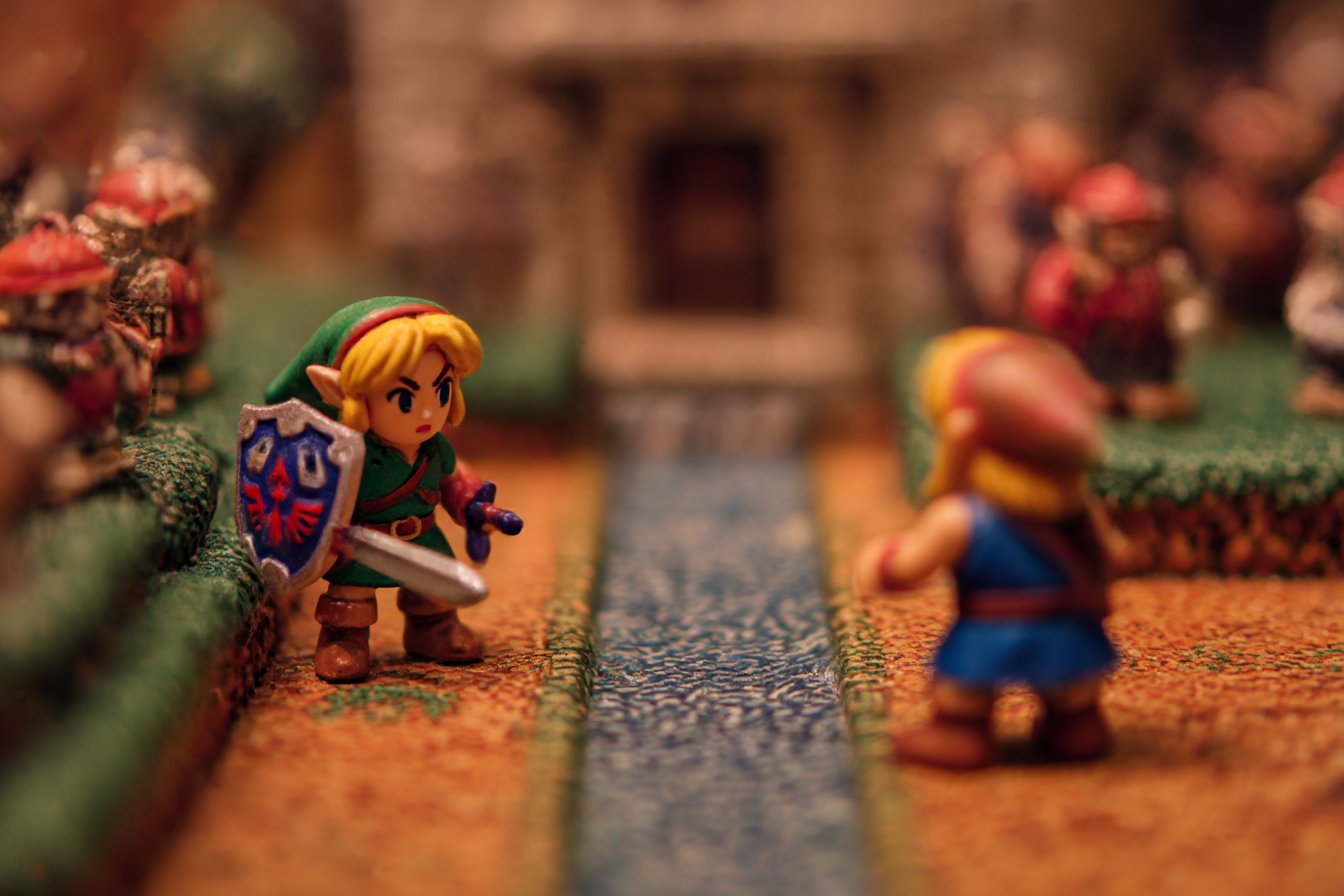

I am also willing to admit that I have a confession to make — I’ve spent the last few thousand words fawning over a Nintendo game, which I know is antithetical to everything I’ve believed in since 1985. However, A Link to the Past is so damn good that it breaks the bonds of loyalty to a particular console platform, and I have thirty years of gameplay to support that statement. Yes, you read that correctly — I’m a Sega fanboy who’s been secretly obsessed with Link’s SNES adventure since I was 13, and now I’m finally ready to admit it to the public.
Christmas 1991, I’d recently received my Genesis the year prior and was completely devoted to Sonic and all that Sega represented. But my cousin Danny got a Super Nintendo for Christmas that year and when we went there for Christmas dinner, he booted up this game using the gold cartridge that made me question my loyalty to Sega. The opening sequence – that rainy night, the telepathic princess calling for help, your uncle grabbing his sword and telling you to stay put – gripped me harder than any Genesis game had to that point. Honestly, it hurt me to admit that.
What got me wasn’t just the obvious technical superiority over anything on my Genesis, although let’s be real – the SNES was producing graphics that made Sonic look primitive. The rain effects, the detailed character sprites, the smoothness of transitions between areas without those abrupt cuts you find in most 16-bit games – it was like stepping into a fully realized world rather than simply playing a video game. I spent the entirety of that Christmas visit glued to Danny’s TV, barely speaking to my family members, and completely consumed with exploring Hyrule.
The moment that really got me was when Danny pulled the Master Sword from its pedestal. He’d been playing for weeks and finally got to that point while I was sitting there watching. The whole sequence – the beam of light slicing through the Lost Woods, the ancient text warning about the sword’s power, and that spectacular musical buildup as Link pulls the blade from the pedestal – it was video game magic unlike anything I experienced with the Genesis. I remember thinking, “Man, Nintendo actually understands how to use this stuff.” Not something I was comfortable admitting at the time.
Then came the twist that completely changed what I thought games were capable of accomplishing. The Dark World reveal – finding out that the entire kingdom I’d been exploring had a corrupted mirror image and I could travel between them – absolutely obliterated my teenage brain. When Danny first used the Magic Mirror and we traveled to the twisted version of the same map, I literally blurted out, “What the hell?” to my aunt, which got me in trouble. Worth it. The Dark World wasn’t just a new level or area – it was like I stumbled upon a secret basement under my house that was twice the size of the top floor.
The brilliance of the Dark World was its ability to elevate the game’s storytelling beyond mere console loyalty – it made the story feel intimate and urgent in ways that few other games were able to accomplish. Seeing Kakariko Village transformed into this monstrous Thieves’ Town infested with monsters and watching Lake Hylia turn into a drained poison swamp – neither of those were just obstacles to overcome in gameplay, they were brutal gut punches. You weren’t saving Hyrule in some abstract sense; you were stopping this specific nightmare from turning into a perpetual reality. That struck a chord deeper than “save the princess, the game says so.”
I wound up borrowing Danny’s cartridge for two weeks that summer – told my folks I was spending the weekend at his place, but the truth is I spent that entire weekend in my basement playing Link to the Past while they were at work. Yep, I lied to my parents to play a Nintendo game. My thirteen-year-old Sega fanboy self would’ve died of embarrassment if he saw what was going on.
What drew me in more than anything else was the quality of the dungeon design in ways that the Genesis games just weren’t able to touch at the time.
Each of the game’s six dungeons were designed like a perfect puzzle box with every room serving a function and every item you picked up contributing to your success somewhere in the game. Getting the Hookshot in Swamp Palace wasn’t just necessary to beat that dungeon; with it you could access more than half of the overworld in ways you hadn’t before. I spent hours just swinging that thing back and forth for the sheer joy of it and listening to that perfect “thwack” sound effect when I hit it. My dad caught me doing this at one point and asked if I was crazy.
The boss battles in Link to the Past were a major departure from what I was used to in Genesis games. Most Genesis games were either pure pattern memorization or button-mashing chaos, but Link to the Past bosses demanded that you come up with a plan and improvise. I’ll never forget my first battle with Blind the Thief in Thieves’ Town – I was terrified. I wasn’t expecting a Zelda game to incorporate horror elements in the same way that most movies don’t, but when she turned into that creature that throws heads at you with that light overhead, I was about to toss the controller.
Brilliantly done. That design used the game’s own mechanics to create true story surprises.
What really got me, though, was how much the game respected my intelligence and gave me the freedom to learn at my own pace. This was 1991, long before GameFAQs existed, before YouTube tutorials showed you step-by-step solutions, and before you could look up answers on Google. If you got stuck in the game, you had to figure out how to fix it yourself, or rely on friends. The game trusted you to do that. There were no tutorials popping up explaining every mechanic, no arrows pointing the way to the nearest checkpoint. It just dropped you into this world and expected you to explore and experiment until you figured out how everything worked.
I kept a notebook — yes, a real paper notebook — to track the location of heart pieces and places I couldn’t reach yet, but wanted to remember for when I eventually could. When I finally obtained the Titan Mitt, allowing me to move the massive blocks, I flipped through my notes and located all the areas I had marked months earlier. The thrill of entering a previously inaccessible area with new abilities and discovering what was waiting for me inside never wore off. With modern games employing quest logs and automatic checkpoints, this type of personal exploration has become almost extinct.
The music in Link to the Past was doing things that were truly making me jealous as a Sega fan. Don’t get me wrong, Genesis had some amazing soundtracks — Streets of Rage 2, Sonic, Phantasy Star — but Koji Kondo was working on an entirely different plane with Link to the Past. That overworld theme made walking around Hyrule feel both epic and significant. The Dark World version of the same melody perfectly captured the essence of corruption without being obnoxious to listen to for hours. I still find myself humming the Lost Woods theme when I’m hiking, thirty years later. My wife recognizes it immediately and just shakes her head.
The inventory system in Link to the Past was smarter than it should’ve been. With only two buttons to control your items, I was forced to think tactically about what items to keep equipped. For example, do I keep the Bow equipped for ranged attacks, or switch to the Hookshot for increased mobility? The fire rod for damage, or the lantern to allow you to see in the dark? None of those were busywork decisions — they directly affected how you approached each area and fought each boss. Contrast that with modern games that give you seventeen different guns and the ability to swap between them instantaneously — sometimes limitations result in better design.
One of the biggest reasons I’m willing to admit my Nintendo betrayal to the world is that Link to the Past does not contain a single wasted element. Every screen, every item, and every mechanic plays multiple roles and contributes to the overall experience in a meaningful way. As someone who’s defended Sega’s sometimes experimental and often incomplete design choices for decades, I have to respect Nintendo’s near-surgical precision with this game. It’s like they took all the good ideas from the first two Zelda games, fixed everything that didn’t work, and then polished the whole thing until it shone.
I’ve played Link to the Past roughly fifteen times over the years, and I still find new details. Hidden passageways I had somehow overlooked, changes to dialogue based on how far you are along in the game, and visual details that only make sense once you’ve seen the entire story. Last year I played it with my fifteen-year-old daughter, who initially griped about the “old-school” graphics but was completely immersed by the end of the first dungeon. Seeing her reaction to discovering the Dark World for the first time evoked all the memories I experienced during the first time I played it.
The fundamental design of Link to the Past is so solid that it transcends generations.
Link to the Past’s influence on modern game design cannot be overstated, and as someone who’s watched the industry grow for forty years, I can clearly see its DNA in Metroid and in basically every modern indie game. The dual-world design, the item-gated progression, the mix of exploration and puzzle-solving, and the combat — all of these became standard practices in modern game design because they’re done so well in Link to the Past. Playing Link to the Past today doesn’t feel like studying a historical artifact; it feels like witnessing a master class in interactive storytelling that few modern games have equaled.
Look, I’ll never stop being a Sega guy. The Genesis will forever be my first love, the Saturn deserved a lot better than it got, and the Dreamcast’s demise was a tragedy for the gaming industry. However, I wouldn’t lie if I said Link to the Past helped me understand why Nintendo dominated the way it did. Sometimes the competition creates something so good that you have to raise your hands and concede that it’s excellent, even when it comes from the “opponent.” This is one of those times, and after thirty years of basically keeping this opinion to myself, it’s nice to finally admit it.

0 Comments