As soon as we released this ranking, we knew there would be total chaos. Over three weeks of heated Zoom calls; seventeen dropped connections when things got too personal; and Joe threatening to leave the group chat after we suggested that maybe LucasArts made some better games than Sierra. We argued about whether Marcus’ obsession with the technological innovations of adventure games should count against him; Elena fighting tooth and nail for UK developers to get some proper recognition; David championing the underdogs as he usually does; and John wouldn’t stop talking about how horror elements were undervalued in adventure game rankings.
It seemed like a simple set of criteria, but as usual, when you have five opinionated gamers trying to agree on something, “simple” doesn’t exist. We needed Carl to act as a mediator when the debate turned ugly over whether Myst killed the traditional adventure games or saved them.
Adventure games matter because they proved that interactive storytelling could be sophisticated, that puzzles could be narrative devices rather than arbitrary barriers to progress, and that games could deal with adult subject matter without relying on either violence or spectacle. All ten of these games entertained, but they also helped advance the medium. From the pixel art masterpieces of the early ’90s to the 3D experiments that tested the limits of what was possible technically, each of these titles added something important to the advancement of gaming. They are the reason adventure games survived the “death” of the genre and continue to inspire developers to this day.
Fast Rankings
- Grim Fandango – The noir masterpiece that showed games could be art
- Day of the Tentacle – Perfectly executed time-travel comedy from LucasArts
- The Longest Journey – The epic fantasy that revived the adventure games
- Myst – The puzzle game that sold more PCs than any marketing campaign
- Broken Sword – British storytelling that rivalled Hollywood thrillers
- Sam & Max Hit the Road – Buddy comedy that made adventure games enjoyable again
- Full Throttle – The coolest motorcycle adventure ever made
- Gabriel Knight – Horror mystery that made Sierra relevant again
- Beneath a Steel Sky – Aussie cyberpunk with genuine personality
- Indiana Jones and the Fate of Atlantis – The adventure game better than most Indy films
1. Grim Fandango (1998)
| Metacritic Score | 94/100 |
| Playtime | 20-25 hours for completion |
| Cultural Impact | Featured in Encyclopedia Britannica |
| Community | Dedicated fans since 1998 |
Tim Schafer’s masterpiece is the only adventure game to have transcended its medium to be considered true art. That is no exaggeration, nor is it fanboy worship. Grim Fandango achieved something remarkable: a complete artistic vision using every aspect of game design to tell a cohesive story about death, bureaucracy, and finding meaning in an afterlife that mirrors the worst of corporate America.
What sets it apart: The Art Deco visuals that create a believable underworld that combines film noir with Mexican folklore, where every character model and background painting contribute to the atmosphere. The voice acting from Tony Plana and other talented actors that bring real emotion to characters made of bones and shadows. The puzzle design that never deviates from the character, where solutions emerge logically from understanding the bizarre world logic rather than random combinations of items. The soundtrack by Peter McConnell that smoothly transitions from jazzy investigation tunes to traditional Mexican music, perfectly synchronising with the emotional beat of the scene. The writing that is both funny and melancholy, producing actual pathos for a dead protagonist.
Does it still hold up? The remastered version shows that great art direction outlasts technical wizardry. The tank controls may feel clumsy compared to modern adventures, but the world design and storytelling remain unmatched. The puzzles demand patience and logical thought rather than pixel-hunting, making them more accessible now than many of its contemporaries.
Read Joe’s assessment of how Grim Fandango demonstrated games can be art
2. Day of the Tentacle (1993)
| Time To Achieve | 2-3 hours for completion |
| Leaderboard Community | Active speedrunning community |
| Technical Accomplishment | SCUMM Engine at peak performance |
| Remaster Success | Double Fine restored the original |
MARCUS was correct that this was LucasArts at their creative and technical peak. The time travel mechanics could have been disastrous, but instead they provide the base for the most ingenious puzzle design in the history of adventure games. The three main characters each exist in a separate time period, but the actions they take in one period will affect the others in unpredictable yet rational ways.
What sets it apart: The time manipulation puzzles that allow you to alter events in the past and see the effects of those changes in the future in unanticipated but logical ways. The cartoon visual style from Peter Chan that accurately replicates the look and feel of Chuck Jones/Warner Bros. cartoons whilst still retaining a distinctly video game quality of interactivity. The voice acting that provides individual personalities to each of the characters, with Bernard, Hoagie, and Laverne being relatable friends rather than video game characters. The comedic writing that uses multiple forms of humour such as visual gags, puns, historical references, and character-based humour, all operating on multiple levels simultaneously. The SCUMM interface perfected to the point where every interaction feels natural and contextually relevant.
Is it still good today? The remastered version demonstrates that perfect game design is timeless. The cartoon visuals remain visually appealing, the puzzles retain their cleverness and ability to generate genuine laughter as opposed to nostalgic chuckles. The remastered interface improves upon the original in terms of usability and playability.
Read MARCUS’s assessment of how Day of the Tentacle is the pinnacle of time-travel comedy
3. The Longest Journey (1999)
| Metacritic Score | 91/100 |
| Revived Genre | Proved adventure games were not dead |
| Availability | Digital availability via Steam and GOG |
| Legacy of Franchise | Official site maintained 25 years later |
When everyone wrote off adventure games as a thing of the past, Ragnar Tørnquist’s Norwegian epic came along and proved that complex, well-written storytelling and deep character development could still attract an audience. What he did is truly unique: a fantasy adventure that treats its themes with the gravity of literature, and yet retains the lightheartedness that is necessary to be an adventure game.
What makes it unique: The dual-world concept of Stark and Arcadia that creates a valid distinction between science and magic, and technology and tradition, without descending into simplistic binary oppositions. April Ryan as a protagonist who evolves from an uncertain art student to a confident hero, as a result of her own growth and development as a person rather than due to the accumulation of powers. The voice acting from Sarah Hamilton and others that add emotional depth to what could have simply been a string of expositional dialogue. The world-building that is rich and believable, where both the cyberpunk dystopian world and the magical realm have their own histories and logics. The puzzles that integrate seamlessly with exploration and conversation, and do not feel like artificial barriers to progressing the story.
Does it still hold up? The 2D backgrounds remain visually stunning, and the character animations have a charm that few modern 3D animations can replicate. Modern players may not have the patience for some of the puzzles that require thought, but the sheer quality of the storytelling makes the effort worth it. The themes of global devastation, corporate power, and finding your place in a chaotic world are more relevant today than ever.
Read New Player Ready’s analysis of how The Longest Journey proved adventure games were not dead
4. Myst (1993)
| Impact on Sales | Sold more PCs than any marketing campaign |
| Technological Innovations | CD-ROM showcase for the industry |
| Achievement Time | 6-8 hours for all achievement types |
| Long-Term Support for Platforms | Multiple remakes/remasters |
John continued to argue that Myst was responsible for killing traditional adventure games, demonstrating that atmospheric puzzle solving could be successful without character interaction or thematic complexity. Whilst he is not entirely incorrect, he misses why Myst was significant to the evolution of the medium. Myst represented the foreign film that proves mainstream audiences will accept challenging art as long as it is presented aesthetically.
What sets it apart: The pre-rendered 3D environments that provided a photo-realistic world at a time when nearly all other games were cartoons, providing visual fidelity as a legitimate sales pitch for interactive entertainment. The puzzle design philosophy where understanding systems and environments is more important than accumulating items to solve puzzles, providing the player with moments of realisation as opposed to trial-and-error solutions. The atmospheric sound design that uses audible cues and musical themes to guide exploration without explicit instructions. The marketing success that drew in non-gamer audiences to the medium, proving that games could reach demographics outside of traditional gamers. The CD-ROM technology showcase that convinced hardware manufacturers and software developers that CD-ROM technology had commercial viability.
Does it still hold up? The puzzles are still satisfying for players that enjoy logical thinking over action reflexes. The atmospheric design continues to produce a sense of mystery and discovery. The pacing is glacial compared to modern games, but the deliberate pace rewards patience with moments of genuine insight that modern fast paced adventures cannot deliver.
Read New Player Ready’s analysis of how Myst sold more PCs than any marketing campaign
5. Broken Sword: The Shadow of the Templars (1996)
| Legacy of Development | Flagship title of Revolution Software |
| Success of Franchise | Multiple sequels spawned |
| Updated Versions | New platform Reforged Edition |
| Recognition of Critical Success | Tracking on OpenCritic for remasters |
Elena was spot on in her advocacy for British adventure gaming, and Charles Cecil’s thriller proved that European developers understand cinematic storytelling far better than most Hollywood productions. The Templars conspiracy framework could have been crass and shallow Dan Brown-style nonsense, but instead serves as the basis for genuine character development and historical intrigue.
What sets it apart: The hand-drawn animation from Dave Gibbons that produces character expression and movement with the same level of quality as Disney whilst maintaining distinctly European sensibilities. The globe-trotting adventure structure that utilises real historical locations and actual research to create plausible conspiracy theories. The developing relationship between George Stobbart and Nico Collard that develops organically through their joint investigations rather than forced romantic subplot. The voice acting from Rolf Saxon and Hazel Ellerby that provides authentic personalities to characters that could easily have been caricatures. The puzzle design that arises from the process of investigation and deductive reasoning as opposed to inventory gathering, which allows the solutions to feel earned and not arbitrary.
Does it still hold up? The 2D artwork holds up better than almost all of its contemporary 3D counterparts, and the conspiracy thriller elements feel even more pertinent to our current global politics. Some puzzles require specific knowledge that modern players may need to seek out themselves, but the realistic way of investigating creates a more authentic experience of detection than most modern adventure games.
Read Elena’s assessment of how Broken Sword rivals Hollywood thrillers
6. Sam & Max Hit the Road (1993)
| Speedrun Community | Active leaderboard community |
| Availability | Digital availability on Steam and GOG |
| Based On Source Material | Based on the comics of Steve Purcell |
| Impact on Franchise | Multiple episodes of sequel series |
John’s love for this buddy-comedy is totally justified. Steve Purcell’s freelance police duo translates to interactive adventure games perfectly, creating something that feels similar to playing through a Saturday morning cartoon whilst also having the sophistication to produce genuine humour on multiple levels.
What sets it apart: The buddy-cop dynamic between Sam’s straight-laced detective work and Max’s outrageous violence, that create comedy based on contrasting characteristics rather than cheap gags. The road trip structure throughout various areas of American oddity that use tourist traps as opportunities for surreal interactions and puzzles. The voice acting from Bill Farmer and Nick Jameson that captures the comedic timing of the comic book characters whilst providing the opportunity for additional interactive personality. The cartoon violence that maintains the consequences of comic books, where being shot or exploded merely results in temporary setbacks rather than permanent harm. The puzzle design that takes advantage of the cartoon logic, where the solution requires thinking like animated characters rather than attempting to solve problems realistically.
Does it still hold up? The cartoon aesthetic remains ageless, and the humour generates genuine laughter as opposed to nostalgic chuckles. Some of the puzzle solutions require specific knowledge of the early 90s, but the period-specific detail adds a charming factor rather than annoyance. The pacing moves quickly enough to keep up with the modern gamer’s attention span without feeling rushed.
Read John’s appreciation of how Sam & Max Hit the Road made adventure games enjoyable again
7. Full Throttle (1995)
| Success of Remastered Version | The original Double Fine restoration preserves the essence of the original |
| Recognition in the Press | Tracking on OpenCritic for the remastered version |
| Time Needed to Complete | A compact, fast-paced experience for an adventure |
| Character Voice Acting | Impressive voice performance by Roy Conrad as Ben Throttle |
As LucasArts at their creative best, Tim Schafer’s biker adventure represents the best of the genre in terms of its style, a blend of interactivity and cinematic storytelling. Rather than being a generic Mad Max-inspired wasteland, the post-apocalyptic motorcycle-adventure aesthetic serves as a base for some truly impressive character design and world-building.
What Makes It Unrivaled: Ben Throttle is a true embodiment of “cool” in the sense that he has no pretentious posturing to be “tough,” and therefore, feels authentically so. The motorcycle combat sequences are innovative because they break the pace of the typical adventure game experience without feeling like random mini-games. The voice acting by Roy Conrad delivers classic, unparodied tough guy dialogue with conviction. The art direction is visually stunning and establishes a believable near-future wasteland where corporate domination and biker rebellion provide meaningful conflict. The soundtrack complements the road warrior aesthetic and the emotional beats of the story perfectly.
Still Relevant?: The remastered version demonstrates that strong, well-designed art will endure longer than technological innovation. Although some puzzle solutions may seem slightly obscure compared to modern adventure design, the experience as a whole remains satisfying. The relatively short length of the experience makes it ideal for today’s attention span, whilst providing enough time for each character to develop completely.
Read David’s analysis of why Full Throttle was “too cool” for its own good
8. Gabriel Knight: Sins of the Fathers (1993)
| Edition Release | The 20th Anniversary edition, celebrating the 20th anniversary of the game |
| Reputation | Critics praised the game upon release; today, OpenCritic and Metacritic also track it |
| Originality | Gabriel Knight’s horror mystery adventure is a pioneering game in the genre |
| Legacy | The Gabriel Knight series spawned several award-winning sequels |
Jane Jensen’s supernatural detective game demonstrated that Sierra Games could produce complex, adult-oriented adventures that could easily compare to those of LucasArts. Using a voodoo mystery framework allowed for an opportunity to include horror elements, whilst keeping the game within the boundaries of an adventure game, making it an original in the genre.
What makes it untouchable: The New Orleans location is uniquely grounded in real historical and cultural aspects of the city, allowing the game to utilise those to make the supernatural thriller elements feel more realistic. Gabriel Knight is a flawed hero whose character growth is a key factor in developing the mystery, and does not simply serve as a player avatar. The voice acting of Tim Curry and other actors adds gravity to potentially campy supernatural thriller elements. The research aspect of the game forces you to actually investigate things to solve puzzles, rather than collecting items randomly, allowing you to feel like your detective work has paid off. The horror elements of the game create a chilling atmosphere, and do not rely on cheap jump scares or gore.
Is it Still Good?: The 20th Anniversary Edition updated the visuals of the game to improve upon the originals’ atmosphere, whilst still retaining the spirit of the original. Whilst there are some puzzle solutions that require knowledge of voodoo and the history of New Orleans, that authenticity helps make the puzzle solving in the game feel much more rewarding than many of the simplified puzzle solving techniques used in modern games.
Read John’s analysis of how Gabriel Knight brought Sierra back to relevance
9. Beneath a Steel Sky (1994)
| Comic Book Inspiration | Artwork and design by Dave Gibbons |
| Sequel Success | Beyond a Steel Sky is OpenCritic tracked |
| Preservation in Digital Format | Available at Internet Archive |
| Support for Open-Source Platforms | Supported by ScummVM |
David praised this Australian cyberpunk adventure as a unique piece of adventure gaming history. Revolution Software developed something completely new: a story set in a dystopian future that utilises humour to explore serious topics such as corporate control and environmental disaster, with beautiful Dave Gibbons artwork.
What makes it untouchable: The cyberpunk setting of the game is a believable dystopian future rather than a stylised imitation of Mad Max. Joey, the AI companion, offers both comedic relief and assistance in puzzle-solving without being an obnoxious sidekick. The artwork and design from Dave Gibbons creates a believable future world with visually stunning background and character design, similar to comic book visual storytelling. The development team from Australia provided a fresh take on the cyberpunk theme. The puzzle design naturally incorporates hacking and technology concepts.
Still Good Today?: The pixel art graphics of the game look amazing even today, and the cyberpunk themes feel more timely than ever in our current technological landscape. Whilst some puzzles require more logical thinking than modern adventure games would require, the solutions are more rewarding because of the challenge.
Read David’s analysis of how Beneath a Steel Sky represented adventure gaming that Australia made
10. Indiana Jones and the Fate of Atlantis (1992)
| Integration with Film Franchise | Better than most of the movies |
| Multi-Path Design | Two additional gameplay approaches available |
| Support for Open-Source Platforms | Preserved via ScummVM |
| Availability in Digital Formats | Released on Steam and GOG |
LucasArts demonstrated that a company could successfully use licensed properties to create an Indiana Jones adventure that captured the essence of the character, whilst also producing a story that rivals the best films in the franchise. The Atlantis mythology provides the perfect framework for a treasure hunt-style adventure without the possibility of going too far into the realm of supernatural absurdity.
What makes it untouchable: This is the ultimate Indiana Jones experience, capturing the character and the tone of the films without requiring Harrison Ford’s direct involvement. Sophia Hapgood is a partner character who plays a meaningful role in both the puzzle-solving and the story development. There are three different gameplay paths that focus on either fighting, puzzle-solving, or co-operation, adding replayability to the game. The Nazi villains feel menacing and threatening without crossing the line into cartoonish villainy, whilst maintaining the serious themes that made the films successful. The adventure is grounded in archaeological authenticity that relies on historical research to support fantastical elements.
Still Good Today?: The SCUMM engine is still easy to navigate and the puzzle design encourages logical thinking without relying on pixel-hunting. The story is still engaging and the character development meets the expectations of both Indy fans and general adventure gamers. Whilst the combat sequences may be less intense than modern action games, the purpose of combat is to advance the story rather than to compete with dedicated action games.
Read New Player Ready’s argument for why Fate of Atlantis was better than most of the Indy films
Almost Made the List
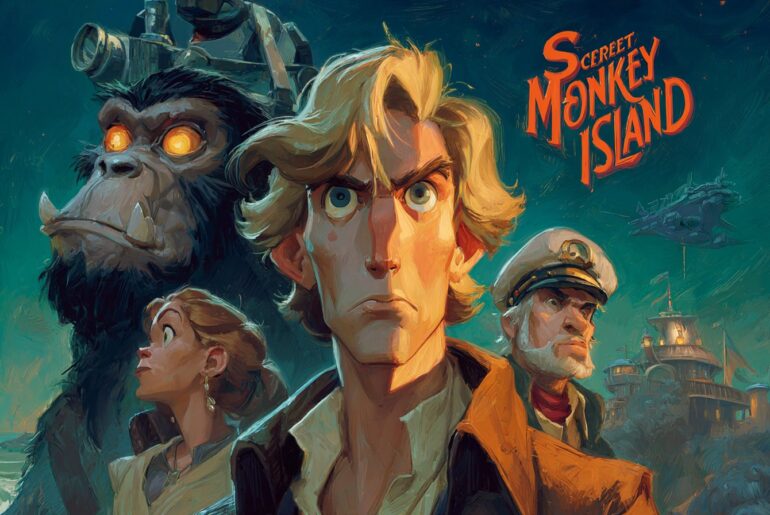
Monkey Island Series — Sam fought hard for the first two games, saying that they are the most defining examples of the LucasArts adventure game experience. They both feature the style that defined the company, including the use of humour and parody. Insult sword fighting, the pirate-themed Caribbean setting, and the character development of Guybrush Threepwood are all examples of great design. However, Sam kept bringing up the same problem, which is which one of the two games should be on the list?
King’s Quest VI — John supported this as Sierra’s greatest achievement and felt the same way about the fairy-tale type integration and multi-solution paths. The voice acting was revolutionary at the time and the story was complex like many of LucasArts’ titles. However, the ability to die and sometimes unfair puzzle design kept it out of the list, but everyone acknowledged its historic significance.
Discworld — David advocated for Terry Pratchett’s interactive adaptation, claiming that the British humour and voice acting of Eric Idle made it a unique experience. The puzzle design requires a basic understanding of Pratchett’s satirical view of the world and therefore creates both brilliant solutions and frustrating ones. A close call, but the inconsistent pacing kept it from competing with the top 10.
Police Quest — Elena supported Jim Walls’ procedural adventure series, specifically the first Police Quest’s authentic police work simulation. The educational value and unique gameplay mechanics deserve recognition, but the technical limitations and somewhat dry presentation prevented it from competing with the more dramatic and exciting options.
Space Quest III — Joe supported the Two Guys from Andromeda for the Space Quest series, particularly the comedic writing and meta-textual humour that influenced later adventure games. The arcade sequences and Sierra’s death mechanics worked better in this title than most of their titles, but ultimately, it did not meet the level of consistency found in the top 10.
We fought over each one of them. MARCUS said he would leave if Monkey Island didn’t make the cut. David claimed we were biased against British developers until Broken Sword was included. John insisted that horror elements were consistently underrated. Carl had to step in when the debate over whether Sierra or LucasArts was better became personal.
The truth is, the golden age of adventure gaming produced more classic games than any possible top 10 list can contain. The almost-made-the-list candidates above demonstrate the wealth of talented creators and designers that thrived during the genre’s golden years. All of these deserve consideration, critical evaluation, and for modern gamers to discover why they matter. But, rankings force us to make difficult decisions, and these 10 games represent what we believe to be the pinnacle of achievement in interactive storytelling.
You likely have favourites that did not make the cut. That is inevitable when passionate gamers attempt to narrow the incredible breadth of design and creativity from the past four decades into a single list of 10 games. Prove us wrong.