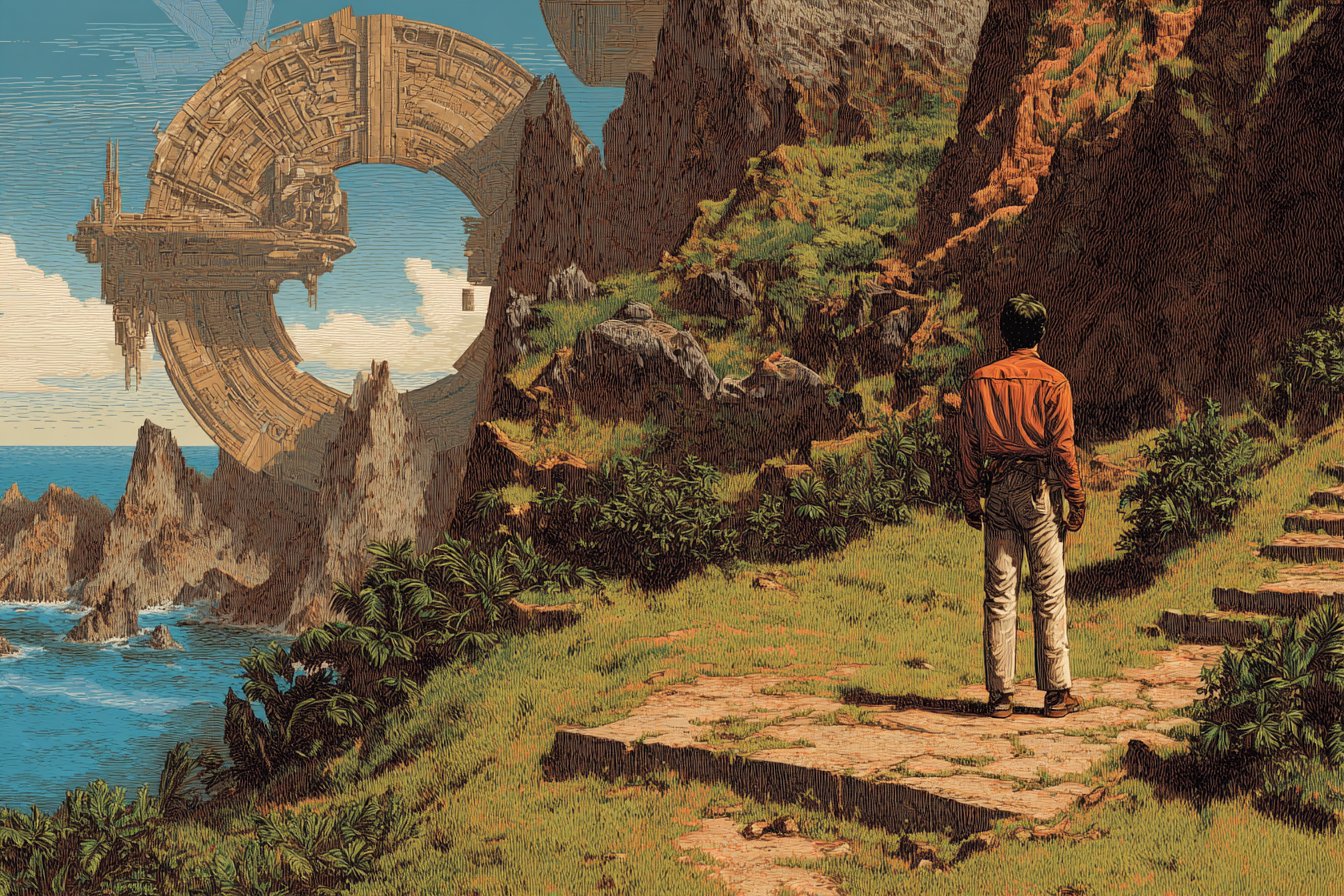

OKAY — Let’s cut to the chase. As a die-hard Sega fanatic, I shouldn’t have cared about PC games at all. However, 1994 threw me a curveball in the form of a blue CD case at my friend Tony’s house. “You’ve got to see this,” he said, waving the CD box like it was some kind of holy grail. At the time, his family had spent a small fortune on a Compaq Presario with a CD-ROM drive – essentially the equivalent of buying a spaceship back then.
At the time, I was a skeptic. I had a Genesis, and I had Sonic — why did I need some computer game? But Tony wouldn’t give up, so I humored him. He put the CD in the machine, navigated through a series of menus, and suddenly we’re watching what appeared to be an actual movie – not some cheap FMV garbage like the stuff we got on Sega CD, but something else altogether. Once the intro finished, and I realised I could actually click around this photorealistic world… man, I think my mouth literally dropped open. “Can I try?” I said, already reaching for the mouse.
After three hours of clicking away, his mom had to bring us sandwiches because we’d completely forgotten about lunch. I was crouched over that monitor like a caveperson discovering fire, frantically writing notes in Tony’s algebra notebook. Poor Tony had given up on getting his computer back, and was just sitting there watching me click around, occasionally offering suggestions when I got hung up. “Try flipping those levers in a different order?” “Didn’t we see that symbol somewhere else?”
When I finally looked up, it was night outside, and my eyes were scratchy like sandpaper. “I need that game,” I told him with the sort of desperation usually reserved for teenage boys talking about their crushes.
Now, here’s what you have to understand about 1994 – PC games were pretty much crap at that point. They were like this jumble of pixels, maybe 256 colours if you were lucky, and sound that would make a Game Gear cry itself to sleep. Myst was being run off of a CD-ROM with 650 megabytes of storage. That was a lot of space compared to the 1.44MB floppies I was used to, but the difference was still huge. Here was this game with pre-rendered environments that looked more realistic than anything I’d ever seen outside of movies, actual video footage of real people acting, and audio that made you feel like you were standing on some mysterious island.
It took me three weeks of lawn work and guilt trips to my parents to come up with the $60 to buy a copy of my own. When I finally got it home, I basically declared war on our family computer. My dad, who mainly used the computer for QuickBooks and the occasional game of FreeCell, didn’t get why I had to hog it for entire weekends. “What are you trying to do?” he asked after watching me click around the island for a good 20 minutes. “You’re just solving puzzles,” I explained. He sat there for a minute longer, and then said, “Nothing’s happening. You’re just staring at pictures.” While technically correct, he didn’t see what I saw – this amazing mystery that begged to be solved.
One of the things that I love about Myst is how much it respects your intelligence. It has no tutorials. No helpful characters explaining every little detail. No giant arrows pointing you toward your next destination. It’s just an abandoned island filled with weird machines and cryptic notes, with books that somehow transport you to even stranger places. You have to use your own judgment – every single piece of paper could potentially be important, every single sound may tell you something vital, and the position of every single switch could matter. Coming from a bunch of action games where you mostly just run around and shoot things, this was like learning a whole new language.
My Myst notebook quickly evolved into my bible during the months I spent playing it. It started out nice and clean, with neatly drawn maps and precisely transcribed symbols. By the end it looked like the manifesto of a madman – quick scribbles with illegible handwriting, like “Mechanical Age Rotation: 2-3-1 Clicks Right Then Left IMPORTANT!!!” next to completely unrecognizable sketches of the fortress mechanism. “Stoneship Water Level = Key to Lighthouse????” has about 15 underlines with increasing frantic exclamation points. I found this notebook a few years ago when I was cleaning out my old bedroom, and honestly, it looks like I was trying to crack the Da Vinci Code.
There’s also the whole brothers deal – Sirrus and Achenar stuck inside those red and blue books, both claiming the other is the bad guy. This was the first time I experienced morality in a game before. Who was lying? Were you about to free some kind of psycho if you collected all the pages? The beauty of it is how the story unfolds through environmental clues – Achenar’s rooms are filled with torture equipment, Sirrus’ rooms are filled with all the treasure he stole. The game never directly tells you what happened – you have to figure it out like a detective. I remember arguing with my friends at lunch about who was more believable – which brother seemed more trustworthy, and analyzing their rooms like we were detectives.
Each puzzle in those linking book worlds was a perfect blend of logic and utterly insane. The Mechanical Age fortress rotation puzzle had me stumped for what felt like forever. When I finally figured it out – that magical moment when everything clicked – I literally screamed and probably startled my mom. The Selenitic Age with its sound puzzles had me humming strange tone combinations on the school bus, trying to commit them to memory. And don’t even get me started on the subway system – I’m still having nightmares about those directional audio cues.
Getting stuck in Myst in 1994 – well, you were really, really stuck. No Google. No YouTube. No GameFAQS. Your choices were either: continue to beat your head against the puzzle until something magically works, spend money on that annoying hint hotline (which my parents had forbidden me from using under threat of death), or find a friend who’d already solved it. I finally broke once – the Stoneship Age had me stumped for two weeks solid. My friend Jason took pity on me and offered one cryptic clue: “Water levels can change in ways you think they can’t.” That vague suggestion sent me running back to the computer, and when I finally solved it, the satisfaction felt incredibly earned.
The point-and-click interface was revolutionary after years of fighting with text parsers. Do you remember those conversations? “OPEN DOOR” “I don’t understand.” “UNLOCK DOOR” “You don’t have a key.” “USE KEY” “What are you going to use the key on?” “USE KEY ON DOOR” “Nope.” Myst just allowed you to click on things. Easy. Simple. No more guesswork about the exact word combination the programmer intended you to enter. The interface faded away and let the world shine.
Nobody thought Myst was going to be as big as it became. Over six million copies sold – the biggest selling PC game until The Sims dethroned it. I remember being stunned when I started seeing it at Target and Walmart, not just computer stores. For a short time in the mid-90s, it seemed like everybody who owned a CD-ROM drive owned Myst, regardless of whether they considered themselves gamers or not. Even my English teacher casually mentioned playing it during class one day, and I instantly viewed her as the coolest adult alive.
When Riven was announced, I immediately pre-ordered it – the first time I’d ever done so. The hype among my friends was unbelievable. When it finally showed up on five CDs (5!), I cleared my whole weekend. Riven was bigger, more complex, more beautiful… but somehow it never recaptured that same magic. Either it was because the original was so revelatory, or because by the time Riven was released in 1997 the internet was gaining traction and the temptation to cheat was too great to ignore. Still, the first hour or so of exploring a new linking book world gave me that same sense of wonder.
You can easily see Myst’s influence in many modern games. Games that focus on environmental storytelling like Gone Home, puzzle games like The Witness, and games that are more about the experience than the goal (like walking simulators) all borrow from Cyan.
Anytime I play a game that trusts me to pay attention to the world around me, that doesn’t hold my hand, that doesn’t tell me where to go next, I feel a tiny echo of the first time I entered Myst Island.
Over the years, I’ve replayed Myst many times – the Masterpiece edition, the realMyst version with full 3D movement, and most recently the VR version that somehow made those old environments feel new again. I know all the answers now – the solutions to those puzzles are etched into my brain along with my Social Security number and my first phone number. But I still get goosebumps walking into that library, listening to that ambient soundtrack, and looking at those linking books, ready to be opened.
What sticks with me most isn’t the solution to any particular puzzle or the visuals – it’s that feeling of utter isolation that Myst instilled in me. There was something almost Zen about wandering through those empty worlds with no threats to kill you, no timer to rush you, and no distractions – just you, the environment, and the mysteries hidden within. Modern games seem terrified of leaving players alone with their thoughts, and instead fill every moment with action or dialogue. Myst trusted that I would stay still and listen – to the waves crashing against the dock, to the mechanical grinding of the rotating fortress.
Each item in Myst felt significant. Every single page you found, every single lever you flipped, every single symbol you deciphered mattered in some way. In contrast to modern games where you may collect hundreds of worthless items or flip dozens of identical switches, Myst’s minimalist design made everything important because everything mattered. No unnecessary items, no busywork, no collectables solely to pad the length of the game.
Sometimes I wonder how differently my gaming tastes would have developed if I hadn’t discovered Myst at the exact moment in my late teens that I did. Would I still be interested in atmospheric experiences and brain-busting puzzles? Would I have the patience for games that don’t immediately explain themselves? I’m not sure, but I do believe that Myst rewired something in my developing brain to teach me to slow down, pay attention, and always carry a notebook.
About two years ago, I decided to introduce my nephew to the original Myst. Smart kid, likes puzzles, so I assumed he would enjoy this piece of gaming history, regardless of how dated the graphics may appear. I let him play on the computer for about 10 minutes before he turned to me with a puzzled expression and asked, “What am I supposed to do?” I began to explain about exploration, paying attention to clues, figuring out the puzzles on my own. He nodded politely, but I could tell he was totally confused by the lack of guidance, the lack of visual cues, the fact that nothing highlighted when he moused over it. About 5 minutes later, he asked if we could play something else. I can’t blame him – how could a game that relies on instant knowledge access and guides you from one objective to the next possibly evoke the same feelings?
Even today, whenever I play a modern adventure game, I still reach for a notebook due to muscle memory. I still feel compelled to sketch out the area manually, and I still instinctively avoid checking online solutions whenever I get stuck. Those habits, formed during those countless hours of Myst, are now part of how I engage with games. Occasionally, though not often, a game will plop me into a mysterious world with little to no explanation, trust me to figure things out myself, and give me that same feeling I experienced in 1994.
Those are the moments when I’m back on Myst Island, listening to those ambient sounds, experiencing that mix of isolation and discovery, haunted in the best possible way by the lessons Myst taught me about patience, attention, and the pure joy of solving something that truly challenged me. Sometimes the best games aren’t the ones that provide you with everything you want.

Joe’s a history teacher who treats the console wars like actual history. A lifelong Sega devotee from Phoenix, he writes with passion, humor, and lingering heartbreak over the Dreamcast. Expect strong opinions, bad puns, and plenty of “blast processing.”
0 Comments