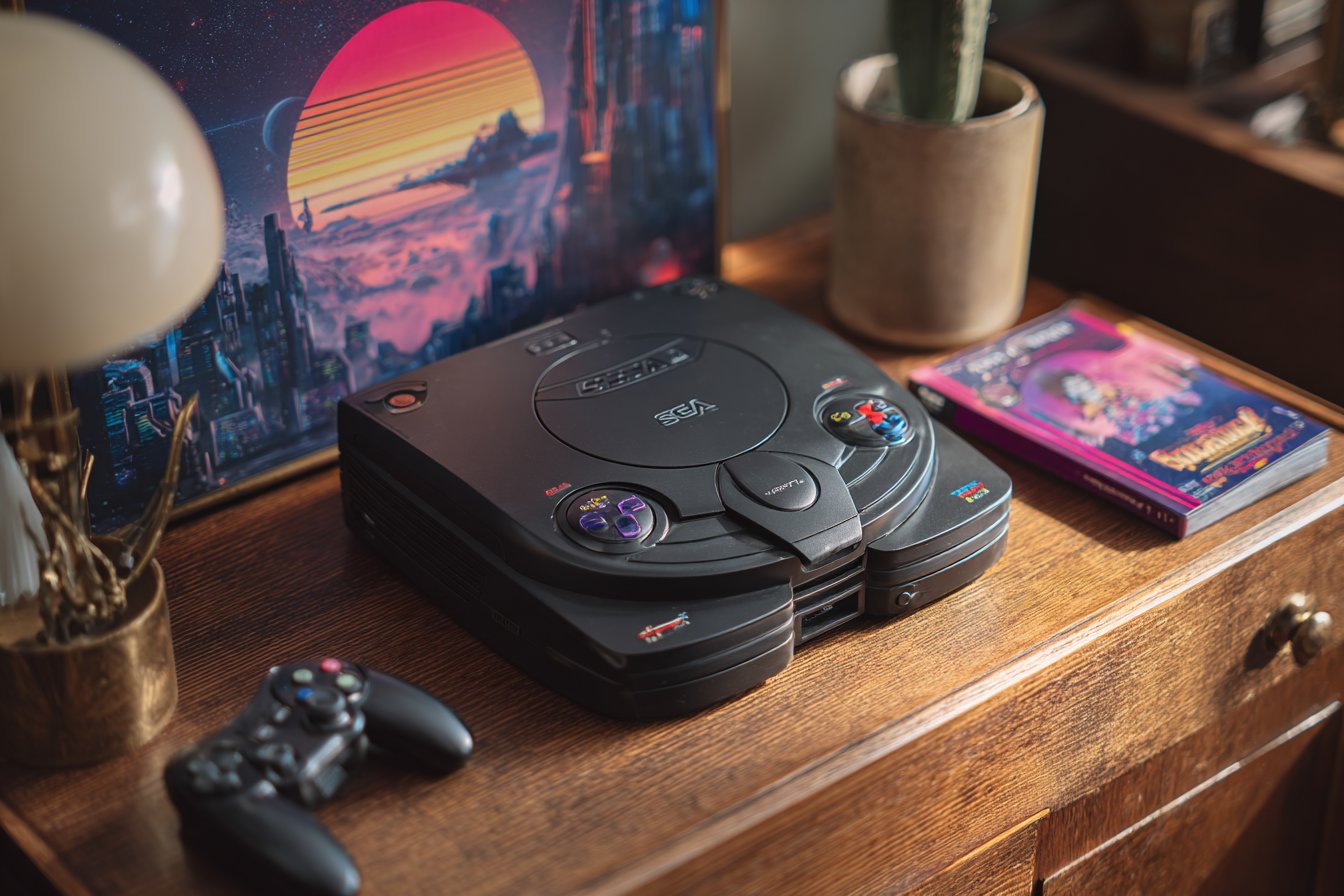

There’s something uniquely enjoyable about betting on the loser, don’t you think? That’s probably why my Sega Saturn sits alongside my PS5 in the entertainment unit; and I’m honest when I say I switch it on more frequently than my new Sony gaming console. Last Sunday I spent three hours playing Guardian Heroes again — and my wife came walking in, saw those large pixelated sprites taking up her 55-inch TV, and gave me “that look.” You know the one. “You’ve got literally hundreds of modern games, and you’re playing…this?” Yes, I am!
It’s simply that I acquired my Saturn by accident rather than design. This was 1997, and I’d saved up for months to buy myself a PlayStation — everyone at college was raving about Resident Evil and how great Tomb Raider looked. But my friend Dave’s dad worked at Dixons and called me up one day to tell me that they were selling their Saturn stock for knock-down prices. “Console plus four games for less than the price of a PlayStation,” he said. And I was broke as a student living on baked beans for breakfast, lunch and dinner; therefore, this mathematics was quite attractive.
And I remember bringing that odd-looking black console home to my grimy shared house; I had no idea I was buying into what would essentially turn out to be a gaming cult. The Saturn was already being written off by the magazines — CVG and Edge were effectively holding a funeral for it by that point. But I didn’t give two hoots about the commercial success of the Saturn or Sony’s domination of the market; I cared about the games, and my Saturn came with Virtua Fighter 2, Daytona USA, and NiGHTS. That first weekend was just gone — fighting combos, racing round those crazy tracks in Daytona, flying through those bizarre dreamscapes. Proper magic stuff.
The whole Saturn early launch debacle is the stuff of legend, isn’t it? Sega’s greatest self-goal. At E3 1995, they announced “Surprise! It’s available now!” — four months ahead of schedule — thinking they were being cute. However, the problem was, nobody was prepared — developers hadn’t finished making games for the console yet; only about half the retailers were stocking it; and Sony instantly undercut them on price. I still have the old magazines reporting on the fiasco, all the shocked headlines and quotes from publishers saying, “What are they bloody well doing?!”. Now, looking back at the whole debacle seems to be watching a car crash in slow motion.
However, beneath all the corporate ineptitude lay truly fantastic hardware. Everyone goes on about how the PlayStation was superior for 3D gaming, and fair enough, Sony’s machine was easier to program for. But the Saturn had dual processors and all sorts of additional chips that made it an absolute beast for 2D gaming. It was as though Sega had constructed a Formula One car but provided programmers with a manual written in hieroglyphics — the potential was certainly there; you just required a PhD to decipher how to use it properly.
The 2D capability was something else altogether. Games like Guardian Heroes and Marvel Super Heroes demonstrated what the Saturn could actually do with traditional sprites — massive characters, smooth animations, dozens of things occurring on-screen with barely a hiccup. Meanwhile, PlayStation owners were excitedly celebrating wobbly polygons and texture warping, whereas Saturn was enjoying arcade-perfect 2D games in their living rooms. It was as though they had a NeoGeo without needing to mortgage their homes.
Fighting games soon became my obsession. The Virtua Fighter 2 port was essentially identical to the arcade version, and having that at home revolutionized everything for me. I’d wasted countless amounts of money in arcades playing it, but now I could spend hours practicing Akira’s complex moves without spending a single penny. And my housemate Marcus and I established a Friday-night ritual — pizza, cheap beer, and Virtua Fighter tournaments until stupid o’clock. We maintained actual statistics, created actual brackets, took the whole thing far too seriously. My girlfriend at the time thought we were completely bonkers, but she had no clue about the importance of mastering Wolf’s German suplex.
Things really hit home for me later when I stumbled upon the Japanese-only releases. This occurred because Marcus’s brother was working in Tokyo and sending back these exotic Saturn games featuring Japanese text, but gameplay that was easily understood by anyone. Radiant Silvergun, Sakura Wars, Dragon Force — games that never made it to the West but showcased what the machine was capable of achieving. I purchased one of those Action Replay cartridges that enabled me to bypass the region lock on my UK Saturn, and essentially transformed my UK Saturn into a window into the world of Japanese gaming culture.
My parents had absolutely no understanding as to why I was wasting sixty quid on games that I couldn’t read. “The gameplay does not require translation,” I attempted to explain, which satisfied nobody but me. These imports exposed me to a whole other world — the Saturn had been failing miserably in the West, but in Japan it was actually competing with the PlayStation for years.
Over the years, collecting Saturn games has evolved from a hobby into a true passion, albeit a financially ruinous one. Due to the fact that the Saturn failed commercially, many excellent games had small print runs and thus created ideal conditions for future rarity. I picked up my copy of Panzer Dragoon Saga at a car boot sale in 2001 for a tenner — the vendor obviously had no idea what he had. Today, it is valued at over a grand complete, although I’d sooner sell a kidney than part with it. That 30-hour journey through the strange post-apocalyptic world of Panzer Dragoon is one of the finest gaming experiences I have ever had.
The hardware issues also contributed to the charm. Those CD protective rings — the transparent plastic bits in the centre — were allegedly intended to reinforce the discs but appeared to be designed to shatter if you looked at them the wrong way. I became proficient at identifying hairline cracks in the rings prior to catastrophic failure, thereby allowing me to replace my favourite games before they ended up as coasters. I owned three separate copies of NiGHTS over the years, and each replacement cost more money as the game grew rarer.
The original controller was however utterly dreadful — the shape was all wrong, the D-pad was squishy, it was simply an awful controller to use. The later Japanese model improved everything and became one of the best controllers of that generation, but by then the damage was done. First impressions count, and that original controller gave a very poor one.
NiGHTS is worthy of special mention as it was simply… mad. After producing Sonic, Yuji Naka produced this flying dream simulator that defied all logic. A jester character soaring through dream worlds, collecting orbs, linking combos using giant hoops — sounds ridiculous when described, but the act of playing it created this flow state unlike any other. The annual Christmas NiGHTS demo that came with magazine subscriptions became an annual tradition for me. To date, I still play it every year in December, much to my wife’s puzzlement.
In addition to the obvious classics, the Saturn had numerous lesser-known gems. Burning Rangers — a firefighting game developed by Sonic Team that no-one played. Shining Force III — where only one of three linked chapters was released outside of Japan. Enemy Zero — this insane horror game where you had to track invisible enemies solely based on their movement sounds. These games demonstrated what developers could produce when they comprehended the Saturn’s hardware limitations. They weren’t merely great Saturn games — they were merely great games in general — doomed by being on the incorrect console at the incorrect time.
The differences between regions were fascinating. While the Saturn was faltering in America and Europe, it was competing directly with the PlayStation in Japan for years. Japanese gamers preferred 2D titles such as fighters and RPGs — types of games that the Saturn excelled at. I possess a number of Japanese Saturn magazines from that era — another collecting rabbit hole I went down — showcasing a thriving gaming ecosystem of games and peripherals that never left Japan.
The technical restrictions became part of the charm. Due to the fact that the Saturn was incapable of performing correct transparency effects, developers used mesh patterns instead — providing games with that distinct dithered appearance. What began as a work-around became an aesthetic. The fog in Panzer Dragoon wasn’t merely atmospheric — it hid the limited view range of the Saturn. These technical restrictions produced exclusive visual styles that differentiated Saturn games from every other type of game.
My collection now stands at over 200 games — a combination of UK, European and Japanese releases in their original packaging (fragile long boxes) and jewel cases. Each one has a tale to tell. The Shining Wisdom I traded my entire Warhammer army for. The Dragon Force I salvaged from a house clearance. The Magic Knight Rayearth I eventually found complete after hunting for it for fifteen years. It takes up three bookshelves in the spare room and is arranged by publisher rather than alphabetically — something that drives my wife nuts but makes total sense to me.
Every five years or so, some gaming website discovers the Saturn once again and publishes articles asking, “Was the Saturn Really Any Good?” which leaves long-time fans both vindicated and irate. Of course, it was good — we’ve been saying this for thirty years! It’s similar to watching a movie that was savaged by critics, only to be rediscovered as a classic — only I get to feel smug about being right all along.
The Saturn’s legacy continues through emulation and the collectors’ market, but nothing compares to the genuine article. The distinctive startup noise, the short delay between disc loads, even the specific plastic scent of the Saturn — all of these sensory elements have disappeared from modern gaming.
During a power outage last winter, I pulled out my battery-powered portable CRT for retro gaming emergencies. In the darkness, the Saturn’s startup sequence illuminated the room with those familiar colour spheres merging into the Sega logo. My wife, who had been bewildered by my enthusiasm for this ancient hardware, sat down for a round of Bomberman. Three hours later, when the power returned, she looked almost disheartened. “I see now,” she said.
That is the thing about the Saturn — it was never about the number of polygons, or sales figures. It was about games that did something unusual, developers who understood the Saturn’s hardware limitations and produced memorable experiences. PlayStation owners were playing the same blockbuster games as everyone else, whilst Saturn fans discovered obscure gems like Elevator Action Returns or Three Dirty Dwarves.
Being a member of the Saturn enthusiasts’ club means belonging to a dwindling tribe, exchanging knowing glances when you spot someone else reading Saturn magazines in WHSmith, or quietly rejoicing at discovering Saturn games in secondhand shops. It wasn’t merely a console — it was membership of a community united by promoting something brilliant and misinterpreted.
Perhaps that is why, twenty-five years later, as gaming has become more corporate and repetitive, I continue to access my Saturn on a regular basis. Not simply for nostalgia — but for that sense of discovery, of playing something that chose to be different. In today’s gaming environment, where games treat you like a child through endless tutorials, there is something pleasing about the Saturn’s library — games that respect your intelligence and reward experimentation.
Therefore, my Saturn will remain online and ready to roll, not as a museum artifact, but as a portal to gaming’s most interesting parallel universe. Each time I hear the startup sequence, I connect with my individual gaming history and an alternate reality in which Sega continued to compete in the hardware market. The Saturn was not simply an underrated console — it was a glimpse of what gaming might have been.

Marcus is a retired software engineer from Seattle who spent his career debugging games before the industry transformed beyond recognition. He writes with technical precision about the engineering elegance behind classics, from Z80 assembly language to Mode 7 scaling tricks, treating code like archaeological artifacts worthy of study. His articles are deep dives into why certain games pushed their hardware to breaking points, paired with the dry humor of someone who’s actually shipped titles and understands the impossible constraints developers faced. For readers interested in the “how” behind their favorite games, Marcus is essential reading.
0 Comments