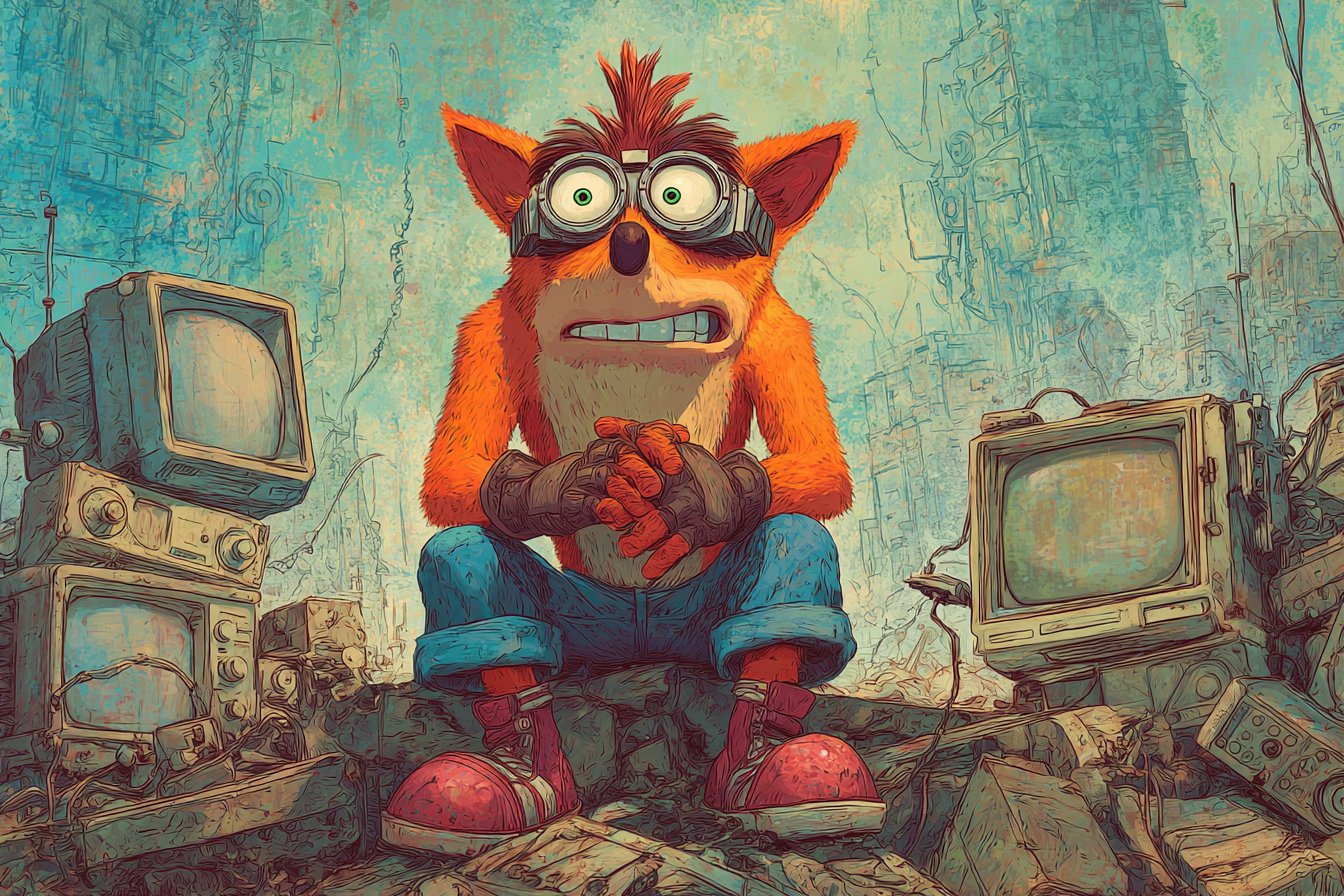

You know, there’s this whole thing about Crash Bandicoot being this huge PlayStation icon, and I get it, I really do. But from where I sat in Manchester during the mid-90s watching the whole PlayStation launch unfold, Crash felt like… well, like someone else’s mascot that we were supposed to care about. Don’t get me wrong, the games are amazing, but there’s this whole narrative about Crash being PlayStation’s answer to Mario that doesn’t quite ring true if you lived through the European gaming scene back then.
I remember exactly when I first saw Crash Bandicoot running. Must’ve been late 1996, early ’97 – the PlayStation had been out long enough for it to be competing with the Saturn and our beloved Amigas for shelf space. My mate Dave had convinced his parents to buy him a PlayStation for Christmas, and we spent Boxing Day huddled around his little portable TV, taking turns with this orange marsupial spinning through what looked like the most advanced 3D graphics we’d ever seen on a home console. The colour palette was amazing, totally vibrant and colorful, which made our Amiga games look a bit dated, much as I hate to say it.
However, the thing that sticks out – and this is where the American gaming narrative falls apart when applied to the UK – we didn’t grow up wanting a PlayStation mascot like the American kids apparently did. We had Dizzy the Egg from the Oliver Twins, we had all those wonderful Amiga characters that no one remembers anymore. So, when Crash arrived, he was visually stunning, yes, but emotionally? He was an import. Obviously, he was an import – even though Naughty Dog were attempting to create a universally appealing character, there was something uniquely American about Crash’s personality and sense of humor that didn’t translate.
Technically though? Bloody hell, Andy Gavin and Jason Rubin knew what they were doing when they created Crash to showcase the PlayStation’s 3D capabilities. Having come from years of side-scrolling platformers on the Amiga and Mega Drive, seeing Crash run towards the screen in those “into the screen” levels was truly mind-blowing. We were accustomed to flat sprites and clever tricks to simulate 3D depth, and here was this character moving through actual 3D space with a functioning camera. The animations were silky smooth as well – you could see every frame of Crash’s expressions, which may seem silly today, but felt revolutionary at the time.
Honestly, the first Crash game was brutally difficult. More so than many of the European platformers I was used to, anyway. Those bridge levels? I spent hours upon hours trying to get past those bloody wooden planks, timing your jumps to the pixel, while massive chasms were opening up below you. The lives system felt incredibly punitive compared to something like Sensible Soccer where you could instantly restart the match. However, when you finally nailed a flawless run through one of those torturous levels, collecting every box and dodging every hole… there was something addictive about it that continued to pull you back in.
What’s interesting is how each subsequent installment improved upon the last, which wasn’t always the case back then. Cortex Strikes Back introduced the slide and body slam moves, which dramatically altered how you approached the level design. All of a sudden, you could smash through certain boxes that were previously unattainable, and the entire game opened up in ways that made you want to replay the previous levels using your new abilities. The hub world layout was excellent as well – reminded me of the overworld maps from some of the better Amiga adventure games, providing that sense of exploration between the linear platforming sections.
The polar bear levels in Cortex Strikes Back were completely insane. Racing through ice caves on the back of a bear, jumping over gaps while everything whizzed by at a dizzying pace – it was as if someone took the vehicle segments from our favorite Amiga games and turned them up to 11. These weren’t simply gimmicky levels either – they required genuine skill and timing. I must have played “Bear Down” 50+ times attempting to achieve the perfect run without losing a life.
Warped was where the series reached its peak, introducing time travel and vehicle-based gameplay that felt like two entirely separate games contained within the same package. The flying levels, motorcycle racing, underwater swimming sections – each controlled differently and required the development of new skills. The inclusion of a time trial mode was pure brilliance – transforming levels you’d already mastered into entirely new challenges centered on speed and efficiency, rather than merely surviving. I found myself completely enthralled by shaving seconds off my fastest times, finding every possible shortcut, and optimizing every single jump.
However, this is where things get somewhat murky from a UK perspective. As all of this was unfolding, we were still deep in the midst of the Amiga gaming Golden Age. Teams17 were releasing Worms, Sensible Software had Cannon Fodder, we had this entire parallel gaming subculture that was very much our own. Crash was certainly impressive, but he was not replacing anything we already loved – he was merely an additional option in our already full gaming diet. The PlayStation succeeded here not because Crash replaced our Mario, but because it provided experiences we couldn’t get elsewhere.
The whole mascot idea never quite resonated in Europe the same way it did in America. We weren’t searching for a single character to represent our gaming identity. We were perfectly content playing Crash one night, firing up Speedball 2 the following night, and possibly taking a crack at some Quake on the PC the night after that. Gaming wasn’t nearly as tribal in Europe – or perhaps tribalism manifested in different forms tied to the platform wars between Amiga and PC rather than console mascots.
However, Crash Team Racing was something entirely unique. Launched in 1999 when kart racing games were beginning to gain traction as a legitimate genre, CTR felt as though Naughty Dog were attempting to produce a title capable of competing head-to-head against Mario Kart 64. And honestly? In many ways, they succeeded. The track design in CTR was top-notch, combining recognizable Crash Bandicoot universe locations with authentic racing circuit layouts. The weapon system was more balanced than the random item boxes in Mario Kart, and the Adventure Mode provided a comprehensive campaign to complete, whereas Mario Kart 64 consisted of nothing but random races.
I clearly recall spending entire weekends with my fellow university students competing in split-screen CTR tournaments. This was the height of PlayStation multiplayer gaming – 4 controllers, pizza boxes stacked everywhere, debating who was using the cheap characters. The game had a near-perfect balance where the greatest player generally won, but there was sufficient chaos and rubber band AI to ensure every player remained engaged. I also recall my girlfriend at the time (who is now my wife, amazingly) developing a surprising amount of skill at the game, which contributed to a number of highly competitive matches that likely weren’t beneficial for our relationship.
It is fascinating to reflect upon how Crash’s legacy unfolded differently in various geographic areas. In America, Crash appears to have evolved into a nostalgic benchmark for PlayStation gaming – the character responsible for defining Sony’s entrance into the console wars. In the UK, he was simply a good series of games featuring the same protagonist. Although we appreciated the quality, and purchased the games, we didn’t have an emotional investment in Crash as a mascot in the same manner that American children appeared to.
The release of the N. Sane Trilogy in 2017 demonstrated just how strong that global nostalgic connection was. I acquired the collection primarily out of curiosity – I was interested in seeing how the retro PlayStation visuals would fare under a properly updated remake. The visual update was astounding, however, what struck me was how well the gameplay had aged. These weren’t simply beautiful remakes – they were genuinely difficult platformers requiring the exact same timing and spatial awareness as the originals.
As I progressed through the remastered trilogy, I discovered I was appreciative of aspects of the game I hadn’t recognised initially. The level design in particular – every platform, every enemy, every box placement felt carefully thought-out and intentional. These weren’t randomly generated levels or haphazard obstacle courses – they were meticulously crafted challenges that educated you on new skills and then challenged your mastery of those skills in an increasingly creative manner. It is a design philosophy that has seemingly fallen out of favour in modern gaming – where everything is either far too simple or uses artificial difficulty mechanisms such as random elements.
Crash Bandicoot 4: It’s About Time felt like a suitable sequel rather than merely another remake. The addition of the Quantum Masks brought new mechanics that expanded the gameplay without disrupting what made the original trilogy great. However, they also illustrated how punishing the original series’ gameplay could be – the difficulty curve was so severe that I questioned whether my reaction time had slowed down with age or whether I had forgotten how intense the original series was.
What is apparent to me now is how Crash embodies that distinct moment in gaming history when developers began to figure out how to adapt the principles of 2D platforming into 3D environments. The original trilogy resolved issues that may appear obvious today, but were undoubtedly innovative at the time. How do you preserve the accuracy of 2D jumping in a 3D environment? How do you design a camera system that displays the player exactly what they require to see, without obstructing their view? How do you develop memorable characters using polygonal models, rather than traditional sprite art?
Naughty Dog’s resolutions to these problems influenced countless other developers, including several of my favorite European studios that subsequently experimented with 3D character models in their own games. The technological innovation of Crash permeated throughout the industry, although the character himself never developed into the universal icon that Sony presumably desired.
Viewing Crash Bandicoot today from 2024, he represents the transitionary phase in gaming history when gaming was evolving to become more mainstream, but hadn’t yet lost its slightly underground, enthusiast vibe. The original trilogy launched during my university years, when I was mature enough to appreciate the technical accomplishments, yet youthful enough to become completely immersed in the challenge of the gameplay.
Today, whenever I fire up one of the Crash titles, I am not experiencing solely nostalgia – I am recognising genuine quality in the game design that has endured the test of time. The character may not have had the same significance to UK gamers as he did to American youth, but the games themselves? They established a place in gaming history based upon their inherent quality, not due to marketing hype. And sometimes, that is enough.

John grew up swapping floppy disks and reading Amiga Power cover to cover. Now an IT manager in Manchester, he writes about the glory days of British computer gaming—Sensible Soccer, Speedball 2, and why the Amiga deserved more love than it ever got.
0 Comments