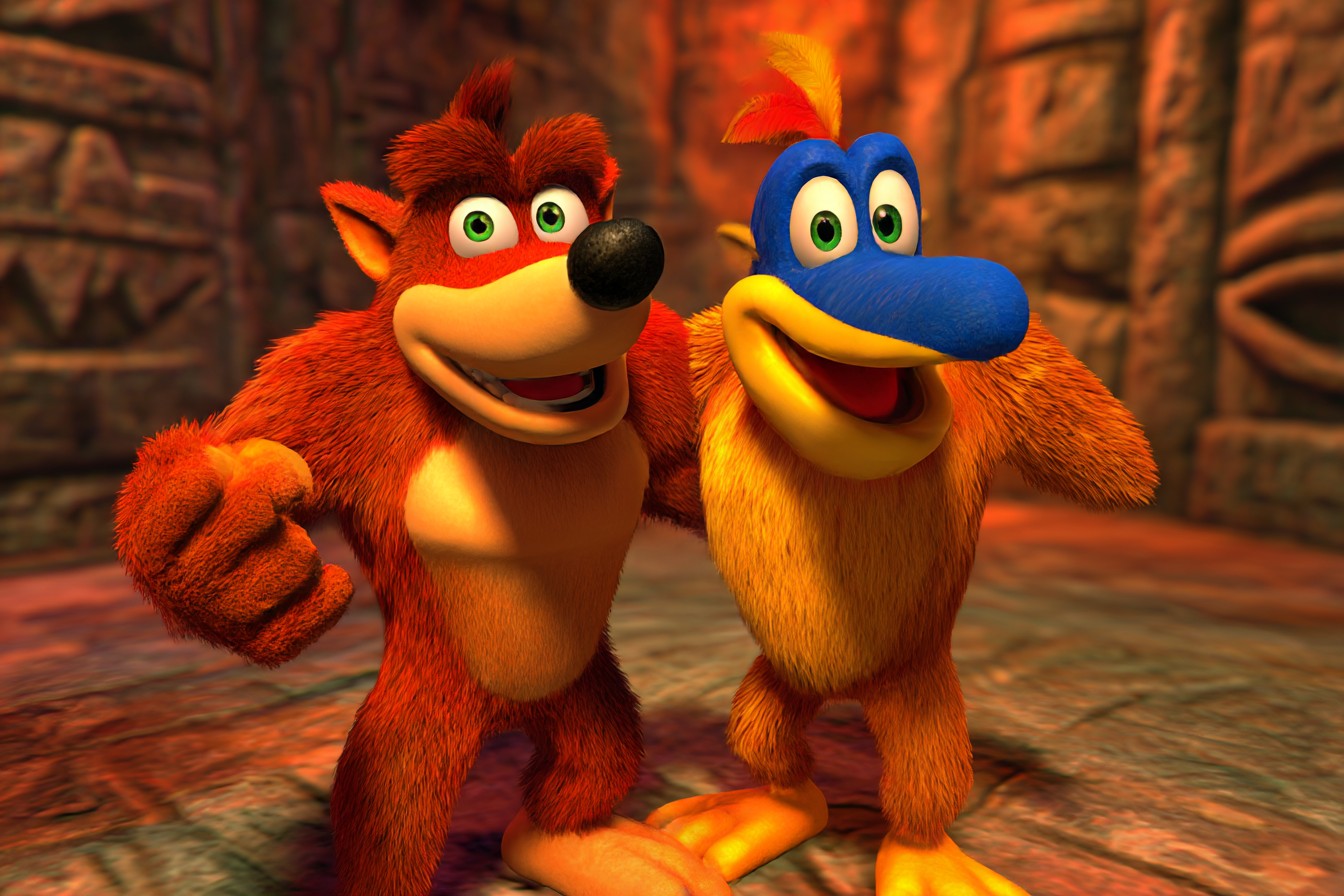

So, I guess I need to admit something that may have made me seem like a full-on gaming heretic — I’ve never actually played Banjo-Kazooie when it first came out in 1998. I know, I know. So here I was, 19 years old, totally in love with my Amiga 1200, and fully believing that consoles were nothing more than fancy, expensive toys that only nerds used instead of proper computers. The N64 had been out for years by this point, but I was still spouting off about how my Amiga’s custom chips were infinitely superior to anything Nintendo could possibly dream up. I’m sure I was a total pain.
I didn’t truly discover what I had been missing until 2003, when I purchased a second hand N64 from a coworker who was upgrading to a GameCube. Along with a bunch of football titles and racing games, he gave me a ton of games, and included with them was this beat-up copy of Banjo-Kazooie. The label was torn, the casing was cracked, and, honestly, it looked like it had been run through the wash a few dozen times. However, it did work, and after about 10 minutes of playing it, I realised I had been a total moron for missing console gaming for so long.
First off, I thought it felt kinda British. Not super British like watching EastEnders, but there was something in the humor, the character design, and the way everybody was roasting each other that seemed to ring a bell. As I found out, Rare was located in Twycross, which is roughly an hour from where I grew up in Manchester. No surprise, it felt like home – it was built by people who probably went shopping at the same Tesco as my mom.
At this point, I had played Super Mario 64 (borrowed from the same colleague), and while I appreciated what Nintendo did with it, it just never quite clicked with me. Too abstract, too…Japanese, I suppose. All those floating platforms and those crazy castle paintings you jump through. Brilliant tech-wise, etc., etc., but it felt like running through someone else’s fever dream rather than a real location. Banjo-Kazooie, however, felt like wandering through real places, even if those places were filled with talking bears and musical notes floating in mid-air.
I was totally consumed by the collect-a-thon element. I’d finish my 12-hour shift at the logistics firm (this was during my days as a senior analyst, years before they turned me into a manager), and then I’d head home to spend hours searching for Jiggies and musical notes. My then-girlfriend (who is now my wife – I know, I know) would find me at 2 AM, still playing, and mutter something about needing to redo an entire level because I missed two notes in Bubblegoop Swamp. She’d give me that look that said “you’re a grown man obsessing over a kid’s game,” but she never actually said it out loud, thank goodness.
The collecting in Banjo-Kazooie never felt arbitrary. Every Jiggy was a legitimate puzzle to solve, and every note placement made sense within the level design. Many of the later collect-a-thons (looking at you, Donkey Kong 64) made collecting feel arbitrary – they’d just scatter hundreds of random objects around massive levels and call it content. Collecting in Banjo-Kazooie felt meaningful, purposeful even. Each world had exactly 100 notes and 10 Jiggies, and you knew every single one had been placed intentionally.
The way the game introduced new skills through the use of Bottles the mole was pure genius. Rather than giving you all the tools you’ll ever need to play the game from the very beginning like most platformers, Bottles would introduce you to new abilities gradually. Each new ability unlocked previously inaccessible areas you’d walked past dozens of times before, and therefore, new areas of familiar levels became fresh again. I remember learning the Beak Buster and immediately thinking, “Ah, I’m gonna go back to Mumbo’s Mountain and see if I can do this on that switch I couldn’t reach before.” It was like receiving a new tool that inspired you to go back and look at your previous work.
Gruntilda, the primary antagonist, was also perfectly suited to a British sense of humor. Her constant rhyming felt a bit forced and clumsy – but that was probably intentional. She was trying too hard to be menacing and poetic, and the end result was this wonderfully absurd character who was scary enough to further the story, yet goofy enough that you weren’t really afraid of her. The voice acting – those odd, distorted noises that somehow communicated personality – was spot on. Each character had their own distinctive voice, and you could tell instantly who was who simply by listening to their nonsensical speech.
Each of the worlds were absolute masterpieces of themed level design. Treasure Trove Cove felt like a genuine seaside resort town, complete with sandcastles and a lighthouse. Clanker’s Cavern was this bleak industrial nightmare that managed to be simultaneously creepy and intriguing. Mad Monster Mansion featured all the typical horror elements, but due to its whimsical nature, it was more charming than frightening. Each world had a defined identity and adhered to its theme without being redundant.
But Click Clock Wood… Bloody hell, Click Clock Wood. When I first realised you were playing through the exact same area under four different seasonal conditions, with changes that impacted not only appearance, but the actual gameplay mechanics and puzzle solutions, I literally stopped the game and sat back in my chair for a minute. This was 1998 technology – or rather, this was me playing it in 2003, but it was designed in 1998 – and Rare had created this dynamic, living environment that changed with the seasons. The acorn you helped grow in Spring eventually turned into a tree you could climb in Autumn. Characters aged and their needs changed based upon the season. It was a form of environmental storytelling that most modern games still have yet to match.
The seasonal changes also provided additional layers of variety to keep the experience fresh. Mumbo Jumbo would transform you into various creatures – a termite, a pumpkin, a walrus – each with their own unique abilities and controls. It was not merely cosmetic; you had to learn how to play each creature. The termite could climb steep surfaces but was fragile. The walrus was tough but slow on land. Each transformation felt like playing a small mini-game within the larger game, and they were incorporated into the overall design, rather than being seen as novelty features.
Grant Kirkhope’s score deserves its own section because it was simply incredible. How the music transitioned smoothly as you traveled between different areas – underwater music when you dove, echoey music in caverns, muted music inside buildings – was not only technically impressive, but also emotionally resonant. Each world had a memorable main theme that perfectly represented its ambiance. I can still hum the Freezeezy Peak theme, and it has been years since I last played it seriously.
The British humor I talked about earlier was not only in the writing, but in the comedic visuals, the character animations, and the myriad of small details scattered throughout the worlds. Kazooie constantly roasted everyone, especially poor Bottles. There were toilet jokes that actually worked because they were stupidly funny rather than crudely so. Overall, the game had a cheeky, irreverent quality that never felt malicious, but certainly had more of an edge than Nintendo typically allowed itself.
As such, it reminded me of the type of humor you’d find in British comics like The Beano or video games like Worms – distinctly British sensibilities that rarely translate perfectly, but are naturally appealing if you grew up with them.
When I played it in 2003, I was experiencing it with entirely different expectations than somebody who played it when it was brand new. I wasn’t comparing it to the limited group of N64 games available in ’98; I was comparing it to everything I’d played up to that point, including some of the early PS2 and Gamecube titles. And you know what? It held up perfectly. Of course, the graphics were ancient by then, but the gameplay, the world-building, and the characters – all of these were timeless.
The camera system performed admirably considering it was running on N64 hardware. For anyone who has played early 3D games, it is obvious that cameras were usually the greatest enemy; however, Rare did an excellent job with theirs. You could zoom out for a broader view when necessary, the auto-camera function was generally intelligent, and manual camera control was responsive when you needed it. Far from perfect – no N64 title was perfect with regards to camera functionality – but much better than many of its contemporaries.
Most striking, however, was how assured the game felt. Rare knew they were creating something special, and that confidence showed in virtually every design choice. The levels were large enough to be expansive, but not so enormous that you’d become disoriented or bored. The difficulty curve was perfectly calibrated – difficult enough to be gratifying, but never unfair. The progress tracking system ensured you were constantly striving toward multiple objectives without becoming overwhelmed. Every design decision felt deliberate and well-though-out.
Ultimately, I played through Banjo-Kazooie three times in the span of a year. First time was purely to enjoy the experience and finish it. Second was to get 100% completion, find every Jiggy and note, and every Jinjo. Third was to show it to friends and family, and try to explain why this wacky-looking game about a bear and a bird was actually amazing. My younger brother, who was in the midst of his PS2 obsession, laughed at the “childlike graphics” and then borrowed the N64 for two weeks to play through it himself.
Banjo-Tooie, the sequel, improved upon everything – larger worlds, new abilities, more interconnecting gameplay between levels. It should have been theoretically superior, and in many ways it was. However, it lost something in translation, some of the focused charm of the original. The worlds were sometimes too large, the collecting occasionally felt monotonous rather than rewarding. More does not necessarily equal better, and the original Banjo-Kazooie proved that sometimes restrictions produce better design than infinite options.
In retrospect, having experienced decades of 3D platformers, Banjo-Kazooie remains one of the top examples of the genre. It built upon what Mario 64 pioneered, and developed a personality and a sense of humor that differentiated it from Nintendo’s efforts. It created environments that felt like places you’d want to explore, rather than just obstacle courses to overcome. It demonstrated that British game designers could develop games that rivaled Nintendo’s finest, while maintaining their own uniquely British identities.
I still have my N64 permanently set up in my office (one of the benefits of marrying someone who has long since given up on trying to convince me to put my gaming equipment away). I continue to replay Banjo-Kazooie every few years, and it still never ceases to amuse me. The graphics are laughable today, but the gameplay holds up perfectly. Even more important, it still puts a smile on my face. In a world where games often appear to be focus-grouped and committee-driven, there’s something refreshingly honest about a game that so clearly represents the vision of people who actually care about what they’re doing.
By the way, the beat-up copy of Banjo-Kazooie I bought from my colleague all those years ago still works perfectly. The label is completely gone now and the plastic case is held together with tape, but it loads up every time. Occasionally, the most significant gaming experiences originate from the most improbable of places – a dismissal of consoles, a random collection of games, and a willingness to admit you were completely wrong about something. Banjo-Kazooie taught me that lesson, along with many others.

Samuel’s been gaming since the Atari 2600 and still thinks 16-bit was the golden age. Between accounting gigs and parenting teens, he keeps the CRTs humming in his Minneapolis basement, writing about cartridge quirks, console wars, and why pixel art never stopped being beautiful.
0 Comments