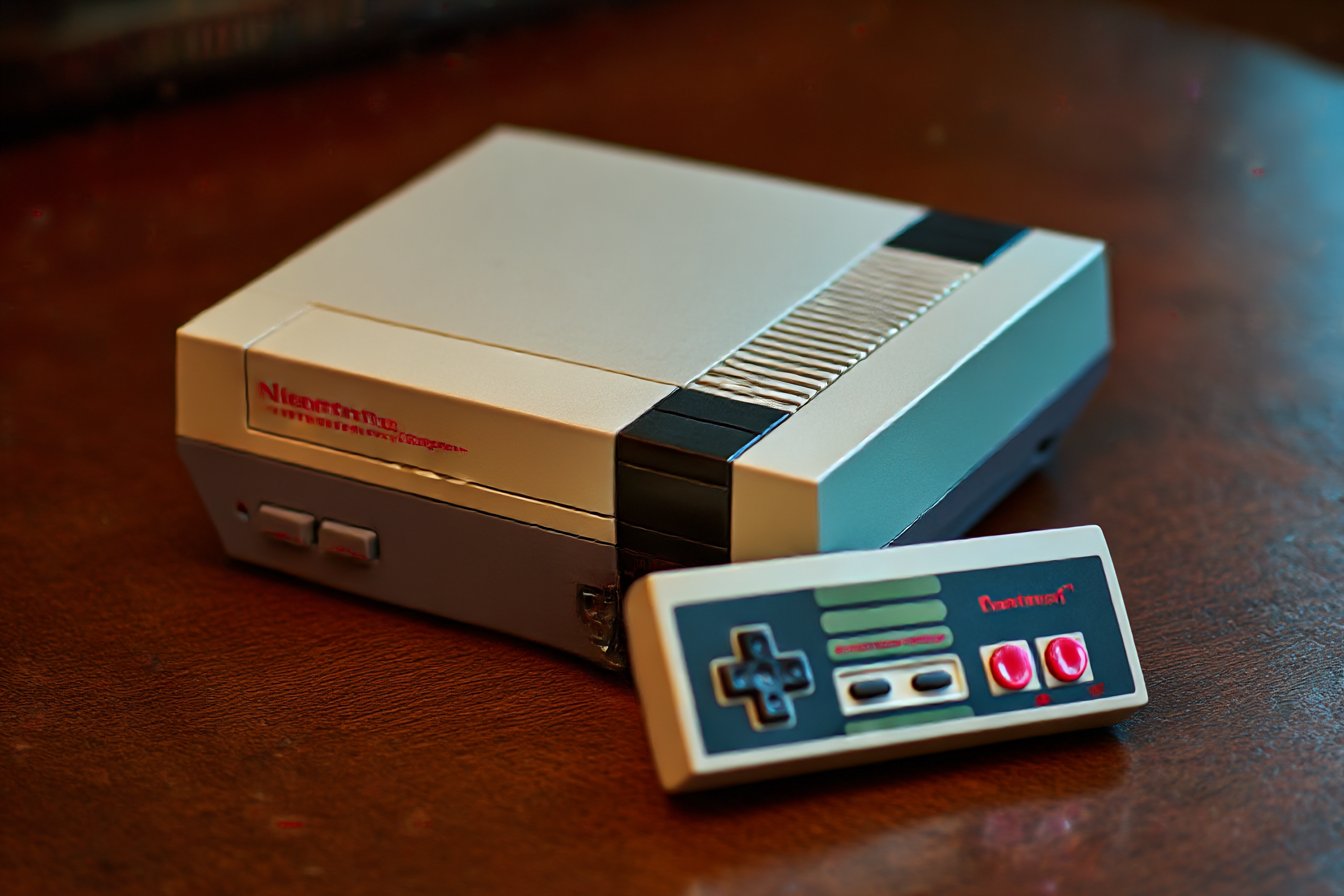

Reading stories about Christmas morning NES unwrapping always gives me the feeling like I am flipping through someone else’s family photo album. I was not present for that moment in 1986 when kids throughout the country ripped open their gray boxes and were left awestruck. I was 18 years old, working construction with my dad, and trying to save every dollar possible because my girlfriend was expecting a baby and we were going to get married immediately after she graduated high school. Video games were foreign to me and only the rich families with money could afford them.
It has now been twenty years since that point (as of 2011), and I was sitting in my living room in Denver, Colorado, with the original NES Action Set I purchased from Craigslist for $60. My daughter Sarah had been begging me for months to try retro games and insisted I was missing a crucial part of my life as a gamer. She had come over a few times with her SNES, introduced me to Super Metroid, and kept stating that I needed to go back further in order to truly understand gaming history. So, here I was, a 43-year-old construction foreman, holding a big, clunky gray controller for the first time, and ready to boot-up Super Mario Bros.
One of the first things that caught my attention was how intentional everything felt. Modern video games – and even the SNES games that Sarah showed me – are smooth, rounded, and have fluid animation. However, the original Mario on the NES was deliberately precise. Each pixel was intentionally placed with great detail. The movement of Mario across the screen, his jump, and the behavior of enemies were all intentional. Knowing what I do today regarding game development in the 80s, this was probably true for many developers.
The controller also took some getting used to. Having spent a year playing SNES games with their curved controller and 4 face buttons, returning to the NES rectangle felt like changing from a modern power drill to a manual screwdriver. Not bad, necessarily, but… different. Less advanced. However, after an hour with Mario, I began to realize how the simplicity of the NES allowed the games to use ingenuity to develop unique control systems. Only 2 buttons and a d-pad. That’s it. Use it.
What really impressed me about Super Mario Bros., was how it showed me how to play without ever having to say a word. As a construction worker, I train guys all the time, and I believe the best way to train anyone is to show them, let them try, and then guide them when they make mistakes. The first level of Mario is like watching a master carpenter teach an apprentice. Here’s a Goomba, try to jump on him. Here’s a pipe, see if you can go down it. Here’s a question block, hit it and see what happens. By the end of World 1-1, you have all the knowledge you’ll ever need to be Mario, and Nintendo never stops the action to tell you how to play.
I quickly burned through the rest of the pack-in games. Duck Hunt was enjoyable for about twenty minutes, however, that darn dog’s laughter sent a primal response in me – probably the same response millions of kids experienced back in the day. However, I needed more games, and that’s when the expenses quickly added up. Apparently, collecting NES games as an adult in 2011 was not like walking into Toys”R”Us in 1987. That copy of The Legend of Zelda I wanted? Forty dollars on eBay for a loose cartridge. A little gold thing cost more than I paid for the whole system.
However, Zelda was well worth it. I had never played anything like it – this huge world that simply dropped you into the middle with almost no direction except “it’s dangerous to go alone, take this”. I am a person who reads instructions manuals front-to-back before attempting to assemble anything, and here was a game telling me to figure it out on my own. Therefore, I did what any sensible adult would do – I bought a composition book and began making maps.
At first, I thought it was silly to sit at my kitchen table and draw crude drawings of screens and mark where I’d found heart containers. But you know what? It worked. And more importantly, it was rewarding in a way that modern games with their waypoints and objective markers cannot possibly replicate. When I finally discovered my way through that lost woods maze, it was not due to the fact that the game held my hand – it was because I had earned it through trial-and-error and meticulous note-taking.
As I continued to play NES games, I noticed that the technical restrictions of the NES became clearer. Sound chip that could barely produce three distinct notes at once, graphics that were essentially animated tiles, color palette that looked like someone had spilled a particular set of crayons. But you know what is interesting? Those restrictions made the games that exceeded them feel like small miracles. When I first heard the music in Mega Man 2 – these complex, driving melodies coming from hardware that should barely be capable of producing “Mary Had a Little Lamb”, I had to pause my game and just listen.
I bought Mega Man 2 at a local game store for thirty-five dollars, and I think I was crazy until I played it. The precision necessary, the manner in which each robot master had a specific strategy, the weapons you acquired to access certain areas and bosses – it was as if a mechanical engineer had created a mechanical puzzle that was entertaining. I likely died at least 200 times learning the patterns, but I was never frustrated because each death taught me something new.
As for the infamous cartridge blowing ritual that everyone talks about? Yes, I quickly learned that one. My sixty-dollar NES came with a defective connector that was on its last leg, and often, games would freeze or display the dreaded gray screen of death. Obviously, previous owner was a blower, as you could see the corrosion on the pins when I eventually opened it up to properly clean it.
However, prior to cleaning it properly, I went through the exact same superstitious routine that every other NES owner went through: blow, reinsert, jiggle, and pray to whatever deity governs 8-bit electronics.
One of the most striking aspects of experiencing these games as an adult was the extent to which I appreciated the design philosophy behind the games. These were not games produced by large development teams with unlimited budgets – they were created by small groups of individuals working under extremely tight constraints. Each sprite, each sound effect, each level had to justify its existence, as space was limited and every byte mattered. It is similar to how the best construction projects occur when you have a tight budget and a demanding client – the limitations force you to be resourceful and creative.
I started exploring other NES games after mastering the fundamentals. I purchased Startropics based upon a suggestion from an online forum and had absolutely no idea what I was getting into. The game came with a letter that you were supposed to wet and then pull apart to reveal a hidden code. Of course, purchasing it twenty-five years later, I did not receive the original packaging. I spent nearly an hour scouring online forums before I located someone who had posted the answer to the puzzle. This type of outside-of-the-game puzzle would never pass muster in modern gaming, but apparently, it was par-for-the-course for Nintendo in 1990.
The more NES games I played, the more I realized how different they were from modern gaming experiences. These games did not care whether I became frustrated and quit. They did not offer difficulty levels or checkpoints every 30 seconds. I had to learn the patterns and develop the reflexes to progress. Plain and simple. Coming from modern games that continually reward me just for showing up, the NES’s apathy towards my emotions was actually refreshing.
My daughter Sarah was excited that I had taken to the NES, although she consistently encouraged me to try games that were simply too difficult for a middle-aged beginner. “You should try Battletoads”, she grinned as if she suggested I attempt to juggle chainsaws. I managed to complete the first level of Battletoads after taking three attempts. That speeder bike portion of the level? Forget it. Some challenges are intended for those who have spent their lives training their reflexes since they were 8 years old.
However, I was able to find my niche with games that were at my skill level and offered problem-solving opportunities. The Legend of Zelda led to Zelda II, which was entirely different but equally engaging once I was willing to accept that it was basically a side-scrolling RPG. Metroid provided that same sense of exploration that the first Zelda provided, along with a science-fiction theme reminiscent of the Alien movies I enjoyed during the 80s.
In retrospect, twelve years after purchasing that initial NES, I understand why my daughter was so adamant that I experience these games. It was not nostalgia – I had none. It was the pure game design, free from modern conventions and gimmicks. These games were designed to entertain using nothing but pixels, simplistic sounds, and clever programming. There was no voice acting, no impressive graphics, and no online multiplayer to detract from the poor foundation of the core gameplay. Only you, the controller, and the creator of the game’s vision for interactive entertainment.
The NES did not provide my childhood with the same identity that it did for millions of other children. However, discovering it as an adult gave me something different – an understanding of how a lot of creativity can flourish in a vacuum of limitations, how a simple tool can create a complex experience, and how some types of enjoyment are ageless and will remain enjoyable regardless of when you initially enjoy them.

0 Comments