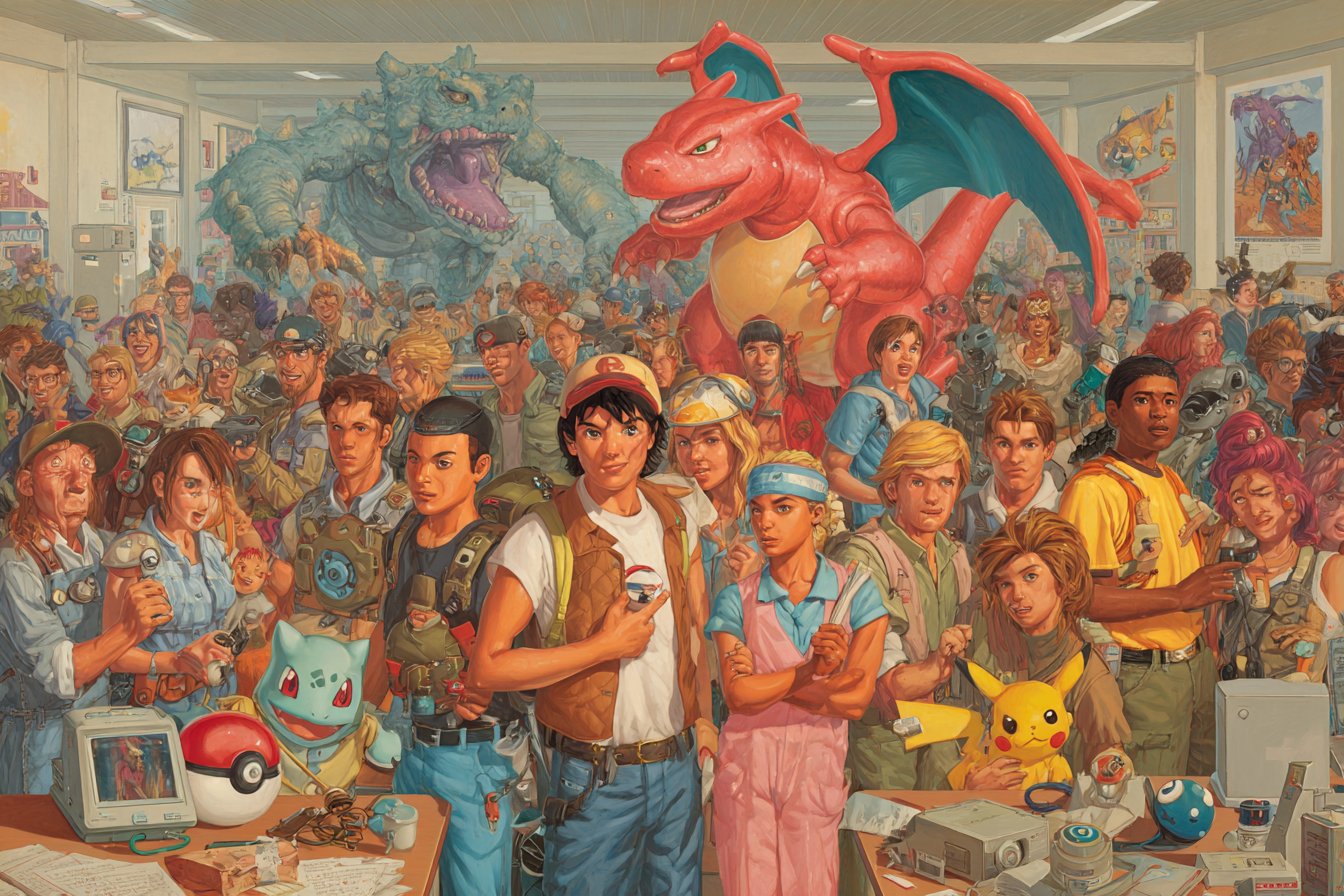

I remember exactly when the social hierarchy at Woodridge High School shifted — and it all began with Scott Thompkins trying to hide his Game Boy during English class in Spring of ’98.
We were in Ms. Harrington’s classroom reading (or pretending to) Catcher in the Rye — which honestly wasn’t the most exciting novel to read. I heard these little electronic beeps coming from two rows ahead. Scott was hunched over something and muffled the sounds of the beeps with his sleeve whenever they happened. Once the bell rang, I cornered him. “Dude, what was that?” He looked like he was ready to give me the secret password to a top-secret society and pulled out this grey cartridge with a red monster on it. “Pokémon,” he said with excitement. “It’s from Japan. You capture these creatures and battle with them. Dude, it’s insane.”
A couple of weeks later, I’d blown all of my pay from washing dishes ($127) on a Game Boy Pocket and Pokémon Red. Scott had Blue, and he’d given me the rundown of the version differences with an enthusiasm that usually only comes out when people are talking about cars or girls. Different monsters in each version, he said. To catch them all, you had to trade. When I asked how many “all” was and he said “151”, it seemed both an unrealistic and incredibly important goal in my sixteen year old life.
I had no clue I was witnessing the total collapse of the social structure at Woodridge High School. By the end of that semester, no one cared about who was dating whom or who was making varsity — the only thing that mattered was how complete your Pokédex was.
One thing that adults just don’t understand — my mom sure didn’t when she saw me walk in the door with “another video game” — is that Pokémon isn’t really just a video game. Game Freak had created the ultimate storm of collection, competition, and cooperation, all tied together in a package that looks like it belongs to a kid. You’re not just playing something, you’re participating in this living, breathing community that exists far beyond the small Game Boy screen.
My first choice for a starter was Charmander — after spending maybe half an hour looking at the choices in my room. Choosing a partner for this whole journey felt big — not just choosing a character or a weapon, but choosing the partner for the entire adventure. I chose the fire lizard because he looked cool, which basically encapsulates my decision-making prowess at 16 years old.
About a week later, our lunchtime conversations had dramatically changed. Instead of the typical conversation topics — complaining about Mr. Peterson’s pop quizzes, speculating about whether Jennifer Martinez was single, weekend plans that almost always consisted of hanging out at the mall — we were engaged in heated debates over type advantages and evolution strategies. Dave, who normally only talked about his drum set, discovered he was a tactical genius when it came to explaining how his Alakazam could defeat almost any other Pokémon. Tom, our walking encyclopedia of sports statistics, applied the same analytical mind to determining the most efficient ways to raise Pokémon.
The link cable soon became more valuable than any textbook. The grey cord linking two Game Boys was a tangible representation of the relationships and rivalries developing as a result of the game. Trust was essential in order to trade, particularly when it came to evolution trades. Giving away your hard earned Graveler so it could evolve into Golem was essentially giving your full trust to someone else. Even today, I break a sweat thinking about Dave hovering his finger over the B button when I was trying to trade my Kadabra, threatening to cancel the evolution. “Don’t even think about it,” I said. The whole table fell silent for the remainder of lunch.
“Just kidding,” Dave laughed. I didn’t speak to him the rest of the day.
Having Red and Blue versions with exclusive Pokémon was pure evil marketing genius. If you want a Sandshrew for your Red version, you’ll need to find someone with Blue who will trade with you. This required cooperation to create an underground economy that existed throughout the hallways and school busses. The corner of the library became our de facto trading post, as far away from Mrs. Cleary’s desk as possible so she couldn’t overhear the beeping of the Game Boys when we linked them. Negotiations were fierce — no way a Pinsir was worth a Scyther, regardless of what the Blue version players claimed.
Rumors and urban legends surrounding Pokémon had a viral quality to them, similar to nothing that would exist again until social media. Everyone “knew” that Mew was hidden under the truck near the S.S. Anne, although no one has ever found it. I spent an entire Saturday trying everything possible to get that truck sprite to move, believing that I had simply not figured out the correct sequence yet. Although it was obvious that the information regarding where Mew was located was false, it was coming from someone’s “cousin who works at Nintendo,” and therefore it was believable.
Glitches that we did discover were like discovering forbidden knowledge. MissingNo — a jumbled mess of pixels that appears when you surf past Cinnabar Island after speaking with the old man in Viridian — was both terrifying and exhilarating. It could clone your items in your inventory, which meant limitless Rare Candies if you were crazy enough to try it. When Blake Carlton’s save file got corrupted after catching too many MissingNo, it became this cautionary tale that somehow made the whole thing even more desirable rather than less. “He just messed it up,” we’d say confidently, although none of us truly knew the programming errors we were taking advantage of.
I approached completing my Pokédex with a level of organization that definitely didn’t translate to my actual homework. I had a spiral notebook — initially purchased for Biology class but quickly repurposed for more pressing issues — where I catalogued every Pokémon I captured, organised by location, and included extensive details about how to evolve them and trade them. Those pages got used more than any of my textbooks.
Completing my Pokédex to 150 was the easy part. However, getting that last one, Tauros, was another story altogether. I was stuck at 149 for what felt like an eternity, and I was only missing Tauros, which refused to appear in the Safari Zone no matter how many times I tried to capture it. The Safari Zone was its own form of torment — limited steps, no battles, and Pokémon that would run away if you looked at them wrong. I eventually memorized the step-by-step route to each zone to optimize my routes like I was planning a military campaign.
When Tauros finally showed itself, my entire lunch table witnessed my reaction. I tried to suppress my excitement but still managed to generate enough noise that Mr. Lopez walked over from his regular spot next to the vending machine. “Is everything okay here?” he asked, eyeing the cluster of Game Boys suspiciously. We told him we were working on math problems. As soon as he walked away, everyone swarmed around to cheque out my completed Pokédex. For approximately ten blissful minutes, I was the King of the Cafeteria.
The emergence of the Pokémon anime on television added a new layer to our experience. We compared the show to our experiences playing the games. “Ash is a terrible trainer,” Tom noted after Ash once again made an amateur mistake in the show. “Charmander should’ve evolved by now based on what we’ve seen.” We became these bizarre media analysts, dissecting every episode like film students.
Then the Pokémon Trading Card Game emerged, and suddenly it wasn’t enough to catch all 151 Pokémon — you also needed the cards. The school parking lot after the final bell transformed into an impromptu marketplace, with cards being exchanged for cash, trades, or creative barter. I traded a holographic Blastoise card to Jake Miller for his lunch for an entire week. His mom makes these incredible turkey sandwiches with cranberry sauce that made our cafeteria food look like prison fare. In retrospect, I definitely got the better deal, but Jake already had three Blastoise cards and was likely employing some sort of long term market strategy.
Schools prohibited Pokémon cards after what was referred to as the “Charizard Incident” — whatever occurred between Jake Carlton, three 8th graders, a holographic Charizard, and a unfortunate dodge ball occurrence in gym class. No one ever got the full story, but cards were suddenly verboten from school property. The games were obviously easier to conceal, so they continued to thrive under desks and in bathrooms.
One of the wildest things about Pokémon was how it broke down the traditional social hierarchies within high schools. Students who had never spoken before were now huddled together, discussing trading strategies. I watched the senior class football captain trading with this freshman computer whiz behind the gymnasium, both of them completely engrossed in their Game Boys. For a short time, your social standing was not about which clique you belonged to — it was about your Pokémon knowledge and collection.
Creating the ideal battle team became very serious business. I eventually settled on Charizard, Alakazam, Gyarados, Jolteon, Gengar, and poor Nidoking who wound up with all the HM moves that no one else wanted to learn. Debates about the best team composition grew quite heated. “The special stats are completely broken in this generation,” Dave would say, building his entire strategy around Psychic-type Pokémon. He was not wrong — however, there was something uncool about that method. I left Charizard on the team even when better options arose because — well, he was my first Pokémon. Some bonds are stronger than any statistic.
We developed our competitive scene naturally during lunch hours and bus rides home. We established our own rules — no legendary Pokémon, no duplicates — and ran tournaments in the back of the school bus. Jason Mills ruled for weeks with his expertly trained team until Sarah Chen surprised everyone by defeating him using an unusual ice-type strategy. She was the champion for about three weeks until Jason returned with a team specifically designed to counter ice-type attacks. The complexity that existed beneath the adorable monster designs was beginning to become impossible to ignore.
Competitive battles via link cable were entirely different than battling the computer. You couldn’t simply react to what you saw — you had to predict moves, anticipate substitutions, and get inside your opponents’ heads. Would Dave use Alakazam like always, or was he anticipating that I would anticipate that? It was a game of chess with monsters, and our strategies evolved every week.
As parents and educators failed to recognise the educational aspects of our obsession with Pokémon, it became clear that there was more to the game than meets the eye. Pokémon taught us the principles of probability through encounter rates, resource management through the PP and money systems, basic economic principles through the trading process, biological concepts through evolution and type advantages, and vocabulary through the descriptions of each Pokémon. I learned words such as “resilient” and “formidable” from Pokémon before I ever came across them elsewhere. While Ms. Harrington may not have approved of the source material, my writing skills certainly improved.

Samuel’s been gaming since the Atari 2600 and still thinks 16-bit was the golden age. Between accounting gigs and parenting teens, he keeps the CRTs humming in his Minneapolis basement, writing about cartridge quirks, console wars, and why pixel art never stopped being beautiful.
0 Comments