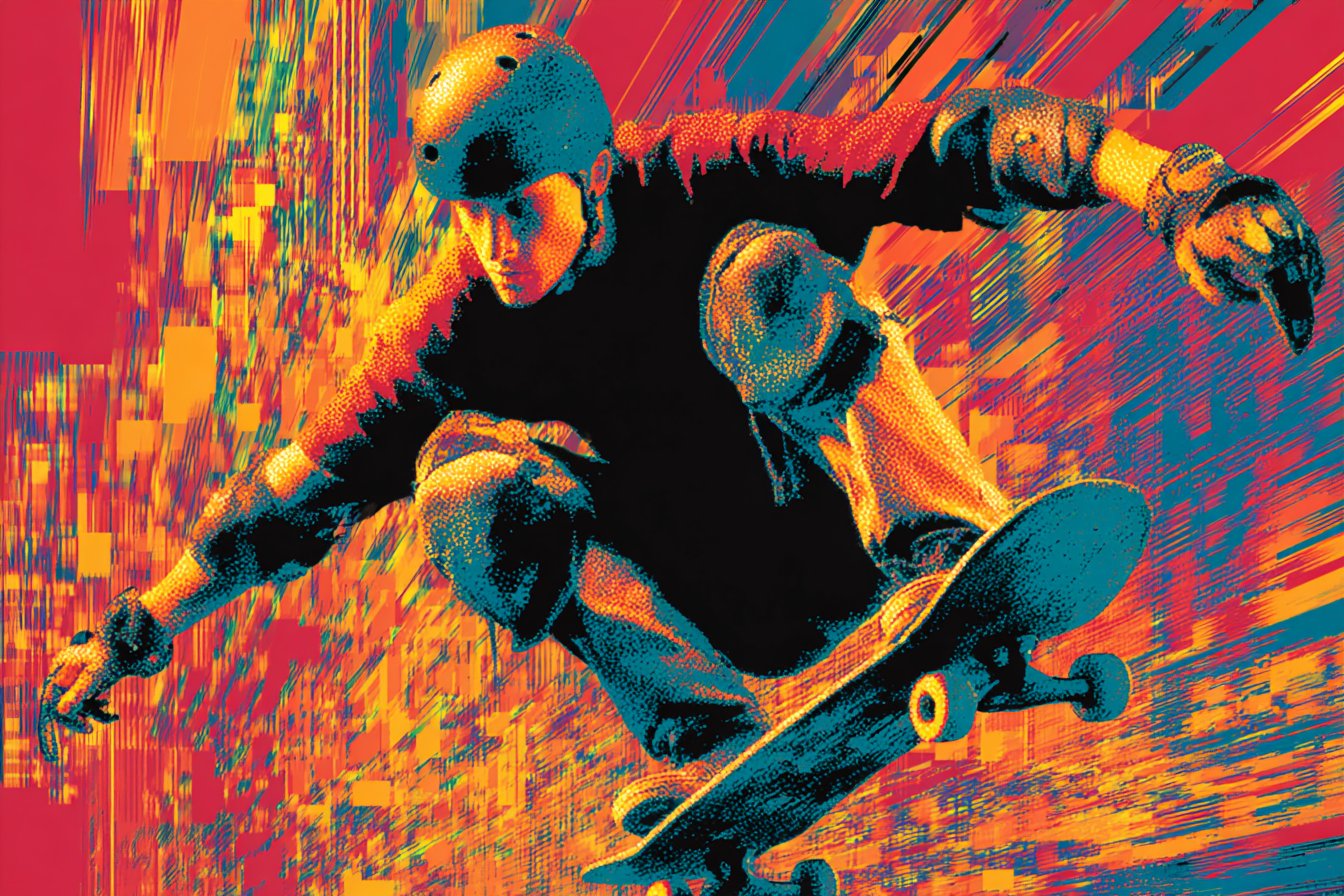

Tony Hawk’s Pro Skater (THPS) was the first sports game that really opened my eyes to what sports games could be. I grew up playing mostly Sega Genesis and Dreamcast games (Sonic, Streets of Rage, etc.). So, I just didn’t really care about sports games. They seemed boring and predictable — kick the ball, throw the ball, try to score more than the other team. What’s the fun in that? I mean, I think I enjoyed the creativity and unpredictability of the Sega games that I grew up playing.
In 1999, I visited a friend Mike’s house (he had a PS One, I was still stuck on my Dreamcast). He booted up this new skateboarding game, “Tony Hawk,” and told me, “You’ve got to cheque this out.” And that’s basically what every gamer does when they want to show off something new. Usually I would roll my eyes and tell them to go ahead and play it for a few minutes until they’re done showing it off, and then we’d get back to playing Crazy Taxi or Power Stone on my Dreamcast.
However, there was something different about the energy emanating from Mike’s TV. The music came on first, and I thought the song was pretty cool — it was a punk-rock song that didn’t sound like the typical rock music most games use. Then I saw Tony Hawk drop into what I now know as the Warehouse, and within 30 seconds he was doing this crazy combination of tricks that looked completely impossible but felt extremely natural. Mike handed me the controller after his two-minute run, and I thought I’d just humor him for a couple of minutes before we got back to playing some Crazy Taxi or Power Stone on my Dreamcast.
Except… Damn. Within seconds I was grinding rails I didn’t even know I could grind, linking tricks together in ways that made no logical sense but felt amazing. The whole thing had this arcade-style accessibility that reminded me of why I loved Sega games — they were easy to pick up and understand, yet there were layers of complexity beneath the surface that would take a long time to master.
What really impressed me wasn’t just that the game felt great to play, but that it had this scoring system that actually rewarded creativity. Most sports games are about winning and losing, right? Score more goals, get more touchdowns, etc. However, THPS was about expressing yourself through movement. Every trick could flow into another, and the longer you kept your combo going, the higher your multiplier climbed. It was like… Imagine if Street Fighter rewarded you for creating your own custom combos instead of just memorizing preset ones. That’s the kind of creative freedom we’re talking about here.
I ended up buying my own copy the following week. Which was a big deal for me because I was in college at the time and had approximately zero dollars at any given time. However, I had become completely obsessed with the combo system in the game. The risk-reward element was perfect — you could play it safe and land basic tricks for decent points, or you could keep pushing your luck and landing increasingly complex combinations of tricks for enormous points. But fail to land it and you’d lose everything. It created this constant tension that had me literally on the edge of my dorm room bed, gripping my controller so tightly my knuckles were white.
The genius of it was how the levels in the game were designed to encourage this type of creative expression. These weren’t realistic skateparks — they were elaborate playgrounds where every surface existed to be tricked on. The School level alone probably kept me busy for months, just figuring out how to connect different parts of the school through precise manuals and wall rides. I remember discovering that you could link the gymnasium to the outdoor area through this absurd sequence of a grind, a gap jump, and a perfectly timed manual, and it felt like I had uncovered some kind of secret knowledge.
Remember when Sega games would have those moments when you would find a hidden path or discover a new way to approach a level? THPS had that same energy, but instead of finding secret paths through Green Hill Zone, you were finding secret lines through suburban California. Every session provided new possibilities, new ways to chain areas together, and new routes through familiar spaces. The secret tape locations became these legendary challenges — spotting that glowing VHS cassette somewhere that seemed nearly impossible to reach, and then spending hours figuring out the exact sequence of moves required to obtain it.
Can we talk about the soundtrack for a second? Holy crap. I thought I had good taste in music — I was into some punk bands, listened to what was on alternative radio, and owned a handful of CDs that weren’t completely embarrassing. But THPS introduced me to this entire world of music I’d never heard of before. Goldfinger’s “Superman” became etched into my brain, but in the best possible way. Dead Kennedys, Rage Against the Machine, and Suicidal Tendencies — bands I’d never have discovered otherwise — became part of my regular rotation.
The music wasn’t just background noise, though. It was perfectly incorporated with the gameplay in a way that created these incredible moments of synchronization. You’d be building up this massive combo, and the tension would be building as your multiplier climbs higher and higher, and then you’d land that final trick right as the chorus kicks in, and it feels like the game is celebrating your success. I’ve never experienced anything quite like it in gaming — where the music, the visuals, and the gameplay mechanics come together to create these perfect moments of flow-state.
What really impressed me was how authentic the whole thing felt. This wasn’t some corporate committee’s idea of what skateboarding should be — you could tell it was made by people who actually understood skate culture. The inclusion of real professional skateboarders wasn’t just a marketing gimmick — each one had their own stats, special moves, and skateboarding style that reflected their real-life personalities. I knew absolutely nothing about Rodney Mullen prior to playing THPS2, but after watching him skate in the game, I went down this rabbit hole of watching actual skateboarding videos. And it turns out, he’s even crazier in real life than his video game representation suggests.
The cultural impact was immediate and obvious. All of a sudden everyone was talking about skateboarding. Kids who’d never stood on a skateboard were debating the merits of different deck brands. Skate shops that were barely holding on financially were getting more customers than ever before. The X-Games went from a niche cable TV event to something that people actually cared about. THPS didn’t just reflect skate culture — it helped spread it to millions of people who may have never been exposed to it otherwise.
I was certainly one of those people who briefly tried to skateboard in reality due to the game. At 20 years old, I’m probably too old to have started skateboarding, but that didn’t stop me from buying a complete skateboard setup and trying to ollie in my apartment complex’s parking lot. The disconnect between effortlessly pulling 900s using a PlayStation controller and barely popping the board six inches off the ground in real life was both humbling and hilarious. I quit after a few weeks of minimal progress and many spectacular crashes, but the game had instilled in me an immense respect for what real skaters are capable of.
Each subsequent entry in the series continued to refine the formula in ways that expanded the creative potential. The manual system in THPS2 was revolutionary — now you could link street tricks with vert tricks, and maintain your combos across entirely different sections of a level. The revert mechanism in THPS3 took this even further, enabling you to transition from ramp tricks back to street skating without ending your combo. These may seem like minor improvements, but they significantly amplified the creative potential.
By THPS3 and THPS4, the series had found the perfect equilibrium of accessibility and depth. The levels in the game became elaborate puzzle-boxes designed to encourage exploration and experimentation. The create-a-park mode allowed you to design your own skateboarding playgrounds, and I probably spent more time in the level editor than actually playing the levels included in the game. There was something extremely rewarding about designing the perfect flow of motion between various obstacles, and creating these outrageous-looking courses that skated beautifully.
What really surprised me about the series was how it demonstrated that sports games did not require realism to be authentic. THPS captured the essence and the freedom of skateboarding far better than any simulation could have. It recognised that what makes skateboarding enjoyable isn’t the technical difficulties or the physics — it’s the creative expression, the self-expression, and the ability to view urban environments as opportunities for skateboarding rather than as barriers to it.
The impact of the series extended well beyond the realm of skateboarding games. All of a sudden every action-sports game was attempting to capture some of the THPS magic. SSX took snowboarding in a similar arcade direction. Racing games began incorporating trick systems and creative-scoring methods. The idea that sports games could focus on individual expression rather than merely competing to win or lose became a template that developers continue to follow today.
Years later, EA released the Skate series, which utilized a more simulation-based approach. While I appreciated the direction they were headed, it felt like a response to Tony Hawk rather than something entirely new. The analog stick control method was innovative, and it certainly felt more like actual skateboarding, but I kept returning to THPS for those moments when I desired to feel like a skateboarding superhero rather than a clumsy novice trying to learn how to kick-turn.
Eventually, the series lost its way, as successful franchises typically do. Later entries in the series attempted to innovate in directions that deviated from what originally made the series successful. Underground added storyline elements that no one requested. The skateboard controller experiments with Ride and Shred were disastrous and clearly missed the mark entirely. By the time Tony Hawk’s Pro Skater 5 was released in 2015, it was apparent that the magic had dissipated somehow during the development process.
But then, in 2020, Tony Hawk’s Pro Skater 1+2 was released — an extraordinary remake that comprehended precisely what made the originals great. Playing it was like my muscle memory reactivated after twenty years — within minutes, I was again stringing together combos that I hadn’t attempted since college, and the underlying rhythmic patterns of the game remained embedded in my neural pathways. Both of my teenage children, who’d never played the originals, developed the same level of obsession as I had, demonstrating that excellent game design is truly timeless.
Ultimately, what Tony Hawk’s Pro Skater achieved was creating this perfect middle ground that sports games had never achieved before. It was simple enough for total newcomers like myself to quickly grasp and appreciate, but complex enough to provide hundreds of hours of practice to players who wanted to master it. It was true to skate culture while still inviting non-skateboarders into the fold. It illustrated that developing a more arcade-like experience doesn’t equate to dumbing it down — it means distilling the essence of what makes the activity exciting.
The series’ influence has extended far beyond skateboarding games. Whenever I see a game that places player creativity at its core mechanic, creates environments as interactive playgrounds rather than static backgrounds, and utilizes licensed music as an integral part of the overall experience — I see echoes of what Tony Hawk’s Pro Skater pioneered. It altered my entire perception of what sports games could be, transitioning me from someone who viewed the entire category with disdain to someone who understood that, at their finest, sports games can be about so much more than simply simulating competitive athletics.

David runs a pub in Bristol and has transformed his back room into a functional shrine to arcade cabinets and early home systems. By night he writes about arcade culture, MAME emulation ethics, and why certain games simply feel different on original hardware versus emulation. He brings a perspective that matters: he owns these machines, maintains them, and plays them regularly, rather than just holding memories of them. His technical knowledge of arcade hardware is matched only by his ability to explain why authenticity genuinely matters to the experience.
0 Comments