There's something about plunging into a castle you can actually walk around that hits differently than anything that came before. I mean, I'd spent years mashing buttons to make a sprite hop left-to-right across screens, but the first time I grabbed that analog stick and made Mario pivot on his heels? Felt like discovering fire.
I remember getting my N64 on launch day—well, sort of launch day. My local Electronics Boutique (remember those?) got their shipment three days late, and I'd been haunting that shop like a ghost with pocket money. The bloke behind the counter knew me by name at that point. "Still no Mario," he'd say before I even opened my mouth. When it finally arrived, I practically sprinted home with that yellow box tucked under my arm like stolen treasure.
Setting it up was its own little ritual. RF switch first, then that chunky power adapter that looked like it could jumpstart a car. The controller felt alien in my hands—three prongs, seriously? Who designed this, an octopus? But once Mario's face popped up on that file select screen, everything clicked. Literally clicked, actually, because you could grab his nose and stretch it around like digital Play-Doh. I must've spent ten minutes just yanking on his ears before I even pressed start.
That first star in the courtyard taught me everything I needed to know about 3D movement, even though I didn't realize it at the time. The camera was doing its own thing—and let's be honest, it had opinions about where it wanted to look—but somehow it all worked. Mario's shadow was my compass, that little circle of darkness that told me exactly where I'd land. Revolutionary stuff, though I took it completely for granted.
The castle itself was like a puzzle box wrapped in another puzzle box. Each painting was a portal, each door a question mark. I'd run laps around that main hall just because I could, taking the stairs two at a time or sliding down the banister like I was eight years old again. The sound design was incredible too—Mario's footsteps changed depending on the surface, his voice echoed in the bigger rooms, and that ambient castle music made everything feel both cozy and mysterious.
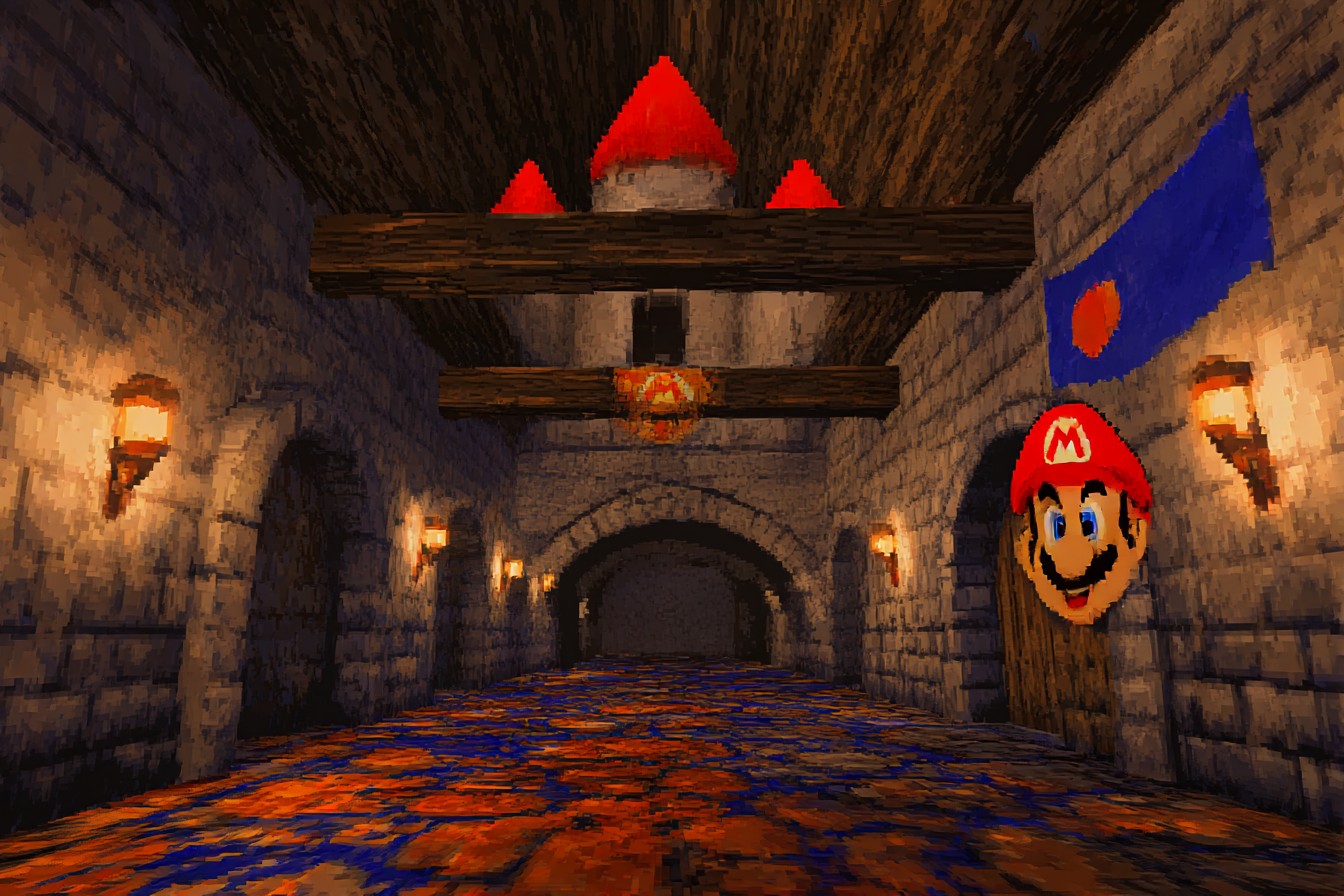
But oh, that camera. Sweet, stubborn, occasionally helpful camera. Learning to wrangle it was like training a particularly willful pet. Right shoulder button to center it behind Mario, except when it decided centering meant showing you a lovely view of the wall instead. Trying to platform with precision while the camera swung around like it had vertigo? Character building, that's what that was. I developed this weird muscle memory for when to fight the camera and when to just accept its artistic choices.
Star hunting became an obsession. Not just collecting them, but figuring out the logic behind their placement. Nintendo had this way of teaching you mechanics without you realizing you were being taught. That first Goomba encounter in the courtyard? It's showing you how jumping works in 3D space. The chain-link fence leading to the back garden? Camera control 101. By the time you're facing off against King Bob-omb on his mountain, you're ready for it—even if you don't feel ready.
I kept a notebook. Proper old-school strategy guide style, with hand-drawn maps and star locations marked in different colored pens. My handwriting was terrible, but those pages were sacred. "Red coins behind waterfall," scribbled next to a rough sketch of the courtyard layout. "Penguin race—take shortcuts!!!" with approximately seventeen exclamation marks because teenage me was very enthusiastic about slide controls.
The beauty of Mario 64 was how it made exploration feel like discovery. Every wall could potentially have a secret, every painting might hide something unexpected. I remember finding that hidden star behind the castle for the first time—you know, the one you get by doing a backwards long jump up the endless staircase? Felt like breaking the game in the best possible way. Nintendo knew players would find exploits and glitches, and instead of patching them out, they just… left them there. Like little rewards for curiosity.
Controlling Mario was poetry in motion once you got the hang of it. The analog stick gave you this beautiful range of movement speeds—tippy-toes for precision platforming, full tilt for those satisfying long jumps. And the long jump! Hold the run button, tap jump, and Mario would superman-dive across gaps that looked impossible. The physics felt just cartoony enough to be fun while still making sense. You could triple jump up walls if you got the timing right, backflip to reach higher platforms, and dive-slide under obstacles like some kind of plumber-shaped torpedo.
Boss fights were these perfect little skill checks. Bowser holding you by the tail, swinging you around that arena—it wasn't just about button mashing, you had to read the space, find your timing, aim for the bombs. King Bob-omb teaching you throw mechanics. The giant eel in the submarine level making you rethink how swimming works when you're not on a 2D plane anymore. Each encounter built on what you'd learned, but never felt like homework.
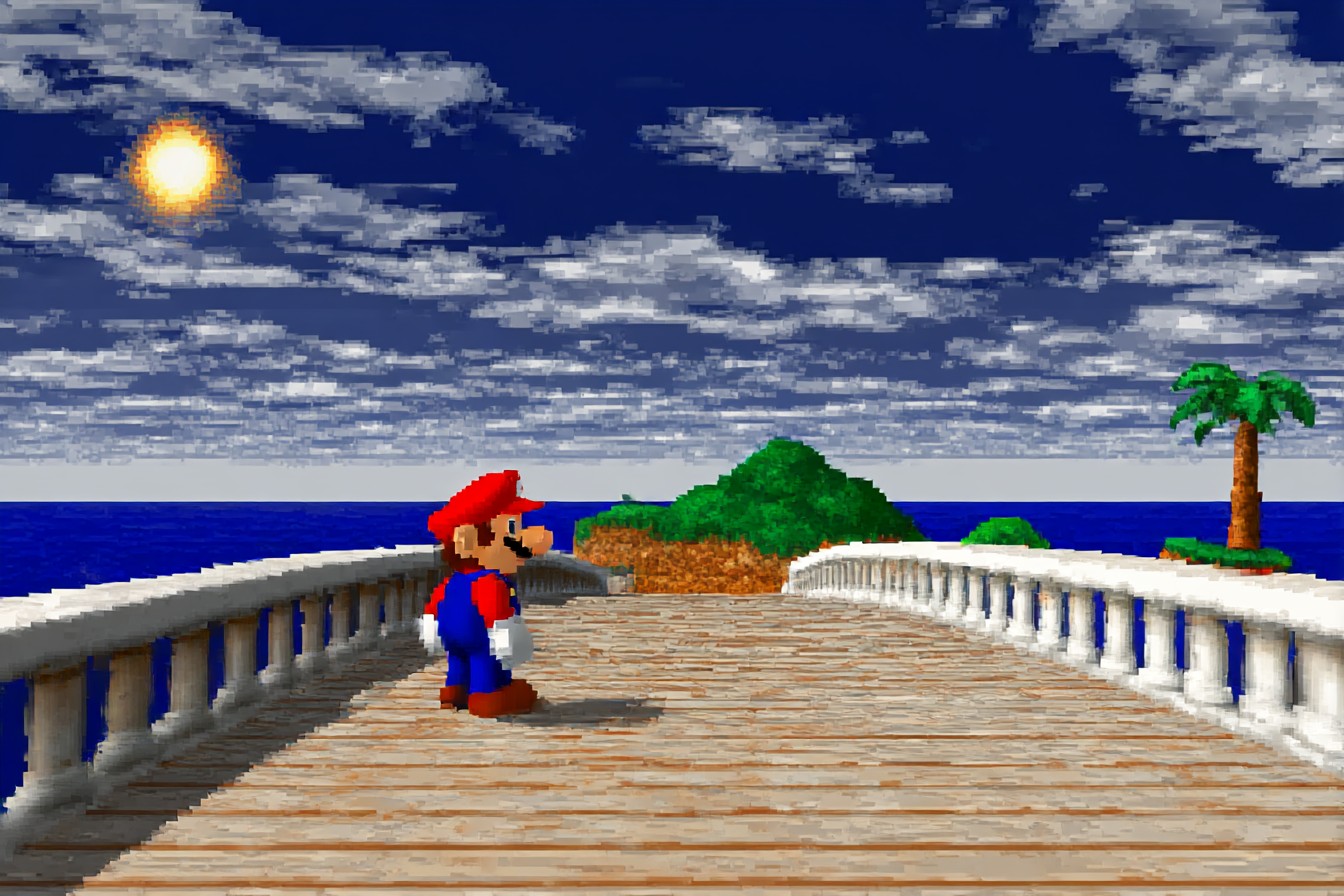
And those paintings! Each one was a promise of something completely different. Desert worlds with shifting sand that actually moved under your feet. Ice levels where penguins had personality and racing them felt genuinely competitive. That tiny-huge island where the same space became two completely different challenges depending on which painting you entered through. The variety was staggering, especially coming from a world where most games stuck to grass-ice-desert-castle and called it a day.
The soundtrack deserves its own paragraph, honestly. Koji Kondo created these melodies that perfectly matched the 3D exploration vibe. That main castle theme is still lodged in my brain twenty-five years later, along with the slide music, the underwater tracks, and especially that Bob-omb Battlefield tune that made running around felt like an adventure. Sound effects too—Mario's voice clips were revolutionary at the time, even if "Wahoo!" got a bit repetitive after the thousandth jump.
Looking back now, playing it on original hardware versus emulation, there's something to be said for both experiences. The authentic N64 controller with its slightly loose stick and that particular plastic feel in your hands? That's the real deal. But being able to play it in widescreen, with save states, maybe even some texture improvements? That's not cheating, that's just giving yourself permission to enjoy it differently. Sometimes I fire it up on my Steam Deck during lunch breaks, and it still feels like magic.
What strikes me most about Super Mario 64 isn't just that it was the first great 3D platformer—it's that it was the first game that made 3D space feel like home. After Mario 64, every other game had to live up to those movement controls, that camera system, that sense of place. It rewrote the rules and then made it look effortless. Absolute masterpiece, wonky camera and all.



