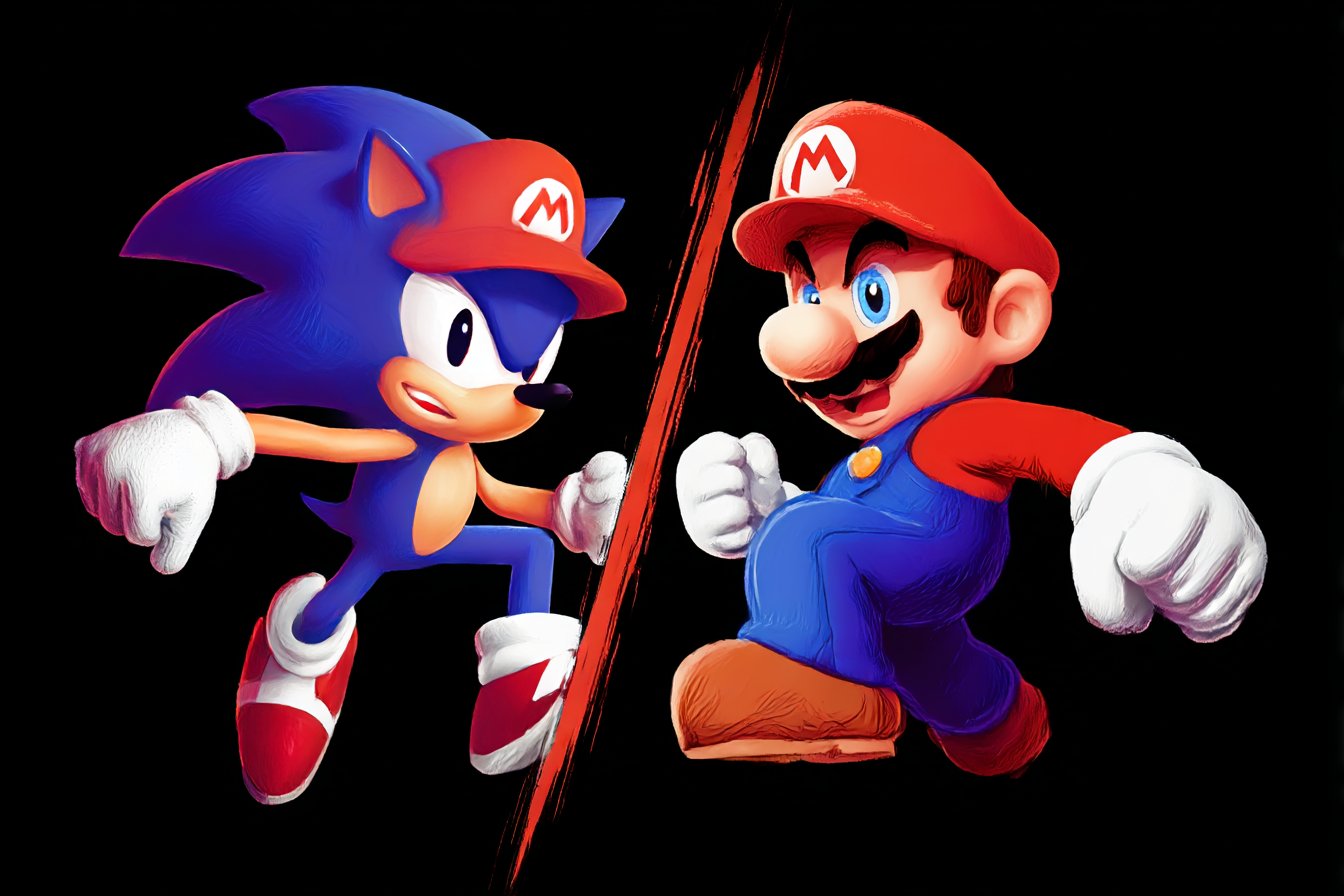

Everything changed for me in the summer of 1991. I was 14, and dealing with all of the usual awkwardness associated with teenagers, when my buddy Mike acquired a Sega Genesis. I had been a Nintendo guy since Christmas ’85 when I opened up that NES. That was essentially a part of my DNA at that point. However, Mike had been pestering me to come over to play this new system, and tell me to “trust me” and that it was “different.”
Well, “different” was an understatement. Mike fired up the Genesis and that “SEGA!” sound burst almost knocked me off his basement couch. There was also this music — this absolutely infectious Green Hill Zone theme that I still hum note-for-note today, thirty plus years later — and suddenly there is this blue streak blasting across the screen faster than I had ever seen in a video game. I think my jaw literally dropped, which Mike certainly noticed because he had a huge grin on his face. “That is Sonic,” he said with pride. “He’s way cooler than Mario, right?”
Honestly? He was correct.
Okay, I liked Mario. I still do. That plumber got me into gaming in the first place and taught me what a video game could be. However, Sonic had something Mario did not — attitude with a big A. If you left Sonic sitting around for too long, he would tap his foot and shoot you a look like “come on already, we doing this or what?” Mario simply sat there waiting patiently, hands on his hips, content to wait forever. Nintendo style. Safe.
The design differences between these two characters were like night and day. Mario was designed to be a completely ordinary character — a chunky, everyman type in overalls who moved with a pleasant, predictable rhythm. Sonic was all sleek lines and speed, those spikes that seemed like they were cut by the wind, and eyes that conveyed both arrogance and genuine coolness. Even when stationary, Sonic looked fast. The first time I watched him curl into a ball and fly through one of those loops, I knew I was seeing something that would revolutionize gaming forever.
That night, walking home from Mike’s house, I did something that I would have thought was absurd just a few hours prior — I began thinking of how I was going to save up for a Genesis. Me, the kid who had fought for Nintendo against all comers for six years. By Christmas ’91, after combining birthday money, saved allowance, and some suspiciously generous gifts from relatives (pretty sure my mom told them specifically to give me money), I was the proud owner of my very own Genesis and a copy of Sonic the Hedgehog.
Sega’s marketing was pure brilliance, and a 14-year-old version of me was their exact target audience. That whole “Genesis Does What Nintendon’t” marketing campaign portrayed Sonic as the rebellious alternative to Mario’s wholesome family fun. Their TV commercials featured Sonic racing to actual rock music while some impossibly cool teen with perfect 90’s hair played with an intensity that I instantly wanted to emulate. Meanwhile, Nintendo’s commercials felt like they were written by a corporate boardroom.
The attitude was a big deal. This was the early 90s — neon everything, Bart Simpson telling authority figures to “eat my shorts,” and everyone was obsessed with being “extreme.” Sonic embodied that whole vibe perfectly. He had edge. When Mario collected a coin, you heard a pleasant little “plink!” sound. When Sonic collected a ring, you heard a satisfying cascade of electronic chimes that felt cooler. Mario shouted “Yahoo!” and “Let’s-a-go!” Sonic didn’t need catchphrases — the way he moved was his personality.
My group of friends split almost down the middle regarding Mario vs. Sonic, which resulted in several heated playground arguments. “Mario’s got better power-ups!” “Yeah, but Sonic moves way faster!” “Mario’s games are longer!” “Sonic’s levels are cooler!” I am fairly certain that these debates sometimes concluded with someone getting pushed into a fence, which sounds ridiculous now, but felt like we were arguing fundamental truths about the universe at the time.
When Sonic 2 released in 1992, it was an actual event in my teenage life. I saved up enough to buy it on release day and coerced four friends to come over for what we called a “launch party” — basically each of us took turns playing while demolishing bag after bag of Doritos in my parent’s basement. The inclusion of Tails as a co-op partner was pure genius — suddenly you could have a friend controlling the little fox sidekick. This led to incredible teamwork… and some great testing of our friendships when your buddy couldn’t keep up with your expert Sonic skills. Sorry, Dave, but you were awful at being Tails.
That spin-dash ability they introduced in Sonic 2 was a total game-changer. Being able to rev Sonic up like a motorcycle and then launch him across the screen added a whole new dimension to the gameplay. I spent hours honing my skills to find the optimal amount of time to rev for max speed on various surfaces. Every time I walked by the living room, my mom would glance at the TV and see Sonic spinning in place and wonder aloud if the game was broken. “No,” I’d tell her, “I’m practicing a technique!” She’d give me that look that parents have perfected during their kids’ teenage years — equal parts confusion and mild concern.
As Sonic’s popularity skyrocketed, so did the merchandising, and I was all in. I wore a Sonic t-shirt to school until the collar was stretched to the breaking point and the print was flaking off. My backpack had a Sonic pin. My bedroom walls, which used to be exclusively Nintendo territory, began featuring Sonic posters. I collected the Archie Comics Sonic series religiously — they added back-stories and created a massive, more mature universe than what you might expect from video-game tie-in comics.
The Saturday morning cartoon landscape was interesting, as there were actually two separate Sonic cartoons airing at the same time. “Adventures of Sonic the Hedgehog” was the goofy one with the rubber hose animation and slapstick comedy. However, “Sonic the Hedgehog” — the one fans referred to as “SatAM” — was dark, cool, and more serious. That show had Sonic leading a rebellion to free his world from the tyranny of Robotnik (we called him Robotnik back then, not Eggman). That was a lot to take in for a children’s show based on a video game character. The animation was good, and Jaleel White’s voice acting as Sonic was spot-on.
In contrast to the Super Mario Brothers Super Show, which felt like it was created for 6 year olds, the Sonic cartoons were far superior. Those live-action skits with Lou Albano as Mario were bizarre and the animated portions were…adequate, I suppose? However, they lacked the complexity and cool factor of Sonic’s television adventures. Mario cartoons were something you watched before you realized better. Sonic cartoons were something you watched when you had developed some real taste.
When Sonic 3 & Knuckles released in 1994, I was thoroughly entrenched in the blue blur. The addition of Knuckles, this enigmatic, red echidna who could glide and climb walls and had this complex relationship with Sonic, brought an entirely new level of cool to the franchise. Knuckles was like the Wolverine of the Sonic universe — rough-around-the-edges, strong, and complicated. His presence made even Sonic seem somewhat conventional, which was no small feat.
The console wars between Sega and Nintendo were heating up, and having Sonic games felt like a declaration of loyalty to the underdog system. Nintendo kids were viewed as playing it safe; whereas, Sega kids were seen as the rebels who weren’t afraid to support the underdog. Obviously, this was a marketing ploy to create brand allegiance through tribalism, but it worked on me completely. I genuinely felt cooler for being on the Team Sonic bandwagon, even though I secretly purchased a Super Nintendo (kept that acquisition quiet among certain friends — like I was concealing some embarrassing secret).
My Sonic merchandise collection reached epic proportions. In addition to the typical tee-shirts and posters, I had Sonic bedding that I insisted were “perfectly reasonable” for a high school student, a full set of Sonic McDonald’s toys, and a pair of Sonic slippers that I wore until they literally disintegrated. The pinnacle of my collection was a Sonic watch that played the Green Hill Zone theme when you pressed a button. I wore it to school until Mrs. Henderson confiscated it after I “accidentally” activated it during a chemistry test. Defending myself, I stated that I was attempting to solve a particularly vexing problem and needed some inspiration.
The Genesis hardware was perfect for showcasing what made Sonic so special. The Genesis’ processing capabilities allowed for that signature speed that defined the character. When I played Sonic, it felt like I was pushing the console to its limits in an exhilarating manner. The momentum-based physics engine was revolutionary — how Sonic would generate speed rolling down hills, how you could use that momentum to propel him up impossible inclines, how a perfectly-timed jump could send him careening across entire sections of a level. It felt more dynamic, more alive than the more methodical and predictable pace of Mario games.
Sonic’s level design was in a class of its own. While Mario’s levels were ingenious, multi-path obstacle courses that generally progressed from left-to-right, Sonic’s levels were these sprawling, multi-layered playgrounds with high pathways and low pathways, hidden areas and as much vertical exploration as horizontal. To date, Chemical Plant Zone from Sonic 2 is one of my all-time favorite video game levels — that perfect balance of speed sections, precision platforming, and sheer terror of that rising pink water with its ominous drowning countdown music. I can still hear those warning beeps in my nightmares.
Comparing other 90s mascot characters to what makes Sonic unique really puts what sets Sonic apart in perspective. Crash Bandicoot arrived later with maniacal energy, but lacked Sonic’s effortless cool — he was too goofy, too obvious in his attempts to be zany. Bonk had an interesting caveman element, but never developed any true personality or mass appeal. Not to mention, even Bubsy, with his forced attitude and horrible one-liners, felt like some corporate committee trying to capture Sonic’s essence without truly understanding what made it so appealing. Sonic wasn’t trying to be cool — he simply was.
The playground debates regarding who would win in a sprint between Sonic and Mario grew increasingly detailed. “If Mario has a star power-up, he may be able to keep up with you!” “Yes, but stars only last for approximately ten seconds — Sonic is always fast!” “What if it’s underwater? Mario is a better swimmer!” Kids who had never talked about physics in their lives were all of a sudden experts on momentum, acceleration and friction coefficients, all due to the video game characters.
By the mid-90s, Sonic had transcended gaming to become a genuine cultural phenomenon. You did not need to own a Genesis to know who he was. His image was everywhere — lunchboxes, backpacks, TV shows, floats in parades, etc. Mario had done it first, no doubt, but Sonic achieved this same level of recognition in less than half the time. For a character designed by corporate committee to promote consoles, Sonic had developed a distinct personality and a loyal fan base that went beyond his intended marketing scope.
It is interesting to follow Sonic’s development throughout the years. While Mario successfully transitioned to 3D with Super Mario 64, Sonic’s leap to 3D with Sonic Adventure was…more complicated. The speed that made him so iconic in 2D created camera and control issues in 3D that the series has yet to rectify. However, even as the quality of Sonic games ebbed and flowed throughout the decades, the core qualities that made Sonic so beloved — the attitude, the speed, the unbridled coolness — remained a staple of the character.
Even today, I still get a little rush of nostalgia when I hear the opening notes of Green Hill Zone. I have a small shelf in my home office with a few Sonic action figures, including a 30th Anniversary figure I probably overpaid for. When my nephew saw them, he asked why I had “toys” on display, and that prompted me to provide a possibly too-passionate explanation of Sonic’s cultural significance that probably glazed over his eyes within 30 seconds. Sorry, Tyler — some experiences you just have to go through yourself to truly understand.

Samuel’s been gaming since the Atari 2600 and still thinks 16-bit was the golden age. Between accounting gigs and parenting teens, he keeps the CRTs humming in his Minneapolis basement, writing about cartridge quirks, console wars, and why pixel art never stopped being beautiful.
0 Comments