My mate Dave used to have this theory about the Sega Genesis – sorry, Mega Drive to those of us who lived through the proper naming convention – that it was basically a sports car disguised as a games console. "Listen to that sound," he'd say, cranking up OutRun 2019 until his mum shouted from downstairs. That Yamaha FM synthesis chip didn't just make music; it made automotive poetry. Every rev, every screech of tyres, every thump of the bass line felt like it was mixed in a garage rather than a studio.
I spent more Saturday afternoons than I care to count hunched over that black plastic beauty, working my way through what I now realize was probably the greatest collection of racing games ever assembled on one machine. Not that I knew it at the time, of course. Back then, I just knew that when I fired up Road Rash, something magical happened to the living room. The furniture seemed to lean in. The air got thicker. Even the cat would stop washing itself and stare at the screen like it could smell the asphalt.
Road Rash wasn't just a racing game – it was barely a racing game at all, really. Sure, you had bikes and you went fast and there was technically a finish line somewhere ahead, but what it actually was, was pure vehicular anarchy wrapped in leather jackets and served with a side of chain-swinging violence. I remember the first time I successfully knocked another rider off his bike with a well-timed punch. The satisfaction was immediate and slightly worrying. My dad walked past just as I was celebrating, shook his head, and muttered something about "the youth of today." He wasn't wrong, but he wasn't entirely right either.
The thing about Road Rash was how it made you complicit in its madness. You started each race with good intentions – just get to the finish line, maybe win a few dollars, upgrade the bike a bit. But then some leather-clad lunatic would come alongside you with a club, and suddenly all bets were off. Before you knew it, you were the one wielding the chain, the one causing pile-ups, the one laughing maniacally as hapless riders tumbled into ditches. The police chases only made it better. Nothing quite compared to the panic of seeing those red and blue lights in your mirrors, knowing you'd pushed things too far this time.
OutRun, on the other hand, was pure class. If Road Rash was the motorcycle gang your parents warned you about, OutRun was the sports car your dad dreamed about in traffic jams. That Ferrari Testarossa – though they could never actually call it that, licensing being what it was – represented everything cool about the late eighties. The blonde passenger, the endless highways, the radio stations you could actually choose between… it was like playing inside a music video.
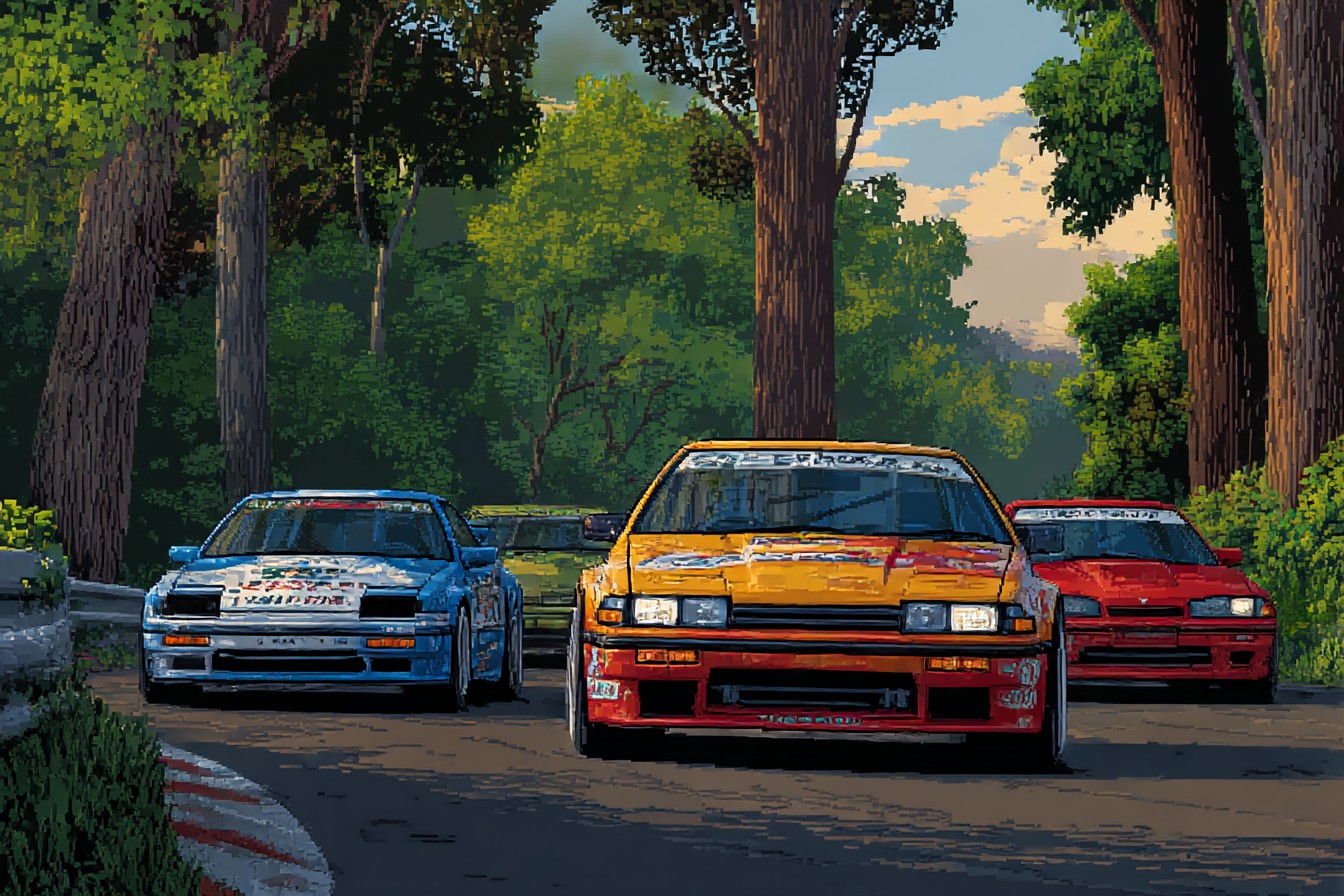
I must've driven that coastal highway ten thousand times, but it never got old. The way the road curved and dipped, the palm trees swaying in the background, the sunset painting everything golden – it was automotive meditation. Even the timer felt generous rather than stressful. OutRun didn't want to punish you; it wanted you to feel like you were living your best life at 180 mph.
The Genesis port was surprisingly faithful, too. Sure, the arcade original had better sprite scaling and smoother animation, but what we got at home captured the essential magic. That moment when you'd perfectly time a corner, threading between slower traffic while "Splash Wave" pounded through the tinny speakers – pure joy, every single time. I still have muscle memory for every turn on that first stage. Left, slight right, hard left around the rocks, straight through the tunnel. Poetry in motion.
Then there was Virtua Racing, which absolutely shouldn't have worked on the Genesis but somehow did. Sega basically had to reinvent the cartridge to make it happen, cramming in extra chips and charging accordingly. My parents nearly fainted at the price – "Forty pounds for a game? Are you having a laugh?" – but it was worth every penny. This was proper 3D racing, none of that fake sprite-scaling stuff. Real polygons, proper physics, cars that actually felt like they had weight and momentum.
The frame rate was choppy, sure, and the graphics looked like they'd been assembled from angular building blocks, but it was the future running on hardware that had no right to handle it. I'd spend ages just watching the replay cameras, marveling at how they could show my car from different angles. In 1994, this felt like science fiction made real.
Super Monaco GP deserves a mention too, even if it was more simulation than arcade action. Formula One racing with proper qualifying sessions, realistic handling, and enough technical depth to keep you busy for months. It wasn't as immediately thrilling as the others, but there was something deeply satisfying about gradually improving your lap times, learning the optimal racing line through each corner, figuring out when to brake and when to floor it.
What made all these games special wasn't just the individual quality – though that was exceptional – but how they worked together as a collection. Each one scratched a different itch. Road Rash for when you wanted chaos and attitude. OutRun for when you needed to zen out with some scenic driving. Virtua Racing for when you wanted to glimpse the future. Super Monaco GP for when you felt like being serious about your motorsport.

The Genesis controller was perfect for racing games too. That six-button pad felt substantial in your hands, the d-pad was responsive enough for precise steering, and the buttons had just the right amount of tactile feedback. I burned through so many controllers playing these games, wearing down the d-pad until left and right started sticking. My mum would find me with a cotton bud and some isopropyl alcohol, performing surgery on yet another casualty.
Looking back now, with decades of gaming evolution behind us, it's remarkable how well these games still hold up. Modern racing games have better graphics, more realistic physics, online multiplayer, downloadable content – all the bells and whistles you could want. But they rarely have that same sense of pure, uncomplicated fun. Road Rash was violent and silly and completely over the top, and that was exactly the point. OutRun was style over substance, and the style was so good that the substance didn't matter.
The Genesis era was lightning in a bottle for racing games. The hardware was powerful enough to handle proper arcade ports but limited enough that developers had to be creative, had to focus on what really mattered. No photo-realistic graphics to hide behind, no complex physics engines to mask boring gameplay – just pure, concentrated racing joy served up in 16-bit perfection.
I still fire up these games occasionally, usually late at night when the house is quiet and I'm feeling nostalgic. They're all available in various collections now, playable on modern hardware with enhanced graphics and save states and all sorts of conveniences. But honestly? They're best experienced exactly as they were – on original hardware, through RF cables, with the slight input lag and fuzzy picture quality that somehow made everything feel more authentic. Sometimes the imperfections are part of the magic.



