The summer I first wrapped my hands around that bizarre three-pronged controller, everything clicked. Not immediately, mind you—I spent the first hour trying to figure out which prong went where, rotating the thing like I was solving a Rubik's cube. But when Mario's face appeared on that file select screen and I realized I could grab his nose and stretch it like digital Play-Doh, something fundamental shifted in my understanding of what games could be.
See, up until that moment in 1997, games felt like watching television with buttons. You moved sprites across backgrounds, jumped over pits, shot at things that moved predictably from left to right. Even the best ones—your Mega Mans, your Sonics, your Streets of Rage 2—were essentially very clever flipbooks. Brilliant flipbooks that I absolutely loved, don't get me wrong, but still fundamentally flat.
Then Mario turned his head to follow my analog stick movements, and I swear the hair on my arms stood up. This wasn't a sprite. This was a character who lived in actual space, who could look at me looking at him. The little rubber nub under my thumb wasn't just moving a cursor—it was controlling a camera, and that camera was my eyes in this world.
I remember the exact moment I stepped into Princess Peach's courtyard for the first time. The way that camera swept around behind Mario as he jogged forward, the sense of depth as the castle loomed ahead, the realization that I could run in literally any direction I wanted. Not just left and right anymore—anywhere. I could circle that fountain until I got dizzy. I could run straight into walls just because I could. The freedom felt intoxicating.
But it wasn't just the freedom that got me—it was how natural it all felt once you stopped thinking about it. That analog stick had this perfect resistance, this tactile feedback that made tiptoeing across narrow ledges feel genuinely precarious. Push it slightly and Mario walked. Push it more and he jogged. Slam it to the edge and he ran full tilt, arms pumping. The controller became an extension of your intentions in ways that D-pads never could.
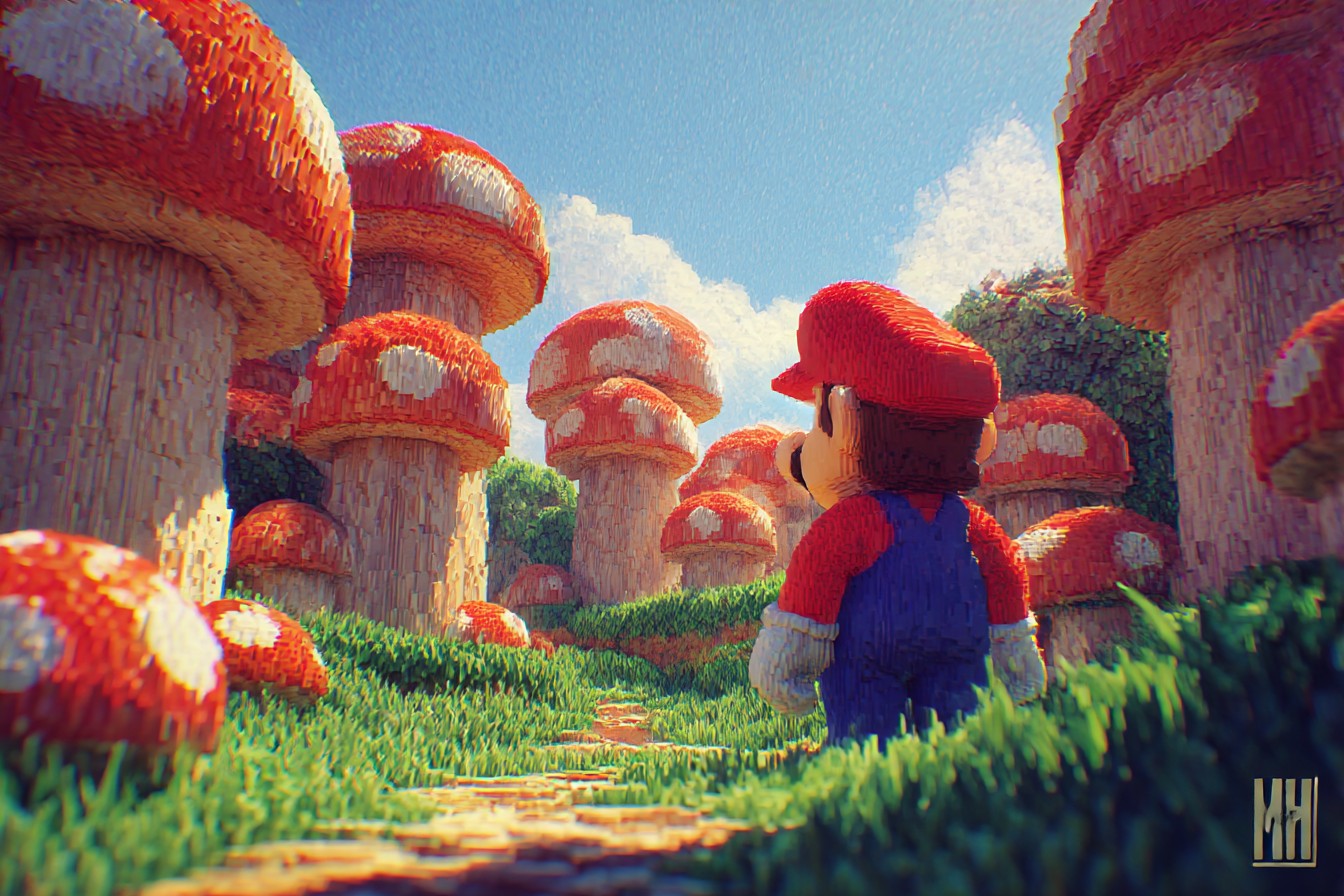
My mate Dave came over the day after I got it, took one look at the controller and said, "What's that middle bit for then?" Fair question. The middle prong seemed completely mental until you realized Nintendo had designed something brilliant: multiple grip styles for different games. Racing games, you held it like a steering wheel. Most everything else, you gripped the left and right prongs like a traditional pad. Simple once you knew, baffling until you did.
The camera system in Mario 64 deserves its own chapter in gaming history. Those C buttons became your best friends—or your worst enemies if you got the angles wrong. I spent entire afternoons just mucking about with camera positions, finding the perfect view for each jump, each tricky platforming section. The game taught you to think in three dimensions, to consider space from multiple angles. Lakitu wasn't just the referee from the Kart games anymore—he was your cinematographer, swooping around Mario with that little film camera, making every moment feel like you were directing your own adventure movie.
What really blew my mind though was how the whole experience felt so… physical. When Mario long-jumped across those massive gaps in Dire Dire Docks, I'd lean forward on the sofa without even realizing it. When he was climbing those endless spiral stairs toward Bowser, I'd unconsciously move my thumb in little circles on that analog stick, as if I was helping him climb. The Rumble Pak—when I finally saved up enough pocket money for one—made everything even more tactile. Suddenly you could feel Mario's footsteps, feel the thud when he landed a big jump.
Those first few weeks with the console were pure exploration. I'd pick a random painting in the castle and just… disappear into it for hours. Bob-omb Battlefield taught me how to fight in 3D space—not just hitting attack buttons, but positioning, timing, using the camera to line up throws. Cool, Cool Mountain introduced me to the joy of momentum-based movement, sliding down that massive slope and learning to steer by shifting my weight on the analog stick.
The Lakitu cam became second nature pretty quickly, but I'll never forget those early moments of confusion. Getting the camera stuck behind a wall, frantically hammering C buttons trying to find Mario again. Learning that you could go into first-person mode with the C-up button—suddenly you were looking through Mario's eyes, seeing this world from his perspective. It was like having X-ray vision, being able to peek around corners, line up distant jumps with surgical precision.
Every painting world felt like discovering a new planet. Jolly Roger Bay with its submarine and that bloody eel that scared the life out of me. The racing penguins in Cool, Cool Mountain—I must've raced that big penguin a thousand times, trying to shave seconds off my best time. Hazy Maze Cave with its metal cap transformations that turned Mario into a living statue. Each world had its own physics, its own rules, its own personality.
But what really stuck with me—what still gives me goosebumps when I fire up the game today—is how revolutionary that first analog stick felt. Every other console was still thinking in digital terms: pressed or not pressed, left or right, on or off. Nintendo looked at that and said, "What if we could measure how much?" That tiny gray nub could detect 256 different positions, giving you granular control that made every movement feel intentional.
Playing Mario 64 now, whether on original hardware or through emulation, still feels magical. Sure, the graphics look chunky by today's standards, and that camera system seems clunky compared to modern third-person adventures. But the core of what made it special—that sense of existing in a real space, of having precise control over movement and perspective—that hasn't aged a day.
I've introduced my own kids to Mario 64, watched them struggle with those same camera angles, seen their faces light up when they nail a tricky triple jump sequence. The game still teaches the fundamentals of 3D movement better than almost anything that's come since. It's like learning to walk all over again, but in digital space.
That three-pronged controller might've looked like alien technology, but it was really Nintendo's love letter to the future of gaming. Every analog stick since owes something to that original gray nub that taught an entire generation how to navigate three-dimensional worlds with their thumbs.



