There's something deeply absurd about standing in your living room, casting an imaginary line into pixelated waters while your mum shouts from the kitchen that dinner's ready. But that's exactly what happened when Sega's Bass Fishing hit our local arcade, complete with its ridiculous fishing rod controller that somehow made perfect sense the moment you grabbed it.
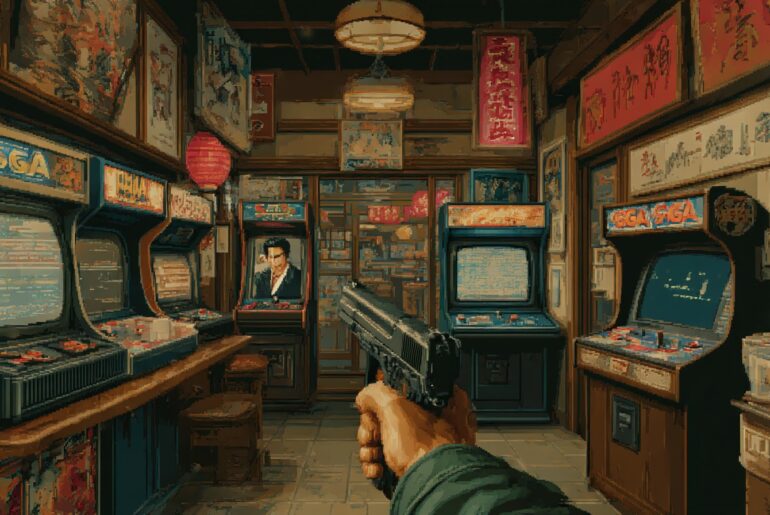
I remember the first time I spotted that setup tucked between Street Fighter Alpha 3 and a slightly knackered House of the Dead cabinet. The fishing rod looked proper—weighted, realistic, with a spinning reel that actually worked. Not like those flimsy light gun replicas that felt like hollow tubes wrapped in gray plastic. This thing had heft. Authority. It demanded respect, which felt weird for something attached to a video game about catching fish.
The arcade owner, a bloke called Tony who wore the same Manchester United shirt every day and somehow made it work, had positioned the Bass Fishing cabinet near the back corner. Smart placement, really. Far enough from the fighting game crowd that you wouldn't get self-conscious about your casting technique, but close enough to the change machine that you'd definitely feed it more coins than planned.
My first go was… well, embarrassing. Proper embarrassing. I treated it like a normal arcade game—button mash, waggle the stick, hope for the best. Completely missed the point. The rod controller wasn't just a gimmick; it was the entire experience. You had to cast with actual technique, feel for the bite through subtle vibrations, work the reel with patience rather than panic. It was almost meditative, which sounds ridiculous when you're talking about feeding 20p coins into a machine that plays the same cheerful fishing tune on loop.
But here's the thing—it worked. Brilliantly. That controller transformed what could've been another bland arcade experience into something genuinely special. The weight distribution felt natural in your hands. The casting motion required proper timing and technique. When a fish bit, you felt it through haptic feedback that somehow conveyed the difference between a nibble and a proper strike. I've used plenty of specialty controllers over the years, from Steel Battalion's apocalyptic button farm to those ridiculous Donkey Konga bongos, but Sega's fishing rod remains one of the few that felt like it was built by people who actually understood the thing it was simulating.

The game itself looked gorgeous for its time. Water that actually moved like water, fish that behaved like fish rather than swimming sprites, environments that captured that specific early-morning-on-the-lake atmosphere that real anglers bang on about. Playing it on a proper CRT monitor made everything shimmer in just the right way. The reflections, the ripples when your lure hit the water, the way light filtered through the trees—it all came together to create something that felt less like a video game and more like a tiny vacation.
Tony eventually bought the home version for Dreamcast, and I convinced my dad to let me have a go during one of our weekend visits. The home controller was smaller, obviously, but still impressive. Sega had somehow managed to cram most of the arcade experience into something that would fit in a living room without requiring structural reinforcement of the floor. The Dreamcast version looked nearly identical to the arcade, which was proper wizardry in 1999. We're talking about a home console matching arcade-perfect visuals when most ports still looked like someone had smeared Vaseline on the screen.
What struck me most was how the controller changed my relationship with the game. Without it, Bass Fishing would've been just another fishing sim—probably decent, but ultimately forgettable. With it, every session became an event. You couldn't half-arse it. The controller demanded your attention, your posture, your commitment to the bit. I found myself standing up to cast, adjusting my stance for different angles, even developing a preferred grip after extended sessions.
The tactile feedback was genuinely impressive. Different fish fought differently through the rod. Bass pulled hard and sudden. Trout were more delicate, requiring finesse. Even the environmental conditions affected how the controller felt—windy conditions meant your casts behaved differently, and you could sense it through the mechanism. It wasn't just rumble pack vibrations; it was properly engineered resistance and response.
Looking back, that fishing controller represents something I miss about Sega's approach to hardware. They weren't afraid to be weird, to take genuine risks on peripherals that might only work with one or two games. Nintendo does this too, but more cautiously. Sony occasionally dabbles. But Sega? They'd throw money at any idea that seemed even slightly mental, and sometimes—like with the Bass Fishing rod—they'd create something genuinely magical.

The controller also solved a problem I didn't know existed. Traditional fishing games always felt disconnected from their subject matter. You'd press X to cast, wiggle the analog stick to reel, maybe tap some buttons during a quick-time event. Functional, but about as exciting as filing tax returns. The rod controller made every action feel earned. Your casting distance depended on your technique. Your success in landing fish required actual skill development. It turned a simple arcade game into something approaching a proper simulation.
I ended up buying my own Dreamcast fishing rod years later, purely for nostalgia purposes. Still works perfectly, which says something about Sega's build quality when they bothered to get it right. The springs still have proper tension, the reel still clicks satisfyingly, the whole thing still feels substantial rather than toyish. Sometimes I'll fire it up just to experience that specific combination of tactile feedback and visual polish that modern gaming rarely captures.
That fishing controller taught me something important about game design—that sometimes the interface is the innovation. Graphics improve, processors get faster, but the way you interact with a game world? That's where the real magic happens. Sega understood this instinctively. They built controllers that didn't just translate your inputs; they made you part of the experience in ways that felt natural and exciting.
These days, everyone's obsessed with VR and motion controls and haptic suits, searching for that perfect simulation. But sometimes I think they're overcomplicating things. Sega's Bass Fishing controller worked because it focused on doing one thing exceptionally well rather than trying to revolutionize everything at once. Simple concept, brilliant execution, unforgettable results.