The dusty plastic smell hit me first—that familiar cocktail of old electronics and childhood weekends. I'd just pulled out my Mega Drive from the storage box in the loft, carefully wrapped in the same old towel mum used to dry the dishes. Beneath it sat a stack of cartridges, their spines faded but still readable. And there it was, wedged between Streets of Rage 2 and Gunstar Heroes: Contra: Hard Corps.
Christ, what a game that was.
I remember the exact Saturday morning I first saw it in the local game shop—you know the type, squeezed between a newsagent and a chippy, with those handwritten price tags that always seemed to be in biro. The shopkeeper, Dave I think his name was, had this habit of describing games like he was selling cars. "Oh, this one's a proper beast," he'd say, tapping the plastic case. "Four different characters, multiple endings, weapons that'll make your thumbs ache."
He wasn't wrong about the thumbs.
Contra: Hard Corps was Konami firing on all cylinders, showing everyone exactly what the Mega Drive could do when you pushed it hard enough. This wasn't your typical run-and-gun shooter—though it certainly was that too. This was… well, it was controlled chaos in the best possible way.

The first thing that grabbed me was the character selection screen. Four fighters, each with their own personality written into every pixel. Ray Poward, the soldier with the bandana who looked like he'd stepped straight out of an action movie. Sheena Etranzi, the android who could lock onto targets in ways that made my twelve-year-old brain think "this is the future." Brad Fang, the werewolf (because why wouldn't you have a werewolf in a contra game?), and Browny, this tiny robot that moved like it had springs for legs.
Each one played completely differently, which was mental for 1994. I mean properly different, not just "this one jumps higher" different. Ray felt like classic Contra—disciplined, military, all business. Sheena could aim in eight directions while moving, which sounds simple until you're trying to nail a helicopter while sliding down a cliff face. Brad had this melee attack that let you get up close and personal with enemies, which went against everything I thought I knew about Contra games. And Browny? That little maniac could curl into a ball and bounce around like he'd escaped from a Sonic game.
The weapons system was absolutely bonkers too. You'd start with your basic pea shooter—fair enough—but then the power-ups would start flying. The laser, the spread gun, the homing missiles that actually bloody homed (revolutionary stuff for the time). But here's what made it special: different characters could use the same weapons in completely different ways. Give Ray a flamethrower and he'd torch enemies methodically. Hand it to Brad and he'd use it like a close-combat tool, getting right in their faces.
I spent entire afternoons just experimenting with different character and weapon combinations. My mate Chris would come round—he was always better at these games than me, the jammy git—and we'd argue about who was the best character. He swore by Sheena's targeting system. I was all about Brad's raw power. Neither of us could handle Browny properly; that little robot required reflexes we just didn't have.
The levels themselves were absolutely mad. One minute you're fighting through a burning city, the next you're surfing on missiles (actual missiles!) high above the clouds. There was this one stage where you're riding on the back of some enormous robot spider-thing, and the screen's shaking, and explosions are going off everywhere, and somehow you're supposed to be shooting enemies while not falling into the abyss below. It was brilliant. Absolutely mental, but brilliant.
What really got me was how fast everything moved. This wasn't a game where you could take your time and plan your next move. Enemies came at you from all directions—ground troops, flying drones, things that crawled out of the walls, massive robots that filled half the screen. The Mega Drive's sound chip was working overtime, pumping out this frantic, driving soundtrack that made your heart race even during the quiet bits (what few quiet bits there were).
The bosses… Jesus, the bosses. Each one was like fighting a small building that someone had taught to hate you personally. There was this mechanical octopus thing early on that had tentacles everywhere, and you had to figure out which bit to shoot while dodging about fifteen different attack patterns. The final boss—I won't spoil it for anyone who hasn't played it—was so big they had to scroll the screen just to fit it all in.
But here's what made Hard Corps special: it had multiple paths through the story. Actual branching storylines in 1994! Depending on the choices you made during certain cutscenes, you'd end up fighting different bosses, visiting different locations, seeing different endings. I must have played through that game a dozen times just to see all the variations. Each playthrough felt like discovering a slightly different version of the same brilliant madness.
The difficulty was absolutely savage, mind you. This was proper old-school Contra difficulty—three hits and you're done, no continues unless you'd earned them, and the game expected you to memorize enemy patterns like you were studying for GCSEs. I probably spent more on batteries for the Mega Drive's joypad than I did on the game itself, given how many times I threw the bloody thing across the room in frustration.
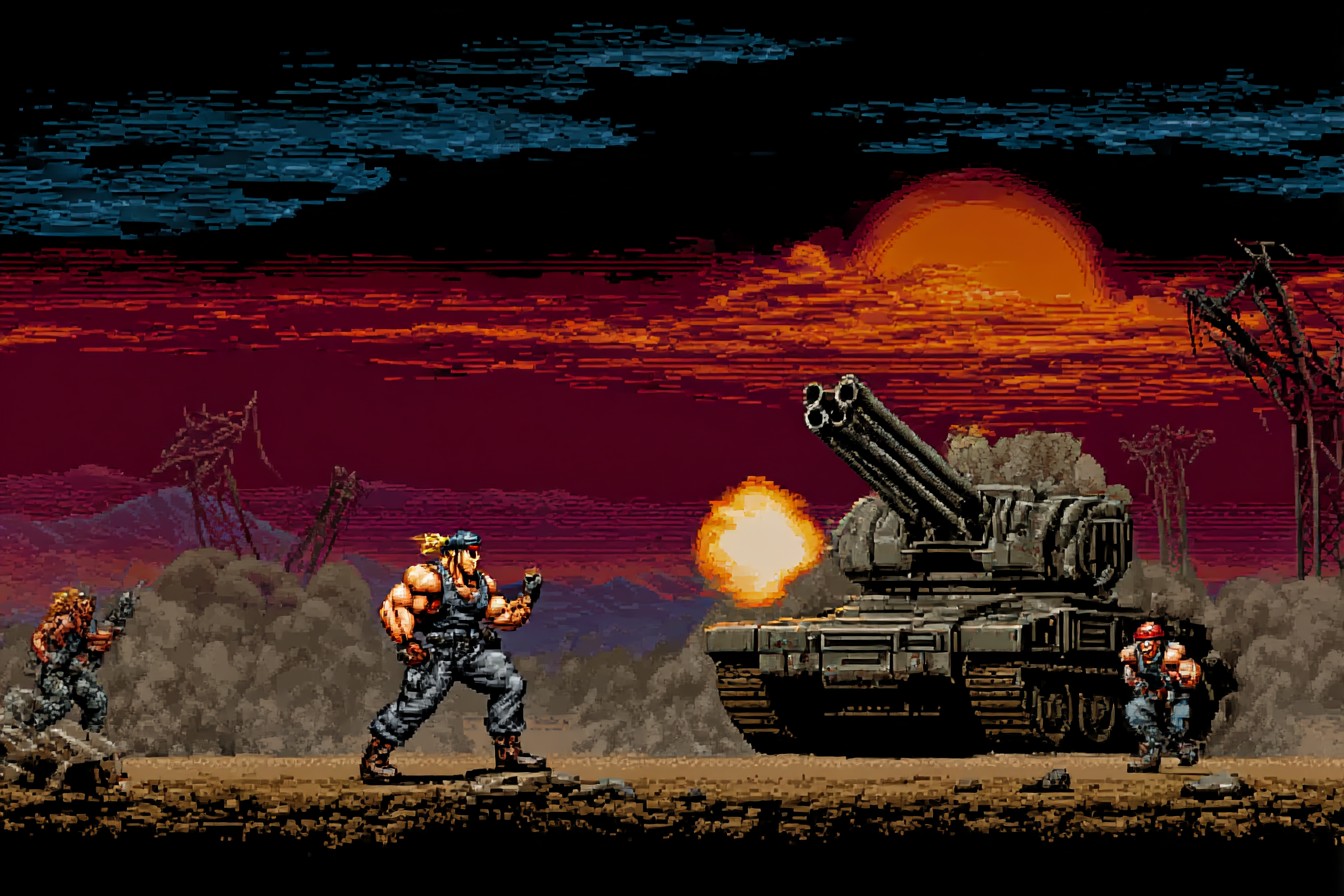
Yet somehow, when you finally nailed a perfect run through a particularly vicious section, it felt incredible. Like you'd just conducted an orchestra of explosions and emerged unscathed. The game demanded precision, but it rewarded it with moments of pure gaming zen where everything clicked into place.
Looking back now, Hard Corps represents everything I loved about the Mega Drive era. It was developers taking risks, pushing hardware limits, creating experiences you literally couldn't find anywhere else. Konami didn't just port their arcade formula—they rebuilt it from the ground up for home consoles, adding features and complexity that wouldn't have been possible in the coin-op world.
Sometimes I fire it up on my old CRT, just to hear that opening music kick in and feel that familiar controller weight in my hands. The game hasn't aged a day. If anything, modern gaming's taught me to appreciate just how tightly designed every element was—the character balance, the weapon progression, the enemy placement. Nothing was accidental.
Contra: Hard Corps wasn't just a great game. It was proof that run-and-gun could be an art form.



