The smell of a fresh copy of PC Gamer magazine with its demo disc still sealed in plastic—that's my Proust's madeleine. I'm sitting in WHSmith circa 1994, pocket money burning a hole in my tracksuit bottoms, trying to decide if this month's cover-mounted disc justified the £3.50 when I could just as easily spend that on a Galaxy bar and some Panini stickers. But those demo discs? They were gateway drugs to a world that made my Mega Drive feel suddenly small.
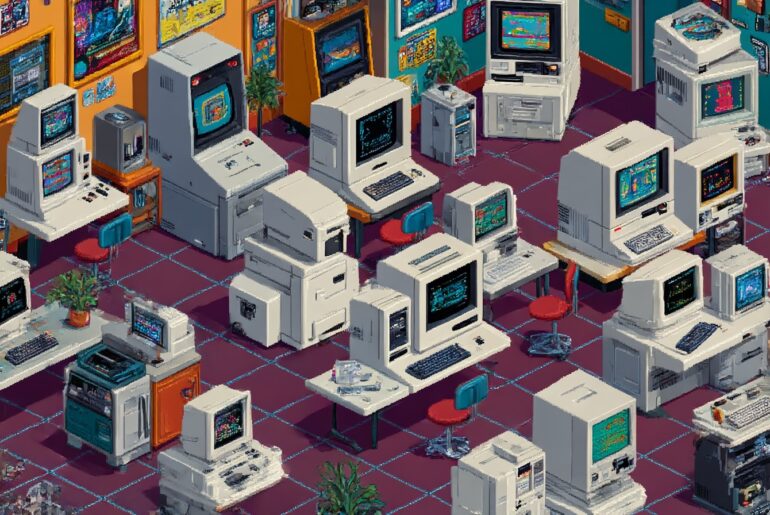
See, I'd grown up thinking games meant cartridges, controllers, and the living room telly. Consoles were toys that plugged into your parents' domain, subject to teatime negotiations and the eternal "you'll get square eyes" warnings. But PCs? They lived in spare bedrooms and box rooms, humming quietly like electronic pets that occasionally demanded feeding with floppy disks. My dad's beige tower had been bought for "spreadsheets and word processing," but it came with Windows 3.1 and something called Solitaire, and I knew there had to be more.
The first time I saw DOOM running on a mate's dad's 486, I genuinely thought someone had brought an arcade machine home and somehow squeezed it into a monitor. The graphics weren't better than my Mega Drive—they were different. Grittier. More… adult? The sound came through tinny PC speakers that made every shotgun blast sound like someone snapping a ruler, but something about that low-res violence felt transgressive in a way console games never did. Maybe it was because you had to type commands to make it work. Maybe it was because the manual looked like a technical document rather than a comic book. Whatever it was, PC gaming felt like joining a secret club.
Shareware changed everything for kids like me who had more time than money. You'd get the first episode of Commander Keen or Wolfenstein 3D for free, then spend weeks trying to convince your parents that yes, actually, sending a postal order to some address in Texas for the "full registered version" was a legitimate use of birthday money. The whole system was genius—like being given the first chapter of a book that ended on a cliffhanger. I must have played the shareware episode of DOOM a hundred times, memorizing every pixel of E1M1, before finally scraping together the cash for the real thing.
CD-ROMs felt like magic when they arrived. Suddenly games could have voice acting, full-motion video, and soundtracks that didn't sound like they'd been composed on a doorbell. The first time I heard the opening narration to The 7th Guest, I knew gaming had grown up while I wasn't looking. Sure, the acting was ham-fisted and the puzzles were occasionally mental, but it was our ham-fisted acting and our mental puzzles, played through speakers that could actually reproduce human speech without sounding like Stephen Hawking having a bad day.

LucasArts adventures became my obsession. Monkey Island, Day of the Tentacle, Sam & Max—games that proved you could be funny and clever simultaneously without needing to shoot anything. The SCUMM interface was like learning a new language: "Use rubber chicken with pulley." "Talk to man in chicken suit." These weren't just games; they were interactive novels with jokes that actually landed and puzzles that rewarded lateral thinking rather than twitch reflexes.
I learned more about music from tracker files and MOD formats than I ever did from the radio. Hearing Unreal Tournament's industrial soundtrack pumping through a proper sound card for the first time was a religious experience. PC gaming didn't just sound different—it sounded expensive. Rich. Every weapon had weight, every explosion had bass that made your desk vibrate slightly. Console games had catchy tunes; PC games had soundscapes.
The whole culture was different too. Console gaming was social—you played with mates on the sofa, taking turns, sharing controllers. PC gaming was solitary until it suddenly wasn't. LAN parties were these bizarre gatherings where teenage boys would lug enormous CRT monitors and tower PCs to someone's garage, string ethernet cables everywhere like Christmas lights, and spend entire weekends in marathon sessions of Quake or StarCraft. The logistics were insane. Someone always forgot their mouse. Someone else's network card would have driver issues that required an hour of troubleshooting. But when it all worked? When you had eight people fragging each other in perfect synchronization? Nothing else came close.
Half-Life didn't just change first-person shooters—it changed expectations. Here was a game that never took control away from you, never broke the fourth wall, never reminded you that you were playing a game. Gordon Freeman never spoke because you were Gordon Freeman. The Black Mesa facility felt like a real place with real people, right up until the point where interdimensional aliens started turning those real people into headcrab zombies. I must have played through that opening tram ride fifty times, just soaking up the atmosphere.

Strategy games found their natural home on PC in a way they never could on consoles. Command & Conquer, Age of Empires, Civilization—these were games that needed keyboards, mice, and the kind of sprawling complexity that wouldn't fit on a D-pad. Real-time strategy became this weird spectator sport where you'd crowd around someone's monitor watching them micromanage a base while fending off attacks, everyone shouting contradictory advice like football fans. "Build more pylons!" "No, get anti-air!" "You need more workers!" The person actually playing would usually tell everyone else to shut up, but we never did.
The modding scene was where PC gaming really showed its personality. Games weren't just games—they were platforms. Half-Life spawned Counter-Strike, which started as a hobby project and ended up defining online competitive gaming for years. Quake had so many total conversion mods that tracking them all became a full-time job. You could download new levels, new weapons, new characters, new entire games built on existing engines. Console games were finished products; PC games were starting points.
I spent countless hours tweaking config files, editing autoexec.bat to squeeze every last drop of performance from whatever hardware I could afford. Boot disks for different games because you needed that extra 64KB of base memory. IRQ conflicts that required actual detective work to solve. Sound cards that needed manual configuration because plug-and-play was still more wishful thinking than reality. Looking back, half my childhood was spent troubleshooting rather than actually playing, but somehow that was part of the appeal. Making it work felt like an achievement in itself.
Those formative PC gaming years taught me that games could be more than entertainment—they could be art, literature, music, and engineering problems all rolled into one endlessly customizable package. Every new graphics card was a window into the future. Every processor upgrade meant better frame rates and more complex simulations. The platform grew with you in ways consoles never could, constantly evolving, always promising that next month's hardware would finally let you run everything at maximum settings. Of course, it never did, but that was part of the charm too.